Results by title
15 books match the query 'Middle'
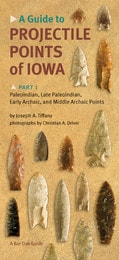
A Guide to Projectile Points of Iowa, Part 1
Paleoindian, Late Paleoindian, Early Archaic, and Middle Archaic PointsJoseph A. Tiffany
University of Iowa Press, 2009
The two beautifully illustrated parts depict a total of sixty-one full-size stone point types in color by archaeological period. References are provided for those wishing to learn more about each type shown. Archaeologist Joseph Tiffany lists the stone type for each point as well as its estimated range of use based on calibrated radiocarbon age, catalog number, and the county where it was found. By providing actual-size color images of the typed points, each part is very easy to use in the field, lab, or classroom.
From the highly finished Clovis points of the Paleoindian period to the delicate notched and stemmed points of the Woodland period, these tangible remnants of vanished cultures reveal the huge changes in the lifeways of Iowa’s native populations over time. Lay and professional archaeologists, collectors, students, and enthusiasts will appreciate the beauty of the photos and the usefulness of the information in this pocket guide to Iowa projectile points.

Arthur Vandenberg
The Man in the Middle of the American CenturyHendrik Meijer
University of Chicago Press, 2017
Originally the editor and publisher of the Grand Rapids Herald, Vandenberg was appointed and later elected to the Senate in 1928, where he became an outspoken opponent of the New Deal and a leader among the isolationists who resisted FDR’s efforts to aid European allies at the onset of World War II. But Vandenberg soon recognized the need for unity at the dawn of a new world order; and as a Republican leader, he worked closely with Democratic administrations to build the strong bipartisan consensus that established the Marshall Plan, the United Nations, and NATO. Vandenberg, as Meijer reveals, was instrumental in organizing Congressional support for these monumental twentieth-century foreign policy decisions.
Vandenberg’s life and career offer powerful lessons for today, and Meijer has given us a story that suggests an antidote to our current democratic challenges. After reading this poignant biography, many will ask: Where is the Vandenberg of today?
Canada and Eastern Europe, 1945–1991
Meeting in the MiddleAndrea Chandler
Central European University Press, 2024
How democratic regimes should engage with authoritarian regimes, or self-proclaimed authorities in states under occupation, has long been a subject of debate. The work examines Canada's relations with member-states of the Warsaw Pact during the Cold War. Central and East European communist states were nominally independent but established under occupation. Canadian leaders explored whether engaging in foreign relations with these countries would encourage liberalization or embolden dictatorships. Over time, Canada's position evolved as a policy of encouraging bilateral and multilateral diplomacy, while calling for the respect of human rights. However, Canada's economic relationship with East European states was at times at cross-purposes with its democratic principles. Andrea Chandler concludes that while Canada did play a role in encouraging democratization, the country's leaders did not sufficiently consider the impact of these policies on the citizens of Warsaw Pact countries.
This book treats Canada’s engagement with Hungary, Poland, the German Democratic Republic, Romania, Bulgaria and Czechoslovakiaduring the Cold War, in which the Western countries of the North Atlantic Treaty Organization (including Canada) had an adversarial relation with the Soviet bloc nations.
Fear in the Middle of a Vast Field and Other Stories
Mustafa Taj Aldeen Almosa; translated by Maisaa Tanjour and Alice Holttum
University of Texas Press, 2025
Short stories by a celebrated playwright bare the horrors of the Syrian civil war.
A selection of stories by Syrian author and playwright Mustafa Taj Aldeen Almosa about characters enduring the horrors of the Syrian civil war. With exquisite wit and lightness of touch, Almosa portrays the internal world of characters facing great physical violence or psychological pressures. Using both realism and fantastic elements, Almosa weaves short stories that are strange, violent, and delicate at the same time. This collection is an invaluable attempt to denounce war, to exist, to love life in all its manifestations and to learn how to cope with loss and disappointment. It is a cry against fear and death as much as it is an ode and a homage to life and love in times of both war and peace.
In the Middle of Nowhere
Fanny Howe
University of Alabama Press, 1984

Kids in the Middle
How Children of Immigrants Negotiate Community Interactions for Their FamiliesKatz, Vikki S
Rutgers University Press, 2014
Through a unique interdisciplinary approach that combines elements of sociology and communication approaches, Katz investigates not only how immigrant children connect their families with local institutional networks, but also how they engage different media forms to bridge gaps between their homes and mainstream American culture. Drawing from extensive firsthand research, Katz takes us inside an urban community in Southern California and the experiences of a specific community of Latino immigrant families there. In addition to documenting the often-overlooked contributions that children of immigrants make to their families’ community encounters, the book provides a critical set of recommendations for how service providers and local institutions might better assist these children in fulfilling their family responsibilities. The story told in Kids in the Middle reveals an essential part of the immigrant experience that transcends both geographic and ethnic boundaries.

Linguistic Atlas of the Middle and South Atlantic States, Fascicle 2
Raven I. McDavid Jr. and Raymond K. O'Cain
University of Chicago Press, 1980
Lying in the Middle
Musical Theater and Belief at the Heart of AmericaJake Johnson
University of Illinois Press, 2021
Vibrant and strikingly original, Lying in the Middle discovers some of the most potent musical theater taking place in the hoping, beating hearts of Americans.

Managing in the Middle
Robert Farrell
American Library Association, 2012
Marginalized in the Middle
Alan Wolfe
University of Chicago Press, 1996
"In applying a realist approach to controversies over immigration, pornography, race relations, and the apparent communications gap between the genders, Wolfe seeks to demonstrate the advantages of combining the insights of criticism and the tools of social science."—Library Journal
"A plea for a return to liberal thinking, an insistence on the value of 'social criticism beyond politics.' "—Washington Post Book World
"[Wolfe] surveys contemporary public discourse on racial and sexual relations, welfare policy, immigration, pornography, education and cultural politics . . . he manages to bring some fresh thinking to most of these stale debates."—T. J. Jackson Lears, New York Times Book Review
Men in the Middle
Searching for Masculinity in the 1950sJames Gilbert
University of Chicago Press, 2005
In Men in the Middle, James Gilbert uncovers a fascinating and extensive body of literature that confronts the problems and possibilities of expressing masculinity in the 1950s. Drawing on the biographies of men who explored manhood either in their writings or in their public personas, Gilbert examines the stories of several of the most important figures of the day-revivalist Billy Graham, playwright Tennessee Williams, sociologist David Riesman, sex researcher Alfred Kinsey, Playboy literary editor Auguste Comte Spectorsky, and TV-sitcom dad Ozzie Nelson-and allows us to see beyond the inherited stereotypes of the time. Each of these stories, in Gilbert's hands, adds crucial dimensions to our understanding of masculinity the 1950s. No longer will this era be seen solely in terms of the conformist man in the gray flannel suit or the Marlboro Man.
Nearest East
American Millenialism and Mission to the Middle EastAuthored by Hans-Lukas Kieser
Temple University Press, 2012
Long before oil interests shaped American interaction with the Middle East, the U.S. had a strong influence on the late Ottoman and post-Ottoman region. Covering the period from approximately 1800 to the 1970s, Hans-Lukas Kieser’s compelling Nearest East tells the story of this intimate, identity-building relationship between the U.S. and the Near East.
Kieser chronicles how American missionaries worked to implement their belief in Biblical millennialism, enlightened modernity, and a modern Zion-Israel. Millennialism was part of an American identity that constituted itself religiously in the interaction with and the representation of the “cradle of Zion.” As such, "going Near East" was—at least to American evangelical Protestants—in some ways more important than colonizing the American West. However, many Ottoman Muslims felt threatened by the American missionaries perceiving their successful institutions as an estranging challenge from the outside.
Measuring the long twisted road from the missionary Zion-builders of the early 19th century to the privileged US-Israeli partnership in the late 20th century, Nearest East looks carefully on both sides of the relationship. Kieser uses a wide range of Ottoman, Turkish, French, German and other sources, unfamiliar to most Anglophone readers, to tell this story that will appeal to historians of all stripes.
Queering the Middle
Race, Region, and a Queer Midwest, Volume 20Martin Manalansan, Chantal Nadeau, Richard T. Rodríguez, and Siobhan B. Somerville
Duke University Press, 0
The introduction provides a discussion of the theoretical and critical motivations for understanding the middle as a queer vantage, while the six articles focus on social movements, queer community networks, Midwest-based expressive cultures, and local and diasporic rearticulations of racial, gender, and sexual politics.
At the University of Illinois at Urbana-Champaign, Martin Manalansanis Associate Professor in the Department of Anthropology, Chantal Nadeau is Professor and Chair of Gender and Women’s Studies, and Richard T. Rodríguez and Siobhan B. Somerville are Associate Professors in the Department of English.
Reformed America
The Middle and Southern States 1783-1837Fred J. Hood
University of Alabama Press, 1980
The success of the Reformed of the middle and southern states at shaping a distinctly American ideology of the relationship of religion and government was truly amazing. Unlike their New England counterparts, many of whom continued to enjoy some sort of establishment well into the nineteenth century, these Reformed entered the national experience with a backlog of experience in religious diversity and practical disestablishment, and even, in the South, as religious dissenters. They would have preferred a religious establishment that would have essentially recognized the validity of their understanding of Christianity. It was perhaps their own rigidity that caused them to fail in that attempt, especially in Virginia. But for such a rigid people, and they were rigid, they demonstrated a remarkable flexibility. When it became apparent that the American legal settlement would be one in which the state disengaged from the support of religion, the Reformed of the middle and southern states welcomed it and declared it to be the solution that would be most conducive to the spread and ultimate domination of Reformed Christianity. Unlike twentieth-century liberals, the Reformed interpreted disestablishment as the legal and official recognition of the twin Reformation doctrines of the priesthood of all believers and the absolute and unquestioned authority of the Christian Scriptures. And, to a very large degree, it was their definition, rather than the thinking of Jefferson and Madison, that captured the imagination of the American people and became the dominant popular opinion in the land.
But perhaps of even greater significance, the Reformed of the middle and southern states forged an ideology that ultimately based American national prosperity on national adherence to Reformed Christianity. Under the tutelage of John Witherspoon and Samuel Stanhope Smith, the Reformed captured the Enlightenment and brought it into the service of Reformed Christianity, altering traditional Calvinism in the process. Witherspoon and Smith, declaring that the truth of the law of nations could be devised by observation and reason alone, propounded a doctrine of natural law and political science that substantially reinforced the Calvinistic doctrine of providence in an era of skepticism and enlightenment. All history, they argued, proved beyond any reasonable doubt that those nations that adhered to the moral principles taught by Christianity had prospered and those that had taken a contrary route had fallen into ruin. The Reformed preachers of whatever denomination picked up this message and proclaimed it throughout the land. The United States, if it were to prosper, was required to be a Christian nation.
SOFT IN THE MIDDLE
CONTEMPORARY SOFTCORE FEATURE IN ITS CONTEXTSDAVID ANDREWS
The Ohio State University Press, 2006
In meticulous detail, Soft in the Middle demonstrates that softcore’s under-the-radar success and pervasive cultural devaluation may be understood in terms of the “postfeminist” strategies employed by successive generations of producers and distributors, each intent on overcoming obstacles to the mainstream distribution of pornographic material. Softcore and its American precursors became more “feminized” and “female friendly” as their distribution widened, a process hastened in the 1980s by the industry’s transition to private, non-theatrical modes of distribution and exhibition (e.g., home-video outlets and premium-cable networks like Cinemax). One of the byproducts of this development is that contemporary softcore has frequently resorted to what are arguably anti-male or “misandristic” attitudes and depictions. Clearly, the genre challenges traditional assumptions about pornography, including those held by feminists on both sides of “the porn debates.”
Drawing on original industrial research, extensive sampling, and wide-ranging scholarship, Soft in the Middle offers a nuanced look at a discreetly indecent genre whose central commodity has always been female nudity. The book examines the genre’s history, describes its deflationary trajectory, and differentiates the reading patterns of its disparate audiences, including “cult” critics and feminist critics. Naturally, the book also considers the genre’s formal and ideological conventions, surveying its most exemplary subgenres, styles, and motifs—and lavishing particular attention on its most influential studios, directors, and texts.