Results by title
34 books match the query 'Military art and science'
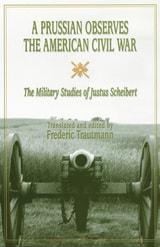
A Prussian Observes the American Civil War
The Military Studies of Justus ScheibertEdited & Translated by Frederic Trautmann
University of Missouri Press, 2001
Prussia, like much of nineteenth-century Germany, was governed by the belief that knowledge, and thus understanding, was best derived from direct observation and communicated through documentation. Justus Scheibert, an officer in the Royal Prussian Engineers, was therefore sent to the United States for seven months to observe the Civil War and report the effects of artillery on fortifications. His interests, however, surpassed that limited assignment, and his observations, as well as the writings translated in this work, went on to include tactics, strategy, logistics, intelligence, combined operations, and the medical service.
Scheibert, an expert on warfare, had access to the Confederate high command, including such luminaries as Robert E. Lee, J. E. B. Stuart, and Stonewall Jackson. He brought to the war not only the fresh perspective of a foreigner, but also the insightful eye of a career military officer and a skillful author and correspondent. Although he was personally sympathetic to the South, Scheibert researched both sides of the conflict in order to write unbiased, informed commentary for his fellow Prussian officers. His firsthand account of many aspects of the Civil War included a theoretical discussion of every branch of service and the Confederate high command, illustrated with his personal observations.
Sheibert's narrative portrays soldiers, weaponry, and battles, including the first, and one of the few, studies of combined operations in the Civil War. Trautmann combines two of Scheibert's publications, The Civil War in the North American States: A Military Study for the German Officer (1874) and Combined Operations by Army and Navy: A Study Illustrated by the War on the Mississippi, 1861-1863 (ca. 1887), which for decades influenced German military writing. Trautmann's translations evince the grace and achieve the readability of Scheibert's intricate and complex works.
A Prussian Observes the American Civil War makes an important addition to Civil War studies and will appeal greatly to professional historians and those interested in, and dedicated to, Civil War and military studies.

A Study of War
Quincy Wright
University of Chicago Press, 1983
"The most comprehensive work ever published in any language on the history, the nature, the causes, and the cure of war. . . . A Study of War is a liberal education in the social disciplines."—Frederick L. Schuman
"A major contribution to the realistic study of international relations."—Garrett Mattingly, New York Times
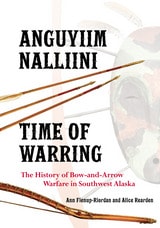
Anguyiim Nalliini/Time of Warring
The History of Bow-and-Arrow Warfare in Southwest AlaskaAnn Fienup-Riordan and Alice Rearden
University of Alaska Press, 2016
The book is presented in bilingual format, with facing-page translations, and it will be hailed as a landmark work in the study of Alaska Native history and anthropology.
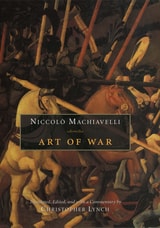
Art of War
Niccolò Machiavelli
University of Chicago Press, 2003
Machiavelli scholar Christopher Lynch offers a sensitive and entirely new translation of the Art of War, faithful to the original but rendered in modern, idiomatic English. Lynch's fluid translation helps readers appreciate anew Machiavelli's brilliant treatments of the relationships between war and politics, civilians and the military, and technology and tactics. Clearly laying out the fundamentals of military organization and strategy, Machiavelli marshals a veritable armory of precepts, prescriptions, and examples about such topics as how to motivate your soldiers and demoralize the enemy's, avoid ambushes, and gain the tactical and strategic advantage in countless circumstances.
To help readers better appreciate the Art of War, Lynch provides an insightful introduction that covers its historical and political context, sources, influence, and contemporary relevance. He also includes a substantial interpretive essay discussing the military, political, and philosophical aspects of the work, as well as maps, an index of names, and a glossary.
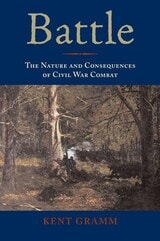
Battle
The Nature and Consequences of Civil War CombatEdited by Kent Gramm
University of Alabama Press, 2008
A critical, multidisciplinary examination of Civil War combat that interrogates the technological, medical, psychological, and cultural forces shaping battlefield experience and its enduring national legacy.
“In our youth, our hearts were touched with fire,” wrote Oliver Wendell Holmes of his generation’s Civil War days. Through the ages, war stories have gleamed with romantic glory, and American memories of the cataclysmic Civil War inspire pageantry and poetry even today.
The essays in Battle form a corrective to such celebratory histories by examining the lethal realities of Civil War combat—Enlightenment science applied to the creation of weapons that maimed and killed, which far outpaced advances in diet, sanitation, and medical treatment. The book reveals that behind the drums and trumpets, sashes and swords, the armies of the Union and Confederacy alike were haunted by fear, pain, and death.
The collection includes an introduction and afterword by editor Kent Gramm, who also contributes an essay titled “Numbers” that reveals the war in statistics. Paul Fussell contributes a powerful essay titled “The Culture of War.” D. Scott Hartwig examines the face of battle at Gettysburg. Bruce A. Evans discusses medical technology in “Wounds, Death, and Medical Care in the Civil War.” Eric T. Dean challenges the meanings and consequences of combat in “The Awful Shock and Rage of Battle.” The collection is rounded out by Alan T. Nolan’s masterful review of the national consequences of battle and the resultant myth of the Confederacy’s Lost Cause.
Battling to the End
Conversations with Benoit ChantreRené Girard
Michigan State University Press, 2010
Carl von Clausewitz (1780–1831), the Prussian military theoretician who wrote On War, is known above all for his famous dictum: “War is the continuation of politics by other means.” In René Girard’s view, however, the strategist’s treatise offers up a more disturbing truth to the reader willing to extrapolate from its most daring observations: with modern warfare comes the insanity of tit-for-tat escalation, which political institutions have lost their ability to contain. Having witnessed the Napoleonic Wars firsthand, Girard argues, Clausewitz intuited that unbridled “reciprocal action” could eventually lead foes to total mutual annihilation. Haunted by the Franco-German conflict that was to ravage Europe, in Girard’s account Clausewitz is a prescient witness to the terrifying acceleration of history. Battling to the End issues a warning about the apocalyptic threats hanging over our planet and delivers an authoritative lesson on the mimetic laws of violence.

Chemical Heroes
Pharmacological Supersoldiers in the US MilitaryAndrew Bickford
Duke University Press, 2020
Conquering the American Wilderness
The Triumph of European Warfare in the Colonial NortheastGuy Chet
University of Massachusetts Press, 2003
A study of military tactics and strategy before the War of Independence, this book reexamines the conquest of the North American wilderness and its native peoples by colonial settlers. Historians have long believed that the peculiar conditions of the New World, coupled with the success of Indians tactics, forced the colonists to abandon traditional European methods of warfare and to develop a new “American” style of combat. By combining firearms with guerrilla-like native tactics, colonial commanders were able not only to subdue their Indian adversaries but eventually to prevail against more conventionally trained British forces during the American Revolution. Yet upon closer scrutiny, this common understanding of early American warfare turns out to be more myth than reality.
As Guy Chet reveals, clashes between colonial and Indian forces during the seventeenth and eighteenth centuries did not lead to a reevaluation and transformation of conventional military doctrine. On the contrary, the poor performance of the settlers during King Philip's War (1675–76) and King William's War (1689–1697) prompted colonial magistrates to address the shortcomings of their military forces through a greater reliance on British troops and imperial administrators. Thus, as the eighteenth century wore on, growing military success in the New England colonies reflected an increasing degree of British planning, administration, participation, and command. The colonies' military and political leadership, Chet argues, never rejected the time-tested principles of European warfare, and even during the American War of Independence, the republic's military leadership looked to Europe for guidance in the art of combat.
Fighting for the King and the Gods
A Survey of Warfare in the Ancient Near EastCharlie Trimm
SBL Press, 2017
The most up-to-date sourcebook on warfare in the ancient Near East
Fighting for the King and the Gods provides an introduction to the topic of war and the variety of texts concerning many aspects of warfare in the ancient Near East. These texts illustrate various viewpoints of war and show how warfare was an integral part of life. Trimm examines not only the victors and the famous battles, but also the hardship that war brought to many. While several of these texts treated here are well known (i.e., Ramses II's battle against the Hittites at Qadesh), others are known only to specialists. This work will allow a broader audience to access and appreciate these important texts as they relate to the history and ideology of warfare.
Features
- References to recent secondary literature for further study
- Early Greek and Chinese illustrative texts for comparisons with other cultures
- Indices to help guide the reader
Global Perspectives on Landscapes of Warfare
Hugo C. Ikehara-Tsukayama
University Press of Colorado, 2021
Global Perspectives on Landscapes of Warfare examines the effects of conflict on landscapes and the ways landscapes have shaped social and political boundaries over time. Contributors from different archaeological traditions introduce a variety of methodologies and theories to understand and explain how territories and geographies in antiquity were modified in response to threat.
Drawing from eleven case studies from periods ranging over eight thousand years in the Americas, Asia, and Europe, contributors consider how social groups moved and concentrated residences, built infrastructure, invested resources, created alliances and negotiated with human and nonhuman entities for aid, formed and reformed borders, and memorialized sites and territories. Because landscapes of warfare deal with built environments, chapters are presented with rich graphic documentation—detailed maps, site plans, and artifacts—to support the analysis and interpretations.
Territories that have been appropriated and transformed by communities at war illustrate how built landscapes not only reflect immediate events but also influence subsequent generations. With a diverse array of case studies and an explicit focus on landscapes, Global Perspectives on Landscapes of Warfare will be of great interest to students and scholars of conflict archaeology and the anthropology and history of violence across the globe.
Contributors: Elizabeth Arkush, Viktor A. Borzunov, Igor V. Chechushkov, Tiffany Earley-Spadoni, Nam C. Kim, Lauren Kohut, Takehiko Matsugi, Kerry Nichols, Russell S. Quick, Lizzie Scholtus, James T. Williams
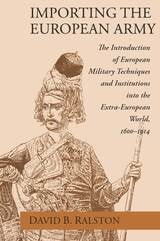
Importing the European Army
The Introduction of European Military Techniques and Institutions in the Extra-European World, 1600-1914David B. Ralston
University of Chicago Press, 1996
Following the same format in his discussion of each country, Ralston makes this central theme in world history easily accessible to students while offering scholars a sophisticated understanding of the exact nature of the changes brought about by Europeanizing military reforms.
David B. Ralston, associate professor of history at the Massachusetts Institute of Technology, is the author of The Army of the Republic.
Killer Apps
War, Media, MachineJeremy Packer and Joshua Reeves
Duke University Press, 2020
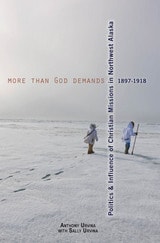
More Than God Demands
Politics and Influence of Christian Missions in Northwest Alaska, 1897-1918Anthony Urvina with Sally Urvina
University of Alaska Press, 2016
Anthony Urvina, whose mother was an orphan raised at one of the missions established as part of this program, draws on details from her life in order to present the first full history of this missionary effort. Smoothly combining personal and regional history, he tells the story of his mother’s experience amid a fascinating account of Alaska Native life and of the men and women who came to Alaska to spread the word of Christ, confident in their belief and unable to see the power of the ancient traditions they aimed to supplant.
On Posthuman War
Computation and Military ViolenceMike Hill
University of Minnesota Press, 2022
Tracing war’s expansion beyond the battlefield to the concept of the human being itself
As military and other forms of political violence become the planetary norm, On Posthuman War traces the expansion of war beyond traditional theaters of battle. Drawing on counterinsurgency field manuals, tactical manifestos, data-driven military theory, and asymmetrical-war archives, Mike Hill delineates new “Areas of Operation” within a concept of the human being as not only a social and biological entity but also a technical one.
Delving into three human-focused disciplines newly turned against humanity, OnPosthuman War reveals how demography, anthropology, and neuroscience have intertwined since 9/11 amid the “Revolution in Military Affairs.” Beginning with the author’s personal experience training with U.S. Marine recruits at Parris Island, Hill gleans insights from realist philosophy, the new materialism, and computational theory to show how the human being, per se, has been reconstituted from neutral citizen to unwitting combatant. As evident in the call for “bullets, beans, and data,” whatever can be parted out, counted, and reassembled can become war materiel. Hill shows how visible and invisible wars within identity, community, and cognition shift public-sphere activities, like racial identification, group organization, and even thought itself, in the direction of war. This shift has weaponized social activities against the very notion of society.
On Posthuman War delivers insights on the latest war technologies, strategies, and tactics while engaging in questions poised to overturn the foundations of modern political thought.
Ottoman Warfare 1500-1700
Murphey, Rhoads
Rutgers University Press, 1999
Predator Empire
Drone Warfare and Full Spectrum DominanceIan G. R. Shaw
University of Minnesota Press, 2016
What does it mean for human beings to exist in an era of dronified state violence? How can we understand the rise of robotic systems of power and domination? Focusing on U.S. drone warfare and its broader implications as no other book has to date, Predator Empire argues that we are witnessing a transition from a labor-intensive “American empire” to a machine-intensive “Predator Empire.”
Moving from the Vietnam War to the War on Terror and beyond, Ian G. R. Shaw reveals how changes in military strategy, domestic policing, and state surveillance have come together to enclose our planet in a robotic system of control. The rise of drones presents a series of “existential crises,” he suggests, that are reengineering not only spaces of violence but also the character of the modern state. Positioning drone warfare as part of a much longer project to watch and enclose the human species, he shows that for decades—centuries even—human existence has slowly but surely been brought within the artificial worlds of “technological civilization.” Instead of incarcerating us in prisons or colonizing territory directly, the Predator Empire locks us inside a worldwide system of electromagnetic enclosure—in which democratic ideals give way to a system of totalitarian control, a machinic “rule by Nobody.”
As accessibly written as it is theoretically ambitious, Predator Empire provides up-to-date information about U.S. drone warfare, as well as an in-depth history of the rise of drones.
Reflections of a Civil War Historian
Essays on Leadership, Society, and the Art of WarHerman Hattaway & Foreword by Frank E. Vandiver
University of Missouri Press, 2003

Reminiscences of Conrad S. Babcock
The Old U.S. Army and the New, 1898-1918Edited by Robert H. Ferrell
University of Missouri Press, 2012
Babcock’s original manuscript has been shortened by Robert H. Ferrell into eight chapters which illustrate the tremendous shift in warfare in the years surrounding the turn of the century. The first part of the book describes small actions against Filipinos and such assignments as taking a cavalry troop into the fire-destroyed city of San Francisco in 1906 or duty in the vicinity of Yuma in Arizona when border troubles were heating up with brigands and regular troops. The remaining chapters, beginning in 1918, set out the battles of Soissons (July 18–22) and Saint-Mihiel (September 12–16) and especially the immense battle of the Meuse-Argonne (September 26–November 11), the largest (1.2 million troops involved) and deadliest (26,000 men killed) battle in all of American history.
By the end of his career, Babcock was an adroit battle commander and an astute observer of military operations. Unlike most other officers around him, he showed an ability and willingness to adapt infantry tactics in the face of recently developed technology and weaponry such as the machine gun. When he retired in 1937 and began to write his memoirs, another world war had begun, giving additional context to his observations about the army and combat over the preceding forty years.
Until now, Babcock’s account has only been available in the archives of the Hoover Institution, but with the help of Ferrell's crisp, expert editing, this record of army culture in the first decades of the twentieth century can now reach a new generation of scholars.
Roman Siege Warfare
Josh Levithan
University of Michigan Press, 2013
Roman siege warfare had its own structure and customs, and expectations both by the besieged and by the attacking army. Sieges are typically sorted by the techniques and technologies that attackers used, but the more fruitful approach offered in Roman Siege Warfare examines the way a siege follows or diverges from typical narrative and operational plotlines. Author Josh Levithan emphasizes the human elements—morale and motivation—rather than the engineering, and he recaptures the sense of a siege as an event in progress that offers numerous attitudes, methods, and outcomes. Sieges involved a concentration of violent effort in space and the practical challenge posed by a high wall: unlike field battles they were sharply defined in time, in space, and in operational terms.
Chapters examine motivation and behavior during a siege and focus on examples from both the Roman Republic and the Empire: Polybius, Livy, Julius Caesar, Flavius Josephus, and Ammianus Marcellinus. Levithan examines the “gadgetary turn,” during which writers began to lavish attention on artillery and wall-damaging techniques, fetishizing technology and obscuring the centrality of the assault and of human behavior.
This volume speaks to classicists and historians of all stripes. All passages are translated, and references are accessible to nonspecialists. Military historians will also find much of interest in the volume, in its treatment both of Roman military conduct and of wider military practice.
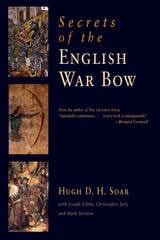
Secrets of the English War Bow
Hugh D. H. Soar
Westholme Publishing, 2010
A Complete Recreation of the Deadliest Medieval Arm
Dominating medieval battlefields for more than two centuries but requiring long and arduous practice to command, the English war bow and its battle shaft are the symbols of the rise of British power in Europe. Despite being crafted for hundreds of years and wielded by generations of archers, no example of the war bow—the military version of the longbow—exists, outside of a single broken limb. Now for the first time, expert craftsmen use all available evidence including applied archaeology to unlock the secrets of the English war bow. Historian Hugh D. H. Soar is joined by Mark Stretton, master blacksmith, and Joseph Gibbs, bowyer, in order to demonstrate how a war bow and its associated arrow heads and shafts may have been constructed and used. In addition to showing the complete manufacture of a bow from tree selection to stringing and how specialized arrowheads were forged and attached to shafts, Secrets of the English War Bowprovides information on the actual performance of the war bow, including the bow's effectiveness against various materials and, for the first time, its use against moving targets, since bows were often drawn against mounted soldiers. Armed with this new information, Soar provides an analysis of both successes and failures of the war bow in several important battles. Illustrated in color and black and white, Secrets of the English War Bowprovides an invaluable service for those interested in medieval military history, archery, and technology.
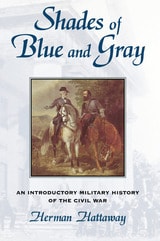
Shades of Blue and Gray
An Introductory Military History of the Civil WarHerman Hattaway
University of Missouri Press, 1997
An introductory military history of the American Civil War, Shades of Blue and Gray places the 1861-1865 conflict within the broad context of evolving warfare. Emphasizing technology and its significant impact, Hattaway includes valuable material on land and sea mines, minesweepers, hand grenades, automatic weapons, the Confederate submarine, and balloons. The evolution of professionalism in the American military serves as an important connective theme throughout. Hattaway extrapolates from recent works by revisionists William Skelton and Roy Roberts to illustrate convincingly that the development of military professionalism is not entirely a post-Civil War phenomenon.
The author also incorporates into his work important new findings of recent scholars such as Albert Castel (on the Atlanta Campaign), Reid Mitchell (on soldiers' motivation), Mark Grimsley (on "hard war"), Brooks D. Simpson (on Ulysses S. Grant), and Lauren Cook Burgess (on women who served as soldiers, disguised as men). In addition, Hattaway comments on some of the best fiction and nonfiction available in his recommended reading lists, which will both enlighten and motivate readers.
Informative and clearly written, enhanced by graceful prose and colorful anecdotes, Shades of Blue and Gray will appeal to all general readers.
The Art of Military Coercion
Why the West's Military Superiority Scarcely MattersRob de Wijk
Amsterdam University Press, 2014

The Art of War in Western World
Archer Jones
University of Illinois Press, 1987
The Crooked Stick
A History of the LongbowHugh D. H. Soar
Westholme Publishing, 2004
The Complete Story of a Legendary Weapon
"Spendidly enthusiastic. . . . Soar's book is indispensable."—Bernard Cornwell
"A fascinating study of a forgotten weapon. . . . For centuries the longbow dominated battle, affecting the fates of nations" —Wall Street Journal
"Bowyers, bowhunters, target archers and students of archery history should all find cause for celebration with Hugh Soar's concise but authoritative text." —Traditional BowhunterOn a clear July morning in 1346, a small force approached the walls of Caen for battle. The attackers rode to the field on horseback, banners and pennants fluttering in the light breeze. Behind them marched bowmen in tightly ranked units. At the sound of a crisp battle horn, they halted. A twinge of apprehension rippled through the thousands of Norman defenders as they looked down at the opposing army, for precision archery formation had long since disappeared as a military concept in medieval France. Here was not the expected rabble of unrated bucolics cowed by the might of France; confronting them was a quietly determined group of trained soldiers armed not with the familiar arbalest but with a new and strange weapon of great length. The defenders of Caen were about to meet the English war bow and its deadly battle shaft. For the next 100 years, this weapon, the "crooked stick," would command continental battlefields, etching its fearsome reputation at Crécy, Poitiers, Agincourt, and Verneuil, while establishing England as an international power for the first time.
Although the longbow is best known for its deployment during the Hundred Years' War, its origins lie with ancient Saxon seafighters and Welsh craftsmen, while today the bow is a vibrant part of the traditional archery scene. In The Crooked Stick: A History of the Longbow, historian Hugh D. H. Soar pulls together all of these strings, presenting the engaging story of this most charismatic standoff weapon. After a careful consideration of Neolithic bows and arrows, the author describes the bow's use in the medieval hunt and its associated customs. The longbow made its deepest mark in warfare, however, and the author follows the weapon's development and tactical deployment from the hand-bow of William the Conqueror's campaigns to the continental set-piece battles between England and France. Although soldiers reluctantly gave up the longbow for firearms, its recreational use became immensely popular, particularly during the Regency and Victorian periods. In the twentieth century it appeared as if the longbow would disappear into the fog of legend, but a new interest in traditional craft and expertise gained hold, and the pleasure of using this ancient instrument is now firmly part of archery around the world.
Through a remarkable command of manuscript and printed sources and a judicious use of material evidence, including his own important collection of rare longbows, Hugh Soar establishes the deep connections of this bow to England, Scotland, and Wales. Figures in the past like William Wallace, Edward III, and Henry V appear alongside detailed descriptions of bows, strings, arrows, and arrowheads, while the rise of institutions and craftsmen devoted to the longbow are presented to show how knowledge of this weapon was carried forward across the centuries. Today, those in the sport of archery and military historians will find that The Crooked Stick will enhance their own interests in a weapon of legendary status.
In addition to the illustrated text, the book contains appendices detailing the history and design of bracers, tabs and tips, quivers, and arrowheads associated with the longbow.
The Eye of Command
Kimberly Kagan
University of Michigan Press, 2006
Challenging Keegan's seminal work, The Eye of Command offers a new approach to studying and narrating battles, based upon an analysis of the works of the Roman military authors Julius Caesar and Ammianus Marcellinus. Kimberly Kagan argues that historians cannot explain a battle's outcome solely on the basis of soldiers' accounts of small-unit actions. A commander's view, exemplified in Caesar's narratives, helps explain the significance of a battle's major events, how they relate to one another and how they lead to a battle's outcome. The "eye of command" approach also answers fundamental questions about the way commanders perceive battles as they fight them-questions modern military historians have largely ignored.
"The Eye of Command is a remarkable book-smart, thoughtful, clear, vigorous, factual but creative, and grounded in the practical. It is at once scholarly and readable, combining classical scholarship and military theory. Rarely have I come across a book that makes two-thousand-year-old events seem so alive."
-Barry Strauss, Professor of History, Cornell University
"In a work well written, concisely presented, and convincingly argued, Kagan uses examples from Caesar's Gallic Wars to challenge John Keegan's focus on lower-echelon experiences of battle in favor of 'The eye of command': a narrative technique emphasizing decisions and events that shape a battle's outcome."
-Dennis Showalter, Professor of History, Colorado College
"To know whether a battle is won or lost is not enough. Kagan's deep analysis of theory and practice points to a new way of understanding complex army-commander and small-unit perspectives that can properly claim the status of history."
-Gordon Williams, Thacher Professor of Latin Emeritus, Yale University
Kimberly Kagan was an Assistant Professor of History at the United States Military Academy between 2000 and 2005. Since then, she has served as a lecturer in International Affairs, History, and the Humanities at Yale University and as an adjunct professor at Georgetown's Edmund A. Walsh School of Foreign Service and at American University's Department of History. She received her Ph.D. in Ancient History from Yale University.
The Indian Militia and Description of the Indies
Captain Bernardo de Vargas Machuca, Edited with an introduction by Kris Lane
Duke University Press, 2008
Containing advice on curing rattlesnake bites with amethysts and making saltpeter for gunpowder from concentrated human urine, The Indian Militia is a manual in four parts, the first of which outlines the ideal qualities of the militia commander. Addressing the organization and outfitting of conquest expeditions, Book Two includes extended discussions of arms and medicine. Book Three covers the proper behavior of soldiers, providing advice on marching through peaceful and bellicose territories, crossing rivers, bivouacking in foul weather, and carrying out night raids and ambushes. Book Four deals with peacemaking, town-founding, and the proper treatment of conquered peoples. Appended to these four sections is a brief geographical description of all of Spanish America, with special emphasis on the indigenous peoples of New Granada (roughly modern-day Colombia), followed by a short guide to the southern coasts and heavens. This first English-language edition of The Indian Militia includes an extensive introduction, a posthumous report on Vargas Machuca’s military service, and a selection from his unpublished attack on the writings of Fray Bartolomé de Las Casas.
The Pursuit of Power
Technology, Armed Force, and Society since A.D. 1000William H. McNeill
University of Chicago Press, 1982
Transformations of Warfare in the Contemporary World
John C. Torpey
Temple University Press, 2016
Today’s warfare has moved away from being an event between massed national populations and toward small numbers of combatants using high-tech weaponry. The editors of and contributors to the timely collection Transformations of Warfare in the Contemporary World show that this shift reflects changes in the technological, strategic, ideological, and ethical realms.
The essays in this volume discuss:
·the waning connection between citizenship and soldiering;
·the shift toward more reconstructive than destructive activities by militaries;
·the ethics of irregular or asymmetrical warfare;
·the role of novel techniques of identification in military settings;
·the stress on precision associated with targeted killings and kidnappings;
·the uses of the social sciences in contemporary warfare.
In his concluding remarks, David Jacobson explores the extent to which the contemporary transformation of warfare is a product of a shift in the character of the combatants themselves.
Contributors include: Ariel Colonomos, Roberto J. González, Travis R. Hall, Saskia Hooiveld, Rob Johnson, Colonel C. Anthony Pfaff, Ian Roxborough, and the editors
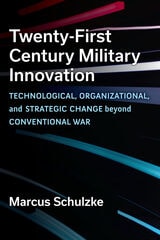
Twenty-First Century Military Innovation
Technological, Organizational, and Strategic Change beyond Conventional WarMarcus Schulzke
University of Michigan Press, 2022
Contemporary war is as much a quest for decisive technological, organizational, and doctrinal superiority before the fighting starts as it is an effort to destroy enemy militaries during battle. Armed forces that are not actively fighting are instead actively reengineering themselves for success in the next fight and imagining what that next fight may look like. Twenty-First Century Military Innovation outlines the most theoretically important themes in contemporary warfare, especially as these appear in distinctive innovations that signal changes in states’ warfighting capacities and their political goals.
Marcus Schulzke examines eight case studies that illustrate the overall direction of military innovation and important underlying themes. He devotes three chapters to new weapons technologies (drones, cyberweapons, and nonlethal weapons), two chapters to changes in the composition of state military forces (private military contractors and special operations forces), and three chapters to strategic and tactical changes (targeted killing, population-centric counterinsurgency, and degradation). Each case study includes an accessible introduction to the topic area, an overview of the ongoing scholarly debates surrounding that topic, and the most important theoretical implications. This book can be read as an overview of the themes that run throughout innovations of varying types or it can be used by readers who are interested in particular topic areas.

Under the Shadow of Napoleon
The US Army’s Doctrine, Education, and Theory of Victory from 1814 to 1941. Second EditionMichael A. Bonura
University of North Texas Press, 2026
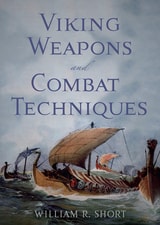
Viking Weapons and Combat Techniques
William R. Short
Westholme Publishing, 2009
A source of enduring fascination, the Vikings are the most famous raiders of medieval Europe. Despite the exciting and compelling descriptions in the Icelandic sagas and other contemporary accounts that have fueled this interest, we know comparatively little about Viking age arms and armor as compared to weapons from other historical periods. We know even less about how the weapons were used. While the sagas provide few specific combat details, the stories are invaluable. They were written by authors familiar with the use of weapons for an audience that, likewise, knew how to use them. Critically, the sagas describe how these weapons were wielded not by kings or gods, but by ordinary men, as part of their everyday lives. Viking Weapons and Combat Techniques provides an introduction to the arms and armor of the people who lived in Northern Europe during the Viking age, roughly the years 793–1066. Using a variety of available sources, including medieval martial arts treatises, and copiously illustrated with images of historical artifacts, battle sites, and demonstrations of modern replicas of Viking weapons, the author and his colleagues at Hurstwic (a Viking-age living history organization) and at the Higgins Armory Sword Guild have reconstructed the combat techniques of the Viking age and what is known about the defensive and offensive weapons of the time in general. Throughout, the author corrects some popular misconceptions about Viking warriors and warfare, such as the belief that their combat techniques were crude and blunt rather than sophisticated. In addition, the book provides an overview of Viking history and culture, focusing on the importance of weapons to the society as well as the Vikings’ lasting impact on Europe through their expeditions of trade and exploration.

War Against the People
Israel, the Palestinians and Global PacificationJeff Halper
Pluto Press, 2015
Modern warfare has a new form. The days of international combat are fading. So how do major world powers maintain control over their people today?
This book is a disturbing insight into the new ways world powers such as the US, Israel, Britain and China forge war today. It is a subliminal war of surveillance and whitewashed terror, conducted through new, high-tech military apparatuses, designed and first used in Israel against the Palestinian population. Including nano-technology, hidden camera systems, information databases on civilian activity, automated targeting systems and unmanned drones, it is used to control the very people the nation's leaders profess to serve.
Jeff Halper reveals that this practice is much more insidious than was previously thought. As Western governments claw back individual liberties, War Against the People is a reminder that fundamental human rights are being compromised for vast sections of the world, and that this is a subject that should concern everyone.
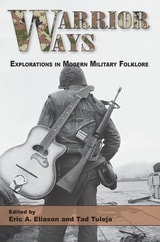
Warrior Ways
Explorations in Modern Military FolkloreEric Eliason and Tad Tuleja
Utah State University Press, 2012
Warrior Ways is one of the first book-length explorations of military folklife, and focuses on the lore produced by modern American warriors, illuminating the ways in which members of the armed services creatively express the complex experience of military life. In short, lively essays, contributors to the volume, all of whom have close personal or professional relationships to the military, examine battlefield talismans, personal narrative (storytelling), “Jody calls” (marching and running cadences), slang, homophobia and transgressive humor, music, and photography, among other cultural expressions.
Military folklore does not remain in an isolated subculture; it reveals our common humanity by delighting, disturbing, infuriating, and inspiring both those deeply invested in and those peripherally touched by military life. Highlighting the contemporary and historical importance of the military in American life, Warrior Ways will be of interest to scholars and students of folklore, anthropology, and popular culture; those involved in veteran services and education; and general readers interested in military culture.
Warriors and Scholars
A Modern War ReaderPeter B. Lane
University of North Texas Press, 2005