Results by title
12 books match the query 'Mill, John Stuart'
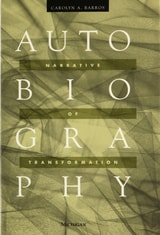
Autobiography
Narrative of TransformationCarolyn A. Barros
University of Michigan Press, 1997
In Autobiography: Narrative of Transformation, Carolyn Barros creates a primer for the study of autobiography, a genre many consider highly problematic. She sees autobiography as a "narrative of transformation"--a text that presents the "before" and "after" of an individual's life. Focusing on autobiography as narrative, of something that "happened to me," Barros highlights the various metamorphoses that are emplotted, bounded, and framed by the author's language and demonstrates that change is the operative metaphor in autobiographical discourse. The study focuses primarily on autobiographies from the rich Victorian period. Thomas Carlyle's Sartor Resartus, as it self-consciously fictionalized the composition of Diogenes Teufelsdröckh's life narrative, provides a striking analog and paradigm for introducing the study and its methodological approach. Barros's major chapters on John Henry Cardinal Newman, John Stuart Mill, Charles Darwin, and Margaret Oliphant detail four very different types of autobiographical transformation -- religious, philosophical, scientific, and literary -- and in Barros's judgment establish benchmarks for considering autobiographies from antiquity to the present. A final chapter discusses autobiography's significance to an individual writer's corpus, to a particular culture, and finally to a history of "narratives of transformation."
[more]
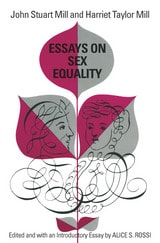
Essays on Sex Equality
John Stuart Mill and Harriet Taylor Mill
University of Chicago Press, 1970
This volume brings together for the first time all the writings of John Stuart Mill and Harriet Taylor Mill on equality between the sexes, including John Stuart Mill's The Subjection of Women, a classic in the history of the women's rights movement since its publication one hundred years ago.
Also contained in this volume is a major interpretative essay by Alice S. Rossi on Mill and Harriet Taylor which describes and analyzes their long personal and intellectual relationship.
Also contained in this volume is a major interpretative essay by Alice S. Rossi on Mill and Harriet Taylor which describes and analyzes their long personal and intellectual relationship.
[more]

Fictions of Consciousness
Mill, Newman, and the Reading of Victorian ProseJonathan Loesberg
Rutgers University Press, 1986
Mill, Newman, and the Reading of Victorian Prose
[more]

Hayek on Mill
The Mill-Taylor Friendship and Related WritingsF. A. Hayek
University of Chicago Press, 2015
Best known for reviving the tradition of classical liberalism, F. A. Hayek was also a prominent scholar of the philosopher John Stuart Mill. One of his greatest undertakings was a collection of Mill’s extensive correspondence with his longstanding friend and later companion and wife, Harriet Taylor-Mill. Hayek first published the Mill-Taylor correspondence in 1951, and his edition soon became required reading for any study of the nineteenth-century foundations of liberalism.
This latest addition to the University of Chicago Press’s Collected Works of F. A. Hayek series showcases the fascinating intersections between two of the most prominent thinkers from two successive centuries. Hayek situates Mill within the complex social and intellectual milieu of nineteenth-century Europe—as well as within twentieth-century debates on socialism and planning—and uncovers the influence of Taylor-Mill on Mill’s political economy. The volume features the Mill-Taylor correspondence and brings together for the first time Hayek’s related writings, which were widely credited with beginning a new era of Mill scholarship.
This latest addition to the University of Chicago Press’s Collected Works of F. A. Hayek series showcases the fascinating intersections between two of the most prominent thinkers from two successive centuries. Hayek situates Mill within the complex social and intellectual milieu of nineteenth-century Europe—as well as within twentieth-century debates on socialism and planning—and uncovers the influence of Taylor-Mill on Mill’s political economy. The volume features the Mill-Taylor correspondence and brings together for the first time Hayek’s related writings, which were widely credited with beginning a new era of Mill scholarship.
[more]
John Stuart Mill and the Religion of Humanity
Linda C. Raeder
University of Missouri Press, 2002
John Stuart Mill and the Religion of Humanity introduces material that requires significant reevaluation of John Stuart Mill’s contribution to the development of the liberal tradition. Through his influence, the radical anti-Christianity of the French tradition was incorporated into the Anglo-American political tradition. Mill’s nontheological utilitarianism also involved the equally important insinuation of Comtean “altruism,” with its notion of the superiority of social morality over personal morality, into Anglo-American consciousness. Linda C. Raeder’s study carefully examines the nature of modern secular liberalism, the chief political carrier of the Millian form of secular religiosity in the American context.
Raeder explores the influence of James Mill, Jeremy Bentham, Claude-Henri Saint-Simon, and Auguste Comte on John Stuart Mill’s religious thought and aims. She treats Mill’s Three Essays on Religion, discusses his participation in the Mansel controversy, and offers a new interpretation of On Liberty and Utilitarianism, both of which were crucial instruments in the accomplishment of his religious mission.
Raeder contends that Mill’s religious aim was two-pronged—the undermining of Christian belief and the establishment of the allegedly superior social morality and spirituality embodied in the “Religion of Humanity” that he adopted, with revisions, from Comte. Mill intended his philosophical writings to assist in the realization of this aim, and they cannot adequately be comprehended without an awareness of their subterranean religious theme.
John Stuart Mill and the Religion of Humanity examines the religious thought and aspirations of the philosopher and shows that, contrary to the conventional view of Mill as the prototypical secular liberal, religious preoccupations dominated his thought and structured his endeavors throughout his life. For a proper appreciation of Mill’s thought and legacy, the depth of his animus toward traditional transcendent religion must be recognized, along with the seriousness of his intent to found a nontheological religion to serve as its replacement.
[more]
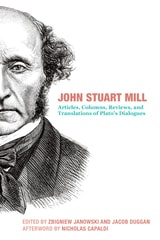
John Stuart Mill
Articles, Columns, Reviews and Translations of Plato's DialoguesJohn Stuart Mill
St. Augustine's Press, 2021
This is the second volume, following the well-received edition of Mill’s writing essential to understanding the liberal tradition. His commentary on a full spectrum of issues gives further insight into the strengths and vulnerabilities of liberal democratic theory in practice. Rare and difficult to locate material is here brought to attention and made available.
The contribution of Mill’s most authoritative biographer, Nicholas Capaldi, is a singular and unmatched highlight. The tenor of St. Augustine’s Press volumed on Mill is distinct in its intention to place his work in the framework of political philosophy and the conversation of the viability of liberalism as a tradition of thought.
The contribution of Mill’s most authoritative biographer, Nicholas Capaldi, is a singular and unmatched highlight. The tenor of St. Augustine’s Press volumed on Mill is distinct in its intention to place his work in the framework of political philosophy and the conversation of the viability of liberalism as a tradition of thought.
[more]
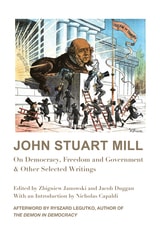
John Stuart Mill
On Democracy, Freedom and Government & Other Selected WritingsJohn Stuart Mill
St. Augustine's Press, 2019
In addition to “On Liberty” and “On Representative Government,” this new selection of Mill’s writings includes, among others, a number of less known of his writings, such as: “Civilization,” “Perfectibility,” “The Negro Question,” “On Education,” “On Aristocracy,” “On Marriage,” “On Free Press,” “Socialism,” Mill’s review of Tocqueville’s “Democracy in America,” his letters to Tocqueville, and several other writings.
If one can use a somewhat exaggerated language, Mill’s writings are to liberal-democracy what Marx and Engels’ writings were to Communism. Both systems gave expression to 19th century man’s longing for equality and justice, both promised to liberate him from the shackles of oppression, authority and tradition. Instead of liberating man, Communism created the most brutal system in human history, and its spectacular fall in 1989 is one of history’s greatest events. Western world today shows that liberal-democracy is no longer a benign doctrine, which advocates free market, minimum state and individual liberties, but, like Communism, is an all-encompassing ideology which forces an individual to abdicate his freedom and soul in favor of a Communist-like collective.
As many critics of real Socialism could see the seeds of totalitarianism in the writings of Marx and Engels, so one can see the seeds of liberal totalitarianism in Mill’s writings. This new edition is intended to help readers to understand why democratic-liberalism came so close to its 19th century ideological rival.
[more]
Liberty, Equality, Fraternity
And Three Brief EssaysJames Fitzjames Stephen
University of Chicago Press, 1992
With great energy and clarity, Sir James Fitzjames Stephen (1829-1894), author of History of the Criminal Law of England, and judge of the High Court from 1879-91, challenges John Stuart Mill's On Liberty and On Utilitarianism, arguing that Mill's view of humanity is sentimental and utopian.
"His writing is strong meat—full of the threat of hellfrire, the virtue of government by the lash and a fervent belief that the state cannot remain neutral but has a duty to espouse a moral code."—Roderick Munday, Cambridge Law Journal
"His writing is strong meat—full of the threat of hellfrire, the virtue of government by the lash and a fervent belief that the state cannot remain neutral but has a duty to espouse a moral code."—Roderick Munday, Cambridge Law Journal
[more]
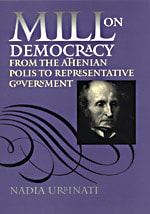
Mill on Democracy
From the Athenian Polis to Representative GovernmentNadia Urbinati
University of Chicago Press, 2002
Despite John Stuart Mill's widely respected contributions to philosophy and political economy, his work on political philosophy has received a much more mixed response. Some critics have even charged that Mill's liberalism was part of a political project to restrain, rather than foster, democracy.
Redirecting attention to Mill as a political thinker, Nadia Urbinati argues that this claim misrepresents Mill's thinking. Although he did not elaborate a theory of democracy, Mill did devise new avenues of democratic participation in government that could absorb the transformation of politics engendered by the institution of representation. More generally, Urbinati assesses Mill's contribution to modern democratic theory by critiquing the dominant "two liberties" narrative that has shaped Mill scholarship over the last several decades. As Urbinati shows, neither Isaiah Berlin's theory of negative and positive freedom nor Quentin Skinner's theory of liberty as freedom from domination adequately captures Mill's notion of political theory.
Drawing on Mill's often overlooked writings on ancient Greece, Urbinati shows that Mill saw the ideal representative government as a "polis of the moderns," a metamorphosis of the unique features of the Athenian polis: the deliberative character of its institutions and politics; the Socratic ethos; and the cooperative implications of political agonism and dissent. The ancient Greeks, Urbinati shows, and Athenians in particular, are the key to understanding Mill's contribution to modern democratic theory and the theory of political liberty.
Urbinati concludes by demonstrating the importance of Mill's deliberative model of politics to the contemporary debate on liberal and republican views of liberty. Her fresh and persuasive approach not only clarifies Mill's political ideas but also illustrates how they can help enrich our contemporary understanding of democracy.
[more]
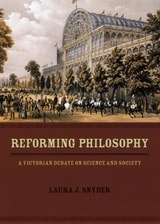
Reforming Philosophy
A Victorian Debate on Science and SocietyLaura J. Snyder
University of Chicago Press, 2006
The Victorian period in Britain was an “age of reform.” It is therefore not surprising that two of the era’s most eminent intellects described themselves as reformers. Both William Whewell and John Stuart Mill believed that by reforming philosophy—including the philosophy of science—they could effect social and political change. But their divergent visions of this societal transformation led to a sustained and spirited controversy that covered morality, politics, science, and economics. Situating their debate within the larger context of Victorian society and its concerns, Reforming Philosophy shows how two very different men captured the intellectual spirit of the day and engaged the attention of other scientists and philosophers, including the young Charles Darwin.
Mill—philosopher, political economist, and Parliamentarian—remains a canonical author of Anglo-American philosophy, while Whewell—Anglican cleric, scientist, and educator—is now often overlooked, though in his day he was renowned as an authority on science. Placing their teachings in their proper intellectual, cultural, and argumentative spheres, Laura Snyder revises the standard views of these two important Victorian figures, showing that both men’s concerns remain relevant today.
A philosophically and historically sensitive account of the engagement of the major protagonists of Victorian British philosophy, Reforming Philosophy is the first book-length examination of the dispute between Mill and Whewell in its entirety. A rich and nuanced understanding of the intellectual spirit of Victorian Britain, it will be welcomed by philosophers and historians of science, scholars of Victorian studies, and students of the history of philosophy and political economy.
[more]
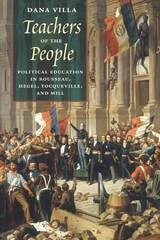
Teachers of the People
Political Education in Rousseau, Hegel, Tocqueville, and MillDana Villa
University of Chicago Press, 2017
2016 witnessed an unprecedented shock to political elites in both Europe and America. Populism was on the march, fueled by a substantial ignorance of, or contempt for, the norms, practices, and institutions of liberal democracy. It is not surprising that observers on the left and right have called for renewed efforts at civic education. For liberal democracy to survive, they argue, a form of political education aimed at “the people” is clearly imperative.
In Teachers of the People, Dana Villa takes us back to the moment in history when “the people” first appeared on the stage of modern European politics. That moment—the era just before and after the French Revolution—led many major thinkers to celebrate the dawning of a new epoch. Yet these same thinkers also worried intensely about the people’s seemingly evident lack of political knowledge, experience, and judgment. Focusing on Rousseau, Hegel, Tocqueville, and Mill, Villa shows how reformist and progressive sentiments were often undercut by skepticism concerning the political capacity of ordinary people. They therefore felt that “the people” needed to be restrained, educated, and guided—by laws and institutions and a skilled political elite. The result, Villa argues, was less the taming of democracy’s wilder impulses than a pervasive paternalism culminating in new forms of the tutorial state.
Ironically, it is the reliance upon the distinction between “teachers” and “taught” in the work of these theorists which generates civic passivity and ignorance. And this, in turn, creates conditions favorable to the emergence of an undemocratic and illiberal populism.
[more]
The Moment of Racial Sight
A HistoryIrene Tucker
University of Chicago Press, 2012
The Moment of Racial Sight overturns the most familiar form of racial analysis in contemporary culture: the idea that race is constructed, that it operates by attaching visible marks of difference to arbitrary meanings and associations. Searching for the history of the constructed racial sign, Irene Tucker argues that if people instantly perceive racial differences despite knowing better, then the underlying function of race is to produce this immediate knowledge. Racial perception, then, is not just a mark of acculturation, but a part of how people know one another.
Tucker begins her investigation in the Enlightenment, at the moment when skin first came to be used as the primary mark of racial difference. Through Kant and his writing on the relation of philosophy and medicine, she describes how racialized skin was created as a mechanism to enable us to perceive the likeness of individuals in a moment. From there, Tucker tells the story of instantaneous racial seeing across centuries—from the fictive bodies described but not seen in Wilkie Collins’s realism to the medium of common public opinion in John Stuart Mill, from the invention of the notion of a constructed racial sign in Darwin’s late work to the institutionalizing of racial sight on display in the HBO series The Wire. Rich with perceptive readings of unexpected texts, this ambitious book is an important intervention in the study of race.
[more]