Results by title

4 books match the query 'Modern Life'

cover of Filth: Dirt, Digust, and Modern Life

Filth

Dirt, Digust, and Modern Life

William A. Cohen

University of Minnesota Press, 2004

From floating barges of urban refuse to dung-encrusted works of art, from toxic landfills to dirty movies, filth has become a major presence and a point of volatile contention in modern life. This book explores the question of what filth has to do with culture: what critical role the lost, the rejected, the abject, and the dirty play in social management and identity formation. It suggests the ongoing power of culturally mandated categories of exclusion and repression.Focusing on filth in literary and cultural materials from London, Paris, and their colonial outposts in the nineteenth and early twentieth centuries, the essays in Filth, all but one previously unpublished, range over topics as diverse as the building of sewers in nineteenth-century European metropolises, the link between interior design and bourgeois sanitary phobias, fictional representations of laboring women and foreigners as polluting, and relations among disease, disorder, and sexual-racial disharmony. Filth provides the first sustained consideration, both theoretical and historical, of a subject whose power to horrify, fascinate, and repel is as old as civilization itself.Contributors: David S. Barnes, U of Pennsylvania; Neil Blackadder, Knox College; Joseph Bristow, U of California, Los Angeles; Joseph W. Childers, U of California, Riverside; Eileen Cleere, Southwestern U; Natalka Freeland, U of California, Irvine; Pamela K. Gilbert, U of Florida; Christopher Hamlin, U of Notre Dame; William Kupinse, U of Puget Sound; Benjamin Lazier, U of Chicago; David L. Pike, American U; David Trotter, U of Cambridge.William A. Cohen is associate professor of English at the University of Maryland and the author of Sex Scandal: The Private Parts of Victorian Fiction.Ryan Johnson is completing his Ph.D. in the Department of English at Stanford University, where he has served as general editor of the Stanford Humanities Review.
[more]
cover of Living On After Failure: Affective Structures of Modern Life

Living On After Failure

Affective Structures of Modern Life

Irving Goh

Duke University Press, 2025

In Living On After Failure, Irving Goh dwells with failure and all of its negative affects. Goh does not seek a theorization of failure as something to overcome or turn into a recuperative philosophy or progress narrative. Rather, he engages with the ontological condition of failure as a process of staying with the impasse that failure brings. Drawing on the thought of Berlant, Derrida, Foucault, and Nancy, Goh examines works by contemporary writers like Ottessa Moshfegh, Rachel Cusk, Édouard Levé, Yiyun Li, and Kate Zambreno. He guides readers through stages of reckoning with failure as an immersive impasse: flopping, drifting itself, a dark care of the self, melodrama, and postscripting. By unsettling the failure/success binary, Goh provides those who cannot shake off their sense of failure, or who refuse the narratives of progress or success and their ideologies of grit and resilience, with discursive and affective spaces in which to attend to their desire to be attached to their failures.
[more]
cover of Making Jazz French: Music and Modern Life in Interwar Paris

Making Jazz French

Music and Modern Life in Interwar Paris

Jeffrey H. Jackson

Duke University Press, 2003

Between the world wars, Paris welcomed not only a number of glamorous American expatriates, including Josephine Baker and F. Scott Fitzgerald, but also a dynamic musical style emerging in the United States: jazz. Roaring through cabarets, music halls, and dance clubs, the upbeat, syncopated rhythms of jazz soon added to the allure of Paris as a center of international nightlife and cutting-edge modern culture. In Making Jazz French, Jeffrey H. Jackson examines not only how and why jazz became so widely performed in Paris during the 1920s and 1930s but also why it was so controversial.

Drawing on memoirs, press accounts, and cultural criticism, Jackson uses the history of jazz in Paris to illuminate the challenges confounding French national identity during the interwar years. As he explains, many French people initially regarded jazz as alien because of its associations with America and Africa. Some reveled in its explosive energy and the exoticism of its racial connotations, while others saw it as a dangerous reversal of France’s most cherished notions of "civilization." At the same time, many French musicians, though not threatened by jazz as a musical style, feared their jobs would vanish with the arrival of American performers. By the 1930s, however, a core group of French fans, critics, and musicians had incorporated jazz into the French entertainment tradition. Today it is an integral part of Parisian musical performance. In showing how jazz became French, Jackson reveals some of the ways a musical form created in the United States became an international phenomenon and acquired new meanings unique to the places where it was heard and performed.
[more]
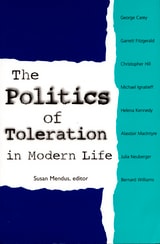
cover of The Politics of Toleration in Modern Life

The Politics of Toleration in Modern Life

Susan Mendus, ed.

Duke University Press, 1999

In The Politics of Toleration in Modern Life Susan Mendus gathers a group of distinguished public figures—philosophers, historians, lawyers, and religious leaders—to reflect on a core issue within contemporary political debate. At the close of a century that will be remembered for its two world wars and its eruptions of genocide, the contributors examine the importance of an insistence on tolerance and the dangers of its lack, both historically and in the present day.
How can toleration be fostered in a contentious and tightly populated world? What situations and fears have historically fed attitudes of intolerance? When and how should states intervene? The authors of these essays seek answers to such questions and examine topics such as why certain national groups are especially vulnerable to intolerance and narcissistic fantasies and how the colonial view of intolerant exploitation as an acceptable norm of behavior has been replaced by a drive toward international solidarity. The essays address religious tolerance, the role of toleration in legal contexts, the philosophical justification of tolerance, and the concept of solidarity. Ethnic identity, nationalism, the “goods of conflict,” and the treatment of refugees seeking asylum are discussed as well. While one contributor argues that a moment of genuine tolerance is achieved only when there is a cost involved in the act of tolerating another person’s way of living, another stresses that rational, communal dialogue can only take place if the state is excluded from the discussion, if conflict is recognized as valuable, and if local communities come to consensus about what behavior and discourse is intolerable.
Offering an accessible and engaging commentary on the concept of tolerance, The Politics of Toleration in Modern Life will interest a wide range of readers of philosophy, political science, religion, sociology, and history.


Contributors. George Carey, Christopher Hill, Michael Ignatieff, Helena Kennedy, Alasdair MacIntyre, Susan Mendus, Julia Neuberger, Bernard Williams

[more]