Results by title
15 books match the query 'Monarchy'
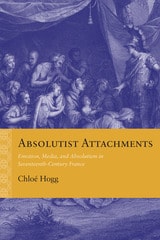
Absolutist Attachments
Emotion, Media, and Absolutism in Seventeenth-Century FranceChloé Hogg
Northwestern University Press, 2019
In Absolutist Attachments, Chloé Hogg uncovers the affective and media connections that shaped Louis XIV’s absolutism. Studying literature, painting, engravings, correspondence, and the emerging periodic press, Hogg diagnoses the emotions that created absolutism’s feeling subjects and publics.
Louis XIV’s subjects explored new kinds of affective relations with their sovereign, joining with the king in acts of aesthetic judgment, tender feeling, or the “newsiness” of emerging print news culture. Such alternative modes of adhesion countered the hegemonic model of kingship upheld by divine right, reason of state, or corporate fidelities and privileges with subject-driven attachments and practices. Absolutist Attachments discovers absolutism’s alternative political and cultural legacy—not the spectacle of an unbound king but the binding connections of his subjects.
Dissing Elizabeth
Negative Representations of GlorianaJulia M. Walker, ed.
Duke University Press, 1998
As editor Julia M. Walker suggests, the breadth of dissent considered in this collection points to a dark side of the Cult of Elizabeth. Reevaluating neglected texts that had not previously been perceived as critical of the queen or worthy of critical appraisal, contributors consider dissent in a variety of forms, including artwork representing (and mocking) the queen, erotic and pornographic metaphors for Elizabeth in the popular press, sermons subtly critiquing her actions, and even the hostility encoded in her epitaph and in the placement of her tomb. Other chapters discuss gossip about Elizabeth, effigies of the queen, polemics against her marriage to the Duke of Alençon, common verbal slander, violence against emblems of her authority, and the criticism embedded in the riddles, satires, and literature of the period.
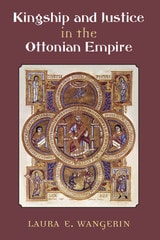
Kingship and Justice in the Ottonian Empire
Laura E. Wangerin
University of Michigan Press, 2019
Scholars have recognized the importance of ritual and symbolic behaviors in the Ottonian political sphere, while puzzling over the apparent lack of administrative organization, a contradiction between what we know about the Ottonians as successful rulers and their traditional characterization as rulers of a disorganized polity. Trying to account for the apparent disparity between their political and military achievements, cultural and artistic efflorescence, and relative dynastic stability, which seemingly accompanied a disinterest in writing law or creating a centralized hierarchical administration, is a tension that persists in the scholarship. This book argues that far from being accidental successes or employing primitive methods of governance, the Ottonians were shrewd rulers and administrators who exploited traditional methods of conflict resolution and delegated jurisdictional authority to keep control over their vast empire. Thus, one of the important things that this book aims to accomplish is to challenge our preconceived notions of what successful government looks like.

Media, Monarchy and Power
Neil Blain and Hugh O'Donnell
Intellect Books, 2013
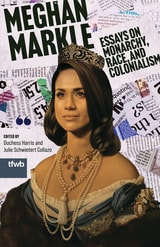
Meghan Markle
Essays on Monarchy, Race, and ColonialismEdited by Duchess Harris and Julie Schwietert Collazo
University of Arizona Press, 2026
This bold and timely anthology interrogates the British monarchy through the lens of race, gender, and postcolonial critique. The contributors of ten original essays use Meghan Markle’s public life and identity as a nexus for understanding the enduring legacies of empire, white supremacy, and institutional exclusion.
Each chapter blends academic analysis with the authors’ own lived experiences and identities, creating a deeply engaging and multifaceted narrative. Essays cover media representation, mental health, motherhood, and the politics of belonging.
Written in an accessible and engaging style, this volume speaks to readers interested in the intersections of monarchy, race, feminism, and celebrity culture. Through its interdisciplinary approach and critical insight, these essays reveal how one woman’s experience within the royal family brings into focus broader social and historical processes of racial identity making and colonial power. This is essential reading for anyone seeking to understand the cultural and political significance of Meghan Markle’s story—and what it tells us about the world we live in.
Contributors
Lucca Ramone Carlson
Duchess Harris
Marissa Kessenich
Jasmine Mitchell
Sarah Olutola
Portia Owusu
Therí Pickens
Amelia Ryan
Julie Schwietert Collazo
Lily Talmont
Ariane Tulloch
Elwood Watson
Stephanie L. Williams
Sharon D. Wright Austin
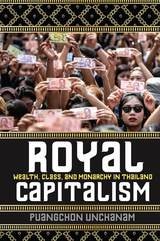
Royal Capitalism
Wealth, Class, and Monarchy in ThailandPuangchon Unchanam
University of Wisconsin Press, 2022
The kingdom positioned itself to connect business elites, patronize local industries, and form strategic partnerships with global corporations. Instead of restraining or regulating royal power, white-collar workers joined with the crown to form a dynamic, symbiotic force that has left the lower classes to struggle in their wake. Unchanam presents a surprising case study that kings and queens live long and large in cooperation with the bourgeoisie's interests and ideology.
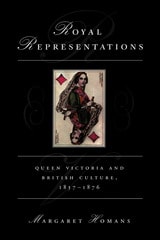
Royal Representations
Queen Victoria and British Culture, 1837-1876Margaret Homans
University of Chicago Press, 1998
Arguing that being, seeming, and appearing were crucial to Victoria's "rule," Homans explores the variability of Victoria's agency and of its representations using a wide array of literary, historical, and visual sources. Along the way she shows how Victoria provided a deeply equivocal model for women's powers in and out of marriage, how Victoria's dramatic public withdrawal after Albert's death helped to ease the monarchy's transition to an entirely symbolic role, and how Victoria's literary self-representations influenced debates over political self-representation.
Homans considers versions of Victoria in the work of Elizabeth Barrett Browning, George Eliot, John Ruskin, Margaret Oliphant, Lewis Carroll, Alfred Lord Tennyson, and Julia Margaret Cameron.
Saul, Benjamin, and the Emergence of Monarchy in Israel
Biblical and Archaeological PerspectivesJoachim J. Krause
SBL Press, 2020
Ponder questions of the united monarchy under Saul and David in light of current historical and archaeological evidence
Reconstructing the emergence of the Israelite monarchy involves interpreting historical research, approaching questions of ancient state formation, synthesizing archaeological research from sites in the southern Levant, and reexamining the biblical traditions of the early monarchy embedded in the books of Samuel and Kings. Integrating these approaches allows for a nuanced and differentiated picture of one of the most crucial periods in the history of ancient Israel. Rather than attempting to harmonize archaeological data and biblical texts or to supplement the respective approach by integrating only a portion of data stemming from the other, both perspectives come into their own in this volume presenting the results of an interdisciplinary Tübingen–Tel Aviv Research Colloquium.
Features:
- Essays on Israel's monarchy by experts in biblical archaeology and biblical studies
- Methods for integrating archaeology and biblical traditions in reconstructing ancient Israel's history
- New research on the sociopolitical process of state formation in Israel and Judah
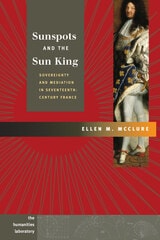
Sunspots and the Sun King
Sovereignty and Mediation in Seventeenth-Century FranceEllen M. McClure
University of Illinois Press, 2006
Mediation, monarchy, and Louis XIV's attempts to legitimize his reign
In order to assert his divine right, Louis XIV missed no opportunity to identify himself as God’s representative on earth. However, in Sunspots and the Sun King Ellen McClure explores the contradictions inherent in attempting to reconcile the logical and mystical aspects of divine right monarchy. McClure analyzes texts devoted to definitions of sovereignty, presents a meticulous reading of Louis XIV’s memoirs to the crown prince, and offers a novel analysis of diplomats and ambassadors as the mediators who preserved and transmitted the king’s authority. McClure asserts that these discussions, ranging from treatises to theater, expose incommensurable models of authority and representation permeating almost every aspect of seventeenth-century French culture.
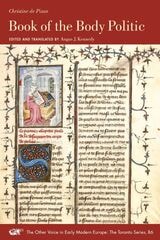
The Book of the Body Politic
Christine de Pizan
Iter Press, 2021
Christine de Pizan’s The Book of the Body Politic is the first political treatise written by a woman. It not only advises the prince, but nobles, knights, and common people as well. It promotes the ideals of interdependence and social responsibility. Rooted in the mindset of medieval Christendom, The Book of the Body Politic heralds the humanism of the Renaissance, highlighting classical culture and Roman civic virtues. This new edition and translation offers a faithful rendering of Christine de Pizan’s writing, as well as a thorough contextualization of her career as a political writer at the end of the Middle Ages in France. The Book of the Body Politic resounds to this day, urging for the need for probity in public life and the importance of responsibilities and rights.
The Culture of Merit
Nobility, Royal Service, and the Making of Absolute Monarchy in France, 1600-1789Jay M. Smith
University of Michigan Press, 1996
Jay M. Smith argues that the early modern nobility instinctively drew a correlation between the meaning of merit and an image of the "sovereign's gaze." In the early seventeenth century, merit meant the qualities traditionally associated with aristocratic values: generosity, fidelity, and honor. Nobles sought to display those qualities before the appreciative gaze of the king himself. But the expansion of the monarchy forced the routinization of the sovereign's gaze, and Louis XIV began to affirm and reward new qualities--talent and application--besides those thought innately noble.
The contradictions implicit within the absolute monarchy's culture of merit are demonstrated by the eighteenth-century French army, which was dominated by the nobility, but also committed to efficiency and expertise. Smith shows that the army's continuous efforts to encourage and reward "merit" led to a clash of principles. The ever-growing emphasis on talent and discipline led reformers--the great majority of them noble--to attack the most egregious examples of privilege and favoritism in the army. Smith's analysis of the long-term evolution in conceptions of royal service suggests a new explanation for the shift in values signified by the French Revolution. The transition away from the "personal" gaze of the king toward the "public" gaze of the monarchy and nation foretold the triumph of a new culture of merit in which noble birth would have no meaning.
The Culture of Merit will interest historians and other social scientists concerned with issues of aristocratic identity, state formation, professionalization, and the changing political culture of pre-Revolutionary France.
Jay M. Smith is Assistant Professor of History, University of North Carolina, Chapel Hill.
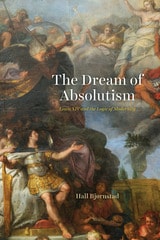
The Dream of Absolutism
Louis XIV and the Logic of ModernityHall Bjørnstad
University of Chicago Press, 2021
What was absolutism, and how did it work? What was the function of the ostentatious display surrounding Louis XIV at Versailles? What is gained—and what is lost—by approaching such expressions of absolutism as propaganda, as present-day scholars tend to do?
In this sweeping reconsideration of absolutist culture, Hall Bjørnstad argues that the exuberance of Louis XIV’s reign was not top-down propaganda in any modern sense, but rather a dream dreamt collectively, by king, court, image-makers, and nation alike. Bjørnstad explores this dream through a sustained close analysis of a corpus of absolutist artifacts, ranging from Charles Le Brun’s famous paintings in the Hall of Mirrors at Versailles via the king’s secret Mémoires to two little-known particularly extravagant verbal and textual celebrations of the king. The dream of absolutism, Bjørnstad concludes, lives at the intersection of politics and aesthetics. It is the carrier of a force that emerges as a glorious image; a participatory emotional reality that requires reality to conform to it. It is a dream, finally, that still shapes our collective political imaginary today.
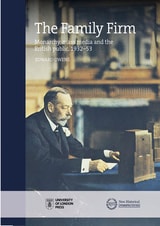
The Family Firm
monarchy, mass media and the British public, 1932-53Edward Owens
University of London Press, 2019
The Rule of Women in Early Modern Europe
Edited by Anne J. Cruz and Mihoko Suzuki
University of Illinois Press, 2008
Drawing on early modern literature and historical documents, this study investigates the various political, discursive, and symbolic measures employed to negotiate and support female sovereignty by both early modern writers and the rulers themselves. The detailed analysis of the women's responses--or inability to respond--to these strictures underscores the relationship between early modern authors and sovereigns and the complex and vexed situation of European women rulers.
Contributors are Tracy Adams, Anne J. Cruz, Éva Deák, Mary C. Ekman, Catherine L. Howey, Elizabeth Ketner, Carole Levin, Sandra Logan, Magdalena S. Sánchez, Mihoko Suzuki, and Barbara F. Weissberger.
The Theological-Political Origins of the Modern State
The Controversy between James I of England and Cardinal BellarmineBernard Bourdin
Catholic University of America Press, 2010