Results by title
10 books match the query 'Moore, Marianne'

Becoming a Poet
Elizabeth Bishop with Marianne Moore and Robert LowellDavid Kalstone
University of Michigan Press, 2001
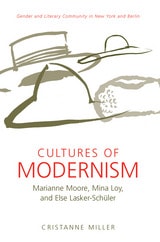
Cultures of Modernism
Marianne Moore, Mina Loy, and Else Lasker-SchulerCristanne Miller
University of Michigan Press, 2005
Cultures of Modernism explores how the structure and location of literary communities significantly influence who writes, what they write about, and their openness to formal experimentation. These influences particularly affect women writers. Author Cristanne Miller notes striking patterns of similarity in the concerns and lives of women living in geographically distant centers of modernist production. She looks at three significant poets---the American Marianne Moore, the British expatriate Mina Loy, and the German Else Lasker-Schüler---in the context of cultural, national, and local elements to argue that location significantly affected their performances of subjectivity, gender, race, and religion. The first book of its kind, Cultures of Modernism breaks new ground while it contributes to the ongoing reconception of the modernist period.
"A fascinating, provocative, and genuinely original study of a 'different' modernism in poetry---namely, the Modernism of women poets."
---Marjorie Perloff, Stanford University
"An important and ambitious work that makes major contributions to the fields of gender studies and modernist studies, and to the study of modernist poetry."
---Robin Schulze, Pennsylvania State University
"Offers a welcome corrective to the unreflective critical tendency . . . to make broad claims about the historical experiences and cultural conundrums of 'women,' and particularly 'women writers.' Miller offers tour-de-force comparative readings . . . threading together the world-historical with the personal, poetics with the political, and wielding the instruments of scansion as deftly as a surgeon."
---Modernism/modernity, The Official Journal of the Modernist Studies Association
Cristanne Miller is Edward H. Butler Professor of English and Chair of the English Department at the University of Buffalo, State University of New York.
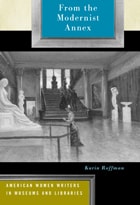
From the Modernist Annex
American Women Writers in Museums and LibrariesKarin Roffman
University of Alabama Press, 2010

Hints And Disguises
Marianne Moore ContemporariesCeleste Goodridge
University of Iowa Press, 1989
The first book-length exploration of Marianne Moore's prose focuses on her private and public critical exchanges with Wallace Stevens, Ezra Pound, William Carlos Williams, and T.S. Eliot. Drawing on previously unpublished material from the Moore Archive—correspondence, notebooks, manuscript notes, and books—Celeste Goodridge establishes Moore's central role as both poet-critic and prose stylist, providing a new perspective for considering Moore in relation to her contemporaries.
With clarity and elegance, Goodridge shows that Moore's most compelling critical judgments can best be recovered by examining the relationship between her private disclosures and her public pronouncements; her aesthetic of "hints and disguises" reveals a tension between what she felt free to voice and what she chose to veil.
In writing about these four poets, Moore made her greatest contribution to modernist criticism. With unusual perspicacity, she anticipated and defined many of the critical debates which still surround these writers' projects. Furthermore, Moore's critical exchanges indicated that her deepest alliances were with Stevens and Pound and not, as most have argued, with Williams and Eliot.
Illusion Is More Precise than Precision
The Poetry of Marianne MooreDarlene Williams Erickson
University of Alabama Press, 1992
Erickson examines the work of Marianne Moore in order to provide some consistently successful strategies for understanding her poetry
In 1935, T.S. Eliot wrote that Marianne Moore’s poems “form part of the small body of durable poetry written in our time.” In this comprehensive critical study of the American poet Marianne Moore (1887-1972) and her work, Erickson amply justifies Eliot’s praise, demonstrating the poet’s ability to combine close observation with a worldview presentation that is at once intuitive, kaleidoscopic, and optimistic. Unfortunately, over the years the excellence and originality of Moore’s work has been overshadowed by its apparent inscrutability. Erickson examines the work of Marianne Moore in order to provide some consistently successful strategies for understanding her poetry.
The thesis is centered in a line from Moore’s poem, “Armor’s Undermining Modesty”:” What is more precise than precision? Illusion.” Erickson argues that Moore came to see herself humorously as “Imagnifico, a Wizard in Words,” a magician who used her conjuries to express a truth beyond reason, a truth described by the philosopher Henri Bergson as intuition, the highest stage of the evolution of human understanding. Is Erickson’s contention that Moore’s sense of magic is inextricably bound up in her own uniquely feminine epistemology, the tendency to place great value on intuition, and to find one’s own voice among collections of many voices.
This study demonstrates that Moore’s voice is arguably the strongest female voice in twentieth century American literature and her poetic voice could hold its own in the company of the best of the other modernists. Unlike many current scholars, Erickson examines closely the texts of Moore’s poems themselves, allowing the poet’s own voice to speak clearly. The study also explores Moore’s obsession with time, her preoccupation with the visual, her interest in the forms of Hebrew verse and her “susceptibility to happiness,” an outlook at some odds with the twentieth century’s fascination with the “romance of failure.”
While the book is scholarly in its intent and carefully documented, it is eminently readable and will be of interest of anyone fascinated by the mind of a brilliant twentieth century woman.
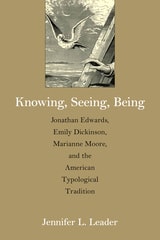
Knowing, Seeing, Being
Jonathan Edwards, Emily Dickinson, Marianne Moore, and the American Typological TraditionJennifer L. Leader
University of Massachusetts Press, 2016
Scholars no longer see Jonathan Edwards as the fire-and-brimstone preacher who deemed his parishioners “sinners in the hands of an angry god.” Edwards now figures as caring and socially conscious and exerts increased influence as a philosopher of the American school of Protestantism. In this study, he becomes the progenitor of an alternative tradition in American letters.
In Knowing, Seeing, Being, Jennifer L. Leader argues that Edwards, the nineteenth-century poet Emily Dickinson, and the twentieth-century poet Marianne Moore share a heretofore underrecognized set of religious and philosophical preoccupations. She contends that they represent an alternative tradition within American literature, one that differs from Transcendentalism and is grounded in Reformed Protestantism and its ways of reading and interpreting the King James Bible and the natural world. According to Leader, these three writers' most significant commonality is the Protestant tradition of typology, a rigorous mode of interpreting scripture and nature through which certain figures or phenomena are read as the fulfillment of prophecy and of God's work. Following from their similar ways of reading, they also share philosophical and spiritual questions about language, epistemology (knowing), perception (seeing), and physical and spiritual ontology (being). In connecting Edwards to these two poets, in exploring each writer's typological imagination, and through a series of insightful readings, this innovative book reevaluates three major figures in American intellectual and literary history and compels a reconsideration of these writers and their legacies.
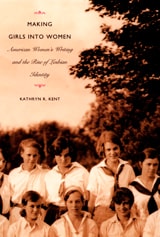
Making Girls into Women
American Women's Writing and the Rise of Lesbian IdentityKathryn R. Kent
Duke University Press, 2003
Kent not only analyzes how texts represent queer erotics, but also theorizes how texts might produce them in readers. She describes the ways postbellum sentimental literature such as that written by Harriet Beecher Stowe, Louisa May Alcott, and Emma D. Kelley eroticizes, reacts against, and even, in its own efforts to shape girls’ selves, contributes to the production of queer female identifications and identities. Tracing how these identifications are engaged and critiqued in the early twentieth century, she considers works by Djuna Barnes, Gertrude Stein, Marianne Moore, and Elizabeth Bishop, as well as in the queer subject-forming effects of another modern invention, the Girl Scouts. Making Girls into Women ultimately reveals that modern lesbian identity marks an extension of, rather than a break from, nineteenth-century women’s culture.
Marianne Moore, Elizabeth Bishop, and May Swenson
The Feminist Poetics of Self-RestraintKirstin Hotelling Zona
University of Michigan Press, 2002
In recent years critical studies of Bishop and Moore have flourished, a large percentage of them devoted to explorations of sexuality and gender. A gap is growing, however, between feminist repossessions of Moore and Bishop and recent readings of their antiessentialist poetics. On the one hand, these poets are appearing more frequently in the feminist canon, but the price of this inclusion is usually the suppression of their strategies of self-restraint. While Zona questions the poetic privileging of self-expression, she establishes contiguity between feminist poetry and developments in American poetry at large. In doing so she asserts the centrality of feminist poetry within discussions of contemporary American poetry, thereby challenging the common perception of feminist poetry as an "alternative" (which often means auxiliary) genre.
Kirstin Hotelling Zona is Assistant Professor of Poetry and Poetics, Illinois State University.
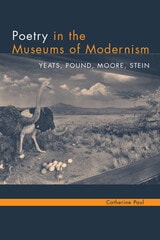
Poetry in the Museums of Modernism
Yeats, Pound, Moore, SteinCatherine Paul
University of Michigan Press, 2002
Although critics have attested to the importance of the visual arts to literary modernists and have begun to explore the relationships between literary production and social institutions, before now no one has examined the particular institutions in which modernist poets found the artworks, specimens, and other artifacts that inspired their literary innovations. Catherine Paul's book offers the reader a fresh encounter with modernism that will interest literary and art historians, literary theorists, critics, and scholars in cultural studies and museum studies.
Catherine Paul is Associate Professor of English, Clemson University.
Quick, Said the Bird
Williams, Eliot, Moore, and the Spoken WordRichard Swigg
University of Iowa Press, 2012