Results by title
14 books match the query 'Multiracial people in literature'
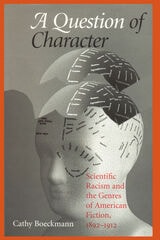
A Question of Character
Scientific Racism and the Genres of American Fiction, 1892-1912Catherine Ann Boeckmann
University of Alabama Press, 2005
Boeckmann links character, literary genre, and science, revealing how major literary works both contributed to and disrupted the construction of race in turn-of-the-century America.
In A Question of Character, Cathy Boeckmann establishes a strong link between racial questions and the development of literary traditions at the end of the 19th century in America. This period saw the rise of "scientific racism," which claimed that the races were distinguished not solely by exterior appearance but also by a set of inherited character traits. As Boeckmann explains, this emphasis on character meant that race was not only a thematic concern in the literature of the period but also a generic or formal one as well.
Boeckmann explores the intersections between race and literary history by tracing the language of character through both scientific and literary writing. Nineteenth-century pseudo-sciences such as phrenology and physiognomy had a vocabulary for discussing racial character that overlapped conceptually with the conventions for portraying race in literature. Through close readings of novels by Thomas Dixon, Mark Twain, William Dean Howells, Charles Chesnutt, and James Weldon Johnson—each of which deals with a black character "passing" as white—Boeckmann shows how this emphasis on character relates to the shift from romantic and sentimental fiction to realism. Because each of these genres had very specific conventions regarding the representation of character, genres often dictated how races could be depicted.

Gothic Passages
Racial Ambiguity and the American GothicJustin D. Edwards
University of Iowa Press, 2003
This groundbreaking study analyzes the development of American gothic literature alongside nineteenth-century discourses of passing and racial ambiguity.
By bringing together these areas of analysis, Justin Edwards considers the following questions. How are the categories of “race” and the rhetoric of racial difference tied to the language of gothicism? What can these discursive ties tell us about a range of social boundaries—gender, sexuality, class, race, etc.—during the nineteenth century? What can the construction and destabilization of these social boundaries tell us about the development of the U.S. gothic?
The sources used to address these questions are diverse, often literary and historical, fluidly moving between “representation” and “reality.” Works of gothic literature by Edgar Allan Poe, Herman Melville, Frances Harper, and Charles Chesnutt, among others, are placed in the contexts of nineteenth-century racial “science” and contemporary discourses about the formation of identity. Edwards then examines how nineteenth-century writers gothicized biracial and passing figures in order to frame them within the rubric of a “demonization of difference.” By charting such depictions in literature and popular science, he focuses on an obsession in antebellum and postbellum America over the threat of collapsing racial identities—threats that resonated strongly with fears of the transgression of the boundaries of sexuality and the social anxiety concerning the instabilities of gender, class, ethnicity, and nationality.
Gothic Passages not only builds upon the work of Americanists who uncover an underlying racial element in U.S. gothic literature but also sheds new light on the pervasiveness of gothic discourse in nineteenth-century representations of passing from both sides of the color line. This fascinating book will be of interest to scholars of American literature, cultural studies, and African American studies.
Injun Joe's Ghost
The Indian Mixed-Blood in American WritingHarry J. Brown
University of Missouri Press, 2004
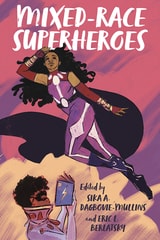
Mixed-Race Superheroes
Sika A. Dagbovie-Mullins
Rutgers University Press, 2021
The essays in this collection contend with the multitude of ways that racial mixedness has been presented in superhero comics, films, television, and literature. They explore how superhero media positions mixed-race characters within a genre that has historically privileged racial purity and propagated images of white supremacy. The book considers such iconic heroes as Superman, Spider-Man, and The Hulk, alongside such lesser-studied characters as Valkyrie, Dr. Fate, and Steven Universe. Examining both literal and symbolic representations of racial mixing, this study interrogates how we might challenge and rewrite stereotypical narratives about mixed-race identity, both in superhero media and beyond.
Mixing It Up
Multiracial SubjectsEdited by SanSan Kwan and Kenneth Speirs
University of Texas Press, 2004
The United States Census 2000 presents a twenty-first century America in which mixed-race marriages, cross-race adoption, and multiracial families in general are challenging the ethnic definitions by which the nation has historically categorized its population. Addressing a wide spectrum of questions raised by this rich new cultural landscape, Mixing It Up brings together the observations of ten noted voices who have experienced multiracialism first-hand.
From Naomi Zack's "American Mixed Race: The United States 2000 Census and Related Issues" to Cathy Irwin and Sean Metzger's "Keeping Up Appearances: Ethnic Alien-Nation in Female Solo Performance," this diverse collection spans the realities of multiculturalism in compelling new analysis. Arguing that society's discomfort with multiracialism has been institutionalized throughout history, whether through the "one drop" rule or media depictions, SanSan Kwan and Kenneth Speirs reflect on the means by which the monoracial lens is slowly being replaced.
Itself a hybrid of memoir, history, and sociological theory, Mixing It Up makes it clear why the identity politics of previous decades have little relevance to the fluid new face of contemporary humanity.
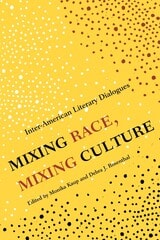
Mixing Race, Mixing Culture
Inter-American Literary DialoguesEdited by Monika Kaup and Debra Rosenthal
University of Texas Press, 2002
Over the last five centuries, the story of the Americas has been a story of the mixing of races and cultures. Not surprisingly, the issue of miscegenation, with its attendant fears and hopes, has been a pervasive theme in New World literature, as writers from Canada to Argentina confront the legacy of cultural hybridization and fusion.
This book takes up the challenge of transforming American literary and cultural studies into a comparative discipline by examining the dynamics of racial and cultural mixture and its opposite tendency, racial and cultural disjunction, in the literatures of the Americas. Editors Kaup and Rosenthal have brought together a distinguished set of scholars who compare the treatment of racial and cultural mixtures in literature from North America, the Caribbean, and Latin America. From various angles, they remap the Americas as a multicultural and multiracial hemisphere, with a common history of colonialism, slavery, racism, and racial and cultural hybridity.
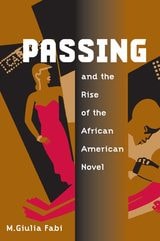
Passing and the Rise of the African American Novel
M. Giulia Fabi
University of Illinois Press, 2001
Focusing on the trope of passing--black characters lightskinned enough to pass for white--M. Giulia Fabi shows how early African American authors such as William Wells Brown, Frank J. Webb, Charles W. Chesnutt, Sutton E. Griggs, Frances E. W. Harper, Edward A. Johnson, and James Weldon Johnson transformed traditional representations of blackness and moved beyond the tragic mulatto motif. Challenging the myths of racial purity and the color line, these authors used passing to celebrate a distinctive, African American history, culture, and worldview.
Fabi examines how early black writers adapted existing literary forms, including the sentimental romance, the domestic novel, and the utopian novel, to express their convictions and concerns about slavery, segregation, and racism. Chesnutt used passing as both a structural and a thematic element, while James Weldon Johnson innovated by parodying the earlier novels of passing and presenting the decision to pass as the result, rather than the cause, of cultural alienation. Fabi also gives a historical overview of the canon-making enterprises of African American critics from the 1850s to the 1990s and considers how their concerns about promoting the canonization of African American literature affected their perceptions of nineteenth-century black fiction.
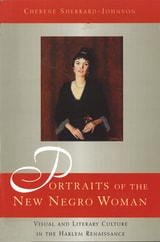
Portraits of the New Negro Woman
Visual and Literary Culture in the Harlem RenaissanceCherene M. Sherrard-Johnson
Rutgers University Press, 2007
Of all the images to arise from the Harlem Renaissance, the most thought-provoking were those of the mulatta. For some writers, artists, and filmmakers, these images provided an alternative to the stereotypes of black womanhood and a challenge to the color line. For others, they represented key aspects of modernity and race coding central to the New Negro Movement. Due to the mulatta’s frequent ability to pass for white, she represented a variety of contradictory meanings that often transcended racial, class, and gender boundaries.
In this engaging narrative, Cherene Sherrard-Johnson uses the writings of Nella Larsen and Jessie Fauset as well as the work of artists like Archibald Motley and William H. Johnson to illuminate the centrality of the mulatta by examining a variety of competing arguments about race in the Harlem Renaissance and beyond.
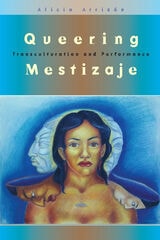
Queering Mestizaje
Transculturation and PerformanceAlicia Arrizón
University of Michigan Press, 2006
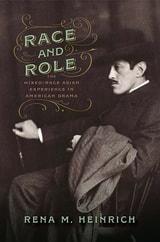
Race and Role
The Mixed-Race Asian Experience in American DramaRena M. Heinrich
Rutgers University Press, 2023
Race and Role: The Mixed-Race Experience in American Drama traces the shifting identities of multiracial Asian figures in theater from the late-nineteenth century to the present day and explores the ways that mixed-race Asian identity transforms our understanding of race. Mixed-Asian playwrights harness theater’s generative power to enact performances of “double liminality” and expose the absurd tenacity with which society clings to a tenuous racial scaffolding.
Rita Dove's Cosmopolitanism
POEMSMalin Pereira
University of Illinois Press, 2003
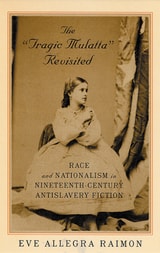
The 'Tragic Mulatta' Revisited
Race and Nationalism in Nineteenth-Century Antislavery FictionEve Allegra Raimon
Rutgers University Press, 2004
Since its inception, the United States has been intensely preoccupied with interracialism. The concept is embedded everywhere in our social and political fabric, including our sense of national identity. And yet, in both its quantitative and symbolic forms, interracialism remains an extremely elusive phenomenon, causing policy makers and census boards to wrangle over how to delineate it and, on an emblematic level, stirring intense emotions from fear to fascination.
In The “Tragic Mulatta” Revisited, Eve Allegra Raimon focuses on the mixed-race female slave in literature, arguing that this figure became a symbolic vehicle for explorations of race and nation—both of which were in crisis in the mid-nineteenth century. At this time, judicial, statutory, social, and scientific debates about the meaning of racial difference (and intermixture) coincided with disputes over frontier expansion, which were never merely about land acquisition but also literally about the “complexion” of that frontier. Embodying both northern and southern ideologies, the “amalgamated” mulatta, the author argues, can be viewed as quintessentially American, a precursor to contemporary motifs of “hybrid” and “mestizo” identities.
Where others have focused on the gendered and racially abject position of the “tragic mulatta,” Raimonreconsiders texts by such central antislavery writers as Lydia Maria Child, William Wells Brown, Harriet Beecher Stowe, and Harriet Wilson to suggest that the figure is more usefully examined as a way of understanding the volatile and shifting interface of race and national identity in the antebellum period.
The Fluency of Light
Coming of Age in a Theater of Black and WhiteAisha Sabatini Sloan
University of Iowa Press, 2013
The Literary Voices of Winnifred Eaton
Redefining Ethnicity and AuthenticityCole, Jean Lee
Rutgers University Press, 2002
Eaton attempted to disguise her Chinese heritage by writing under a hypothetically Japanese pen name. In legal documents, she usually claimed a "white" racial identity. In her fiction, Eaton portrayed Japanese, Chinese, Irish, and American characters, relying on the accepted stereotypes of the day. Jean Lee Cole shows that the many voices Eaton adopted show her deep preoccupations with "American" identity as a whole. The author attempts to reconcile all of these "voices," examining how Eaton survived in a climate hostile to minority writers in the early twentieth century, and how her seemingly anomalous works conjoin Asian American and American literary history.