Results by title
10 books match the query 'Music and the war'
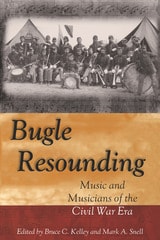
Bugle Resounding
Music and Musicians of the Civil War EraEdited by Bruce C. Kelley & Mark A. Snell
University of Missouri Press, 2004
Although numerous academic resources examine the music and musicians of the Civil War era, the research is spread across a variety of disciplines and is found in a wide array of scholarly journals, books, and papers. It is difficult to assimilate this diverse body of research, and few sources are dedicated solely to a rigorous and comprehensive investigation of the music and the musicians of this era. This anthology, which grew out of the first two National Conferences on Music of the Civil War Era, is an initial attempt to address that need.
Those conferences established the first academic setting solely devoted to exploring the effects of the Civil War on music and musicians. Bridging musicology and history, these essays represent the forefront of scholarship in music of the Civil War era. Each one makes a significant contribution to research in the music of this era and will ultimately encourage more interdisciplinary research on a subject that has relevance both for its own time and for ours. The result is a readable, understandable volume on one of the few understudied—yet fascinating—aspects of the Civil War era.
Coming Out of War
Poetry, Grieving, and the Culture of the World WarsJanis P. Stout
University of Alabama Press, 2005
World War I is widely considered “the Great War” and World War II, “the Good War.” Janis Stout thinks of them as two parts of a whole that continues to engage historians and literary scholars searching for an understanding of both the actual war experiences and the modern culture of grief they embody. In Coming Out of War: Poetry, Grieving, and the Culture of the World Wars Stout argues that poetry, of all the arts, most fully captures and conveys those cultural responses.
While probing the work of such well known war poets as Rupert Brooke, Wilfred Owen, and Randall Jarrell, Stout also highlights the impact of the wars on lesser studied, but equally compelling, sources such as the music of Charles Ives and Cole Porter, Aaron Copland and Irving Berlin. She challenges the commonplace belief that war poetry came only from the battlefield and was written only by men by examining the wartime writings of women poets such as Rose Macaulay, Marianne Moore, Elizabeth Bishop, and Gwendolyn Brooks. She also challenges the assumption that World War II did not produce poetry of distinction by studying the work of John Ciardi, Karl Shapiro, Louis Simpson, Robert Frost, and Wallace Stevens. While emphasizing aesthetic continuity between the wars, Stout stresses that the poetry that emerged from each displays a greater variety than is usually recognized.
A final chapter considers Benjamin Britten’s War Requiem as a culmination and embodiment of the anti-war tradition in 20th-century poetry and music, and speculates on the reasons why, despite their abundance and eloquence, these expressions of grief and opposition to war have effected so little change.
Entertaining History
The Civil War in Literature, Film, and SongEdited by Chris Mackowski
Southern Illinois University Press, 2020
From Ulysses S. Grant’s Memoirs to Abraham Lincoln: Vampire Hunter, from Roots to Ken Burns’s The Civil War, from “Dixie” to “Ashokan Farewell,” and from Civil War photography to the Gettysburg Cyclorama, trendy and well-loved depictions of the Civil War are the subjects of twenty contributors who tell how they and the general public have been influenced by them. Sarah Kay Bierle examines the eternal appeal of Gone with the Wind and asks how it is that a protagonist who so opposed the war has become such a figurehead for it. H. R. Gordon talks with New York Times–bestselling novelist Jeff Shaara to discuss the power of storytelling. Paul Ashdown explores ColdMountain’s value as a portrait of the war as national upheaval, and Kevin Pawlak traces a shift in cinema’s depiction of slavery epitomized by 12 Years a Slave. Tony Horwitz revisits his iconic Confederates in the Attic twenty years later.
The contributors’ fresh analysis articulates a shared passion for history’s representation in the popular media. The variety of voices and topics in this collection coalesces into a fascinating discussion of some of the most popular texts in the genres. In keeping with the innovative nature of this series, web-exclusive material extends the conversation beyond the book.
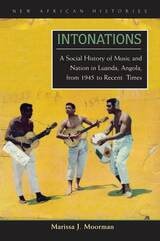
Intonations
A Social History of Music and Nation in Luanda, Angola, from 1945 to Recent TimesMarissa J. Moorman
Ohio University Press, 2008
Intonations tells the story of how Angola’s urban residents in the late colonial period (roughly 1945–74) used music to talk back to their colonial oppressors and, more importantly, to define what it meant to be Angolan and what they hoped to gain from independence. A compilation of Angolan music is included in CD format.
Marissa J. Moorman presents a social and cultural history of the relationship between Angolan culture and politics. She argues that it was in and through popular urban music, produced mainly in the musseques (urban shantytowns) of the capital city, Luanda, that Angolans forged the nation and developed expectations about nationalism. Through careful archival work and extensive interviews with musicians and those who attended performances in bars, community centers, and cinemas, Moorman explores the ways in which the urban poor imagined the nation.
The spread of radio technology and the establishment of a recording industry in the early 1970s reterritorialized an urban-produced sound and cultural ethos by transporting music throughout the country. When the formerly exiled independent movements returned to Angola in 1975, they found a population receptive to their nationalist message but with different expectations about the promises of independence. In producing and consuming music, Angolans formed a new image of independence and nationalist politics.
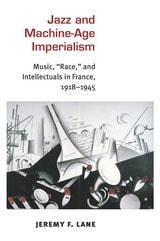
Jazz and Machine-Age Imperialism
Music, "Race," and Intellectuals in France, 1918-1945Jeremy F. Lane
University of Michigan Press, 2014
Jeremy F. Lane’s Jazz and Machine-Age Imperialism is a bold challenge to the existing homogenous picture of the reception of American jazz in world-war era France. Lane’s book closely examines the reception of jazz among French-speaking intellectuals between 1918 and 1945 and is the first study to consider the relationships, sometimes symbiotic, sometimes antagonistic, between early white French jazz critics and those French-speaking intellectuals of color whose first encounters with the music in those years played a catalytic role in their emerging black or Creole consciousness. Jazz’s first arrival in France in 1918 coincided with a series of profound shocks to received notions of French national identity and cultural and moral superiority. These shocks, characteristic of the era of machine-age imperialism, had been provoked by the first total mechanized war, the accelerated introduction of Taylorist and Fordist production techniques into European factories, and the more frequent encounters with primitive “Others” in the imperial metropolis engendered by interwar imperialism. Through close readings of the work of early white French jazz critics, alongside the essays and poems of intellectuals of color such as the Nardal sisters, Léon-Gontran Damas, Léopold Sédar Senghor, and René Ménil, Jazz and Machine-Age Imperialism highlights the ways in which the French reception of jazz was bound up with a series of urgent contemporary debates about primitivism, imperialism, anti-imperialism, black and Creole consciousness, and the effects of American machine-age technologies on the minds and bodies of French citizens.

Nightmare in the Pacific
The World War II Saga of Artie Shaw and His Navy BandMichael Doyle
University of North Texas Press, 2025
Over Here, Over There
Transatlantic Conversations on the Music of World War IEdited by William Brooks, Christina Bashford, and Gayle Magee
University of Illinois Press, 2019
Strains of Dissent
Popular Music and Everyday Resistance in WWII France, 1940 - 1945Kelly Jakes
Michigan State University Press, 2019
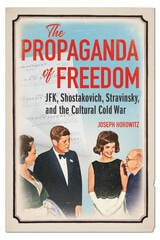
The Propaganda of Freedom
JFK, Shostakovich, Stravinsky, and the Cultural Cold WarJoseph Horowitz
University of Illinois Press, 2023
Eloquently extolled by President John F. Kennedy, the idea that only artists in free societies can produce great art became a bedrock assumption of the Cold War. That this conviction defied centuries of historical evidence--to say nothing of achievements within the Soviet Union--failed to impact impregnable cultural Cold War doctrine.
Joseph Horowitz writes: “That so many fine minds could have cheapened freedom by over-praising it, turning it into a reductionist propaganda mantra, is one measure of the intellectual cost of the Cold War.” He shows how the efforts of the CIA-funded Congress for Cultural Freedom were distorted by an anti-totalitarian “psychology of exile” traceable to its secretary general, the displaced Russian aristocrat/composer Nicolas Nabokov, and to Nabokov’s hero Igor Stravinsky.
In counterpoint, Horowitz investigates personal, social, and political factors that actually shape the creative act. He here focuses on Stravinsky, who in Los Angeles experienced a “freedom not to matter,” and Dmitri Shostakovich, who was both victim and beneficiary of Soviet cultural policies. He also takes a fresh look at cultural exchange and explores paradoxical similarities and differences framing the popularization of classical music in the Soviet Union and the United States. In closing, he assesses the Kennedy administration’s arts advocacy initiatives and their pertinence to today’s fraught American national identity.
Challenging long-entrenched myths, The Propaganda of Freedom newly explores the tangled relationship between the ideology of freedom and ideals of cultural achievement.
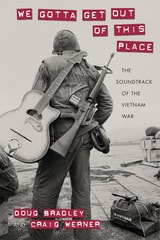
We Gotta Get Out of This Place
The Soundtrack of the Vietnam WarDoug Bradley
University of Massachusetts Press, 2015
Rolling Stone's #1 Music Book of 2015
For a Kentucky rifleman who spent his tour trudging through Vietnam's Central Highlands, it was Nancy Sinatra's “These Boots Are Made for Walkin'.” For a “tunnel rat” who blew smoke into the Viet Cong's underground tunnels, it was Jimi Hendrix's “Purple Haze.” For a Black Marine distraught over the assassination of Martin Luther King Jr., it was Aretha Franklin's “Chain of Fools.” And for countless other Vietnam vets, it was “I Feel Like I'm Fixin' to Die,” “Who'll Stop the Rain,” or the song that gives this book its title.
In We Gotta Get Out of This Place, Doug Bradley and Craig Werner place popular music at the heart of the American experience in Vietnam. They explore how and why U.S. troops turned to music as a way of connecting to each other and the World back home and of coping with the complexities of the war they had been sent to fight. They also demonstrate that music was important for every group of Vietnam veterans—black and white, Latino and Native American, men and women, officers and “grunts”—whose personal reflections drive the book's narrative. Many of the voices are those of ordinary soldiers, airmen, seamen, and marines. But there are also “solo” pieces by veterans whose writings have shaped our understanding of the war—Karl Marlantes, Alfredo Vea, Yusef Komunyakaa, Bill Ehrhart, Arthur Flowers—as well as songwriters and performers whose music influenced soldiers' lives, including Eric Burdon, James Brown, Bruce Springsteen, Country Joe McDonald, and John Fogerty. Together their testimony taps into memories—individual and cultural—that capture a central if often overlooked component of the American war in Vietnam.