Results by title
17 books match the query 'Nabokov, Vladimir Vladimirovich'
Art in Doubt
Tolstoy, Nabokov, and the Problem of Other MindsTatyana Gershkovich
Northwestern University Press, 2021
Leo Tolstoy’s and Vladimir Nabokov’s radically opposed aesthetic worldviews emanate from a shared intuition—that approaching a text skeptically is easy, but trusting it is hard
Two figures central to the Russian literary tradition—Tolstoy, the moralist, and Nabokov, the aesthete—seem to have sharply conflicting ideas about the purpose of literature. Tatyana Gershkovich undermines this familiar opposition by identifying a shared fear at the root of their seemingly antithetical aesthetics: that one’s experience of the world might be entirely one’s own, private and impossible to share through art.
Art in Doubt: Tolstoy, Nabokov, and the Problem of Other Minds reconceives the pair’s celebrated fiction and contentious theorizing as coherent, lifelong efforts to reckon with the problem of other people’s minds. Gershkovich demonstrates how the authors’ shared yearning for an impossibly intimate knowledge of others formed and deformed their fiction and brought them through parallel logic to their rival late styles: Tolstoy’s rustic simplicity and Nabokov’s baroque complexity. Unlike those authors for whom the skeptical predicament ends in absurdity or despair, Tolstoy and Nabokov both hold out hope that skepticism can be overcome, not by force of will but with the right kind of text, one designed to withstand our impulse to doubt it. Through close readings of key canonical works—Anna Karenina, The Kreutzer Sonata, Hadji Murat, The Gift, Pale Fire—this book brings the twin titans of Russian fiction to bear on contemporary debates about how we read now, and how we ought to.
Nabokov Upside Down
Edited by Brian Boyd and Marijeta Bozovic
Northwestern University Press, 2017
Nabokov Upside Down brings together essays that explicitly diverge from conventional topics and points of reference when interpreting a writer whose influence on contemporary literature is unrivaled. Scholars from around the world here read Nabokov in terms of bodies rather than minds, belly-laughs rather than erudite wit, servants rather than master-artists, or Asian rather than Western perspectives. The first part of the volume is dedicated to surveys of Nabokov’s oeuvre that transform some long-held assumptions concerning the nature of and significance of his work.
Often thought of as among the most cerebral of artists, Nabokov comes across in these essays as profoundly aware of the physical world, as evidenced by his masterly representation of physical movement, his bawdy humor, and his attention to gustatory pleasure, among other aspects of his writing. The volume’s second half focuses on individual works or phases in Nabokov’s career, noting connections among them as well as to other fields of inquiry beyond literature. Engaged in conversation with each other and, in his editorial comments, with Brian Boyd, the essays in this volume show Nabokov scholarship continuing to renew itself.
Nabokov and Indeterminacy
The Case of The Real Life of Sebastian KnightPriscilla Meyer
Northwestern University Press, 2018
In Nabokov and Indeterminacy, Priscilla Meyer shows how Vladimir Nabokov’s early novel The Real Life of Sebastian Knight illuminates his later work. Meyer first focuses on Sebastian Knight, exploring how Nabokov associates his characters with systems of subtextual references to Russian, British, and American literary and philosophical works. She then turns to Lolita and Pale Fire, applying these insights to show that these later novels clearly differentiate the characters through subtextual references, and that Sebastian Knight’s construction models that of Pale Fire.
Meyer argues that the dialogue Nabokov constructs among subtexts explores his central concern: the continued existence of the spirit beyond bodily death. She suggests that because Nabokov’s art was a quest for an unattainable knowledge of the otherworldly, knowledge which can never be conclusive, Nabokov’s novels are never closed in plot, theme, or resolution—they take as their hidden theme the unfinalizability that Bakhtin says characterizes all novels.
The conclusions of Nabokov's novels demand a rereading, and each rereading yields a different novel. The reader can never get back to the same beginning, never attain a conclusion, and instead becomes an adept of Nabokov’s quest. Meyer emphasizes that, unlike much postmodern fiction, the contradictions created by Nabokov’s multiple paths do not imply that existence is constructed arbitrarily of pre-existing fragments, but rather that these fragments lead to an ever-deepening approach to the unknowable.
Nabokov's "Invitation to a Beheading"
A Critical CompanionJulian Connolly
Northwestern University Press, 1997
Nabokov's Canon
From "Onegin" to "Ada"Marijeta Bozovic
Northwestern University Press, 2016
Nabokov's Fifth Arc
Nabokov and Others on His Life's WorkEdited by J. E. Rivers and Charles Nicol
University of Texas Press, 1982
In his autobiography Speak, Memory, Vladimir Nabokov compared his life to a spiral, in which “twirl follows twirl, and every synthesis is the thesis of the next series.” The first four arcs of the spiral of Nabokov’s life—his youth in Russia, voluntary exile in Europe, two decades spent in the United States, and the final years of his life in Switzerland—are now followed by a fifth arc, his continuing life in literary history, which this volume both explores and symbolizes.
This is the first collection of essays to examine all five arcs of Nabokov’s creative life through close analyses of representative works. The essays cast new light on works both famous and neglected and place these works against the backgrounds of Nabokov’s career as a whole and modern literature in general. Nabokov analyzes his own artistry in his “Postscript to the Russian Edition of Lolita,” presented here in its first English translation, and in his little-known “Notes to Ada by Vivian Darkbloom,” published now for the first time in America and keyed to the standard U.S. editions of the novel. In addition to a defense of his father’s work by Dmitri Nabokov and a portrait-interview by Alfred Appel, Jr., the volume presents a vast spectrum of critical analyses covering all Nabokov’s major novels and several important short stories. The highly original structure of the book and the fresh and often startling revelations of the essays dramatize as never before the unity and richness of Nabokov’s unique literary achievement.
Narrating Demons, Transformative Texts
Rereading Genius in Mid-Century Modern Fictional MemoirDaniel T. O’Hara
The Ohio State University Press, 2012
Reader as Accomplice
Narrative Ethics in Dostoevsky and NabokovAlexander Spektor
Northwestern University Press, 2021
Reader as Accomplice: Narrative Ethics in Dostoevsky and Nabokov argues that Fyodor Dostoevsky and Vladimir Nabokov seek to affect the moral imagination of their readers by linking morally laden plots to the ethical questions raised by narrative fiction at the formal level. By doing so, these two authors ask us to consider and respond to the ethical demands that narrative acts of representation and interpretation place on authors and readers.
Using the lens of narrative ethics, Alexander Spektor brings to light the important, previously unexplored correspondences between Dostoevsky and Nabokov. Ultimately, he argues for a productive comparison of how each writer investigates the ethical costs of narrating oneself and others. He also explores the power dynamics between author, character, narrator, and reader. In his readings of such texts as “The Meek One” and The Idiot by Dostoevsky and Bend Sinister and Despair by Nabokov, Spektor demonstrates that these authors incite the reader’s sense of ethics by exposing the risks but also the possibilities of narrative fiction.
Social Semiotics As Praxis
Text, Social Meaning Making, and Nabokov’s AdaPaul J. Thibault
University of Minnesota Press, 1991
In Social Semiotics as Praxis, Paul J. Thibault rescues semiotics from terminal formalism by recognizing that the object of a semiotic inquiry is necessarily the way in which human beings, individually and collectively, make sense of their lives. Focusing on Vladimir Nabokov’s Ada, he develops a conception of social semiotics that is a form of both social action and political praxis.
Thibault’s principal intellectual sources are, among others, Bakhtin, Volosinov, Derrida, Foucault, Gramsci, Habermas, and Halliday. Thibault combines the work of Halliday in particular with is own theories of semiotics to explore the dynamics of quoting and reporting speech and to develop a critique of the categories of “self” and “representation.” Thibault accounts for the meaningful relationships constructed among texts and elaborates on the two main themes of relational levels in texts and the dynamics of contextualization to give voice to a unifying discourse for talking about social meaning making.
The Art of Memory in Exile
Vladimir Nabokov & Milan KunderaHana Pichova
Southern Illinois University Press, 2001
Pí chová closely analyzes two novels by each author: the first written in exile (Nabokov's Mary and Kundera's The Book of Laughter and Forgetting) and a later, pivotal novel in each writer's career (Nabokov's The Gift and Kundera's The Unbearable Lightness of Being). In all four texts, these authors explore how the kaleidoscope of personal and cultural memory confronts a fragmented and untenable present, contrasting the lives of fictional é migré s who fail to bridge the gap between past and present with those é migré s whose rich artistic vision allows them to transcend the trials of homelessness.
By juxtaposing these novels and their authors, Pí chová provides a unique perspective on each writer's vast appeal and success. She finds that in the work of Nabokov and Kundera, the most successful exiles express a vision that transcends both national and temporal boundaries.
The Author as Hero
Self and Tradition in Bulgakov, Pasternak, and NabokovJustin Weir
Northwestern University Press, 2011
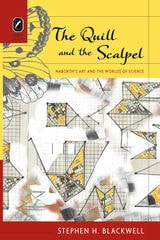
The Quill and the Scalpel
Nabokov's Art and the Worlds of ScienceStephen H. Blackwell
The Ohio State University Press, 2009
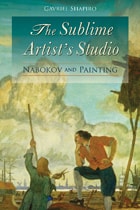
The Sublime Artist's Studio
Nabokov and PaintingGavriel Shapiro
Northwestern University Press, 2009
In his youth, Vladimir Nabokov aspired to become a landscape artist. Even though he eventually realized that his true vocation was literature, his keen sense of visual detail, nuanced perception of color, and vast knowledge of the fine arts are all manifest in his literary works, which abound with painters and paintings, real and imaginary, as well as with magnificent pictorial imagery rendered in a verbal medium. The relation of the visual arts to Nabokov’s work is the subject of The Sublime Artist’s Studio, an in-depth and detailed study of one of the most significant facets of this modern master’s oeuvre.
Gavriel Shapiro pursues his inquiry throughout Nabokov’s literary legacy—poetry, short prose, novels, plays, memoirs, lectures, essays, interviews, and letters. What is the import of Nabokov’s lifelong fascination with the Old Masters? How does landscape function in Nabokov’s writings? What was the author’s relationship to contemporary artists? By addressing these and other questions, while examining Nabokov’s references and allusions to the visual arts and to particular works and artists, Shapiro is able to reveal the centrality of painting to Nabokov’s belles lettres. His book offers a new and promising approach to one of the twentieth century’s most celebrated writers.
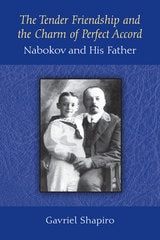
The Tender Friendship and the Charm of Perfect Accord
Nabokov and His FatherGavriel Shapiro
University of Michigan Press, 2014
Vladimir Nabokov (1899–1977), a writer of world renown, grew up in a culturally refined family with diverse interests. Nabokov’s father, Vladimir Dmitrievich (1870–1922), was a distinguished jurist and statesman at the turn of the twentieth century. He was also a great connoisseur and aficionado of literature, painting, theater, and music as well as a passionate butterfly collector, keen chess player, and avid athlete. This book, the first of its kind, examines Vladimir Nabokov’s life and works as impacted by his distinguished father. It demonstrates that V. D. Nabokov exerted the most fundamental influence on his son, making this examination pivotal to understanding the writer’s personality and his world perception, as well as his literary, scholarly, and athletic accomplishments. The book contains never heretofore published archival materials. It is appended with rare articles by Nabokov and his father and is accompanied by old photographs. In addition, the book constitutes a survey of sorts of Russian civilization at the turn of the twentieth century by providing a partial view of the multifaceted picture of Imperial Russia in its twilight hours. The book illumines the historical background, political struggle, juridical battles, and literary and artistic life as well as athletic activities during the epoch, rich in cultural events and fraught with sociopolitical upheavals.
Cover illustration: Vladimir Nabokov and his father, 1906. The Nabokov family photographs. Copyright © The Estate of Vladimir Nabokov, used by permission of The Wylie Agency, LLC; and of The Henry W. and Albert A. Berg Collection of English and American Literature, The New York Public Library, Astor, Lenox and Tilden Foundations.

Vladimir Nabokov - American Writers 96
University of Minnesota Pamphlets on American WritersJulian Moynahan
University of Minnesota Press, 1971
Vladimir Nabokov - American Writers 96 was first published in 1971. Minnesota Archive Editions uses digital technology to make long-unavailable books once again accessible, and are published unaltered from the original University of Minnesota Press editions.
Vladimir Nabokov and the Art of Moral Acts
Dana Dragunoiu
Northwestern University Press, 2022
This book shows how ethics and aesthetics interact in the works of one of the most celebrated literary stylists of the twentieth century: the Russian American novelist Vladimir Nabokov. Dana Dragunoiu reads Nabokov’s fictional worlds as battlegrounds between an autonomous will and heteronomous passions, demonstrating Nabokov’s insistence that genuinely moral acts occur when the will triumphs over the passions by answering the call of duty.
Dragunoiu puts Nabokov’s novels into dialogue with the work of writers such as Alexander Pushkin, William Shakespeare, Leo Tolstoy, and Marcel Proust; with Kantian moral philosophy; with the institution of the modern duel of honor; and with the European traditions of chivalric literature that Nabokov studied as an undergraduate at Cambridge University. This configuration of literary influences and philosophical contexts allows Dragunoiu to advance an original and provocative argument about the formation, career, and legacies of an author who viewed moral activity as an art, and for whom artistic and moral acts served as testaments to the freedom of the will.
Vladimir Nabokov and the Poetics of Liberalism
Dana Dragunoiu
Northwestern University Press, 2011
Showing the particular influence of the thought of Kant and Berkeley, she focuses on what she calls Nabokov’s “most deceptively apolitical novels”: The Gift, Lolita, Pale Fire, and Ada. In bringing to them a more extensive context than previous Nabokov scholars, Dragunoiu argues that their treatment of various moral and political subjects can be more clearly understood in the light of ideas inherited by Nabokov from his father and his father’s generation.