Results by title
43 books match the query 'Natural Disasters'
A Short Treatise on the Metaphysics of Tsunamis
Jean-Pierre Dupuy
Michigan State University Press, 2015
Jean-Pierre Dupuy asks whether, from Lisbon to Sumatra, mankind has really learned nothing about evil. When moral crimes are unbearably great, he argues, our ability to judge evil is gravely impaired, and the temptation to regard human atrocity as an attack on the natural order of the world becomes irresistible. This impulse also suggests a kind of metaphysical ruse that makes it possible to convert evil into fate, only a fate that human beings may choose to avoid. Postponing an apocalyptic future will depend on embracing this paradox and regarding the future itself in a radically new way.
The American edition of Dupuy’s classic essay, first published in 2005, also includes a postscript on the 2011 nuclear accident that occurred in Japan, again as the result of a tsunami.
A Watershed Year
Anatomy of the Iowa Floods of 2008Cornelia F. Mutel
University of Iowa Press, 2010
In June 2008, the rivers of eastern Iowa rose above their banks to create floods of epic proportions; their amazing size—flowing in places at a rate nearly double that of the previous record flood—and the rapidity of their rise ruined farmlands and displaced thousands of residents and hundreds of businesses. In Cedar Rapids, the waters inundated more than nine square miles of the downtown area; in Iowa City, where the flood was also the most destructive in history, the University of Iowa’s arts campus was destroyed. By providing a solid base of scientific and technical information presented with unusual clarity and a wealth of supporting illustrations, the contributors to this far-reaching book, many of whom dealt firsthand with the 2008 floods, provide a detailed roadmap of the causes and effects of future devastating floods.
The twenty-five essays fall naturally into four sections. “Rising Rivers, Spreading Waters” begins by comparing the 2008 floods with the midwestern floods of 1993, moves on to trace community responses to the 2008 floods, and ends by illuminating techniques for forecasting floods and determining their size and frequency. “Why Here, Why Now?” searches for possible causes of the 2008 floods and of flooding in general: annual crops and urban landscapes, inflows into and releases from reservoirs, and climate change. “Flood Damages, Flood Costs, Flood Benefits” considers the complex mix of flood costs and effects, emphasizing damages to cities and farmlands as well as potential benefits to natural communities and archaeological sites. “Looking Back, Looking Forward” lays out approaches to managing the floods of the future that are sure to come.
While the book draws most of its examples from one particular region, it explains flooding throughout a much larger region—the midwestern Corn Belt—and thus its sobering yet energizing lessons apply well beyond eastern Iowa. By examining the relationships among rivers, floodplains, weather, and modern society; by stressing matters of science and fact rather than social or policy issues; and by addressing multiple environmental problems and benefits, A Watershed Year informs and educates all those who experienced the 2008 floods and all those concerned with the larger causes of flooding.
America's Deadliest Twister
The Tri-State Tornado of 1925Geoff Partlow
Southern Illinois University Press, 2014
Winner, ISHS Certificate of Excellence, 2015
Disaster relief as we know it did not exist when the deadliest tornado in U.S. history gouged a path from southeast Missouri through southern Illinois and into southwestern Indiana. The tri-state tornado of 1925 hugged the ground for 219 miles, generated wind speeds in excess of 300 miles per hour, and killed 695 people. Drawing on survivor interviews, public records, and newspaper archives, America’s Deadliest Twister offers a detailed account of the storm, but more important, it describes life in the region at that time as well as the tornado’s lasting cultural impact, especially on southern Illinois.
Author Geoff Partlow follows the storm from town to town, introducing us to the people most affected by the tornado, including the African American population of southern Illinois. Their narratives, along with the stories of the heroes who led recovery efforts in the years following, add a hometown perspective to the account of the storm itself.
In the discussion of the aftermath of the tornado, Partlow examines the lasting social and economic scars in the area, but he also looks at some of the technological firsts associated with this devastating tragedy. Partlow shows how relief efforts in the region began to change the way people throughout the nation thought about disaster relief, which led to the unified responses we are familiar with today.
Cartographies of Danger
Mapping Hazards in AmericaMark Monmonier
University of Chicago Press, 1997
California, for example, takes earthquakes seriously, with a comprehensive program of seismic mapping, whereas Washington has been comparatively lax about earthquakes in Puget Sound. But as the Northridge earthquake in January 1994 demonstrated all too clearly to Californians, even reliable seismic-hazard maps can deceive anyone who misinterprets "known fault-lines" as the only places vulnerable to earthquakes.
Important as it is to predict and prepare for catastrophic natural hazards, more subtle and persistent phenomena such as pollution and crime also pose serious dangers that we have to cope with on a daily basis. Hazard-zone maps highlight these more insidious hazards and raise awareness about them among planners, local officials, and the public.
With the help of many maps illustrating examples from all corners of the United States, Monmonier demonstrates how hazard mapping reflects not just scientific understanding of hazards but also perceptions of risk and how risk can be reduced. Whether you live on a faultline or a coastline, near a toxic waste dump or an EMF-generating power line, you ignore this book's plain-language advice on geographic hazards and how to avoid them at your own peril.
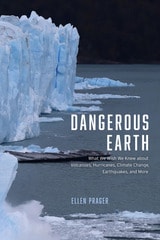
Dangerous Earth
What We Wish We Knew about Volcanoes, Hurricanes, Climate Change, Earthquakes, and MoreEllen Prager
University of Chicago Press, 2020
Today, we know more than ever before about the powerful forces that can cause catastrophe, but significant questions remain. Why can’t we better predict some natural disasters? What do scientists know about them already? What do they wish they knew? In Dangerous Earth, marine scientist and science communicator Ellen Prager explores the science of investigating volcanoes, earthquakes, tsunamis, hurricanes, landslides, rip currents, and—maybe the most perilous hazard of all—climate change. Each chapter considers a specific hazard, begins with a game-changing historical event (like the 1980 eruption of Mt. St. Helens or the landfall and impacts of Hurricane Harvey), and highlights what remains unknown about these dynamic phenomena. Along the way, we hear from scientists trying to read Earth’s warning signs, pass its messages along to the rest of us, and prevent catastrophic loss.
A sweeping tour of some of the most awesome forces on our planet—many tragic, yet nonetheless awe-inspiring—Dangerous Earth is an illuminating journey through the undiscovered, unresolved, and in some cases unimagined mysteries that continue to frustrate and fascinate the world’s leading scientists: the “wish-we-knews” that ignite both our curiosity and global change.
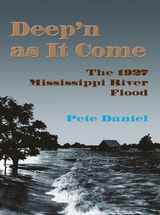
Deep'n as It Come
The 1927 Mississippi River FloodPete Daniel
University of Arkansas Press, 1998
Daniel weaves his narrative with newspaper and firsthand accounts, interviews and survivors, official reports, and over 140 contemporary photographs. The story of the common refugee who suffered most of the effects of the flood emerges alongside the details of the massive rescue and relief operation—one of the largest ever mounted in the United States. The title, Deep’n as It Come, is a phrase from Cora Lee Campbell’s early description of he approaching water, which, Daniel writes, “moved at a pace of some fourteen miles per day,” and in its movement and sound, “had the eeriness of a full eclipse of t he sun, unsettling, chilling.”
“The contradictions of sorrow and humor. . . death and salvation, despair and hope, calm and panic—all reveal the human dimension” in this compassionate and unforgettable portrait of common people confronting a great natural disaster.
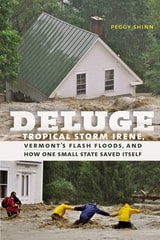
Deluge
Tropical Storm Irene, Vermont’s Flash Floods, and How One Small State Saved ItselfPeggy Shinn
University Press of New England, 2013
Disaster Anarchy
Mutual Aid and Radical ActionRhiannon
Pluto Press, 2022
As disasters become more commonplace, we need to think of alternatives for relief.
'Commendable - a book that prepares us to think about and react to system failures' - Peter Gelderloos
Anarchists have been central in helping communities ravaged by disasters, stepping in when governments wash their hands of the victims. Looking at Hurricane Sandy, Covid-19, and the social movements that mobilized relief in their wake, Disaster Anarchy is an inspiring and alarming book about collective solidarity in an increasingly dangerous world.
As climate change and neoliberalism converge, mutual aid networks, grassroots direct action, occupations, and brigades have sprung up in response to this crisis with considerable success. Occupy Sandy was widely acknowledged to have organized relief more effectively than federal agencies or NGOs, and following Covid-19 the term ‘mutual aid’ entered common parlance.
However, anarchist-inspired relief has not gone unnoticed by government agencies. Their responses include surveillance and co-option, extending at times to violent repression involving police brutality. Arguing that disaster anarchy is one of the most important political phenomena to emerge in the 21st century, Rhiannon Firth shows through her research on and within these movements that anarchist theory and practice are needed to protect ourselves from the disasters of our unequal and destructive economic system.
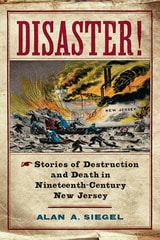
Disaster!
Stories of Destruction and Death in Nineteenth-Century New JerseySiegel, Alan A
Rutgers University Press, 2014
By every measure, Hurricane Sandy was a disaster of epic proportions. The deadliest storm to strike the East Coast since Hurricane Diane in 1955, Sandy killed thirty-seven people and caused more than $30 billion in damages in 2012 to New Jersey alone. But earlier centuries experienced their own catastrophes.
In Disaster!, Alan A. Siegel brings readers face-to-face with twenty-eight of the deadliest natural and human-caused calamities to strike New Jersey between 1821 and 1906, ranging from horrific transportation accidents to uncontrolled fires of a kind rarely seen today. As Siegel writes in his introduction, “None of the stories end well—there are dead and injured by the thousands as well as millions in property lost.” Accounts of these fires, steamboat explosions, shipwrecks, train wrecks, and storms are told in the words of the people who experienced the events firsthand, lending a sense of immediacy to each story.
Disasters bring out the worst as well as the best in people. Siegel focuses on the bravest individuals, including harbor pilot Thomas Freeborn who drowned while attempting to save fifty passengers and crew of a ship foundering on the Jersey Shore, and Warwicke Greene, a fourteen-year-old schoolboy who rescued the injured “like the hero of an epic poem” after a train wreck in the Hackensack Meadows. These and many other stories of forgotten acts of courage in the face of danger will make Disaster! an unforgettable read.
Drift Smoke
Loss and Renewal in a Land of FireDavid J. Strohmaier
University of Nevada Press, 2009
David Strohmaier’s long career as a firefighter has given him intimate knowledge of wildfire and its complex role in the natural world of the American West. It has also given him rare understanding of the painful losses that are a consequence of fire. Strohmaier addresses our ambivalence about fire and the realities of loss to it—of life, human and animal, of livelihoods, of beloved places. He also examines the process of renewal that is yet another consequence of fire, from the infusion of essential nutrients into the soil, to the sprouting of seeds that depend on fire for germination, to the renewal of species as the land restores itself. Ultimately, according to Strohmaier, living with fire is a matter of choices, of “seeing the connection between loss on a personal scale and loss on a landscape scale: in relationship with persons, and in relationship to and with the land.” We must cultivate a longer perspective, he says, accepting that loss is a part of life and that “humility and empathy and care are not only core virtues between humans but are also essential virtues in our attitudes and actions toward the earth.” Drift Smoke is a powerful and moving meditation on wildfire by someone who has seen it in all its terror and beauty, who has lost colleagues and beloved terrain to its ferocity, and who has also seen the miracle of new life sprouting in the ashes. The debate over the role and control of fire in the West will not soon end, but Strohmaier’s contribution to the debate will help all of us better appreciate both the complexity of the issues and the possibilities of hitherto unconsidered solutions that will allow us to inhabit a place where fire is a natural, and needed, part of life.

Economic Behaviour in Adversity
Jack Hirshleifer
University of Chicago Press, 1988
Part I, "Disaster and Recovery," contains previously unpublished studies of major historical catastrophes, among them the Black Death of the fourteenth century, the Civil War in Russia that followed the Bolshevik revolution, and the mass bombing of Germany and of Japan during World War II. Accompanying the historical studies are several analytical papers that interpret the disaster experience.
The essays in Part II, "Cooperation and Conflict," represent innovative theoretical analyses based on a common theme—that cooperation and conflict are alternative strategies whereby individuals, groups, and different forms of social organization struggle with one another for evolutionary survival. Ultimately, these essays indicate, the political economy of the human species is an instance of Darwin's "economy of nature."
Endangered City
The Politics of Security and Risk in BogotáAustin Zeiderman
Duke University Press, 2016
Fatal Isolation
The Devastating Paris Heat Wave of 2003Richard C. Keller
University of Chicago Press, 2015
Fatal Isolation tells the stories of these victims and the catastrophe that took their lives. It explores the multiple narratives of disaster--the official story of the crisis and its aftermath, as presented by the media and the state; the life stories of the individual victims, which both illuminate and challenge the ways we typically perceive natural disasters; and the scientific understandings of disaster and its management. Fatal Isolation is both a social history of risk and vulnerability in the urban landscape and a story of how a city copes with emerging threats and sudden, dramatic change.
Fire Management in the American West
Forest Politics and the Rise of MegafiresMark Hudson
University Press of Colorado, 2011
Drawing on correspondence both between and within the Forest Service and the major timber industry associations, newspaper articles, articles from industry outlets, and policy documents from the late 1800s through the present, Hudson shows how the US forest industry, under the constraint of profitability, pushed the USFS away from private industry regulation and toward fire exclusion, eventually changing national forest policy into little more than fire policy.
More recently, the USFS has attempted to move beyond the policy of complete fire suppression. Interviews with public land managers in the Pacific Northwest shed light on the sources of the agency's struggles as it attempts to change the way we understand and relate to fire in the West.
Fire Management in the American West will be of great interest to environmentalists, sociologists, fire managers, scientists, and academics and students in environmental history and forestry.
Flammable Cities
Urban Conflagration and the Making of the Modern WorldGreg Bankoff
University of Wisconsin Press, 2012
In most cities today, fire has been reduced to a sporadic and isolated threat. But throughout history the constant risk of fire has left a deep and lasting imprint on almost every dimension of urban society. This volume, the first truly global study of urban conflagration, shows how fire has shaped cities throughout the modern world, from Europe to the imperial colonies, major trade entrepôts, and non-European capitals, right up to such present-day megacities as Lagos and Jakarta. Urban fire may hinder commerce or even spur it; it may break down or reinforce barriers of race, class, and ethnicity; it may serve as a pretext for state violence or provide an opportunity for displays of state benevolence. As this volume demonstrates, the many and varied attempts to master, marginalize, or manipulate fire can turn a natural and human hazard into a highly useful social and political tool.

Foundations of Colonial Rule
Rebuilding Lima after the Earthquake of 1687Judith Mansilla
University of Alabama Press, 2026
Foundations of Colonial Rule analyzes diverse primary documents to understand how the viceroyalty, the Catholic clergy, local authorities, and everyday citizens of Lima, Peru, managed and rebuilt after the 1687 earthquake.
Gunflint Falling
Blowdown in the Boundary WatersCary J. Griffith
University of Minnesota Press, 2023
Stories from survivors of the Boundary Waters Canoe Area Wilderness’s epochal weather disaster
On July 4, 1999, in the Boundary Waters Canoe Area Wilderness (BWCAW), a bizarre confluence of meteorological events resulted in the most damaging blowdown in the region’s history. Originating over the Dakotas, the midsummer windstorm developed amid unusually high heat and water-saturated forests and moved steadily east, bearing down on Fargo, North Dakota, and damaging land as it crossed the Minnesota border. Gunflint Falling tells the story of this devastating storm from the perspectives of those who were on the ground before, during, and after the catastrophic event—from first-time visitors to the north woods to returning paddlers to Forest Service Rangers.
The pre-dawn forecasts from the National Weather Service in Duluth for that Sunday of the holiday weekend predicted the day would be “warm and humid. Partly sunny with a thirty percent chance of thunderstorms.” But as the afternoon and evening settled over the Boundary Waters, the first eyewitness accounts began to tell a dramatic and terrifying story. Five friends camping on Lake Polly watched in wonder as the sky turned green and the winds began to whip. They scrambled to pull canoes on shore and secure tarps when a tree snapped and struck one of them in the head, rendering her unconscious. Three women enjoying their last day of a camping trip near the end of the Gunflint Trail took shelter in their tent as winds increased. Water drenched the nylon walls as trees crashed around them, one flattening the tent and pinning a woman beneath its weight. A family vacationing at their cabin dodged falling trees and strained against straight-line winds as they sprinted from the cabin to the safest place they knew: a crawl space underneath it. They watched in awe as trees snapped and toppled, their twisted root balls torn out of the water-logged earth—as they prayed their cabin would hold.
By the time the storm began to subside, falling trees had injured approximately sixty people, and most needed to be medevacked to safety. Amazingly, no one died. The historic storm laid down timber that would later blaze in the Ham Lake fire of 2007, ultimately reshaping the region’s forests in ways we have yet to fully understand.
Harvesting Haiti
Reflections on Unnatural DisastersMyriam J.A. Chancy
University of Texas Press, 2023
2024 Isis Duarte Book Prize, Haiti/ Dominican Republic Section, Latin American Studies Association
2024 Longlist, OCM Bocas Prize for Caribbean Literature, Bocas Lit Fest
This collection ponders the personal and political implications for Haitians at home and abroad resulting from the devastating 2010 earthquake.
The 7.0 magnitude earthquake that struck Haiti in January 2010 was a debilitating event that followed decades of political, social, and financial issues. Leaving over 250,000 people dead, 300,000 injured, and 1.5 million people homeless, the earthquake has had lasting repercussions on a struggling nation. As the post-earthquake political situation unfolded, Myriam Chancy worked to illuminate on-the-ground concerns, from the vulnerable position of Haitian women to the failures of international aid. Originally presented at invited campus talks, published as columns for a newspaper in Trinidad and Tobago, and circulated in other ways, her essays and creative responses preserve the reactions and urgencies of the years following the disaster.
In Harvesting Haiti, Chancy examines the structures that have resulted in Haiti's post-earthquake conditions and reflects at key points after the earthquake on its effects on vulnerable communities. Her essays make clear the importance of sustaining and supporting the dignity of Haitian lives and of creating a better, contextualized understanding of the issues that mark Haitians’ historical and present realities, from gender parity to the vexed relationship between Haiti and the Dominican Republic.
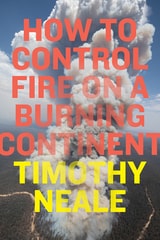
How to Control Fire on a Burning Continent
Timothy Neale
Duke University Press, 2026
Each year, Australia faces increasingly unprecedented wildfires, marked both by their scale and by the intense public disagreements about their political, cultural, and ecological causes. How to Control Fire on a Burning Continent is a critical and ethnographic exploration of wildfire management in Australia and the technoscientific systems of control that shape its current and future possibilities. Timothy Neale observes how two seemingly opposing forces—an entrenched sense of crisis and widespread normalization—combine to form an apparatus of institutional fire management that increasingly centers technical control and militarization. While sympathetic to the double binds many fire management professionals find themselves in, Neale ties contemporary wildfire problems to ongoing colonization and Indigenous dispossession, exploring Indigenous-led land management and cultural burning as a practical assertion of sovereignty. Through dialogue and collaboration with professional fire managers and Indigenous environmental stewards, Neale calls for a collective movement beyond control thinking by fostering new alliances and modes of coping with, rather than commanding, our flammable world.
In the Path of the Storms
Bayou La Batre, Coden, and the Alabama CoastFrye Gaillard
University of Alabama Press, 2008
A Powerful Portrait of Resilience, Heritage, and Change on Alabama's Gulf Coast.
The Gulf Coast villages of Bayou La Batre and Coden are two of Alabama’s most distinctive, with roots going back to the French settlements of the 18th century. For generations, the proud inhabitants of these communities have extracted their modest livings from the sea, sustained by a lesson handed down over time— that providing for the needs of one’s family is the only true measure of success. But the world has changed drastically for them. A global economy of higher gas prices and cheap imported seafood has threatened the lifeblood of the area. And in recent years a rash of hurricanes, culminating with Hurricane Katrina, has battered the hopes and dreams of these Bayou towns.
But they have known hard times and massive changes before. In the 1970s, refugees from Vietnam, Cambodia, and Laos flooded into the area and within a few years made up a third of the local population. Three Buddhist temples soon took their places among the Catholic, Baptist, and Pentecostal churches that predominated, and for a time the different ethnic groups coexisted in a kind of uneasy peace. But now they are learning to pull together in an uncertain struggle to rebuild their communities.
In the Path of the Storms is a powerful portrait in words and photographs of a unique and unforgettable place. It is a story of tradition, and forces of change, and the epic struggle of these Gulf Coast communities to survive and thrive.
Life in the Hothouse
How a Living Planet Survives Climate ChangeMelanie Lenart
University of Arizona Press, 2010
Life in the Hothouse incorporates Lenart’s extensive knowledge of climate science—including the latest research in climate change—and the most current scientific theories, including Gaia theory, which holds that the Earth has some degree of climate control “built in.” As Lenart points out, scientists have been documenting stronger hurricanes and larger floods for many years. There is a good reason for this, she notes. Hurricanes help cool the ocean surface and clear the air of carbon dioxide, the main greenhouse gas responsible for global warming. From the perspective of Gaia theory, these responses are helping to slow the ongoing global warming and Lenart expounds upon this in a clear and understandable fashion.
There is hope, Lenart writes. If we help sustain Earth's natural defense systems, including wetlands and forests, perhaps Mother Earth will no longer need to rely as much on the cooling effects of what we call "natural disasters"—many of which carry a human fingerprint. At a minimum, she argues, these systems can help us survive the heat.
Living with Florida's Atlantic Beaches
Coastal Hazards from Amelia Island to Key WestDavid M. Bush, William J. Neal, Norma J. Longo, Kenyon C. Lindeman, Deborah F. Pilkey, Luciana Slomp Esteves, John D. Congleton, and Orrin H. Pilkey
Duke University Press, 2004
From Amelia Island just south of Georgia to Key West's southern tip, beaches are one of Florida's greatest assets. Yet these beaches are in danger: rapid structural development on a highly erodible coast make them vulnerable to some of nature's greatest storms. The same development that has been driven by the attraction of beautiful beaches and coastal amenities now threatens those very resources. In turn, coastal structures are at risk from sea-level rise, shoreline retreat, winter storms, and hurricanes. Most of the methods for reducing losses associated with storms protect property only in the short term—at a growing cost in dollars and loss of natural habitat in the long term.
Living with Florida's Atlantic Beaches is a guide to mitigating or reducing losses of property, human life, and natural resources by living with, rather than just at, the shore. This illustrated volume provides an introduction to coastal processes and geology as well as a brief history of coastal hazards and short-sighted human responses. This is the first volume in the Living with the Shore series to discuss the significant long-term impact of dredge-and-fill beach construction on living marine resources. Guidance is provided for long-term risk reduction in the form of tips on storm-resistant construction and site evaluation; maps for evaluating relative vulnerability to hazards are also included. A brief review of coastal regulations will help property owners understand and navigate the various permit requirements for developing coastal property. Living with Florida's Atlantic Beaches is an invaluable source of information for everyone from the curious beach visitor to the community planner, from the prudent property investor to the decision-making public official.

Living with the Coast of Alaska
Owen Mason, William Neal, and Orrin H. Pilkey
Duke University Press, 1997
Facing two oceans and three seas, Alaska's coastline stretches through bays, fjords, and around islands for 45,000 miles. Living with the Coast of Alaska, a new volume in the Living with the Shore series, is a user's guide for both present and future inhabitants of Alaska. Providing individual property owners in all regions of the state with the fundamentals of hazard recognition and mitigation strategy, the authors discuss the geological history of Alaska and its relation to the area's cultural history and present customized hazard risk assessments for coastal communities.
Describing the dynamic nature of natural seismic events and coastal processes in Alaska, the authors emphasize the multiplicity of potential effects that result from a unique combination of geology, climate, and the sea. Earthquakes, volcanic eruptions, tsunami waves, avalanches, glacial advances, storm surges, flash flooding, wind channeling, and shoreline erosion combined with human-induced hazards such as oil spills, fire, and beach and offshore mining accidents make living with danger a way of life in Alaska. The authors provide information on federal and state laws and programs regarding natural disasters and coastal zone management as well as practical suggestions for the design and construction of buildings. For private, commercial, and public developments, this book offers a manual to help Alaskans make informed decisions to minimize, if not avoid, damage and danger.
Media, Culture, and the Environment
Anderson, Alison
Rutgers University Press, 1997
Media, Culture and the Environment provides an accessible introduction to key issues and debates surrounding the media politics of risk assessment and the environment. Anderson looks at nature as contested terrain and reveals how news sources use it to compete for our emotions and attention. She shows how framings of risk in relation to the environment are influenced by social, political, and cultural factors, but she also rejects extreme versions of social constructionism.
The book moves beyond traditional disciplinary boundaries by synthesizing recent debates in cultural theory and media studies with key developments in human geography. It offers an in-depth analysis of pressure politics and environmental lobbying groups, while examining the production, transmission and negotiation language of news discourse. The examples, drawn from both Europe and North America, include the tremendous headline controversies over oil spills and killing of baby seals. Difficult issues, clearly surveyed and incisively presented, make this book essential reading for anyone interested in how and why journalists handle environmental news in the ways they do.
November's Fury
The Deadly Great Lakes Hurricane of 1913Michael Schumacher
University of Minnesota Press, 2014
On Thursday, November 6, the Detroit News forecasted “moderate to brisk” winds for the Great Lakes. On Friday, the Port Huron Times-Herald predicted a “moderately severe” storm. Hourly the warnings became more and more dire. Weather forecasting was in its infancy, however, and radio communication was not much better; by the time it became clear that a freshwater hurricane of epic proportions was developing, the storm was well on its way to becoming the deadliest in Great Lakes maritime history.
The ultimate story of man versus nature, November’s Fury recounts the dramatic events that unfolded over those four days in 1913, as captains eager—or at times forced—to finish the season tried to outrun the massive storm that sank, stranded, or demolished dozens of boats and claimed the lives of more than 250 sailors. This is an account of incredible seamanship under impossible conditions, of inexplicable blunders, heroic rescue efforts, and the sad aftermath of recovering bodies washed ashore and paying tribute to those lost at sea. It is a tragedy made all the more real by the voices of men—now long deceased—who sailed through and survived the storm, and by a remarkable array of photographs documenting the phenomenal damage this not-so-perfect storm wreaked.
The consummate storyteller of Great Lakes lore, Michael Schumacher at long last brings this violent storm to terrifying life, from its first stirrings through its slow-mounting destructive fury to its profound aftereffects, many still felt to this day.
Policing in Natural Disasters
Stress, Resilience, and the Challenges of Emergency ManagementTerri M. Adams and Leigh R. Anderson
Temple University Press, 2019
When natural disasters and emergencies strike, the short- and long-term effects of these events on first responders—the very people society relies upon in the midst of a catastrophe—are often overlooked. Policing in Natural Disasters provides a comprehensive analysis of the major challenges faced by law enforcement officers during extreme crisis events. Terri Adams and Leigh Anderson examine the dilemmas police departments face as well as the impact of the disasters on the professional and personal lives of the officers. Case studies explore the response and recovery phases of emergencies including Hurricane Katrina, the 2010 earthquake and subsequent tsunami in Santiago, Chile, and the Superstorm Tornado Outbreak in 2011.
Policing in Natural Disasters was inspired by the personal accounts of triumph and tragedy shared by first responders. It provides an understanding of first-responder behaviors during disasters, as well as the preparedness, mitigation, response and recovery policy implications for first responders and emergency managers. As first responders must frequently cope with stress, uncertainty, and threats to their health and safety during high-consequence events, Adams and Anderson provide lessons from first-hand experiences of police officers that can lead to better management in times of crisis.
Power of Nature
Archaeology and Human-Environmental Dynamicsedited by Monica L. Smith
University Press of Colorado, 2022
Climatic events, pathogens, and animals as nonhuman agents, ranging in size from viruses to mega-storms, have presented our species with dynamic conditions that overwhelm human capacities. In some cases, people have modified architecture to deal with a constant onslaught of storms, as in Japan or the Caribbean; in other cases, they have welcomed the occasional natural disaster as a chance to start fresh or to put into place new ideas and practices, as in the case of ancient Roman cities. Using the concept of “agency” as one in which multiple sentient and nonhuman actors interact in a landscape, and exploring locations such as the Caribbean, the Pacific, South Asia, the Andes, the Mediterranean, Mesoamerica, North America, and the Arctic, the authors provide compelling explanations of the effect of an entire realm of natural powers that beset human societies past and present—from storms, earthquakes, and fires to vegetation, domestic animals, and wild birds. Throughout, the emphasis is on the philosophical and engineering adjustments that people make to stay resilient when facing the perpetual changes of the natural world.
Using an archaeological perspective, The Power of Nature illustrates and analyzes the many
ways that people do not control their environments. It will be of interest to archaeologists, as well as scholars in science, biology, botany, forestry, urban studies, and disaster management.
Contributors: Steven Ammeran, Traci Ardren, Katelyn J. Bishop, Karen Mohr Chávez, Sergio Chávez, Stanislava Chávez, Emelie Cobb, Jago Cooper, Harper Dine, Chelsea Fisher, Jennifer Huebert, Dale L. Hutchinson, Sara L. Juengst, Kanika Kalra, François Oliva, Matthew C. Peros, Jordan Pickett, Seth Quintus, John Robb, Monica L. Smith, Jillian A. Swift, Silvia Tomášková, Kyungsoo Yoo
Rebuilding Community after Katrina
Transformative Education in the New Orleans Planning InitiativeKen Reardon
Temple University Press, 2015
Rebuilding Community after Katrina chronicles the innovative and ambitious partnership between Cornell University’s City and Regional Planning department and ACORN Housing, an affiliate of what was the nation’s largest low-income community organization. These unlikely allies came together to begin to rebuild devastated neighborhoods in New Orleans after Hurricane Katrina.
The editors and contributors to this volume allow participants’ voices to show how this partnership integrated careful, technical analysis with aggressive community outreach and organizing. With essays by activists, organizers, community members, and academics on the ground, Rebuilding Community after Katrina presents insights on the challenges involved in changing the way politicians and analysts imagined the future of New Orleans’ Ninth Ward.
What emerges from this complex drama are lessons about community planning, organizational relationships, and team building across multi-cultural lines. The accounts presented in Rebuilding Community after Katrina raise important and sensitive questions about the appropriate roles of outsiders in community-based planning processes.
Rivers by Design
State Power and the Origins of U.S. Flood ControlKaren M. O Neill
Duke University Press, 2006
O’Neill focuses on the creation of flood control programs along the lower Mississippi River and the Sacramento River, the first two rivers to receive federal flood control aid. She describes how, in the early to mid-nineteenth century, planters, shippers, and merchants from both regions campaigned for federal assistance with flood control efforts. She explains how the federal government was slowly and reluctantly drawn into water management to the extent that, over time, nearly every river in the United States was reengineered. Her narrative culminates in the passage of the national Flood Control Act of 1936, which empowered the Army Corps of Engineers to build projects for all navigable rivers in conjunction with local authorities, effectively ending nationwide, comprehensive planning for the protection of water resources.
Superstorm Sandy
The Inevitable Destruction and Reconstruction of the Jersey ShoreBates, Diane C
Rutgers University Press, 2015
Diane C. Bates offers a wide-ranging look at the Jersey Shore both before and after Sandy, examining the many factors—such as cultural attachment, tourism revenues, and governmental regulation—that combined to create a highly vulnerable coastal region. She explains why the Shore is so important to New Jerseyans, acting as a key cultural touchstone in a state that lacks a central city or even a sports team to build a shared identity among the state’s residents. She analyzes post-Sandy narratives about the Jersey Shore that trumpeted the dominance of human ingenuity over nature (such as the state’s “Stronger than the Storm” advertising campaign) or proclaimed a therapeutic community (“Jersey Strong”)—narratives rooted in emotion and iconography, waylaying any thought of the near-certainty of future storms. The book also examines local business owners, politicians, real estate developers, and residents who have vested interests in the region, explaining why the Shore was developed intensively prior to Sandy, and why restoration became an imperative in the post-storm period.
Engagingly written and insightful, Superstorm Sandy highlights the elements that compounded the disaster on the Shore, providing a framework for understanding such catastrophes and preventing them in the future.
Surviving Sudden Environmental Change
Answers From ArchaeologyJago Cooper
University Press of Colorado, 2012
Tales from an Uncertain World
What Other Assorted Disasters Can Teach Us About Climate ChangeL. S. Gardiner
University of Iowa Press, 2018
So far, humanity hasn’t done very well in addressing the ongoing climate catastrophe. Veteran science educator L. S. Gardiner believes we can learn to do better by understanding how we’ve dealt with other types of environmental risks in the past and why we are dragging our feet in addressing this most urgent emergency. Weaving scientific facts and research together with humor and emotion, Gardiner explores human responses to erosion, earthquakes, fires, invasive species, marine degradation, volcanic eruptions, and floods in order to illuminate why we find it so challenging to deal with climate change. Insight emerges from unexpected places—a mermaid exhibit, a Magic 8 Ball, and midcentury cartoons about a future that never came to be.
Instead of focusing on the economics and geopolitics of the debate over climate change, this book brings large-scale disaster to a human scale, emphasizing the role of the individual. We humans do have the capacity to deal with disasters. When we face threatening changes, we don’t just stand there pretending it isn’t so, we do something. But because we’re human, our responses aren’t always the right ones the first time—yet we can learn to do better. This book is essential reading for all who want to know how we can draw on our strengths to survive the climate catastrophe and forge a new relationship with nature.
That Could Be Us
News Media, Politics, and the Necessary Conditions for Disaster Risk ReductionThomas Jamieson and Douglas A. Van Belle
University of Michigan Press, 2022
In That Could Be Us, Jamieson and Van Belle find that the news media delivers information to observing communities in a form that enables learning from other disasters. Experimental evidence shows that people react to this information in a way that would punish leaders who do not back DRR efforts. Case studies, interviews, experiments, and illustrative examples suggest that leaders and political entrepreneurs heed this public demand, react to news media coverage, and act accordingly. Taken as a whole, this suggests that the policy and research implications derived from this book’s theoretical model are worthy of further exploration, particularly in terms of how they might resolve the puzzle presented by the variations in DRR policy uptake around the world that do not seem to be driven by developmental differences across communities.
The Continuing Storm
Learning from KatrinaKai Erikson and Lori Peek
University of Texas Press, 2022
2023 Finalist, Colorado Book Awards, History/Biography Category
This final volume in the award-winning Katrina Bookshelf series reflects upon the lessons of Hurricane Katrina and what they reveal about our society and current cultural climate.
More than fifteen years later, Hurricane Katrina maintains a strong grip on the American imagination. The reason is not simply that Katrina was an event of enormous scale, although it certainly was by any measure one of the most damaging storms in American history. But, quite apart from its lethality and destructiveness, Katrina retains a place in living memory because it is one of the most telling disasters in our recent national experience, revealing important truths about our society and ourselves.
The final volume in the award-winning Katrina Bookshelf series The Continuing Storm reflects upon what we have learned about Katrina and about America. Kai Erikson and Lori Peek expand our view of the disaster by assessing its ongoing impact on individual lives and across the wide-ranging geographies where displaced New Orleanians landed after the storm. Such an expanded view, the authors argue, is critical for understanding the human costs of catastrophe across time and space. Concluding with a broader examination of disasters in the years since Katrina—including COVID-19—The Continuing Storm is a sobering meditation on the duration of a catastrophe that continues to exact steep costs in human suffering.
The Contradictions of Neoliberal Agri-Food
Corporations, Resistance, and Disasters in JapanKae Sekine
West Virginia University Press, 2016
Sekine and Bonanno stress the incompatibility of the requirements of neoliberalism with the structural and cultural conditions of Japanese agri-food. Local farmers’ and fishermen’s emphasis on community collective management of natural resources, they argue, clashes with neoliberalism’s focus on individualism and competitiveness. The authors conclude by pointing out the resulting fundamental contradiction: The lack of recognition of this incompatibility allows the continuous implementation of market solutions to problems that originate in these very market mechanisms.
The Feminization of Famine
Expressions of the Inexpressible?Margaret Kelleher
Duke University Press, 1997
Kelleher begins with a critical reading of the novels and short stories written about the Irish famine over the last 150 years, from the novels of William Carleton and Anthony Trollope to the writings of Liam O’Flaherty and John Banville. She then moves on to unveil a lesser-known body of literature—works written by women. This literature is read in the context of a rich variety of other sources, including eye-witness accounts, memoirs, journalistic accounts, and famine historiography. Concluding with a reading of the twentieth-century accounts of the famine in Bengal, this book reveals how gendered representations have played a crucial role in defining notions of famine.
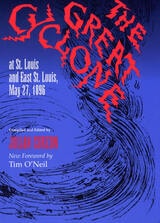
The Great Cyclone at St Louis and East St. Louis, May 27, 1896
Compiled and Edited by Julian Curzon. Foreword by Tim O'Neil
Southern Illinois University Press, 1997
Heavily illustrated by photographs of the damage, The Great Cyclone was compiled from stories in the city’s daily newspapers—the Globe-Democrat, the Post-Dispatch, and, most notably, the old St. Louis Republic. O’Neil points out that "the book’s compilers are not identified, but their glowing praise of the ‘superb descriptive composition’ in the Republic provides a good guess about where most of them worked."
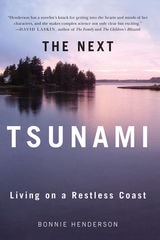
The Next Tsunami
Living on a Restless CoastBonnie Henderson
Oregon State University Press, 2014
More than twenty years passed before geologists discovered that it was neither Seaside’s first nor worst tsunami. In fact, massive tsunamis strike the Pacific coast every few hundred years, triggered not by distant temblors but by huge quakes less than one hundred miles off the Northwest coast. Not until the late 1990s would scientists use evidence like tree rings and centuries-old warehouse records from Japan to fix the date, hour, and magnitude of the Pacific Northwest coast’s last megathrust earthquake: 9 p.m., January 26, 1700, magnitude 9.0—one of the largest quakes the world has known. When the next one strikes—this year or hundreds of years from now—the tsunami it generates is likely to be the most devastating natural disaster in the history of the United States.
In The Next Tsunami, Bonnie Henderson shares the stories of scientists like meteorologist Alfred Wegener, who formulated his theory of continental drift while gazing at ice floes calving from Greenland glaciers, and geologist Brian Atwater, who paddled his dented aluminum canoe up coastal streams looking for layers of peat sandwiched among sand and silt. The story begins and ends with Tom Horning, who grew up to become a geologist and return to his family home at the mouth of the river in Seaside—arguably the Northwest community with the most to lose from what scientist Atwater predicts will be an “apocalyptic” disaster. No one in Seaside understands earthquake science—and the politics and complicated psychology of living in a tsunami zone—better than Horning.
Henderson’s compelling story of how scientists came to understand the Cascadia Subduction Zone—a fault line capable of producing earthquakes even larger than the 2011 Tohoku quake in Japan—and how ordinary people cope with that knowledge is essential reading for anyone interested in the charged intersection of science, human nature, and public policy
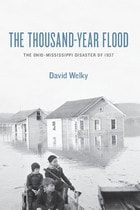
The Thousand-Year Flood
The Ohio-Mississippi Disaster of 1937David Welky
University of Chicago Press, 2011
In the early days of 1937, the Ohio River, swollen by heavy winter rains, began rising. And rising. And rising. By the time the waters crested, the Ohio and Mississippi had climbed to record heights. Nearly four hundred people had died, while a million more had run from their homes. The deluge caused more than half a billion dollars of damage at a time when the Great Depression still battered the nation.
Timed to coincide with the flood's seventy-fifth anniversary, The Thousand-Year Flood is the first comprehensive history of one of the most destructive disasters in American history. David Welky first shows how decades of settlement put Ohio valley farms and towns at risk and how politicians and planners repeatedly ignored the dangers. Then he tells the gripping story of the river's inexorable rise: residents fled to refugee camps and higher ground, towns imposed martial law, prisoners rioted, Red Cross nurses endured terrifying conditions, and FDR dispatched thousands of relief workers. In a landscape fraught with dangers—from unmoored gas tanks that became floating bombs to powerful currents of filthy floodwaters that swept away whole towns—people hastily raised sandbag barricades, piled into overloaded rowboats, and marveled at water that stretched as far as the eye could see. In the flood's aftermath, Welky explains, New Deal reformers, utopian dreamers, and hard-pressed locals restructured not only the flood-stricken valleys, but also the nation's relationship with its waterways, changes that continue to affect life along the rivers to this day.
A striking narrative of danger and adventure—and the mix of heroism and generosity, greed and pettiness that always accompany disaster—The Thousand-Year Flood breathes new life into a fascinating yet little-remembered American story.
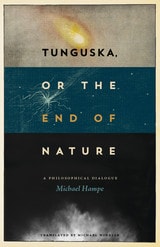
Tunguska, or the End of Nature
A Philosophical DialogueMichael Hampe
University of Chicago Press, 2015
Tunguska, Or the End of Nature uses its four-man setup to tackle some of today’s burning issues—such as climate change, environmental destruction, and resource management—from a diverse range of perspectives. With a kind of foreboding, it asks what the world was like, and will be like, without us, whether we are negligible and the universe random, whether nature can truly be explained, whether it is good or evil, or whether nature is simply a thought we think. This is a profoundly unique work, a thrillingly interdisciplinary piece of scholarly literature that probes the mysteries of nature and humans alike.
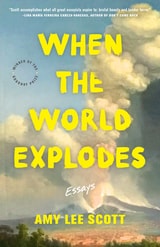
When the World Explodes
EssaysAmy Lee Scott
The Ohio State University Press, 2025
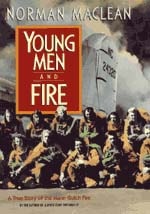
Young Men and Fire
Norman Maclean
University of Chicago Press, 1992
Young Men and Fire won the National Book Critics Circle Award in 1992.
"A magnificent drama of writing, a tragedy that pays tribute to the dead and offers rescue to the living.... Maclean's search for the truth, which becomes an exploration of his own mortality, is more compelling even than his journey into the heart of the fire. His description of the conflagration terrifies, but it is his battle with words, his effort to turn the story of the 13 men into tragedy that makes this book a classic."—from New York Times Book Review Editor's Choice, Best Books of 1992
"A treasure: part detective story, part western, part tragedy, part elegy and wholly eloquent ghost story in which the dead and the living join ranks cheerfully, if sometimes eerily, in a search for truth and the rest it brings."—Joseph Coates, Chicago Tribune
"An astonishing book. In compelling language, both homely and elegant, Young Men and Fire miraculously combines a fascinating primer on fires and firefighting, a powerful, breathtakingly real reconstruction of a tragedy, and a meditation on writing, grief and human character.... Maclean's last book will stir your heart and haunt your memory."—Timothy Foote, USA Today
"Beautiful.... A dark American idyll of which the language can be proud."—Robert M. Adams, The New York Review of Books
"Young Men and Fire is redolent of Melville. Just as the reader of Moby Dick comes to comprehend the monstrous entirety of the great white whale, so the reader of Young Men and Fire goes into the heart of the great red fire and comes out thoroughly informed. Don't hesitate to take the plunge."—Dennis Drabelle, Washington Post Book World
"Young Men and Fire is a somber and poetic retelling of a tragic event. It is the pinnacle of smokejumping literature and a classic work of 20th-century nonfiction."—John Holkeboer, The Wall Street Journal
"Maclean is always with the brave young dead. . . . They could not have found a storyteller with a better claim to represent their honor. . . . A great book."—James R. Kincaid, New York Times Book Review