Results by title
58 books match the query 'Navajo Indians' and 7 start with a

A Diné History of Navajoland
Klara Kelley and Harris Francis
University of Arizona Press, 2019
For the first time, a sweeping history of the Diné that is foregrounded in oral tradition. Authors Klara Kelley and Harris Francis share Diné history from pre-Columbian time to the present, using ethnographic interviews in which Navajo people reveal their oral histories on key events such as Athabaskan migrations, trading and trails, Diné clans, the Long Walk of 1864, and the struggle to keep their culture alive under colonizers who brought the railroad, coal mining, trading posts, and, finally, climate change.
The early chapters, based on ceremonial origin stories, tell about Diné forebears. Next come the histories of Diné clans from late pre-Columbian to early post-Columbian times, and the coming together of the Diné as a sovereign people. Later chapters are based on histories of families, individuals, and communities, and tell how the Diné have struggled to keep their bond with the land under settler encroachment, relocation, loss of land-based self-sufficiency through the trading-post system, energy resource extraction, and climate change.
Archaeological and documentary information supplements the oral histories, providing a comprehensive investigation of Navajo history and offering new insights into their twentieth-century relationships with Hispanic and Anglo settlers.
For Diné readers, the book offers empowering histories and stories of Diné cultural sovereignty. “In short,” the authors say, “it may help you to know how you came to be where—and who—you are.”
[more]
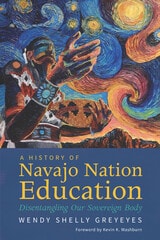
A History of Navajo Nation Education
Disentangling Our Sovereign BodyWendy Shelly Greyeyes; Foreword by Kevin K. Washburn
University of Arizona Press, 2022
A History of Navajo Nation Education: Disentangling Our Sovereign Body unravels the tangle of federal and state education programs that have been imposed on Navajo people and illuminates the ongoing efforts by tribal communities to transfer state authority over Diné education to the Navajo Nation.
On the heels of the fiftieth anniversary of the founding of the Department of Diné Education, this important education history explains how the current Navajo educational system is a complex terrain of power relationships, competing agendas, and jurisdictional battles influenced by colonial pressures and tribal resistance. An iron grip of colonial domination over Navajo education remains, thus inhibiting a unified path toward educational sovereignty. In providing the historical roots to today’s challenges, Wendy Shelly Greyeyes clears the path and provides a go-to reference to move discussions forward.
On the heels of the fiftieth anniversary of the founding of the Department of Diné Education, this important education history explains how the current Navajo educational system is a complex terrain of power relationships, competing agendas, and jurisdictional battles influenced by colonial pressures and tribal resistance. An iron grip of colonial domination over Navajo education remains, thus inhibiting a unified path toward educational sovereignty. In providing the historical roots to today’s challenges, Wendy Shelly Greyeyes clears the path and provides a go-to reference to move discussions forward.
[more]
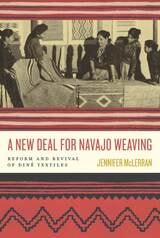
A New Deal for Navajo Weaving
Reform and Revival of Diné TextilesJennifer McLerran
University of Arizona Press, 2022
A New Deal for Navajo Weaving provides a detailed history of early to mid-twentieth-century Diné weaving projects by non-Natives who sought to improve the quality and marketability of Navajo weaving but in so doing failed to understand the cultural significance of weaving and its role in the lives of Diné women.
By the 1920s the durability and market value of Diné weavings had declined dramatically. Indian welfare advocates established projects aimed at improving the materials and techniques. Private efforts served as models for federal programs instituted by New Deal administrators. Historian Jennifer McLerran details how federal officials developed programs such as the Southwest Range and Sheep Breeding Laboratory at Fort Wingate in New Mexico and the Navajo Arts and Crafts Guild. Other federal efforts included the publication of Native natural dye recipes; the publication of portfolios of weaving designs to guide artisans; and the education of consumers through the exhibition of weavings, aiding them in their purchases and cultivating an upscale market. McLerran details how government officials sought to use these programs to bring the Diné into the national economy; instead, these federal tactics were ineffective because they marginalized Navajo women and ignored the important role weaving plays in the resilience and endurance of wider Diné culture.
By the 1920s the durability and market value of Diné weavings had declined dramatically. Indian welfare advocates established projects aimed at improving the materials and techniques. Private efforts served as models for federal programs instituted by New Deal administrators. Historian Jennifer McLerran details how federal officials developed programs such as the Southwest Range and Sheep Breeding Laboratory at Fort Wingate in New Mexico and the Navajo Arts and Crafts Guild. Other federal efforts included the publication of Native natural dye recipes; the publication of portfolios of weaving designs to guide artisans; and the education of consumers through the exhibition of weavings, aiding them in their purchases and cultivating an upscale market. McLerran details how government officials sought to use these programs to bring the Diné into the national economy; instead, these federal tactics were ineffective because they marginalized Navajo women and ignored the important role weaving plays in the resilience and endurance of wider Diné culture.
[more]

A Radiant Curve
Poems and StoriesLuci Tapahonso
University of Arizona Press, 2008
In this sixth collection of stories and verse, award-winning writer Luci Tapahonso finds sacredness in everyday life. Viewing a sunset in a desert sky, listening to her granddaughter recount how she spent her day, or visiting her mother after her father's passing, she finds traces of her own memories, along with echoes of the voices of her Navajo ancestors. The collection also includes an audio CD of the author reading aloud and her voice is warm and inviting, like the “simmering soup and blue corn meal” of her childhood.
These engaging words draw us into a workaday world that, magically but never surprisingly, has room for the Diyin Dine’é (the Holy People), Old Salt Woman, and Dawn Boy. When she describes her grandson’s First Laugh Ceremony—explaining that it was originally performed for White Shell Girl, who grew up to be Changing Woman—her account enriches us and we long to hear more. Tapahonso weaves the Navajo language into her work like she weaves “the first four rows of black yarn” into a rug she is making “for my little grandson, who inherited my father’s name: Hastiin Tsétah Naaki Bísóí.”
As readers, we find that we too are surrounded by silent comfort, held lovingly in the confident hands of an accomplished writer who has a great deal to tell us about life.
[more]
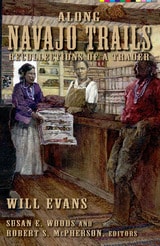
Along Navajo Trails
Recollections of a Trader 1898-1948Will Evans edited by Susan E. Woods and Robert McPherson
Utah State University Press, 2005
Will Evans's writings should find a special niche in the small but significant body of literature from and about traders to the Navajos. Evans was the proprietor of the Shiprock Trading Company. Probably more than most of his fellow traders, he had a strong interest in Navajo culture. The effort he made to record and share what he learned certainly was unusual. He published in the Farmington and New Mexico newspapers and other periodicals, compiling many of his pieces into a book manuscript. His subjects were Navajos he knew and traded with, their stories of historic events such as the Long Walk, and descriptions of their culture as he, an outsider without academic training, understood it. Evans's writings were colored by his fondness for, uncommon access to, and friendships with Navajos, and by who he was: a trader, folk artist, and Mormon. He accurately portrayed the operations of a trading post and knew both the material and artistic value of Navajo crafts. His art was mainly inspired by Navajo sandpainting. He appropriated and, no doubt, sometimes misappropriated that sacred art to paint surfaces and objects of all kinds. As a Mormon, he had particular views of who the Navajos were and what they believed and was representative of a large class of often-overlooked traders. Much of the Navajo trade in the Four Corners region and farther west was operated by Mormons. They had a significant historical role as intermediaries, or brokers, between Native and European American peoples in this part of the West. Well connected at the center of that world, Evans was a good spokesperson.
[more]
Apachean Culture History and Ethnology
Keith H. Basso
University of Arizona Press, 1971
This volume grew out of a symposium held at the Annual Meeting of the American Anthropological Association in November 1969 at New Orleans, Louisiana. The "Apachean Symposium" was designed to provide an opportunity for scholars engaged in research on southern Athapaskan cultures to report upon their findings, and wherever possible, to link them to known fact and existing theory. The diverse work presented here will add significantly to the knowledge about Apachean cultures, and each of contributions also pertains directly to wider spheres of anthropological concern.
[more]

Arc and the Sediment
a NovelChristine Allen-Yazzie
Utah State University Press, 2007
Gretta Bitsilly, a gin-steeped mother of two and self-proclaimed expert at standing just outside the margins of ethnicity and peering in, has been all but eclipsed by the world that eludes her—as a wife, as a writer, as a skeptic in "the other land of Zion," Utah. Gretta has set off to Fort Defiance, Arizona, where she hopes to convince her Navajo husband, who has escaped not from his family but from alcoholism, to come home. Over a sputtering two-steps-forward, one-step-back desert journey, Gretta is diverted by chance, by seizures, an inconstant memory, and the disjointed character of her irresolute quest. She is fueled by a volatile mix of rage and curiosity and is rendered careless by ambivalence toward her marriage—she knows a welcome mat will not be waiting for her, "that white girl" who can't seem to get anything right. On route Gretta fi nds herself lost in the landscape, in strange company, or in her own convolution of language and inner space. With a dictionary and a laptop she attempts to write herself into a better existence—a hopeful existence—and to connect points of intellectual, physical, even spiritual reference.
This tale, though dark and difficult, is infused with tart, twisted humor. Confused, disheveled, self-deprecating, and self-destructive, Gretta is also sharp and funny. Here, first-time novelist Christine Allen-Yazzie breaks apart her own narrative arc but with gritty reality seals it near-shut again, if in rearrangement, drawing us into Gretta's wrestling match with herself, her husband, her addiction, and the road.
The Arc and the Sediment received an honorable mention from the James Jones First Novel Competition, and it won the Utah Arts Council Annual Writing Competiton Publishing Prize.
[more]