Results by title
9 books match the query 'New Poems'
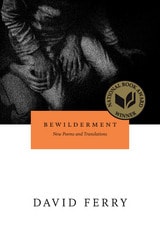
Bewilderment
New Poems and TranslationsDavid Ferry
University of Chicago Press, 2012
Winner of the 2012 National Book Award for Poetry.
To read David Ferry’s Bewilderment is to be reminded that poetry of the highest order can be made by the subtlest of means. The passionate nature and originality of Ferry’s prosodic daring works astonishing transformations that take your breath away. In poem after poem, his diction modulates beautifully between plainspoken high eloquence and colloquial vigor, making his distinctive speech one of the most interesting and ravishing achievements of the past half century. Ferry has fully realized both the potential for vocal expressiveness in his phrasing and the way his phrasing plays against—and with—his genius for metrical variation. His vocal phrasing thus becomes an amazingly flexible instrument of psychological and spiritual inquiry. Most poets write inside a very narrow range of experience and feeling, whether in free or metered verse. But Ferry’s use of meter tends to enhance the colloquial nature of his writing, while giving him access to an immense variety of feeling. Sometimes that feeling is so powerful it’s like witnessing a volcanologist taking measurements in the midst of an eruption.
From Bewilderment:
October
The day was hot, and entirely breathless, so
The remarkably quiet remarkably steady leaf fall
Seemed as if it had no cause at all.
The ticking sound of falling leaves was like
The ticking sound of gentle rainfall as
They gently fell on leaves already fallen,
Or as, when as they passed them in their falling,
Now and again it happened that one of them touched
One or another leaf as yet not falling,
Still clinging to the idea of being summer:
As if the leaves that were falling, but not the day,
Had read, and understood, the calendar.
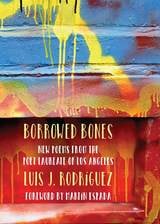
Borrowed Bones
New Poems from the Poet Laureate of Los AngelesLuis J. Rodriguez
Northwestern University Press, 2016
Foreword by Martín Espada
This chapbook collection offers new poems from the prolific career of a community leader, activist, and healer. Luis J. Rodríguez’s work asks profound questions of us as readers and fellow humans, such as, "If society cooperates, can we nurture the full / and healthy development of everyone?" In his introductory remarks, Martín Espada describes the poet as a man engaged in people and places: "Luis Rodríguez is a poet of many tongues, befitting a city of many tongues. He speaks English, Spanish, ‘Hip Hop,’ ‘the Blues,’ and ‘cool jazz.’ He speaks in ‘mad solos.’ He speaks in ‘People’s Sonnets.’ He speaks in the language of protest. He speaks in the language of praise."
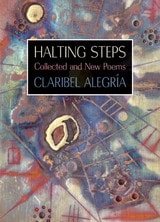
Halting Steps
Collected and New PoemsClaribel Alegria
Northwestern University Press, 2013
Halting Steps represents the most complete single-volume retrospective in English of Claribel Alegría’s seven-decade career. The volume collects all of Alegría’s poems from her fourteen previously published books and debuts several new poems under the title “Otherness.”
Her poetry is not only lyrical and introspective but also politically engaged. Her verse speaks forcefully, specifically, and fearlessly to matters of social justice in her region. She strikes a universal theme, however, in giving a voice to individuals of all classes in their struggle against oppression, but especially women who must contend with a system in which men hold the power and women are excluded. Alegría demonstrates her remarkable range with deeply personal poems, perhaps most notably in the poem cycle “Sorrow,” as she moves steadily through the waves of grief she experiences after her husband’s death.
In Halting Steps, both longtime admirers and those new to her work can appreciate the sustained creative power of Claribel Alegría’s poems.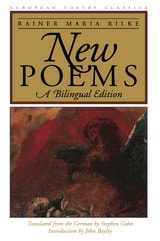
New Poems
A Bilingual EditionRainer Maria Rilke
Northwestern University Press, 1998
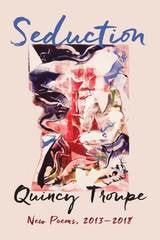
Seduction
New Poems, 2013-2018Quincy Troupe
Northwestern University Press, 2019
time is a bald eagle, a killer soaring high in the blue, / music to men
dodging bullets in speeding cars, / knew death, hoped it'd never come . . .
In this collection we are seduced by Troupe's opus. This is the poet's art laid bare. He is our "Eye." Visions of the transatlantic slave trade, portraits of American violence, pop culture, and historical voices are the lyrical relics in Troupe's masterful verse. One of American literature's most important rhythmical artists, Troupe has created a chronicle reaching through history for the collective "I/Eye" that is all of us.
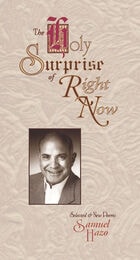
The Holy Surprise of Right Now
Selected and New PoemsSamuel Hazo
University of Arkansas Press, 1996
Toward the Winter Solstice
New PoemsTimothy Steele
Ohio University Press, 2006
Toward the Winter Solstice, Steele’s first collection of new poems in twelve years, features his characteristic grace, wit, and power, while extending his range. In addition to the relatively short lyrical, descriptive, and contemplative poems he has always written so well, this collection offers several middle-length pieces that read almost like compressed novels.
Addressing a variety of topics and themes, Toward the Winter Solstice explores the relationship between the world of nature and the world of ideas. In one way or another, the poems attempt to link the external material universe with that sense of inward self-awareness central to our experience of life. Throughout, Steele writes with a clarity that not only illuminates his subjects but also acknowledges and preserves their ultimate mystery and complexity.

Traveling Light
COLLECTED AND NEW POEMSDavid Wagoner
University of Illinois Press, 1999
Witty, eloquent, and insightful, Traveling Light offers new and familiar treasures from a master observer of both the natural and the human worlds. In a style by turns direct and intricate, Wagoner distills the essential emotions from people's encounters with each other, with nature, and with themselves. Through his compassionate but unblinking eyes, we see ourselves and the world that surrounds us more sharply delineated.
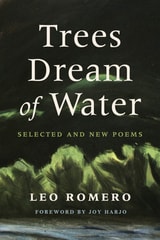
Trees Dream of Water
Selected and New PoemsLeo Romero; Foreword by Joy Harjo
University of Arizona Press, 2025
Leo Romero stands as a foundational figure in Latino letters. With six books of poetry and a book of short fiction to his name, Romero’s contribution to the literary canon is profound and enduring.
Bringing together for the first time his new and selected poems, Trees Dream of Water reflects Romero’s journey from youth to maturity as a person and a poet, and his deep connection to New Mexico and its culture. Traversed by memory, myth, and observation of the natural world, these poems explore family, community belonging and conflict, life as an artist, and the cycles of life and death. This lyrical anthology includes accompanying essays to illuminate Romero’s life and work for longtime admirers and new readers alike.