Results by title
17 books match the query 'New Politics'
Alt-Labor and the New Politics of Workers' Rights
Daniel J. Galvin
Russell Sage Foundation, 2024
Alt-labor groups have long offered their members services and organizing opportunities to contest their unfair treatment on the job. But many groups have grown frustrated by the limited impact of these traditional strategies and have turned to public policy to scale up their work. They have successfully led campaigns to combat wage theft, raise the minimum wage, improve working conditions, strengthen immigrants’ rights, and more. These successes present something of a puzzle: relative to their larger, wealthier, and better-connected opponents, alt-labor groups are small, poor, and weak. Their members are primarily low-wage immigrant workers and workers of color who are often socially, economically, and politically marginalized. With few exceptions, the groups lack large dues-paying memberships and are dependent on philanthropic foundations and other unpredictable sources of funding. How, given their myriad challenges, have alt-labor groups managed to make gains for their members?
Galvin reveals that alt-labor groups are leveraging their deep roots in local communities, their unique position in the labor movement, and the flexibility of their organizational forms to build their collective power and extend their reach. A growing number of groups have also become more politically engaged and have set out to alter their political environments by cultivating more engaged citizens, influencing candidate selection processes, and expanding government capacities. These efforts seek to enhance alt-labor groups’ probabilities of success in the near term while incrementally shifting the balance of power over the long term.
Alt-Labor and the New Politics of Workers’ Rights comprehensively details alt-labor’s turn to policy and politics, provides compelling insights into the dilemmas the groups now face, and illuminates how their efforts have both invigorated and complicated the American labor movement.

Changing Paths
International Development and the New Politics of InclusionPeter P. Houtzager and Mick Moore, Editors
University of Michigan Press, 2005
The contributors suggest there is little basis for the radical polycentrism that colors so much contemporary development thought. They focus on how the political capabilities of different societal and state actors develop over time and how their development is influenced by state action and a variety of institutional and other factors. The final chapter draws insightful conclusions about the political limitations and opportunities presented by current international discourse on poverty.
Peter P. Houtzager is a Fellow at the Institute of Development Studies, University of Sussex. He has been a visiting scholar at the Center for Latin American Studies, University of California, Berkeley, visiting lecturer at Stanford University, and lecturer at St. Mary's College. A political scientist with broad training in comparative politics and historical-institutional analysis, he has written extensively on the institutional roots of collective action.
Mick Moore is a Fellow at the Institute of Development Studies, University of Sussex, as well as Director of the Centre for the Future State. He has been a visiting professor at the Massachusetts Institute of Technology. His professional interests include political and institutional aspects of poverty reduction and of economic policy and performance, the politics and administration of development, and good government.
Creating Political Presence
The New Politics of Democratic RepresentationEdited by Dario Castiglione and Johannes Pollak
University of Chicago Press, 2018
In Creating Political Presence, a diverse and international group of scholars explores the implications of such a turn. Two broad, overlapping perspectives emerge. In the first section, the contributions investigate how political representation relates to empowerment, either facilitating or interfering with the capacity of citizens to develop autonomous judgment in collective decision making. Contributions in the second section look at representation from the perspective of inclusion, focusing on how representative relationships and claims articulate the demands of those who are excluded or have no voice. The final section examines political representation from a more systemic perspective, exploring its broader environmental conditions and the way it acquires democratic legitimacy.

Deserving Americans
Partisanship and the New Politics of Social PolicyChris Faricy and Christopher Ellis
University of Chicago Press, 0
A new framework for showing why deservingness politics, more than ideology, has become the central battleground for social policy in a polarized age.
Why do Americans support some government programs but not others? In Deserving Americans, Chris Faricy and Christopher Ellis argue that the answer lies in identity, not ideology. Specifically, support for particular social policies depends on perceptions of whether beneficiaries of government assistance actually deserve the aid that they receive. As partisanship and social identity have converged, partisans increasingly view government aid as a vehicle for rewarding ingroups and punishing outgroups, creating a politics polarized on identity and who government should serve.
Faricy and Ellis show how these dynamics play out across a wide range of policy domains, from antipoverty to health care to family policy and more. Their findings help to clarify many of our current predicaments, yielding insights that explain trends in public opinion and partisan debates over public policy. Deserving Americans offers a powerful new framework for understanding how Americans view social policy—and each other.

Give a Man a Fish
Reflections on the New Politics of DistributionJames Ferguson
Duke University Press, 2015
New Politics Of Race
Globalism, Difference, JusticeHoward Winant
University of Minnesota Press, 2004

Of Red Dragons and Evil Spirits
Post-Communist Historiography between Democratization and the New Politics of HistoryOto Luthar
Central European University Press, 2017

Power Shift
Keywords for a New Politics of EnergyImre Szeman
West Virginia University Press, 2025
Featuring brief essays on 101 key terms by scholars, artists, and activists from around the world and across disciplines, Power Shift offers an expansive, kaleidoscopic guide to the history of petromodernity, recent technological and social developments, and pathways to new energy futures. The book offers new insights into the emergent politics of energy, contrasting today’s environmental and climate movements with the geopolitical contests of the Cold War era. It explores the still unfolding story of energy transition by focusing on the ongoing struggles of communities and individuals against decisions made by corporations, governments, and international organizations.

The New Politics of Beijing–Hong Kong Relations
Ideological Conflicts and FactionalismSonny Shiu-Hing Lo
Hong Kong University Press, 2024
The New Politics of Beijing–Hong Kong Relations particularly examines the paternalistic authoritarianism that can be seen in Beijing's policy toward Hong Kong since the promulgation of the national security law in late June 2020. Lo analyzes the ideological shift from liberal nationalism to conservative nationalism on the mainland Chinese side since late 2012. The increasingly radical localism on the Hong Kong side after 2014 altered Beijing-Hong Kong relations and introduced factional struggles. While the imposition of the national security law in Hong Kong in late June 2020 has stabilized the city politically, Beijing's policy toward Hong Kong is now guided by the principles of protecting its national security and maintaining economic pragmatism, with implications for Beijing's relations with Taipei in the coming years.

The New Politics of Indian Gaming
The Rise of Reservation Interest GroupsKenneth N. Hansen
University of Nevada Press, 2015

The New Politics of Online Feminism
Akane Kanai
Duke University Press, 2026

The New Politics of Pornography
Donald Alexander Downs
University of Chicago Press, 1989
The New Politics of Protest
Indigenous Mobilization in Latin America's Neoliberal EraRoberta Rice
University of Arizona Press, 2012
In June 1990, Ecuador saw the first major indigenous rebellion within its borders since the colonial era. For weeks, indigenous protesters participated in marches, staged demonstrations, seized government offices, and blockaded roads. Since this insurrection, indigenous movements have become increasingly important in the fight against Latin American Neoliberalism.
Roberta Rice's New Politics of Protest seeks to analyze when, where, and why indigenous protests against free-market reforms have occurred in Latin America. Comparing cases in Ecuador, Peru, Bolivia, and Chile, this book details the emergence of indigenous movements under and against Neoliberal governments. Rice uses original field research and interviews with indigenous leaders to examine long-term patterns of indigenous political activism and overturn accepted theories on the role of the Indian in democracy.
A useful and engaging study, The New Politics of Protest seeks to determine when indigenous movements become viable political parties. It covers the most recent rounds of protest to demonstrate how a weak and unresponsive government is more likely to experience revolts against unpopular reforms. This influential work will be of interest to scholars of Latin American politics and indigenous studies as well as anyone studying oppressed peoples who have organized nationwide strikes and protests, blocked economic reforms, toppled corrupt leaders, and even captured presidencies.

The New Politics of Science
David Dickson
University of Chicago Press, 1988
In The New Politics of Science, David Dickson points out that "the scientific community has its own internal power structures, its elites, its hierarchies, its ideologies, its sanctioned norms of social behavior, and its dissenting groups. And the more that science, as a social practice, forms an integral part of the economic structures of the society in which it is imbedded, the more the boundaries and differences between the two dissolve. Groups inside the scientific community, for example, will use groups outside the community—and vice versa—to achieve their own political ends." In this edition, Dickson has included a new preface commenting on the continuing and increasing influence of industrial and defense interests on American scientific research in the 1980s.

The New Politics of Visibility
Spaces, Actors, Practices and Technologies in the VisibleEdited by Andrea Mubi Brighenti
Intellect Books, 2022
Not only does visibility matter to politics, but it is an increasingly intrinsic constituent element and a crucial asset of it. Accordingly, the challenge to social science is that of understanding how the new institutional, urban, and technological settings are reshaping the organization of the visible.
Ranging from urban public space to the new media and social media platforms, a team of distinguished scholars and researchers here addresses a vast terrain of inquiry by joining together original theoretical elaboration with careful empirical studies. The result is a thoroughly interdisciplinary endeavor, conducted with passion and insight. The New Politics of Visibility comprises nine original interdisciplinary chapters that analyze topical areas in the newly emerging modes of governance and society. The transformations of urban space and the working of new media form a core concern recurring through many of the essays but is by no means the sole topic, as other essays address the politics of visibility in crucial cultural spheres, including gender relations and professional life.

W Stands for Women
How the George W. Bush Presidency Shaped a New Politics of GenderMichaele L. Ferguson and Lori J. Marso, eds.
Duke University Press, 2007
In W Stands for Women ten feminist scholars analyze various aspects of Bush’s persona, language, and policy to show how his administration has shaped a new politics of gender. One contributor points out the shortcomings of “compassionate conservatism,” a political philosophy that requires a weaker class to be the subject of compassion. Another examines Lynndie England’s participation in the abuse of prisoners at Abu Ghraib in relation to the interrogation practices elaborated in the Army Field Manual, practices that often entail “feminizing” detainees by stripping them of their masculine gender identities. Whether investigating the ways that Bush himself performs masculinity or the problems with discourse that positions non-Western women as supplicants in need of saving, these essays highlight the far-reaching consequences of the Bush administration’s conflation of feminist rhetoric, conservative gender ideology, and neoconservative national security policy.
Contributors. Andrew Feffer, Michaele L. Ferguson, David S. Gutterman, Mary Hawkesworth, Timothy Kaufman-Osborn, Lori Jo Marso, Danielle Regan, R. Claire Snyder, Iris Marion Young, Karen Zivi
Michaela Ferguson and Karen Zivi appeared on KPFA’s Against the Grain on September 11, 2007. Listen to the audio.
Michaela Ferguson and Lori Jo Marso appeared on WUNC’s The State of Things on August 30, 2007. Listen to the audio.
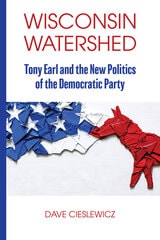
Wisconsin Watershed
Tony Earl and the New Politics of the Democratic PartyDave Cieslewicz
Michigan State University Press, 2027
In 1982, Tony Earl stormed into the Wisconsin governorship with a sweeping victory, rallying blue-collar Democrats around a progressive political platform. Four years later, observers were stunned when he was soundly defeated by conservative Republican Tommy Thompson—not because of any failure as governor, but because, as Dave Cieslewicz notes, the Democratic Party and American politics had undergone a dramatic transformation.
Wisconsin Watershed traces Earl’s journey from Michigan’s Upper Peninsula and the U.S. Navy, through his years in Wisconsin politics and his single, controversial term as Wisconsin’s governor. Earl tackled acid rain, comparable worth, AIDS policy, and tax reform with equal force; he kept American Motors in the state and pulled Wisconsin from a fiscal crisis. Yet voters could not connect his name with his accomplishments. The progressivism that energized new constituencies also alienated the working-class Catholics who had formed the Democratic Party’s backbone. “It’s not the taxes,” one legislator explained. “It’s the desks”—the name for Earl’s symbolic offices to advocate for Native Americans, African Americans, and women.
Earl refused negative campaigning, and he believed that good policy would ultimately prove good politics. His defeat marked the beginning of the end of an era of civility. Through Earl’s story, we witness the Democratic Party’s evolution from New Deal coalition to the emergence of a modern campaign culture that values image and anger over good governance.