Results by title
4 books match the query 'New Preface'

9226 Kercheval
The Storefront that Did Not Burn, With a New PrefaceNancy Milio
University of Michigan Press, 2000
"They make you feel like you're somebody..." The testimony of one black woman in Detroit's Lower Southeast Side ghetto, explaining what the storefront at 9226 Kercheval Street means to her. The storefront houses the Mom and Tots Neighborhood Center—a remarkable experiment in community health care, founded by a diminutive registered nurse named Nancy Milio and run by and for the people of the ghetto. This is the area that was literally burned down during the Detroit Riot of 1967. Not a proper location for a maternity and daycare center, according to many white professionals."These people ought to go away from their neighborhood so they can see how other people live... if we make it too easy for them, they'll never..."During the Riot, buildings on both sides of the Mom and Tots Center were fired and gutted. The Center was untouched. Why it was untouched is one of the implicit themes of 9226 Kercheval; as is the theme of struggle—struggle in the birth and development of a truly relevant health-care center, and struggle to define "health" in its broadest possible terms."Health is... opening, unfolding, from diffuseness towards coherence, simplicity toward complexity... toward wholeness."9226 Kercheval is both a documentary of how a new institution grew and a personal account of how a "social activist" was herself changed. It is the story—beautifully conceived and written—of the strengths of the so-called people of poverty. There is no other book like it.
[more]
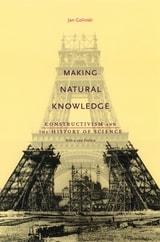
Making Natural Knowledge
Constructivism and the History of Science, with a new PrefaceJan Golinski
University of Chicago Press, 2005
Arguably the best available introduction to constructivism, a research paradigm that has dominated the history of science for the past forty years, Making Natural Knowledge reflects on the importance of this theory, tells the history of its rise to prominence, and traces its most important tensions.
Viewing scientific knowledge as a product of human culture, Jan Golinski challenges the traditional trajectory of the history of science as steady and autonomous progress. In exploring topics such as the social identity of the scientist, the significance of places where science is practiced, and the roles played by language, instruments, and images, Making Natural Knowledge sheds new light on the relations between science and other cultural domains.
"A standard introduction to historically minded scholars interested in the constructivist programme. In fact, it has been called the 'constructivist's bible' in many a conference corridor."—Matthew Eddy, British Journal for the History of Science
[more]
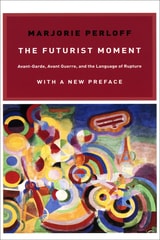
The Futurist Moment
Avant-Garde, Avant Guerre, and the Language of Rupture, with a New PrefaceMarjorie Perloff
University of Chicago Press, 2004
Marjorie Perloff's stunning book was one of the first to offer a serious and far-reaching examination of the momentous flourishing of Futurist aesthetics in the European art and literature of the early twentieth century. Offering penetrating considerations of the prose, visual art, poetry, and carefully crafted manifestos of Futurists from Russia to Italy, Perloff reveals the Moment's impulses and operations, tracing its echoes through the years to the work of "postmodern" figures like Roland Barthes. This updated edition, with its new preface, reexamines the Futurist Moment in the light of a new century, in which Futurist aesthetics seem to have steadily more to say to the present.
[more]
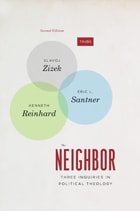
The Neighbor
Three Inquiries in Political Theology, with a new PrefaceSlavoj Žižek, Eric L. Santner, and Kenneth Reinhard
University of Chicago Press, 2013
In Civilization and Its Discontents, Freud made abundantly clear what he thought about the biblical injunction, first articulated in Leviticus 19:18 and then elaborated in Christian teachings, to love one's neighbor as oneself. “Let us adopt a naive attitude towards it,” he proposed, “as though we were hearing it for the first time; we shall be unable then to suppress a feeling of surprise and bewilderment.” After the horrors of World War II, the Holocaust, and Stalinism, Leviticus 19:18 seems even less conceivable—but all the more urgent now—than Freud imagined.
In The Neighbor, three of the most significant intellectuals working in psychoanalysis and critical theory collaborate to show how this problem of neighbor-love opens questions that are fundamental to ethical inquiry and that suggest a new theological configuration of political theory. Their three extended essays explore today's central historical problem: the persistence of the theological in the political. In “Toward a Political Theology of the Neighbor,” Kenneth Reinhard supplements Carl Schmitt’s political theology of the enemy and friend with a political theology of the neighbor based in psychoanalysis. In “Miracles Happen,” Eric L. Santner extends the book's exploration of neighbor-love through a bracing reassessment of Benjamin and Rosenzweig. And in an impassioned plea for ethical violence, Slavoj Žižek’s “Neighbors and Other Monsters” reconsiders the idea of excess to rehabilitate a positive sense of the inhuman and challenge the influence of Levinas on contemporary ethical thought.
In The Neighbor, three of the most significant intellectuals working in psychoanalysis and critical theory collaborate to show how this problem of neighbor-love opens questions that are fundamental to ethical inquiry and that suggest a new theological configuration of political theory. Their three extended essays explore today's central historical problem: the persistence of the theological in the political. In “Toward a Political Theology of the Neighbor,” Kenneth Reinhard supplements Carl Schmitt’s political theology of the enemy and friend with a political theology of the neighbor based in psychoanalysis. In “Miracles Happen,” Eric L. Santner extends the book's exploration of neighbor-love through a bracing reassessment of Benjamin and Rosenzweig. And in an impassioned plea for ethical violence, Slavoj Žižek’s “Neighbors and Other Monsters” reconsiders the idea of excess to rehabilitate a positive sense of the inhuman and challenge the influence of Levinas on contemporary ethical thought.
A rich and suggestive account of the interplay between love and hate, self and other, personal and political, The Neighbor has proven to be a touchstone across the humanities and a crucial text for understanding the persistence of political theology in secular modernity. This new edition contains a new preface by the authors.
[more]