Results by title
7 books match the query 'Oedipus'
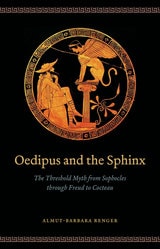
Oedipus and the Sphinx
The Threshold Myth from Sophocles through Freud to CocteauAlmut-Barbara Renger
University of Chicago Press, 2013
Oedipus the King
Sophocles
University of Chicago Press, 2010
Available for the first time as an independent work, David Grene’s legendary translation of Oedipus the King renders Sophocles’ Greek into cogent, vivid, and poetic English for a new generation to savor. Over the years, Grene and Lattimore’s Complete Greek Tragedies have been the preferred choice of millions of readers—for personal libraries, individual study, and classroom use. This new, stand-alone edition of Sophocles’ searing tale of jealousy, rage, and revenge will continue the tradition of the University of Chicago Press’s classic series.
Praise for David Grene and Richmond Lattimore’s Complete Greek Tragedies
“This is it. No qualifications. Go out and buy it everybody.”—Kenneth Rexroth, Nation
“The translations deliberately avoid the highly wrought and affectedly poetic; their idiom is contemporary. . . . They have life and speed and suppleness of phrase.”—Times Education Supplement
Oedipus the King, Second Edition
Sophocles
University of Chicago Press, 2013
Over the years, David Grene and Richmond Lattimore’s Complete Greek Tragedies have been the preferred translations of millions of readers—for personal libraries, individual study, and classroom use. Drawn from the authoritative third edition of the University of Chicago Press’s classic series, this updated stand-alone edition of Grene’s Oedipus the King renders the original Greek in clear, vivid, and poetic English for a new generation to savor.
Mark Griffith and Glenn W. Most’s introduction to Sophocles’s searing tale of jealousy, rage, and revenge provides essential information about the play’s first production, plot, and reception in antiquity and beyond.
Oedipus
A Folklore CasebookEdited by Lowell Edmunds and Alan Dundes
University of Wisconsin Press, 1995
Classicist Lowell Edmunds and folklorist Alan Dundes both note that “the Oedipus tale is not likely to ever fade from view in Western civilization, [as] the tale continues to pack a critical family drama into a timeless form.” Looking beyond the story related in Sophocles’ drama—the ancient Theban myth of the son who unknowingly kills his father and marries his mother—Oedipus: A Folklore Casebook examines variations of the tale from Africa and South America to Eastern Europe and the Pacific. Taking sociological, psychological, anthropological, and structuralist perspectives, the nineteen essays reveal the complexities and multiple meanings of this centuries-old tale.
In addition to the well-known interpretations of the Oedipus myth by Sigmund Freud and James Frazer, this casebook includes insightful selections by an international group of scholars. Essays on a Serbian Oedipus legend by Friedrich Krauss and on a Gypsy version by Mirella Karpati, for example, stress the psychological stages of atonement after the Oedipus figure learns the truth about his actions. Anthropologist Melford E. Spiro investigates the myth’s appearance in Burma and the significance of the mother’s identification with the dragon (the sphinx figure). Vladimir Propp’s essay, translated into English for the first time, and Lowell Edmunds’s theoretical review discuss the relation of the Oedipus story to the larger study of folklore. The result is a comprehensive and fascinating casebook for students of folklore, classical mythology, anthropology, and sociology.
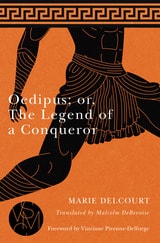
Oedipus; or, The Legend of a Conqueror
Marie Delcourt
Michigan State University Press, 2020
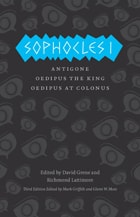
Sophocles I
The Theban Plays: Antigone, Oedipus the King, Oedipus at ColonusEdited and Translated by Mark Griffith, Glenn W. Most, David Grene, and Richmond Lattimore
University of Chicago Press, 2013
Sophocles I contains the plays “Antigone,” translated by Elizabeth Wyckoff; “Oedipus the King,” translated by David Grene; and “Oedipus at Colonus,” translated by Robert Fitzgerald.
Many years ago, the University of Chicago Press undertook a momentous project: a new translation of the Greek tragedies that would be the ultimate resource for teachers, students, and readers. They succeeded. Under the expert management of eminent classicists David Grene and Richmond Lattimore, those translations combined accuracy, poetic immediacy, and clarity of presentation to render the surviving masterpieces of Aeschylus, Sophocles, and Euripides in an English so lively and compelling that they remain the standard translations. The updated third editions of these classic works were designed to ensure that our Greek tragedies remain the leading English-language versions throughout the twenty-first century.
In this highly anticipated third edition, Mark Griffith and Glenn W. Most have carefully updated the translations to bring them even closer to the ancient Greek while retaining the vibrancy for which our English versions are famous. This edition also includes brand-new translations of Euripides’ Medea, The Children of Heracles, Andromache, and Iphigenia among the Taurians, fragments of lost plays by Aeschylus, and the surviving portion of Sophocles’s satyr-drama The Trackers. New introductions for each play offer essential information about its first production, plot, and reception in antiquity and beyond. In addition, each volume includes an introduction to the life and work of its tragedian, as well as notes addressing textual uncertainties and a glossary of names and places mentioned in the plays.
In addition to the new content, the volumes have been reorganized both within and between volumes to reflect the most up-to-date scholarship on the order in which the plays were originally written. The result is a set of handsome paperbacks destined to introduce new generations of readers to these foundational works of Western drama, art, and life.
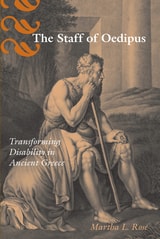
The Staff of Oedipus
Transforming Disability in Ancient GreeceMartha L. Rose
University of Michigan Press, 2013
Ancient Greek images of disability permeate the Western consciousness: Homer, Teiresias, and Oedipus immediately come to mind. But The Staff of Oedipus looks at disability in the ancient world through the lens of disability studies, and reveals that our interpretations of disability in the ancient world are often skewed. These false assumptions in turn lend weight to modern-day discriminatory attitudes toward disability.
Martha L. Rose considers a range of disabilities and the narratives surrounding them. She examines not only ancient literature, but also papyrus, skeletal material, inscriptions, sculpture, and painting, and draws upon modern work, including autobiographies of people with disabilities, medical research, and theoretical work in disability studies. Her study uncovers the realities of daily life for people with disabilities in ancient Greece and challenges the translation of the term adunatos (unable) as "disabled," with all its modern associations.