Results by title
45 books match the query 'Officers'
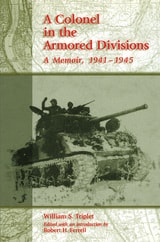
A Colonel in the Armored Divisions
A Memoir, 1941-1945William S. Triplet, Edited by Robert H. Ferrell
University of Missouri Press, 2001
In this fascinating memoir William S. Triplet continues the saga begun in his earlier book, A Youth in the Meuse-Argonne: A Memoir, 1917-1918. After serving in World War I, Triplet chose to become a career military man and entered West Point. Upon graduation in 1924, his assignments were routine—to regiments in the Southwest and in Panama or as an officer in charge of Reserve Officers' Training Corps units or of men sent to a tank school. All this changed, however, when a new war opened in Europe.
From 1940 to1942, Triplet was assigned to the Infantry Board at Fort Benning, Georgia, where he engaged in testing new weapons and machines for the expanding army. He became a full colonel in December 1942. After leaving Benning he received posts with four armored forces: the Thirteenth Armored Division forming in the United States, an amphibious tank and troop carrier group training at Fort Ord, California, and the Second and Seventh Armored Divisions in Europe. His extraordinary abilities as a tank commander became evident in the Seventh Armored, where he took over a four-thousand-man unit known as Combat Command A. He was soon moving from triumph to triumph as he led his unit into Germany. Here was much room for professional judgment and decision, and the colonel was in his element. In the war's last days Triplet and his men fought their way to the Baltic, preventing many German troops from joining in the defense of Berlin against the advancing Soviet army.
Although Triplet was recommended for brigadier general, Dwight D. Eisenhower believed the U.S. Army had enough generals to finish the war; thus, the indomitable Triplet served out the few remaining years of his career as a colonel. After retiring in 1954, Triplet moved to Leesburg, Virginia, where he soon began to mull over his military experiences. Fascinated by the history he had witnessed, engaged by the attraction of writing about it, he recorded his memories with a combination of verve, thoughtfulness, and harsh judgments concerning ranking officers he considered incompetent— generals not excluded.
Through his annotations, Robert H. Ferrell provides the historical context for Triplet's experiences. Well written and completely absorbing, A Colonel in the Armored Divisions provides readers the rare opportunity to see firsthand what a real professional in the U.S. Army thought about America's preparation for and participation in the war against Germany and Japan.
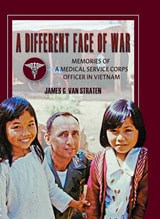
A Different Face of War
Memories of a Medical Service Corps Officer in VietnamJames G. Van Straten
University of North Texas Press, 2015
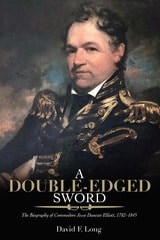
A Double-Edged Sword
The Biography of Commodore Jesse Duncan Elliott, 1782–1845David F. Long
University of Alabama Press, 2026
An overdue reassessment of one of the US Navy’s most decorated—and divisive—early commanders, whose legacy remains teetering between heroism and scandalous.
A Double-Edged Sword: The Biography of Commodore Jesse Duncan Elliott, 1782–1845 is a comprehensive and long-overdue portrait of one of the most polarizing figures in early US naval history. Written over the course of a decade and completed shortly before the author’s death, this meticulously researched biography revisits the career of a man once hailed for his military exploits—and later condemned for a myriad of personal controversies—including his perceived missteps while in command.
David F. Long traces Elliott’s rise from promising young officer to commodore, chronicling his leadership during key moments such as the capture of the brig Caledonia, the defense of Fort Erie, and his central—but contested—role in the Battle of Lake Erie. Despite notable contributions to the Navy’s early successes, including his diplomatic work and restoration of the USS Constitution, Elliott’s legacy was clouded by scandal: accusations of cowardice, a notorious duel, a contentious command style, and a drawn-out court-martial that ended his career in disgrace.
Serving as both biography and reflective historical analysis, Long paints a vivid picture of the early US Navy—its rivalries, growing pains, and evolving institutional identity. His balanced account of Elliott’s life, neither excusing his faults nor downplaying his achievements, places the commodore’s story in direct conversation with the challenges and ambitions of a rapidly expanding American maritime power. This is a must read for scholars of naval and military history, early American politics, or anyone interested in the brazen albeit controversial legacy of a forgotten national hero.
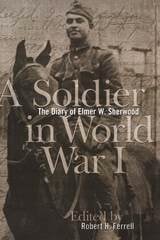
A Soldier in World War I
The Diary of Elmer W. SherwoodRobert H. Ferrell
Indiana Historical Society Press, 2004
Against the Grain
Colonel Henry M. Lazelle and the U.S. ArmyJames Carson
University of North Texas Press, 2015
Antisubmarine Warrior in the Pacific
Six Subs Sunk in Twelve DaysJohn A. Williamson
University of Alabama Press, 2005
A commanding firsthand account of the most successful antisubmarine campaign in U.S. Naval History.
The USS England was a 1200-ton, 306-foot, long-hull destroyer escort. Commissioned into service in late 1943 and dispatched to the Pacific the following February, the England and its crew, in one 12-day period in 1944, sank more submarines than any other ship in U.S. naval history: of the six targets attacked, all six were destroyed. For this distinction, legendary in the annals of antisubmarine warfare, the ship and her crew were honored with the Presidential Unit Citation.
After convoying in the Atlantic, John A. Williamson was assigned to the England—first as its executive officer, then as its commanding officer—from the time of her commissioning until she was dry-docked for battle damage repairs in the Philadelphia Naval Yard fifteen months later. Besides being a key participant in the remarkable antisubmarine actions, Williamson commanded the England in the battle of Okinawa, where she was attacked by kamikaze planes.
Williamson narrates his memoir with authority and authenticity, describes naval tactics and weaponry precisely, and provides information gleaned from translations of the orders from the Japanese high command to Submarine Squadron 7. The author details the challenges of communal life aboard ship and explains the intense loyalty that bonds crew members for life. Ultimately, Williamson offers a compelling portrait of himself, an inexperienced naval officer who, having come of age in Alabama during the Depression, rose to become the most successful World War II antisubmarine warfare officer in the Pacific.
Bataan Survivor
A POW’s Account of Japanese Captivity in World War IIDavid L. Hardee, Edited by Frank A. Blazich, Jr.
University of Missouri Press, 2026
A forgotten account, written in the immediate aftermath of World War II, which vividly portrays the valor, sacrifice, suffering, and liberation of the defenders of Bataan and Corregidor through the eyes of one survivor.
The personal memoir of Colonel David L. Hardee, first drafted at sea from April-May 1945 following his liberation from Japanese captivity, is a thorough treatment of his time in the Philippines. A career infantry officer, Hardee fought during the Battle of Bataan as executive officer of the Provisional Air Corps Regiment. Captured in April 1942 after the American surrender on Bataan, Hardee survived the Bataan Death March and proceeded to endure a series of squalid prison camps. A debilitating hernia left Hardee too ill to travel to Japan in 1944, making him one of the few lieutenant colonels to remain in the Philippines and subsequently survive the war. As a primary account written almost immediately after his liberation, Hardee’s memoir is fresh, vivid, and devoid of decades of faded memories or contemporary influences associated with memoirs written years after an experience. This once-forgotten memoir has been carefully edited, illustrated and annotated to unlock the true depths of Hardee’s experience as a soldier, prisoner, and liberated survivor of the Pacific War.
Chasing the Shadow
Mickey Marcus's 200 Days of DestinySteven L. Ossad
University of Missouri Press, 2024
The life of David “Mickey” Marcus has become the stuff of legends and myths (even fantasy), conspiracy, wild exaggeration, and untethered embellishment. The image of Marcus cast by the character portrayed by Kirk Douglas in the film version of his life still dominates most evocations of the man, for good or ill. And these days, reactions to the book or film rest mostly on the current headlines rather than the historical context of the struggle in which Marcus died, or the events that cast him as a real-life player in an event marked by destiny.
Chasing the Shadow: Mickey Marcus’s 200 Days of Destiny is the first comprehensive and balanced biography of David Daniel “Mickey” Marcus, a founder of American Civil Affairs and Military Government doctrine and practice and a seminal figure in early Israeli military history. Far from merely a tribute to Mickey Marcus's legacy, Ossad’s work serves as a critical tool for understanding the realities of mid-20th-century warfare in a Postwar colonial struggle and the dynamics of U.S.-Israeli military and political relations in 1948, the critical year for Israel’s struggle for independence. Indeed, Chasing the Shadow is a valuable read for those interested in Middle East history, Jewish military history, and a fascinating character whose story is told in an engaging, informative, and insightful narrative.
Command Culture
Officer Education in the U.S. Army and the German Armed Forces, 1901-1940, and the Consequences for World War IIJörg Muth
University of North Texas Press, 2011
Confederate Colonels
A Biographical RegisterBruce S. Allardice
University of Missouri Press, 2008

Desert Mementos
Stories of Iraq and NevadaCaleb S. Cage
University of Nevada Press, 2017
Cage captures similarities in the respective desert landscapes of both Iraq and Nevada, but it is not just a study in contrasting landscapes. The inter-connected stories explore similarities and differences in human needs from the perspectives of vastly different cultures. Specifically, the stories deftly capture the overlap in the respective desert landscapes of each region, the contrasting cultures and worldviews, and the common need for hope. Taken together, the stories represent the arc of a year-long deployment by young soldiers. Cage’s stories are bound together by the soldier’s searing experiences in the desert, bookended by leaving and returning home to Nevada, which in many ways can be just as disorienting as patrolling the Iraq desert.
Emergency Deep
Cold War Missions of a Submarine CommanderAlfred Scott McLaren
University of Alabama Press, 2021
A compelling naval memoir of Arctic submarine duty—operations, engineering realities, and split‑second leadership choices in Emergency Deep.
Captain Alfred Scott McLaren served as commander of the USS Queenfish (SSN 651) from September 1969 to May 1973, the very height of the Cold War. As commander, McLaren led at least six major clandestine operations, including the first-ever exploration of the entire Siberian Continental Shelf: a perilous voyage detailed in his previous book Unknown Waters.
Emergency Deep: Cold War Missions of a Submarine Commander conveys the entire spectrum of Captain McLaren’s experiences commanding the USS Queenfish, mainly in the waters of the Russian Far East and also off Vietnam. McLaren offers a riveting and deeply human story that illuminates the intensity and pressures of commanding a nuclear attack submarine in some of the most difficult circumstances imaginable.
Relying on his own notes and records, as well as discussions with former officers and shipmates, McLaren focuses on operational matters both great and small. He recounts his unique perspectives on attack-submarine tactics and exploratory techniques in high-risk or uncharted areas, matters of leadership and team-building and the morale of his crews, and the innumerable and often unforeseen ways his philosophy of command played out on a day-to-day basis, with consequences that ran the gamut from the mundane to the dire and life-threatening.
Readers are also treated to significant new information and insight on submarine strategy, maneuvers, and culture. Such details illuminate and bring to life, with both great humor and gravitas, the intensity and pressures on those engaged in covert missions on nuclear attack submarines.
From Conciliation to Conquest
The Sack of Athens and the Court-Martial of Colonel John B. TurchinGeorge C. Bradley and Richard L. Dahlen
University of Alabama Press, 2006
In the summer of 1862, the U.S. Army court martialed Colonel John B. Turchin, a Russian-born Union officer, for "outrages" committed by his troops in Athens, Alabama
In the summer of 1862, the U.S. Army court martialed Colonel John B. Turchin, a Russian-born Union officer, for offenses committed by his troops in Athens, Alabama, including looting, safe cracking, the vandalization of homes, and the rape of young black women. The pillage of Athens violated a government policy of conciliation; it was hoped that if Southern civilians were treated gently as citizens of the United States, they would soon return their allegiance to the federal government.
By examining the volunteers who made up Turchin’s force, the colonel's trial, his subsequent promotion, the policy debate surrounding the incident and the public reaction to the outcome, the authors further illuminate one of the most provocative questions in Civil War studies: how did the policy set forth by President Lincoln evolve from one of conciliation to one far more modern in nature, placing the burden of war on the civilian population of the South?

From Texas to Tinian and Tokyo Bay
The Memoirs of Captain J. R. Ritter, Seabee Commander during the Pacific War, 1942-1945Jonathan Templin Ritter
University of North Texas Press, 2019
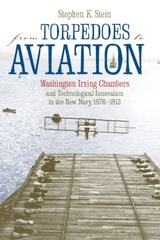
From Torpedoes to Aviation
Washington Irving Chambers & Technological Innovation in the New Navy 1876 to 1913Stephen K. Stein
University of Alabama Press, 2007
The central figure in the modernization of the U.S. Navy.
The career of Washington Irving Chambers spans a formative period in the development of the United States Navy: He entered the Naval Academy in the doldrum years of obsolete, often rotting ships, and left after he had helped like-minded officers convince Congress and the public of the need to adopt a new naval strategy built around a fleet of technologically advanced battleships. He also laid the groundwork for naval aviation and the important role it would play in the modern navy.
This work covers Chambers’s early naval career, his work at the new Office of Naval Intelligence, his participation in the Greeley Relief Expedition, and a survey for the projected isthmian canal through Nicaragua, before becoming the key advocate for naval modernization. As such, Chambers worked as a pioneering torpedo designer, supervised construction of the Maine, modernized the New York Navy Yard, and became a member of the first permanent faculty at the Naval War College.
During his long career, Chambers not only designed torpedoes, but also several warships, including a prototype Dreadnought-style battleship and a host of small devices that ranged from torpedo guidance systems to the first catapult for launching airplanes from ships. At the close of his career, Chambers purchased the navy’s first aircraft and founded its air arm. Working with Glenn Curtiss, Chambers guided a coalition of aviation enthusiasts and pioneers who popularized naval aviation and demonstrated its capabilities. Chambers arranged the first take-off and landing of an airplane from a ship and other demonstrations of naval aviation. Combined with his tireless advocacy for modernization, these contributions secured a place in naval and aviation history for the innovator.

General Catalogue of Officers and Students, 1837-1911
1837-1911University of Michigan
University of Michigan Press, 1912
Gentleman in the Shadows
Benjamin C. Evans Jr. and the Central Intelligence AgencyDouglas A. Wissing
Indiana Historical Society Press, 2019
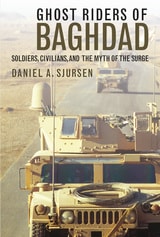
Ghost Riders of Baghdad
Soldiers, Civilians, and the Myth of the SurgeDaniel A. Sjursen
University Press of New England, 2015
Guide to Missouri Confederate Units, 1861-1865
James E. McGhee
University of Arkansas Press, 2010
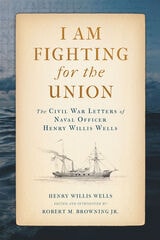
I Am Fighting for the Union
The Civil War Letters of Naval Officer Henry Willis WellsHenry Willis Wells, edited and introduced by Robert M. Browning Jr.
University of Alabama Press, 2023
A young officer’s insightful, detailed and steadfast devotion to the Union Navy—told in his own words.
On May 18, 1862, Henry Willis Wells wrote a letter to his mother telling her in clear terms, “I am fighting for the Union.” Since August 1861, when he joined the US Navy as a master’s mate he never wavered in his loyalty. He wrote to his family frequently that he considered military service a necessary and patriotic duty, and the career that ensued was a dramatic one, astutely and articulately documented by Wells in more than 200 letters home, leaving an invaluable account of daily life in the Union Navy.
Wells joined the navy shortly after the war began, initially on board the Cambridge, attached to the North Atlantic Blockading Squadron, which patrolled the waters of the Chesapeake Bay. He witnessed the Battle of Hampton Roads and the fight between the ironclads CSS Virginia and the USS Monitor. Next, the Cambridge assisted in the blockade of Wilmington, North Carolina. In one instance, the warship chased the schooner J. W. Pindar ashore during her attempt to run the blockade, and Confederate forces captured Henry’s boarding party. After a short prison stay in the infamous Libby Prison in Richmond, his Confederate captors paroled Henry. He travelled back to Brookline, and soon thereafter the Navy Department assigned him to the gunboat Ceres, which operated on the sounds and rivers of North Carolina, protecting army positions ashore. Henry was on board during the Confederate attempt to capture Washington, North Carolina. During this April 1863 attack, Henry was instrumental in the town’s defense, commanding a naval battery ashore during the latter part of the fight.
His exceptional service gained him a transfer to a larger warship, the USS Montgomery, again on the blockade of Wilmington. Later the service assigned him to the Gem of the Sea, part of the East Gulf Blockading Squadron. Through his hard work and professionalism, he finally earned his first command. In September 1864, he became the commanding officer of the Rosalie, a sloop used as a tender to the local warships. Later he commanded the schooner Annie, also a tender. At the end of December 1864, however, the Annie suffered a massive explosion, killing all hands, including Wells. He was twenty-three years old when his life and career ended tragically. Wells’s letters document both his considerable achievements and his frustrations. His challenges, triumphs, and disappointments are rendered with candor. I Am Fighting for the Union is a vital and deeply personal account of a momentous chapter in the history of the Civil War and its navies.
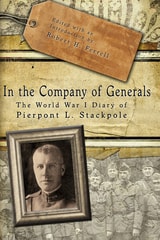
In the Company of Generals
The World War I Diary of Pierpont L. StackpoleEdited & Intro by Robert H. Ferrell
University of Missouri Press, 2009
Pierpont Stackpole was a Boston lawyer who in January 1918 became aide to Lieutenant General Hunter Liggett, soon to be commander of the first American corps in France. Stackpole’s diary, published here for the first time, is a major eyewitness account of the American Expeditionary Forces’ experience on the Western Front, offering an insider’s view into the workings of Liggett’s commands, his day-to-day business, and how he orchestrated his commands in trying and confusing situations.
Hunter Liggett did not fit John J. Pershing’s concept of the trim and energetic officer, but Pershing entrusted to him a corps and then an army command. Liggett assumed leadership of the U.S. First Army in mid-October of 1918, and after reorganizing, reinforcing, and resting, the battle-weary troops broke through the German lines in a fourth attack at the Meuse-Argonne—accomplishing what Pershing had failed to do in three previous attempts. The victory paved the way to armistice on November 11.
Liggett has long been a shadowy figure in the development of the American high command. He was “Old Army,” a veteran of Indian wars who nevertheless kept abreast of changes in warfare and more than other American officers was ready for the novelties of 1914–1918. Because few of his papers have survived, the diary of his aide—who rode in the general’s staff car as Liggett unburdened himself about fellow generals and their sometimes abysmal tactical notions—provides especially valuable insights into command within the AEF.
Stackpole’s diary also sheds light on other figures of the war, presenting a different view of the controversial Major General Clarence Edwards than has recently been recorded and relating the general staff’s attitudes about the flamboyant aviation figure Billy Mitchell. General Liggett built the American army in France, and the best measure of his achievement is this diary of his aide. That record stands here as a fascinating and authentic look at the Great War.
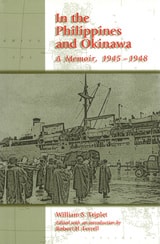
In the Philippines and Okinawa
A Memoir, 1945-1948William S. Triplet & Edited by Robert H. Ferrell
University of Missouri Press, 2001
In the Philippines and Okinawa, the third volume of Colonel William S. Triplet's memoirs, tells of Triplet's experiences during the American occupations in the early years after World War II. Continuing the story from the preceding books of his memoirs, A Youth in the Meuse-Argonne and A Colonel in the Armored Divisions, Triplet takes us to the Philippines, where his duties included rounding up isolated groups of Japanese holdouts, men who refused to believe or admit that their nation had lost the war, and holding them until the time came to transport them back to Japan.
Triplet also had to reorganize his battalions and companies to raise morale, which had plummeted with the end of the war and the seemingly dull tasks of occupation. When he took over his assignment of commanding a regiment in a division, he was dismayed to discover the unmilitary habits of almost everyone, regardless of rank. A strict disciplinarian himself, Colonel Triplet, who had served in both world wars, at one time commanding a four-thousand-man combat group, brought his regiment of garrison troops back into shape in a short time.
Okinawa presented the new challenge of bringing order to an island that had seen the deaths of one hundred thousand civilians. Virtually every building on the island had been leveled, and tens of thousands of Japanese defenders had been killed. Triplet was also obliged to oversee the temporary burial of thirteen thousand U.S. servicemen, both soldiers and sailors.
In the Philippines and Okinawa portrays the ever-changing, very human, and frequently dangerous occupation of two East Asian regions that are still important to American foreign policy. Any reader interested in military history or American history will find this memoir engaging.
Master of the Air
William Tunner and the Success of Military AirliftRobert A. Slayton
University of Alabama Press, 2010
Into this difficult situation the US placed General William Henry Tunner. He was given a task that seemed doomed to failure—to supply a major city by air with everything it needed to survive from food to a winter’s supply of coal—and made it a brilliant success, astonishing the world in a major public relations defeat for the Soviets, and demonstrating the unexpected capacity of air fleets in a postwar world.
Minding the Helm
An Unlikely Career in the U.S. Coast GuardKevin P. Gilheany
University of North Texas Press, 2019
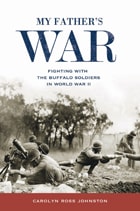
My Father's War
Fighting with the Buffalo Soldiers in World War IICarolyn Ross Johnston
University of Alabama Press, 2012
A compelling story of a unit of Buffalo Soldiers and their white commander fighting on the Italian front during World War II.
The 92nd Division of the Fifth Army was the only African American infantry division to see combat in Europe during 1944 and 1945, suffering more than 3,200 casualties. Members of this unit, known as Buffalo Soldiers, endured racial violence on the home front and experienced racism abroad. Engaged in combat for nine months, they were under the command of southern white infantry officers like their captain, Eugene E. Johnston.
Carolyn Ross Johnston draws on her father’s account of the war and her extensive interviews with other veterans of the 92nd Division to describe the experiences of a naïve southern white officer and his segregated unit on an intimate level. During the war, the protocol that required the assignment of southern white officers to command black units, both in Europe and in the Pacific theater, was often problematic, but Johnston seemed more successful than most, earning the trust and respect of his men at the same time that he learned to trust and respect them. Gene Johnston and the African American soldiers were transformed by the war and upon their return helped transform the nation.
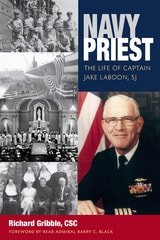
Navy Priest
Richard Gribble
Catholic University of America Press, 2015
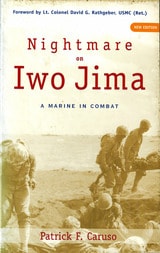
Nightmare on Iwo Jima
A Marine in CombatPatrick F. Caruso, with a foreword by David G. Rathgeber
University of Alabama Press, 2007
Ordered West
The Civil War Exploits of Charles A. CurtisAlan D. Gaff
University of North Texas Press, 2017
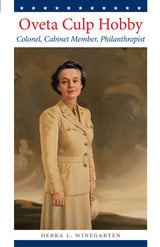
Oveta Culp Hobby
Colonel, Cabinet Member, PhilanthropistBy Debra L. Winegarten
University of Texas Press, 2014
This young adult biography introduces middle school readers to a remarkable woman who founded the Women’s Army Corps, served as Secretary of Health, Education, and Welfare, and ran a media empire that included the Houston Post newspaper and radio and TV stations.
Winner, Gold Medal for Biography, Military Writers Society of America, 2015
Oveta Culp Hobby (1905–1995) had a lifetime of stellar achievement. During World War II, she was asked to build a women’s army from scratch—and did. Hobby became Director of the Women’s Army Corps and the first Army woman to earn the rank of colonel. President Eisenhower chose her as Secretary of Health, Education, and Welfare, making her the second woman in history to be appointed to a president’s cabinet. When she wasn’t serving in the government, Hobby worked with her husband, former Texas governor William P. Hobby, to lead a media empire that included the Houston Post newspaper and radio and TV stations. She also supported the Houston community in many ways, from advocating for civil rights for African Americans to donating generously to the Houston Symphony and the Museum of Fine Arts.
Oveta Culp Hobby is the first biography of this important woman. Written for middle school readers, it traces her life from her childhood in Killeen to her remarkable achievements in Washington, DC, and Houston. Debra Winegarten provides the background to help young adult readers understand the times in which Hobby lived and the challenges she faced as a woman in nontraditional jobs. She shows how Hobby opened doors for women to serve in the military and in other professions that still benefit women today. Most of all, Oveta Culp Hobby will inspire young adults to follow their own dreams and turn them into tangible reality.

PRESIDENTIAL MUSINGS FROM THE MERIDIAN
REFLECTIONS ON THE NATURE OF GEOGRAPHYM. DUANE NELLIS
West Virginia University Press, 2005
For decades, presidents of the Association of American Geographers have written insightful columns in the AAG Newsletter. One of the most popular sections of the newsletter, these columns illustrate the changes and consistencies of geography over the past thirty-four years. They offer an insight into the past of the geography discipline and a broader perspective on the future. Previously inaccessible even to most professional geographers, the Presidential Columns will now be available in Presidential Musings from the Meridian: Reflections of the Nature of Geography.
Phantom in the Sky
A Marine's Back Seat View of the Vietnam WarTerry L. Thorsen
University of North Texas Press, 2019
Project 9
The Birth of the Air Commandos in World War IIDennis R. Okerstrom
University of Missouri Press, 2026
Protecting the Empire’s Frontier
Officers of the 18th (Royal Irish) Regiment of Foot during Its North American Service, 1767–1776Steven M. Baule
Ohio University Press, 2013
Protecting the Empire’s Frontier tells stories of the roughly eighty officers who served in the 18th (Royal Irish) Regiment of Foot, which served British interests in America during the crucial period from 1767 through 1776. The Royal Irish was one of the most wide-ranging regiments in America, with companies serving on the Illinois frontier, at Fort Pitt, and in Boston, New York, and Philadelphia, with some companies taken as far afield as Florida, Spanish Louisiana, and present-day Maine. When the regiment was returned to England in 1776, some of the officers remained in America on staff assignments. Others joined provincial regiments, and a few joined the American revolutionary army, taking up arms against their king and former colleagues.
Using a wide range of archival resources previously untapped by scholars, the text goes beyond just these officers’ service in the regiment and tells the story of the men who included governors, a college president, land speculators, physicians, and officers in many other British regular and provincial regiments. Included in these ranks were an Irishman who would serve in the U.S. Congress and as an American general at Yorktown; a landed aristocrat who represented Bath as a member of Parliament; and a naval surgeon on the ship transporting Benjamin Franklin to France. This is the history of the American Revolutionary period from a most gripping and everyday perspective.
An epilogue covers the Royal Irish’s history after returning to England and its part in defending against both the Franco-Spanish invasion attempt and the Gordon Rioters. With an essay on sources and a complete bibliography, this is a treat for professional and amateur historians alike.
Reminiscences of Conrad S. Babcock
The Old U.S. Army and the New, 1898-1918Edited by Robert H. Ferrell
University of Missouri Press, 2012
Babcock’s original manuscript has been shortened by Robert H. Ferrell into eight chapters which illustrate the tremendous shift in warfare in the years surrounding the turn of the century. The first part of the book describes small actions against Filipinos and such assignments as taking a cavalry troop into the fire-destroyed city of San Francisco in 1906 or duty in the vicinity of Yuma in Arizona when border troubles were heating up with brigands and regular troops. The remaining chapters, beginning in 1918, set out the battles of Soissons (July 18–22) and Saint-Mihiel (September 12–16) and especially the immense battle of the Meuse-Argonne (September 26–November 11), the largest (1.2 million troops involved) and deadliest (26,000 men killed) battle in all of American history.
By the end of his career, Babcock was an adroit battle commander and an astute observer of military operations. Unlike most other officers around him, he showed an ability and willingness to adapt infantry tactics in the face of recently developed technology and weaponry such as the machine gun. When he retired in 1937 and began to write his memoirs, another world war had begun, giving additional context to his observations about the army and combat over the preceding forty years.
Until now, Babcock’s account has only been available in the archives of the Hoover Institution, but with the help of Ferrell's crisp, expert editing, this record of army culture in the first decades of the twentieth century can now reach a new generation of scholars.
Return from Berlin
The Eye of a NavigatorRobert Grilley
University of Wisconsin Press, 2003
Wakened with flashlights on their faces in the predawn hours, he and his crew repeatedly face the Luftwaffe in battles five miles high, flying through flak "so thick you could get out and walk on it." Stretching their stamina to the limits, they succeed time after time in their missions to bomb munitions works, railyards, the Leüna synthetic oil plant at Merseburg in eastern Germany, the V2 rocket research center at Peenemünde on the distant Baltic Coast, and even to strike Hitler’s capital city, Berlin.
But Grilley finds interludes of unexpected grace and restoration on his days off, making serious drawings from nature at the neighboring Yokehill Farm. There he slowly cultivates a friendship with a curious eight-year-old, the lively child Elizabeth, who becomes for the combat flyer a symbol of survival.
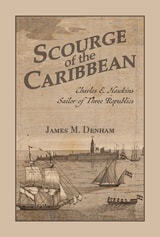
Scourge of the Caribbean
Charles E. Hawkins, Sailor of Three RepublicsJames M. Denham
University of Alabama Press, 2026
Illuminates the early American period in the upper Caribbean
Scourge of the Caribbean explores the mysterious and dramatic life and career of Charles E. Hawkins, a relatively unknown naval figure in early national America. Hawkins’s action-packed life at sea in his brief but accomplished career reveals much about an era when the rules of the maritime world, especially in the Caribbean, were in flux. For the US Navy and its commanders, the Caribbean presented an untold number of ambiguities: revolutionary juntas, privateering, piracy, and deadly disease, all within some of the most beautiful landscapes and waterscapes on earth.
Hawkins, from a well-connected family, took to the sea as a midshipman in the US Navy. Stalled promotion, economic setbacks, and blunted opportunities stymied the young officer, but ambition, combined with varied experiences and maritime pursuits, presented other prospects. At a time when individual agency mattered most, Hawkins stepped outside traditional boundaries of conduct on numerous occasions. Hawkins followed a mentor into the Mexican navy and became the most successful and feared raider of Spanish ships, earning the sobriquet “scourge” because of his raids along Cuba’s northern coast. In 1835, Hawkins joined the Texas independence movement against Mexico. Within the historical narrative are lurid accounts of adultery, affairs of honor, a bloody assassination, and complicated maritime legal battles. Based on prodigious research, this lively tale will appeal to those interested in maritime and early American history and the upper Caribbean in the Age of Sail.
Scouting with the Buffalo Soldiers
John P. Langellier
University of North Texas Press, 2020
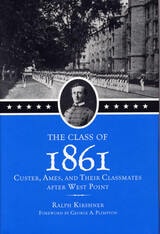
The Class of 1861
Custer, Ames, and Their Classmates after West PointRalph Kirshner
Southern Illinois University Press, 1999
Ralph Kirshner has provided a richly illustrated forum to enable the West Point class of 1861 to write its own autobiography. Through letters, journals, and published accounts, George Armstrong Custer, Adelbert Ames, and their classmates tell in their own words of their Civil War battles and of their varied careers after the war.
Two classes graduated from West Point in 1861 because of Lincoln's need of lieutenants: forty-five cadets in Ames's class in May and thirty-four in Custer's class in June. The cadets range from Henry Algernon du Pont, first in the class of May, whose ancestral home is now Winterthur Garden, to Custer, last in the class of June. “Only thirty-four graduated,” remarked Custer, “and of these thirty-three graduated above me.” West Point's mathematics professor and librarian Oliver Otis Howard, after whom Howard University is named, is also portrayed.
Other famous names from the class of 1861 are John Pelham, Emory Upton, Thomas L. Rosser, John Herbert Kelly (the youngest general in the Confederacy when appointed), Patrick O'Rorke (head of the class of June), Alonzo Cushing, Peter Hains, Edmund Kirby, John Adair (the only deserter in the class), and Judson Kilpatrick (great-grandfather of Gloria Vanderbilt). They describe West Point before the Civil War, the war years, including the Vicksburg campaign and the battle of Gettysburg, the courage and character of classmates, and the ending of the war.
Kirshner also highlights postwar lives, including Custer at Little Bighorn; Custer's rebel friend Rosser; John Whitney Barlow, who explored Yellowstone; du Pont, senator and author; Kilpatrick, playwright and diplomat; Orville E. Babcock, Grant's secretary until his indictment in the "Whiskey Ring"; Pierce M. B. Young, a Confederate general who became a diplomat; Hains, the only member of the class to serve on active duty in World War I; and Upton, "the class genius."
The Class of 1861, which features eighty-three photographs, includes a foreword by George Plimpton, editor of theParis Review and great-grandson of General Adelbert Ames.
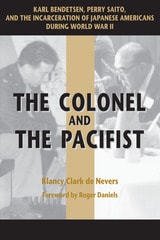
The Colonel and The Pacifist
Klancy Clark De Nevers
University of Utah Press, 2004
The Colonel and the Pacifist tells the story of two men caught up in one of the most infamous episodes in American history. While they never met, Bendetsen and Saito’s lives touched tangentially—from their common hometown to their eventual testimony during the 1981 hearings of the Commission on the Wartime Relocation and Internment of Civilians. In weaving together these contrasting stories, Klancy Clark de Nevers not only exposes unknown or little known aspects of World War II history, she also explores larger issues of racism and war that resonate through the years and ring eerily familiar to our post-9/11 ears.
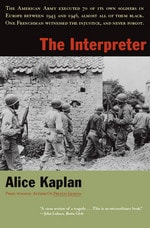
The Interpreter
Alice Kaplan
University of Chicago Press, 2007
No story of World War II is more triumphant than the liberation of France, made famous in countless photos of Parisians waving American flags and kissing GIs as columns of troops paraded down the Champs Élysées. But one of the least-known stories from that era is also one of the ugliest chapters in the history of Jim Crow. In The Interpreter, celebrated author Alice Kaplan recovers this story both as eyewitnesses first saw it, and as it still haunts us today.
The American Army executed 70 of its own soldiers between 1943 and 1946—almost all of them black, in an army that was overwhelmingly white. Through the French interpreter Louis Guilloux’s eyes, Kaplan narrates two different trials: one of a white officer, one of a black soldier, both accused of murder. Both were court-martialed in the same room, yet the outcomes could not have been more different.
Kaplan’s insight into character and setting creates an indelible portrait of war, race relations, and the dangers of capital punishment.
“A nuanced historical account that resonates with today’s controversies over race and capital punishment.” Publishers Weekly
“American racism could become deadly for black soldiers on the front. The Interpreter reminds us of this sad component of a heroic chapter in American military history.” Los Angeles Times
“With elegance and lucidity, Kaplan revisits these two trials and reveals an appallingly separate and unequal wartime U.S. military justice system.” Minneapolis Star Tribune
“Kaplan has produced a compelling look at the racial disparities as they were played out…She explores both cases in considerable and vivid detail.” Sacramento Bee
The Master Of Monterey
A NovelLawrence Coates
University of Nevada Press, 2003
Time in the Barrel
A Marine's Account of the Battle for Con ThienJames P. Coan
University of Alabama Press, 2019
A Marine’s highly personal memoir reliving the hellish days of a pivotal conflict of the Vietnam War.
Con Thien, located only two miles from the demilitarized zone dividing North and South Vietnam, was a United States Marine Corps firebase that was the scene of fierce combat for months on end during 1967. Staving off attacks and ambushes while suffering from ineffectual leadership from Washington as well as media onslaughts, courageous American Marines protected this crucial piece of land at all costs. They would hold Con Thien, but many paid the ultimate price. By the end of the war, more than 1,400 Marines had died and more than 9,000 sustained injuries defending the “Hill of Angels.”
For eight months, James P. Coan’s five-tank platoon was assigned to Con Thien while attached to various Marine infantry battalions. A novice second lieutenant at the time, the author kept a diary recording the thoughts, fears, and frustrations that accompanied his life on “The Hill.” Time in the Barrel: A Marine’s Account of the Battle for Con Thien offers an authentic firsthand account of the daily nightmare that was Con Thien. An enticing and fascinating read featuring authentic depictions of combat, it allows readers to fully grasp the enormity of the fierce struggle for Con Thien.
The defenders of Con Thien were bombarded with hundreds of rounds of incoming rockets, mortars, and artillery that pounded the beleaguered outpost daily. Monsoon downpours turned the red laterite clay soil into a morass of oozing mud, flooded bunkers and trenches, and made Con Thien a living hell. .Being at Con Thien came to be ruefully referred to by the Marines stationed there as "time in the barrel” because they were targets as easy as fish in a barrel.
More than a retelling of military movements, Coan’s engrossing narratives focus on the sheer sacrifice and misery of one Marine’s experience in Vietnam. Through his eyes, we experience the abysmal conditions the Marines endured, from monsoon rainstorms to the constant threat of impending attack. Climatic moments in history are captured through the rare, personal perspective of one particularly astute and observant participant.
To My Dearest Wife, Lide
Letters from George B. Gideon Jr. during Commodore Perry’s Expedition to Japan, 1853–1855Edited by M. Patrick Sauer and David A. Ranzan
University of Alabama Press, 2019
George B. Gideon Jr. served as second assistant engineer aboard the USS Powhatan from 1852 to 1856. From his position on the steam frigate, Gideon traveled to Singapore, Labuan, Borneo, Hong Kong, and many other Asian lands. During his time at sea, Gideon penned dozens of letters to his wife, Lide, back home in Philadelphia. Recently discovered in the attic of his great-great-grandniece, were fifty-one letters penned by Gideon providing thorough and insightful commentary throughout the voyage.
Through these correspondences, Gideon laboriously documents the details of his daily life on board, from the food they ate to the technical aspects of his work, as well as observations concerning the historical events unfolding around him, such as Chinese piracy, the Taiping Rebellion, the Crimean War, and the devastation of Shimoda. To My Dearest Wife, Lide: Letters from George B. Gideon Jr. during Commodore Perry’s Expedition to Japan, 1853–1855 is a rare first-person account of the landmark American naval expedition to Japan to establish commercial relations between the two countries. Gideon’s letters have been meticulously transcribed and annotated by the editors and are an invaluable primary historical source.
Gideon’s letters are candid and revealing, delving into the rampant dysfunction in the navy of the 1850s—sickness and disease, alcohol abuse, and poor leadership, among other challenges. Gideon also unabashedly shares his own cynical views of the navy’s role in supporting American economic interests in Japan. This firsthand account of the political mission of the Perry expedition is a unique contribution to naval and military history and gives readers a better view of life aboard a navy ship.
Until Antietam
The Life and Letters of Major General Israel B. Richardson, U.S. ArmyJack C. Mason
Southern Illinois University Press, 2009
While researching this book, Jack C. Mason made the kind of discovery that historians dream of. He found more than one hundred unpublished and unknown letters from Union general Israel B. Richardson to his family, written from his time as a West Point cadet until the day before his fatal wounding at the Battle of Antietam, the bloodiest day in American history. Using these freshly uncovered primary sources as well as extensive research in secondary materials, Mason has written the first-ever biography of Israel Bush Richardson.
Mason traces Richardson’s growth as a soldier through his experiences and the guidance of his superiors, and then as a leader whose style reflected the actions of the former commanders he respected. Though he was a disciplinarian, Richardson took a relaxed attitude toward military rules, earning him the affection of his men. Unfortunately, his military career was cut short just as high-ranking officials began to recognize his aggressive leadership. He was mortally wounded while leading his men at Antietam and died on November 3, 1862.
Until Antietam brings to life a talented and fearless Civil War infantry leader. Richardson’s story, placed within the context of nineteenth-century warfare, exemplifies how one soldier’s life influenced his commanders, his men, and the army as a whole.
Winner of the Army Historical Foundation 2009 Distinguished Book Award
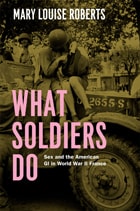
What Soldiers Do
Sex and the American GI in World War II FranceMary Louise Roberts
University of Chicago Press, 2013
That’s not the picture of the Greatest Generation that we’ve been given, but it’s the one Mary Louise Roberts paints to devastating effect in What Soldiers Do. Drawing on an incredible range of sources, including news reports, propaganda and training materials, official planning documents, wartime diaries, and memoirs, Roberts tells the fascinating and troubling story of how the US military command systematically spread—and then exploited—the myth of French women as sexually experienced and available. The resulting chaos—ranging from flagrant public sex with prostitutes to outright rape and rampant venereal disease—horrified the war-weary and demoralized French population. The sexual predation, and the blithe response of the American military leadership, also caused serious friction between the two nations just as they were attempting to settle questions of long-term control over the liberated territories and the restoration of French sovereignty.
While never denying the achievement of D-Day, or the bravery of the soldiers who took part, What Soldiers Do reminds us that history is always more useful—and more interesting—when it is most honest, and when it goes beyond the burnished beauty of nostalgia to grapple with the real lives and real mistakes of the people who lived it.