Results by title
26 books match the query 'Olympics & Paralympics'
A Games Changer
The International Olympic Committee, Tokyo 2020, and COVID-19Stephen R. Wenn
University of Arkansas Press, 2025
From the emergence of the COVID pandemic in early 2020 through the delayed staging of the Tokyo Olympic games in summer 2021, A Games Changer takes the reader behind the scenes to explore the myriad challenges the International Olympic Committee (IOC) and Japanese officials faced during the months of uncertainty leading up not only to the postponement of the Games but also to their delayed.
Drawing on a thorough review of contemporary newspaper and magazine coverage as well as personal interviews with current and former IOC officials, Stephen R. Wenn and Robert K. Barney examine Japan’s rising excitement in 2019 as preparations for the Games accelerated; whispers of a mysterious disease spreading first in China, then worldwide; organizers’ initial resolve to press forward with the Games; the tumultuous discussions that ultimately resulted in the joint March 2020 decision by Japanese Prime Minister Shinzo Abe and IOC President Thomas Bach to postpone the Games; and the numerous negotiations with venues, media, and sponsors required to extend contracts and protect all parties’ health. Wenn and Barney reveal how human relationships—among planners, politicians, competitors, and vaccine researchers—were vital to presenting an Olympics where, in July and August 2021, world records were set, deferred dreams were achieved, and fears of a superspreader event went unrealized.
While tracing the struggles of multiple athletes who had to pause their Olympic hopes and training as COVID-19 closed the world, Wenn and Barney focus on the journey of Canadian decathlete Damian Warner and his coach, Gar Leyshon. Denied his usual training venues, he prepared for the rescheduled Games with ingenuity, determination, and adaptability, reflective of the resilience demonstrated by Tokyo’s Olympians around the globe. The authors’ close account of Warner’s two days in Tokyo recaptures the excitement and drama of sport that home viewers sorely needed amid pandemic lockdowns and incalculable personal loss.
Activism and the Olympics
Dissent at the Games in Vancouver and LondonBoykoff, Jules
Rutgers University Press, 2014
In Activism and the Olympics, Boykoff provides a critical overview of the Olympic industry and its political opponents in the modern era. After presenting a brief history of Olympic activism, he turns his attention to on-the-ground activism through the lens of the Vancouver 2010 Winter Olympics and the 2012 Summer Olympics in London. Here we see how anti-Olympic activists deploy a range of approaches to challenge the Olympic machine, from direct action and the seizure of public space to humor-based and online tactics. Drawing on primary evidence from myriad personal interviews with activists, journalists, civil libertarians, and Olympics organizers, Boykoff angles in on the Games from numerous vantages and viewpoints.
Although modern Olympic authorities have strived—even through the Cold War era—to appear apolitical, Boykoff notes, the Games have always been the site of hotly contested political actions and competing interests. During the last thirty years, as the Olympics became an economic juggernaut, they also generated numerous reactions from groups that have sought to challenge the event’s triumphalism and pageantry. The 21st century has seen an increased level of activism across the world, from the Occupy Movement in the United States to the Arab Spring in the Middle East. What does this spike in dissent mean for Olympic activists as they prepare for future Games?
Africa and the Olympics
Winning Away from the PodiumTodd Cleveland
Ohio University Press, 2024
At the 2020 Tokyo Olympic Games (held in 2021 due to COVID-19), the fifty-four African countries that participated finished the tournament with the lowest medal haul for any continent, continuing a historic trend since the inception of the modern Games in 1896. Reflecting this relative lack of sporting success, African Olympians—aside from elite Kenyan distance runners—rarely register in the minds of even the most dedicated followers of the Games. Yet for all their seeming invisibility on the Olympic landscape, African states, athletes, and officials have long been “winning” at the Olympics, albeit often far removed from the medal podium. Africa and the Olympics shows how African actors have achieved these nonsporting victories and examines how they have used the Olympics to engage in transformative political activity, realize social mobility, and enhance the quality of life for individuals, communities, and entire nations. In tracing these historical and contemporary processes and the motivations that underlie them, the book complicates reductive notions of the Olympics as solely a sporting competition and instead considers Africa’s engagement with the Games as a series of opportunities to improve personal, communal, ethnic, national, and even continental plights. If few sports fans have thought extensively about Africa and the Olympics, scholars have been only slightly more engaged with the subject. Most of this scholarship focuses on the International Olympic Committee’s ban of apartheid South Africa from 1964 to 1988. Other works that consider the Olympics more broadly tend to deal with Africa only summarily, further reducing its already low profile. As a result, the academic literature resembles a patchwork of circumscribed studies dispersed in a range of fields and disciplines. Not since the publication of Africa at the Olympics almost fifty years ago has a single volume featured a comprehensive history of the continent and the Games. This book both updates and expands previous work and, most importantly, reframes the analytical engagement with this topic.
America's First Olympics
The St. Louis Games of 1904George R. Matthews
University of Missouri Press, 2005

Cindy Bentley
Spirit of a ChampionBob Kann
Wisconsin Historical Society Press, 2010
With the encouragement of a teacher at Southern Center, Cindy realized she had a deep passion for sports, and the discipline to train and compete. She began participating in Special Olympics, and gained confidence as she worked with teammates to earn medals in tennis, track and field, and even snowshoeing. Chosen as a Global Messenger for the Special Olympics International in 2000, Cindy has had dinner at the White House with two different American presidents, traveled around the world, and given speeches in front of thousands of people.
In these pages, young readers will learn what gives Cindy her champion spirit, and why she gave away some of her gold medals. Today, Cindy is still competing in Special Olympics. She also continues to advocate for people with disabilities, and helped to start People First, a statewide organization that encourages those with disabilities to speak up for their rights.
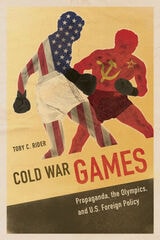
Cold War Games
Propaganda, the Olympics, and U.S. Foreign PolicyToby C Rider
University of Illinois Press, 2016
Drawing on newly declassified materials and archives, Toby C. Rider chronicles how the U.S. government used the Olympics to promote democracy and its own policy aims during the tense early phase of the Cold War. Rider shows how the government, though constrained by traditions against interference in the Games, eluded detection by cooperating with private groups, including secretly funded émigré organizations bent on liberating their home countries from Soviet control. At the same time, the United States utilized Olympic host cities as launching pads for hyping the American economic and political system. Behind the scenes, meanwhile, the government attempted clandestine manipulation of the International Olympic Committee. Rider also details the campaigns that sent propaganda materials around the globe as the United States mobilized culture in general, and sports in particular, to fight the communist threat.
Deeply researched and boldly argued, Cold War Games recovers an essential chapter in Olympic and postwar history.
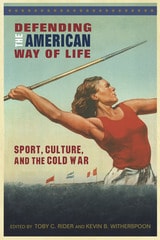
Defending the American Way of Life
Sport, Culture, and the Cold WarToby C. Rider
University of Arkansas Press, 2018
The Cold War was fought in every corner of society, including in the sport and entertainment industries. Recognizing the importance of culture in the battle for hearts and minds, the United States, like the Soviet Union, attempted to win the favor of citizens in nonaligned states through the soft power of sport. Athletes became de facto ambassadors of US interests, their wins and losses serving as emblems of broader efforts to shield American culture—both at home and abroad—against communism.
In Defending the American Way of Life, leading sport historians present new perspectives on high-profile issues in this era of sport history alongside research drawn from previously untapped archival sources to highlight the ways that sports influenced and were influenced by Cold War politics. Surveying the significance of sports in Cold War America through lenses of race, gender, diplomacy, cultural infiltration, anti-communist hysteria, doping, state intervention, and more, this collection illustrates how this conflict remains relevant to US sporting institutions, organizations, and ideologies today.
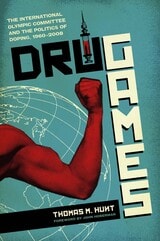
Drug Games
The International Olympic Committee and the Politics of Doping, 1960–2008By Thomas M. Hunt
University of Texas Press, 2011
On August 26, 1960, twenty-three-year-old Danish cyclist Knud Jensen, competing in that year's Rome Olympic Games, suddenly fell from his bike and fractured his skull. His death hours later led to rumors that performance-enhancing drugs were in his system. Though certainly not the first instance of doping in the Olympic Games, Jensen's death serves as the starting point for Thomas M. Hunt's thoroughly researched, chronological history of the modern relationship of doping to the Olympics. Utilizing concepts derived from international relations theory, diplomatic history, and administrative law, this work connects the issue to global political relations.
During the Cold War, national governments had little reason to support effective anti-doping controls in the Olympics. Both the United States and the Soviet Union conceptualized power in sport as a means of impressing both friends and rivals abroad. The resulting medals race motivated nations on both sides of the Iron Curtain to allow drug regulatory powers to remain with private sport authorities. Given the costs involved in testing and the repercussions of drug scandals, these authorities tried to avoid the issue whenever possible. But toward the end of the Cold War, governments became more involved in the issue of testing. Having historically been a combined scientific, ethical, and political dilemma, obstacles to the elimination of doping in the Olympics are becoming less restrained by political inertia.

Going for Wisconsin Gold
Stories of Our State OlympiansJessie Garcia
Wisconsin Historical Society Press, 2016
U-S-A , U-S-A is a familiar refrain heard in every Olympics, but truly it could be Wis-con-sin! Since pioneering hurdler Alvin Kraenzlein got his start here in the 1890s, the Badger State has nurtured, trained, or schooled more than 400 Olympic athletes in a vast array of sports. Wisconsin’s varied landscape and climate accommodate serious athletes whether they compete on ice, on snow, in the water, or on terra firma. We tend to bring a Midwestern work ethic to our endeavors, and our Olympians have often been hailed in the press and in public as being among the most humble and down-to-earth people around. Our state boasts a thriving youth sports culture where many homegrown athletes get their start; others are drawn here by our world-class universities, athletic facilities, and coaching talent. No matter how an athlete comes to Wisconsin, the state becomes part of his or her Olympic story. In Going for Wisconsin Gold, author Jessie Garcia provides insights into the lives of athletes who grew up or spent time in Wisconsin on their journey to the Olympic Games. She shares some of our competitors most captivating tales—from those that have become legend, like Dan Jansen’s heartbreaking falls and subsequent magical gold, to unlikely brushes with glory (do you know which Green Bay Packer was almost an Olympic high jumper?). Featuring the athletes’ personal stories, many of them told here in detail for the first time, plus pictures from their private collections, Going for Wisconsin Gold provides a new and deeper understanding of the sacrifices, joy, pain, heartbreak, and complete dedication it takes to reach the world’s grandest sporting competition.
Making the American Team
Sport, Culture, and the Olympic ExperienceMark Dyreson
University of Illinois Press, 1998
Sport dominates television and the mass media. Politics and business are a-bustle with sports metaphors. Endorsements by athletes sell us products. "Home run," "slam dunk," and the rest of the vocabulary of sport color daily conversation. Even in times of crisis and emergency, the media reports the scores and highlights.
Marky Dyreson delves into how our obsession with sport came into being with a close look at coverage of the Olympic Games between 1896 and 1912. How people reported and consumed information on the Olympics offers insight into how sport entered the heart of American culture as part of an impetus for social reform. Political leaders came to believe in the power of sport to revitalize the "republican experiment." Sport could instill a new sense of national identity that would forge a new sense of community and a healthy political order while at the same time linking America's intellectual and power elite with the experiences of the masses.
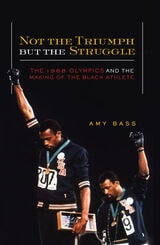
Not the Triumph But the Struggle
The 1968 Olympics and the Making of the Black AthleteAmy Bass
University of Minnesota Press, 2004
A sweeping look at black athletes through the lens of the black power protests at the Mexico City Olympics—now in paperback!
Jesse Owens. Muhammad Ali. Michael Jordan. Tiger Woods. All are iconic black athletes, as are Tommie Smith and John Carlos, the African American track and field medalists who raised black-gloved fists on the victory dais at the Mexico City Olympics and brought the roiling American racial politics of the late 1960s to a worldwide television audience. But few of those viewers fully realized what had led to this demonstration—events that included the assassination of Dr. Martin Luther King Jr., uprisings in American cities, student protests around the world, the rise of the Black Power movement, and decolonization and apartheid in Africa.
In this far-reaching account, Amy Bass offers nothing less than a history of the black athlete. Beginning with the racial eugenics discussions of the early twentieth century and their continuing reverberations in popular perceptions of black physical abilities, Bass explores ongoing African American attempts to challenge these stereotypes. Although Tommie Smith and John Carlos were reviled by Olympic officials for their demonstration, Bass traces how their protest has come to be the defining image of the 1968 Games, with lingering effects in the sports world and on American popular culture generally.
Olimpismo
The Olympic Movement in the Making of Latin America and the CaribbeanAntonio Sotomayor
University of Arkansas Press, 2020
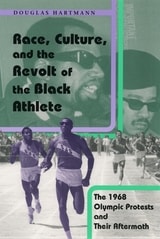
Race, Culture, and the Revolt of the Black Athlete
The 1968 Olympic Protests and Their AftermathDouglas Hartmann
University of Chicago Press, 2003
Drawing on extensive archival research and newly gathered oral histories, Douglas Hartmann sets out to answer these questions, reconsidering this pivotal event in the history of American sport. He places Smith and Carlos within the broader context of the civil rights movement and the controversial revolt of the black athlete. Although the movement drew widespread criticism, it also led to fundamental reforms in the organizational structure of American amateur athletics. Moving from historical narrative to cultural analysis, Hartmann explores what we can learn about the complex relations between race and sport in contemporary America from this episode and its aftermath.
Selling The Five Rings
The IOC and the Rise of the Olympic CommercialismRobert K Barney
University of Utah Press, 2004
The original scheme for the modern Olympic Games was hatched at an international sports conference at the Sorbonne in June 1894. At the time, few provisions were made for the financial underwriting of the project—providence and the beneficence of host cities would somehow take care of the costs. For much of the first century of modern Olympic history, this was the case, until the advent of television and corporate sponsorship transformed that idealism.
Now, linking with the five-ring logo is good business. Advertising during the Olympic Games guarantees a global audience unmatched in size by any other sports audience in the world. However, if the image begins to tarnish and the corporate sector loses interest, television companies can’t sell advertising to business interests. This was the greatest threat posed by the scandal surrounding Salt Lake City’s bid.
Selling the Five Rings outlines the rise of the Olympic movement from an envisioned instrument of peace and brotherhood, to a transnational commercial giant of imposing power and influence. Using primary source documents such as minutes of the IOC General Sessions, minutes and reports of various IOC sub-committees and commissions concerned with finance, reports of key marketing agencies, and the letters and memoranda written to and by the major figures in Olympic history, the authors track the history of a fascinating global institution.
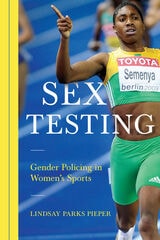
Sex Testing
Gender Policing in Women's SportsLindsay Pieper
University of Illinois Press, 2016
Ranging from Cold War tensions to gender anxiety to controversies around doping, Lindsay Parks Pieper explores sex testing in sport from the 1930s to the early 2000s. Pieper examines how the IOC in particular insisted on a misguided binary notion of gender that privileged Western norms. Testing evolved into a tool to identify--and eliminate--athletes the IOC deemed too strong, too fast, or too successful. Pieper shows how this system punished gifted women while hindering the development of women's athletics for decades. She also reveals how the flawed notions behind testing--ideas often sexist, racist, or ridiculous--degraded the very idea of female athleticism.
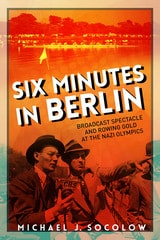
Six Minutes in Berlin
Broadcast Spectacle and Rowing Gold at the Nazi OlympicsMichael J Socolow
University of Illinois Press, 2016
The Berlin Games matched cutting-edge communication technology with compelling sports narrative to draw the blueprint for all future sports broadcasting. A global audience--the largest cohort of humanity ever assembled--enjoyed the spectacle via radio. This still-novel medium offered a "liveness," a thrilling immediacy no other technology had ever matched. Michael J. Socolow's account moves from the era's technological innovations to the human drama of how the race changed the lives of nine young men. As he shows, the origins of global sports broadcasting can be found in this single, forgotten contest. In those origins we see the ways the presentation, consumption, and uses of sport changed forever.
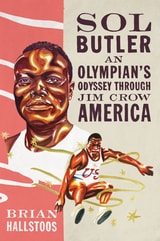
Sol Butler
An Olympian's Odyssey through Jim Crow AmericaBrian Hallstoos
University of Illinois Press, 2026
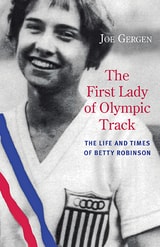
The First Lady of Olympic Track
The Life and Times of Betty RobinsonJoe Gergen
Northwestern University Press, 2014
The 1928 Olympic Games in Amsterdam were the first in which women—over the objections of many, including Pope Pius XI and the founder of the modern Olympics, Baron Pierre de Coubertin—were allowed to run in the marquee track events.
Equally remarkable is the story behind the first female gold medal winner in the 100-meter dash, sixteen-year-old American Betty Robinson. A prodigy running in just her fourth organized meet, Robinson stunned the world, earning special praise from the president of the 1928 American Olympic Committee, General Douglas MacArthur. But Robinson’s triumph soon became tragedy when in 1931 she was involved in a life-threatening plane crash. Unable to assume a sprinter’s crouch, she nevertheless joined fellow pioneer Jesse Owens at the infamous 1936 Berlin Olympics, and achieved further glory on the relay team. Journalist Joe Gergen’s The First Lady of Olympic Track rescues an exceptional figure from obscurity.
The Gold in the Rings
The People and Events That Transformed the Olympic GamesStephen R. Wenn and Robert K. Barney
University of Illinois Press, 2019
Entertaining and expert, The Gold in the Rings maps the Olympics' course from paragon of purity to billion-dollar profits.
The Nazi Olympics
Sport, Politics, and Appeasement in the 1930sEdited by Arnd Krüger and William Murray
University of Illinois Press, 2003
The 1936 Olympic Games played a key role in the development of both Hitler’s Third Reich and international sporting competition. The Nazi Olympics gathers essays by modern scholars from prominent participating countries and lays out the issues--sporting as well as political--surrounding the involvement of individual nations.
The volume opens with an analysis of Germany’s preparations for the Games and the attempts by the Nazi regime to allay the international concerns about Hitler’s racist ideals and expansionist ambitions. Essays follow on the United States, Great Britain, and France--top-tier Olympian nations with misgivings about participation--as well as Germany's future Axis partners Italy and Japan. Other contributions examine the issues involved for Finland, Sweden, Norway, Denmark, and the Netherlands. Throughout, the authors reveal the high political stakes surrounding the Games and how the Nazi Olympics distilled critical geopolitical issues of the time into a spectacle of sport.
The Olympics that Never Happened
Denver '76 and the Politics of GrowthAdam Berg
University of Texas Press, 2023
A look back at how powerful politicians, business leaders, and a diverse cast of activists used a thwarted Olympics to shape the state of Colorado and the city of Denver.
If you don’t recall the 1976 Denver Olympic Games, it’s because they never happened. The Mile-High City won the right to host the winter games and then was forced by Colorado citizens to back away from its successful Olympic bid through a statewide ballot initiative. Adam Berg details the powerful Colorado regime that gained the games for Denver and the grassroots activism that brought down its Olympic dreams, and he explores the legacy of this milestone moment for the games and politics in the United States.
The ink was hardly dry on Denver’s host agreement when Mexican American and African American urbanites, white middle-class environmentalists, and fiscally concerned local politicians realized opposition to the Olympics provided them new political openings. The Olympics quickly became a platform for taking stands on a range of issues, from conservation to urban livability to the very idea of growth, which for decades had been unquestioned in Colorado. The Olympics That Never Happened argues that hostility to the Olympics galvanized and empowered diverse citizens in a major US city, with long-term ramifications for Colorado and political activism elsewhere. The Olympics themselves were changed forever, compelling organizers to take seriously competing interests from subgroups within their communities.
The Olympics
A History of the Modern GamesAllen Guttmann
University of Illinois Press, 1992
This second edition of Guttmann's critically acclaimed history discusses the intended and actual effects of the modern Olympic Games from 1896 to 2000. The glories and fiascoes, the triumphs and tragedies--Guttmann weaves them all into a vivid and entertaining social history. As Guttmann shows, politics has always been one of the Olympics' major events. He also delves into the colorful history of the athletics, from the Paris marathon course that invited French runners to take shortcuts to the odyssey of Egyptian gym teacher Youssef Nagui Assad, who made three different Olympic teams only to be recalled home each time due to boycotts. Guttmann also provides insight into the byzantine maneuvering involved in site selection, as well as little known facts about the Games' history and figures like longtime Olympics czar Avery Brundage.
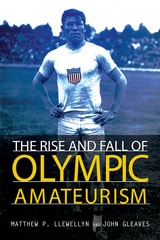
The Rise and Fall of Olympic Amateurism
Matthew P. Llewellyn and John Gleaves
University of Illinois Press, 2016
Matthew P. Llewellyn and John Gleaves analyze how this astonishing transformation took place. Drawing on Olympic archives and a wealth of research across media, the authors examine how an elite--white, wealthy, often Anglo-Saxon--controlled and shaped an enormously powerful myth of amateurism. The myth assumed an air of naturalness that made it seem unassailable and, not incidentally, served those in power. Llewellyn and Gleaves trace professionalism's inroads into the Olympics from tragic figures like Jim Thorpe through the shamateur era of under-the-table cash and state-supported athletes. As they show, the increasing acceptability of professionals went hand-in-hand with the Games becoming a for-profit international spectacle. Yet the myth of amateurism's purity remained a potent force, influencing how people around the globe imagined and understood sport.
Timely and vivid with details, The Rise and Fall of Olympic Amateurism is the first book-length examination of the movement's foundational ideal.
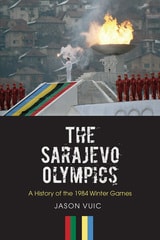
The Sarajevo Olympics
A History of the 1984 Winter GamesJason Vuic
University of Massachusetts Press, 2015
To most observers, the 1984 Winter Olympics in Sarajevo, Yugoslavia, were an unmitigated success. That year, the unlikeliest of candidate cities in the unlikeliest of candidate countries did what many had thought impossible: it hosted an international sports competition at the highest level, housing and feeding hundreds of athletes and thousands of tourists while broadcasting a positive image of socialist Yugoslavia to the world.
The first Winter Games held in a communist country, Sarajevo also marked the first Olympic confrontation of Soviet and American athletes since the U.S. boycott of the 1980 Moscow Summer Games. And the competitions themselves were spectacular and memorable. This was the Olympics of British ice dancers Jayne Torvill and Christopher Dean, American skiers “Wild Bill” Johnson and Debbie Armstrong, and East German skaters Katarina Witt and Karin Enke, not to mention a Soviet hockey team that rebounded from its stunning loss to the Americans at Lake Placid four years earlier to win all seven of its matches.
Yet The Sarajevo Olympics is more than just a history of sport. Jason Vuic also retraces the history of the Olympic movement, analyzes the inner workings of the International Olympic Committee during the troubled 1970s and 1980s, and places the 1984 Winter Games in the context of Cold War geopolitics. The book begins and ends by reminding readers that less than a decade after it hosted the Olympics, the Bosnian city of Sarajevo found itself at the vortex of a bloody and brutal civil war that would end with the dissolution of the multiethnic Yugoslavian state.
Winters of Discontent
The Winter Olympics and a Half Century of Protest and ResistanceEdited by Russell Field
University of Illinois Press, 2025
The essays collectively explore the shifting dynamics and power relations between the civic coalitions that pursue the Winter Olympics and the social movements that oppose their efforts. The contributors look at specific Games impacted by dissent and probe the issues that swirled around failed and withdrawn bids. In addition, contributions on the contemporary Olympics describe current or future bids while delving into the campaigns demanding host nations pay attention to economic, social, humanitarian, and environmental concerns.
A first-of-its-kind collection, Winters of Discontent profiles the wide range of activists and social movements that have organized against the Winter Olympics.
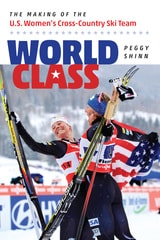
World Class
The Making of the U.S. Women's Cross-Country Ski TeamPeggy Shinn
University Press of New England, 2018