Results by title
10 books match the query 'Our Time'
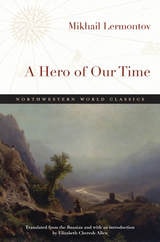
A Hero of Our Time
Mikhail Lermontov, Translated from the Russian and with an Introduction by Elizabeth Cheresh Allen
Northwestern University Press, 2016
Translated from the Russian by Elizabeth Cheresh Allen
Mikhail Lermontov’s A Hero of Our Time was the first modern Russian novel. Published in 1840, it set a model of penetrating observation and psychological depth that would come to typify Russian literature. Its "hero," Grigory Pechorin, also established a character type that became known in Russian fiction as "the superfluous man"—widely familiar from Dostoevsky’s Notes from Underground. At once driven by pride and wracked by self-doubt, both shockingly self-revealing and blindly self-deceived, he flounders to affirm himself in a social world he despises yet yearns to dominate. Pechorin is a troubling and unforgettable character. And A Hero of Our Time, which has provoked much controversy, is a novel not only central to Russian literature but fundamental to the Western literary tradition of the antihero.
Cultural Semantics
Keywords of Our TimeMartin Jay
University of Massachusetts Press, 1998
A selection of Martin Jay's recent writings on contemporary thought and culture, this is a book about ideas that matter—and about why ideas matter. Borrowing from Flaubert's notion of a dictionary of “received ideas” and Raymond Williams's explorations of the “keywords” of the modern age, Jay investigates some of the central concepts by which we currently organize our thoughts and lives. His topics range from “theory” and “experience” to the meaning of “multiculturalism” and the dynamics of cultural “subversion.” Among the thinkers he engages are Bataille and Foucault, Adorno and Lacoue-Labarthe, Walter Benjamin, Christa Wolf, and Jean-François Lyotard.
By looking closely at what “words do and perform,” Jay makes us aware of the extent to which the language we use mediates and shapes our experience. By helping to distance us from much that we now take for granted, he makes it difficult for us to remain comfortably certain about what we think we know.
Elegantly written and richly insightful, this is a work of cultural criticism and intellectual analysis of the first order.
Essayists on the Essay
Montaigne to Our TimeCarl H. Klaus and Ned Stuckey-French
University of Iowa Press, 2012
The first historically and internationally comprehensive collection of its kind, Essayists on the Essay is a path-breaking work that is nothing less than a richly varied sourcebook for anyone interested in the theory, practice, and art of the essay. This unique work includes a selection of fifty distinctive pieces by American, Canadian, English, European, and South American essayists from Montaigne to the present—many of which have not previously been anthologized or translated—as well as a detailed bibliographical and thematic guide to hundreds of additional works about the essay.
From a buoyant introduction that provides a sweeping historical and analytic overview of essayists’ thinking about their genre—a collective poetics of the essay—to the detailed headnotes offering pointed information about both the essayists themselves and the anthologized selections, to the richly detailed bibliographic sections, Essayists on the Essay is essential to anyone who cares about the form.
This collection provides teachers, scholars, essayists, and readers with the materials they need to take a fresh look at this important but often overlooked form that has for too long been relegated to the role of service genre—used primarily to write about other more “literary” genres or to teach young people how to write. Here, in a single celebratory volume, are four centuries of commentary and theory reminding us of the essay’s storied history, its international appeal, and its relationship not just with poetry and fiction but also with radio, film, video, and new media.

Hemingway's Laboratory
The Paris in our timeMilton A. Cohen
University of Alabama Press, 2005
In 1924 Ernest Hemingway published a small book of eighteen vignettes, each little more than one page long, with a small press in Paris. Titled in our time, the volume was later absorbed into Hemingway’s story collection In Our Time. Those vignettes, as Milton Cohen demonstrates in Hemingway’s Laboratory, reveal a range of voices, narrative strategies, and fictional interests more wide-ranging and experimental than any other extant work of Hemingway’s. Further, they provide a vivid view of his earliest tendencies and influences, first manifestations of the style that would become his hallmark, and daring departures into narrative forms that he would forever leave behind.
Many of the chapters are pointillistic glimpses of violence--bullfights, a botched execution, the fleeting thoughts of the wounded on the battlefield. Others reach back into childhood. Still others adopt the wry, mannered voice of English aristocracy. Though critics have often read these chapters as secondary asides to the longer stories that constitute the commercial collection, Cohen argues that not only do the vignettes merit consideration as a unit unto themselves, but that they exhibit a plethora of styles and narrative gambits that show Hemingway at his most versatile.
The final section examines in detail the individual chapters of in our time, their historical origins, their drafts, themes, and styles. The result is an account of what is arguably Hemingway’s most crucial formative period.

Huckleberry Finn as Idol and Target
The Functions of Criticism in Our TimeJonathan Arac
University of Wisconsin Press, 1997
If racially offensive epithets are banned on CNN air time and in the pages of USA Today, Jonathan Arac asks, shouldn’t a fair hearing be given to those who protest their use in an eighth-grade classroom? Placing Mark Twain’s comic masterpiece, Huckleberry Finn, in the context of long-standing American debates about race and culture, Jonathan Arac has written a work of scholarship in the service of citizenship.
Huckleberry Finn, Arac points out, is America’s most beloved book, assigned in schools more than any other work because it is considered both the “quintessential American novel” and “an important weapon against racism.” But when some parents, students, and teachers have condemned the book’s repeated use of the word “nigger,” their protests have been vehemently and often snidely countered by cultural authorities, whether in the universities or in the New York Times and the Washington Post. The paradoxical result, Arac contends, is to reinforce racist structures in our society and to make a sacred text of an important book that deserves thoughtful reading and criticism. Arac does not want to ban Huckleberry Finn, but to provide a context for fairer, fuller, and better-informed debates.
Arac shows how, as the Cold War began and the Civil Rights movement took hold, the American critics Lionel Trilling, Henry Nash Smith, and Leo Marx transformed the public image of Twain’s novel from a popular “boy’s book” to a central document of American culture. Huck’s feelings of brotherhood with the slave Jim, it was implied, represented all that was right and good in American culture and democracy. Drawing on writings by novelists, literary scholars, journalists, and historians, Arac revisits the era of the novel’s setting in the 1840s, the period in the 1880s when Twain wrote and published the book, and the post–World War II era, to refute many deeply entrenched assumptions about Huckleberry Finn and its place in cultural history, both nationally and globally. Encompassing discussion of Harriet Beecher Stowe, Frederick Douglass, Ralph Ellison, Archie Bunker, James Baldwin, Shelley Fisher Fishkin, and Mark Fuhrman, Arac’s book is trenchant, lucid, and timely.
Lermontov's "A Hero of Our Time"
A Critical CompanionLewis Bagby
Northwestern University Press, 2001

Lermontov’s "A Hero of Our Time"
A Critical CompanionLewis Bagby
Northwestern University Press, 0
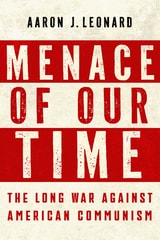
Menace of Our Time
The Long War Against American CommunismAaron J. Leonard
Rutgers University Press, 2025
A survey of the far-reaching measures the U.S. government brought to bear against the CPUSA, from poison-pen letters to the Red Scare and beyond.
Beginning at the turn of the twentieth century and ending only with the Soviet Union’s collapse in 1991, the U.S. government and major elements in the wider society waged an unrelenting campaign to suppress and criminalize domestic communism. This long-overdue book details the longest and most extensive repressive operation ever undertaken by U.S. authorities against a domestic political organization that, however problematic, was largely operating within the scope of constitutionally mandated freedoms. Beyond that, this is the story of how systemic measures against U.S. communists—in contrast to the vaunted claims of American political freedom—defined the political landscape of the last century.
Menace of Our Time tracks the suppression efforts aimed at the group, including the state laws of the twenties that imprisoned the fledgling communist leadership; the tactics used by police and local authorities against communists as they fought for unions, racial equality, and the unemployed; the trials and imprisonment of communist leaders mid-century; the extra-legal efforts of the Counterintelligence Program (COINTELPRO) in the sixties; and the ongoing, relentless surveillance by the FBI that followed. In examining the far-reaching measures the government brought to bear against the Communist Party USA, Aaron J. Leonard provides a clearer picture of the mechanics of social and political repression that abound in the society we still inhabit.
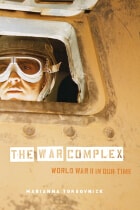
The War Complex
World War II in Our TimeMarianna Torgovnick
University of Chicago Press, 2005
Marianna Torgovnick argues that we have lived, since the end of World War II, under the power of a war complex—a set of repressed ideas and impulses that stems from our unresolved attitudes toward the technological acceleration of mass death. This complex has led to gaps and hesitations in public discourse about atrocities committed during the war itself. And it remains an enduring wartime consciousness, one most recently animated on September 11.
Showing how different events from World War II became prominent in American cultural memory while others went forgotten or remain hidden in plain sight, The War Complex moves deftly from war films and historical works to television specials and popular magazines to define the image and influence of World War II in our time. Torgovnick also explores the 1961 trial of Adolf Eichmann, the emotional legacy of the Holocaust, and the treatment of World War II's missing history by writers such as W. G. Sebald to reveal the unease we feel at our dependence on those who hold the power of total war. Thinking anew, then, about how we account for war to each other and ourselves, Torgovnick ultimately, and movingly, shows how these anxieties and fears have prepared us to think about September 11 and our current war in Iraq.
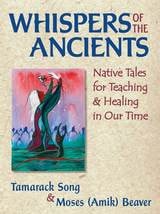
Whispers of the Ancients
Native Tales for Teaching and Healing in Our TimeTamarack Song and Moses (Amik) Beaver
University of Michigan Press, 2010
"Whispers of the Ancients helps us reconnect with the spirit of story that is a part of all our heritages. With respect for the wisdom of the past and with an eye toward the cross-cultural links that legends can make between us, Tamarack Song offers a gathering of tales and insightful comments that point the way back to the circle."
---Joseph Bruchac, author of more than 70 books for children and adults, including (with coauthor Michael J. Caduto) the best-selling Keepers of the Earth: Native American Stories and Environmental Activities for Children
It's easy to imagine yourself transported back to a time when an Elder might have told stories like those in Whispers of the Ancients around a glowing hearth. Thanks to Tamarack Song's storytelling skills, monsters, heroes, and shapeshifters come alive and open a doorway to the mysteries of life. Easily accessible to all ages, this is a book that speaks to each person at his or her own level of comprehension and need. It is as beautiful to read as it is to look at.
Stunning Aboriginal artwork by Moses (Amik) Beaver combines with provocative storytelling to renew, in all their traditional splendor, exceptional legends from around the world. Entertaining, profound, passionate, glorious---these are stories that illustrate and evoke themes common to everyone's life, with an ancient wisdom that helps the listener to cope with today's opportunities for tenderness, grief, passion, and irony.
Easily accessible to all ages, this is a book that speaks to each person at his or her own level of comprehension and need. It's as beautiful to read as it is to look at.
Tamarack Song has sought out the stories of the North African and Central Asian tribal peoples from whom he is descended, and he has listened to the tales of indigenous people from the tundra to the tropics. His books include Journey to the Ancestral Self, and he has contributed to Lois Einhorn's Forgiveness and Child Abuse. He is also a counselor, wilderness skills teacher, rites-of-passage guide, and founder of the Teaching Drum Outdoor School. Song lives in the Nicolet National Forest near Three Lakes, Wisconsin.
Moses (Amik) Beaver is an Ojibwe artist from the isolated fly-in community of Nibinamik (Summer Beaver), Ontario, three hundred miles north of Lake Superior. Grants from the Ontario Arts Council and other sources support his ongoing work with youth, and partial support for this book's illustrations comes from the District School Board of Nibinamik.