Results by title
16 books match the query 'País Vasco (Spain)'
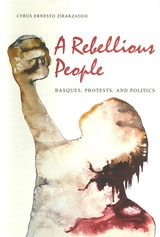
A Rebellious People
Basques, Protests, And PoliticsCyrus Ernesto Zirakzadeh
University of Nevada Press, 1991
In this scholarly work, Zirakzadeh argues that there is a calculated reasoning behind ETA's political violence that is often overlooked by researchers. His book is a comprehensive account of the Basque region's grassroots politics.

Back to Bizkaia
A Basque-American MemoirVince J. Juaristi
University of Nevada Press, 2011
Nevada sheep rancher Joe Juaristi spoke for years about making a trip back to the Spanish Basque Country that he left sixty years earlier, but each time the subject came up the discussion evolved into a family debate about the scope and members of the journey. Finally Joe's son, Vince, secretly resolved to organize the trip that his father wanted and needed--the two of them, traveling alone, making a quiet reunion with Joe's twin sister, who suffers from Alzheimer's, visiting other aging siblings and friends, and recounting the places that formed Joe's memories of his youth.
Back to Bizkaia is part travel book, part memoir of two men exploring their mutual roots and their unique father-son bond. The narrative intertwines an engaging account of the contemporary Basque Country with Joe's experiences as an immigrant making his way in a new country and Vince's memories of growing up in a close Basque-American community in the American West. This is a book about Basques and their American families, but on another level it is every immigrant's story of return to a beloved homeland.
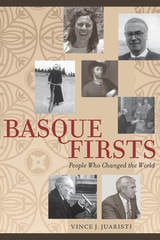
Basque Firsts
People Who Changed the WorldVince J. Juaristi
University of Nevada Press, 2016
The profiles use primary sources to tell fresh stories and offer a wonderful variety, showing the astonishing breadth of Basque contributions. They include Juan Sebastían Elcano, the first person to circumnavigate the earth; St. Ignatius of Loyola, the first Jesuit to seed a worldwide movement in education; Santiago Ramón y Cajal, the Father of Neurology and a Nobel laureate; Cristóbal Balenciaga, the king of haute couture; Paul Laxalt, one of Ronald Reagan’s closest friends in politics; and Edurne Pasaban, the first woman to climb the world’s fourteen tallest mountains.
Basque Firsts provides a rare look at a culture’s people, revealing the significant contributions they have shared.

Basque Nationalism and the Spanish State
Andre Lecours
University of Nevada Press, 2016
An examination of Basque nationalism from a historical perspective. Basque nationalism has been extensively examined from the perspectives of Basque culture and internal conditions in the Basque Country, but André Lecours is among the first to demonstrate how Basque nationalism was shaped by the many forms and historical phases of the Spanish state. His discussion employs one of the most debated approaches in the social sciences—historical institutionalism—and it includes an up-to-date examination of the circumstances for, and consequences of, recent events such as ETA's announcement in 2006 of a permanent cease-fire. Lecours also analyzes other aspects of Basque nationalism, including the international relations of the Basque Autonomous Government, as well as the responses of the contemporary Spanish state and how it deploys its own brand of nationalism. Finally, the book offers a comparative discussion of Basque, Catalan, Scottish, Flemish, and Quebecois nationalist movements, suggesting that nationalism in the Basque Country, despite the historical presence of violence, is in many ways similar to nationalism in other industrialized democracies. Basque Nationalism and the Spanish State is an original and provocative discussion that is essential reading for anyone interested in the Basques or in the development of modern nationalist movements.

Escape Via Berlin
Eluding Franco In Hitler's EuropeJose Antonio Aguirre
University of Nevada Press, 1991

Globalization and Nationalism
The Cases of Georgia and the Basque CountryNatalie Sabanadze
Central European University Press, 2010
This book argues for an original, unorthodox conception about the relationship between globalization and contemporary nationalism. While the prevailing view holds that nationalism and globalization are forces of clashing opposition, Sabanadze establishes that these tend to become allied forces. It acknowledges that nationalism does react against the rising globalization and represents a form of resistance against globalizing influences, but the Basque and Georgian cases prove that globalization and nationalism can be complementary rather than contradictory tendencies.
Nationalists have often served as promoters of globalization, seeking out globalizing influences and engaging with global actors out of their very nationalist interests. In the case of both Georgia and the Basque Country, there is little evidence suggesting the existence of strong, politically organized nationalist opposition to globalization.
Globalization and Nationalism discusses why, on a broader scale, different forms of nationalism develop differing attitudes towards globalization and engage in different relationships.
Identity, Culture, And Politics In The Basque Diaspora
Gloria Pilar Totoricagüena
University of Nevada Press, 2015
Totoricagüena offers a superb quantitative study of an aspect of Basque culture that has been largely ignored by scholars—the diaspora. In doing so, she enlarges the understanding of cultural identity in general—how it is defined and preserved, how it evolves over time, and how both the politics of distant places and the most intimate family habits can shape an individual’s sense of self. Identity, Culture, and Politics in the Basque Diaspora is a major contribution to the knowledge of Basques and their persistent political and cultural traditions.

In a Hundred Graves
A Basque PortraitRobert Laxalt
University of Nevada Press, 2016
The Basques of Europe are legendary for the curtain of privacy they have always drawn around their world, shielding it from visitors from the outside. As a result, accounts of the inner workings of Basque village life are almost nonexistent. In this unique book, author Robert Laxalt has managed to penetrate the deep reserve of Basque village folk. Shepherds, troubadours, merchants, and smugglers, caught up in the panorama of daily life, parade before the reader. They are portrayed against a backdrop of green rugged mountains and stone buildings, typical of the Basque provinces in France and Spain. Laxalt, an American born of Basque parents, unveils the Basque character with warmth, wry humor, and above all, honesty.

Militant Nationalism
Between Movement and Party in Ireland and the Basque CountryCynthia Irvin
University of Minnesota Press, 1999
A comparative analysis of two militant nationalist groups.
Why do some militant nationalists turn to electoral politics while others resist-and even seek to destroy-that arena? Cynthia L. Irvin examines two cases of electoral interventions by nationalist organizations engaged in violent political competition: in Northern Ireland and in the Basque provinces of Spain. Based on her findings, she offers insights into the circumstances that lead such groups to abandon violence in favor of institutional political struggle.
Using fieldwork done in Northern Ireland and the Basque Country, Irvin develops a model linking the internal dynamics of Sinn Fein and Herri Batasuna (the electoral arm of the militant Basque separatists) to changes in their external environments. In this unusual comparative analysis, she draws on interviews with more than 100 Sinn Fein and Herri Batasuna activists and on a unique survey of 140 Herri Batasuna activists. This approach moves Irvin’s work beyond previous analyses, which have relied on either descriptive and historical accounts or formal models of insurgent violence. This detailed account has broad implications for the study of social movements and ethnic identity, providing a valuable new perspective into the strategic interactions and often conflict-ridden relationship between social movements and political parties. ISBN 0-8166-3114-X Cloth £00.00 $49.95xxISBN 0-8166-3115-8 Paper £00.00 $19.95x304 Pages 26 Tables 5 7/8 x 9 MaySocial Movements, Protest, and Contention Series, volume 9Translation inquiries: University of Minnesota Press
Negotiating With ETA
Obstacles To Peace In The Basque Country, 1975-1988Robert P. Clark
University of Nevada Press, 1990
Since the late 1960s, the Basque insurgent organization ETA (Euzkadi ta Askatasuna, or Basque Homeland and Freedom) has been engaged in a violent struggle against the Spanish state in an effort to gain the independence of the Basque Country. ETA violence has led to the death of hundreds of people, making the organization the most violent insurgent group in Europe. Between 1975 and 1988, nearly thirty attempts to negotiate an end to violence, with a few limited exceptions, all ended in failure. This important book examines why the efforts to negotiate have failed and makes suggestions on how to improve the chances for successful discussion in the future. Although Clark does not disprove the conventional wisdom that negotiation with terrorists is a bad idea, he does begin from the opposing point of view that there may be some positive values to be realized from such negotiation.Negotiating with ETA describes the various factions that are interested in the outcome of such negotiations and the Spanish antiterrorist policy throughout the period under examination. The book also recounts the early attempts to negotiate, the first attempt at "social reintegration," various attempts by the Basque Government to get negotiations started, negotiation efforts under the Spanish socialist government of Felipe González, and the lengthy negotiations that took place in Algeria. A wide range of scholars and specialists will find this book valuable, including those interested in contemporary Spanish politics, ethnic nationalism, Basque affairs, the problem of terrorism, and conflict resolution.
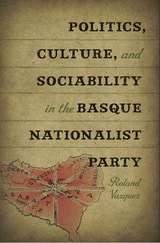
Politics, Culture, and Sociability in the Basque Nationalist Party
Roland Vazquez
University of Nevada Press, 2010
Until now, social scientists studying Spanish politics have focused on party systems, regime transition, and election analysis, and anthropologists studying Spain have largely neglected its political parties. This book is a pathbreaking work of political anthropology and an ethnographic study of the Basque Nationalist Party (PNV). Author Roland Vazquez studies Basque nationalism as not merely a political phenomenon but as a cultural and social one as well. He examines the forces that have shaped the Basque political panorama, the nature of Basque political campaigns, Basque cultural and social movements both inside and outside the explicitly partisan milieu, and the role of other parties in the Basque Country. The study is enhanced by extensive interviews and broad fieldwork among Basque contacts of diverse backgrounds and loyalties. The result is a vivid portrait of political life in the contemporary Basque Country, of the tensions between various nationalist parties and philosophies, and of the way politics are influenced by Basque notions of community, social connections, and national identity. The book also serves as a model for studies of other political and nationalist movements and the cultural and social ties and values that drive them.
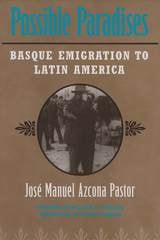
Possible Paradises
Basque Emigration to Latin AmericaAzcona Pastor
University of Nevada Press, 2003
Possible Paradises, José Manuel Azcona Pastor's engaging and meticulously researched study of Basque emigration to the Americas, is a path breaking work of monumental importance. Ranging over the entire former Spanish American empire from Tierra del Fuego to the U.S. Southwest and covering over five centuries of history, Azcona examines the roles and fates of the Basques who came to the New World. He also studies the impact of the New World on the Basque Country, from the importance in the modern Basque diet of such American foodstuffs as corn and beans to the encouragement given to traditional Basque industries by the colonizers' demand for ships and iron tools. He considers the role of Basques in the Spanish imperial expeditions of exploration and conquest; their participation in transatlantic commerce and communication.
The Basque diaspora, although worldwide in dimension, has had its greatest presence and importance in the Americas. Azcona's pioneering study views the Basque presence in the New World through the broadest possible lens, linking Basque communities and activities from Argentina to the North American West.
Foreword by William A. Douglass. Translation by Roland Vazquez.
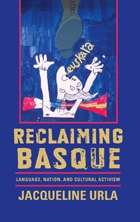
Reclaiming Basque
Language, Nation, and Cultural ActivismJacqueline Urla
University of Nevada Press, 2015

The Basque Insurgents
ETA, 1952–1980Robert P. Clark
University of Wisconsin Press, 1984
Blamed, at first, by the Spanish government for the recent Madrid train bombings, ETA (Euzkadi ta Askatasuna), the Basque nationalist organization, has been perhaps the most violent insurgent group on the European continent. Yet little is known about it outside of Spain. This book, now back in print, offers a full analytical study of ETA.

The Basques
The Franco Years and BeyondRobert P. Clark
University of Nevada Press, 1979
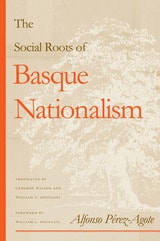
The Social Roots Of Basque Nationalism
Alfonso Pérez-Agote
University of Nevada Press, 2006
Translated by Cameron Watson and William A. Douglass. Foreword by William A. Douglass. The Basque people have preserved their ethnic identity and sense of themselves as a separate community despite centuries of repression, diaspora, and economic and social upheaval—one of the most remarkable achievements in the history of the phenomenon we call nationalism. In The Social Roots of Basque Nationalism, sociologist Alfonso Pérez-Agote addresses the social mechanisms that Basques employed to sustain their ethnic identity under the Franco Regime and demonstrates how persecution actually encouraged the extension of Basque nationalist consciousness. He also reveals how state political pressure radicalized one element of the Basque-nationalist movement, resulting in the formation of ETA, an armed terrorist wing that itself became a mechanism for extending nationalist consciousness. Finally, he examines the subsequent changes in Basque nationalism following Franco’s death and the extension of democracy in Spain, which resulted in the institutionalization of the movement into an autonomous political power. This work is based in part on interviews and polls with informants in the Basque Country and abroad, eliciting such data as the role that family, education, social contacts, and religious environment play in the evolution of political attitudes; the place of violence in the Basque world view and contemporary political culture; regional variations in Basque nationalism; and the factors that contributed to the resilience of Basque nationalism in adapting to new historical conditions. The result is a sophisticated discussion of the various ways in which Basque social reality is constituted and how this reality helps to create political culture. Because Pérez-Agote situates his discussion within the broader frameworks of ethnic identity, group dynamics, and the nature of nationalism, the book makes a significant contribution not only to our understanding of the Basques but to the broader study of the evolution of nationalism and the nation-state, political violence, and the complicated transition of any society from dictatorship to democracy.