Results by title
25 books match the query 'Parker, Hershel'
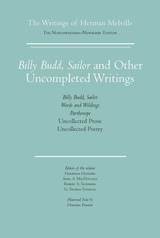
Billy Budd, Sailor and Other Uncompleted Writings
The Writings of Herman Melville, Volume 13Herman Melville; Historical Note by Hershel Parker
Northwestern University Press, 2017
These unfinished writings include, besides Billy Budd, two projected volumes containing poems and prose pieces, Weeds and Wildings and Parthenope; three prose pieces, “Rammon,” “Story of Daniel Orme,” and “Under the Rose”; and some three dozen poems of varying lengths. Some of these pieces were surely composed late in Melville’s career, during his retirement, but others may date to as early as the 1850s. Except for Billy Budd, many of these works have not been readily available in reliable texts, when available at all.
This volume, the result of the editors’ meticulous study of the manuscripts, offers new reading texts, with significant corrections of words, phrases, and titles, the inclusion of heretofore unpublished lines of verse, and the return to their original locations of the two poems, “The Enviable Isles” and “Pausilippo,” that Melville had extracted for use in John Marr (1888) and Timoleon (1891). Hershel Parker’s Historical Note traces how these writings fit into the trajectory of Melville’s career, and the rest of the Editorial Appendix presents the scholarly evidence and decisions made in creating the reading texts. As a whole, the Northwestern-Newberry Edition of The Writings of Herman Melville, now complete in fifteen volumes, offers for the first time the total body of Melville’s extant writings in a critical text, faithful to his intentions.
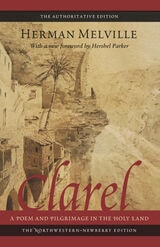
Clarel
A Poem and Pilgrimage in the Holy LandHerman Melville
Northwestern University Press, 2008
Melville’s long poem Clarel: A Poem and Pilgrimage in the Holy Land (1876) was the last full-length book he published. Until the mid-twentieth century even the most partisan of Melville’s advocates hesitated to endure a four-part poem of 150 cantos and almost 18,000 lines about a naive American named Clarel, on pilgrimage through the Palestinian ruins with a provocative cluster of companions.
But modern critics have found Clarel a much better poem than was ever realized. Robert Penn Warren called it a precursor of The Waste Land. It abounds with revelations of Melville’s inner life. Most strikingly, it is argued that the character Vine is a portrait of Melville’s friend Nathaniel Hawthorne. Clarel is one of the most complex theological explorations of faith and doubt in all of American literature, and this edition brings Melville’s poem to new life.
Clarel
Volume Twelve, Scholarly EditionHerman Melville
Northwestern University Press, 1991
But modern critics have found Clarel a much better poem than was ever realized. Robert Penn Warren called it a precursor of The Waste Land. It abounds with revelations of Melville's inner life. Most strikingly, it is argued that the character Vine is a portrait of Melville's friend Hawthorne. Based on the only edition published during Melville's lifetime, this scholarly edition adopts thirty-nine corrections from a copy marked by Melville and incorporates 154 emendations by the present editors, an also includes a section of related documents and extensive discussions.
This scholarly edition is an Approved Text of the Center for Editions of American Authors (Modern Language Association of America).
Flawed Texts and Verbal Icons
Literary Authority and American FictionHershel Parker
Northwestern University Press, 1984
Israel Potter
His Fifty Years of Exile, Volume Eight, Scholarly EditionHerman Melville
Northwestern University Press, 1982
This edition is an Approved Text of the Center for Editions of American Authors (Modern Language Association of America).
Journals
Volume FifteenHerman Melville
Northwestern University Press, 1989
The editors supply full annotations of Melville's allusions and terse entries and an exhaustive index makes available the range of his acquaintance with people, places, and works of art. Also included are related documents, illustrations, maps, and many pages and passages reproduced from the journals. This scholarly edition aims to present a text as close to the author's intention as his difficult handwriting permits. It is an Approved Text of the Center for Editions of American Authors (Modern Language Association of America).

Mardi and a Voyage Thither
Volume ThreeHerman Melville
Northwestern University Press, 1998
This scholarly edition aims to present a text as close to the author's intention as surviving evidence permits. Based on collations of all editions publishing during Melville's lifetime, it incorporates author corrections and many emendations made by the present editors. This edition of Mardi is an Approved Text of the Center for Editions of American Authors (Modern Language Association of America).
Mardi and a Voyage Thither
Volume Three, Scholarly EditionHerman Melville
Northwestern University Press, 1970
This scholarly edition aims to present a text as close to the author's intention as surviving evidence permits. Based on collations of all editions publishing during Melville's lifetime, it incorporates author corrections and many emendations made by the present editors. This edition of Mardi is an Approved Text of the Center for Editions of American Authors (Modern Language Association of America).
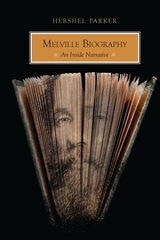
Melville Biography
An Inside NarrativeHershel Parker
Northwestern University Press, 2013
Melville Biography: An Inside Narrative is Hershel Parker’s history of the writing of Melville biographies, enriched by a lifetime of intimate working partnerships with great Melville scholars of different generations and by the author’s experience of successive phases of literary criticism. Throughout this bold book, Hershel Parker champions archival-based biography and the all-but-lost art of embodying such scholarship in literary criticism. First is a mesmerizing autobiographical account of what went into creating the award-winning and comprehensive Herman Melville: A Biography. Then Parker traces six decades of the “unholy war” waged against biographical scholarship, in which critics repeatedly imposed the theory of organic unity on Melville’s disrupted life—not just on his writings—while truncating his body of work and ignoring his study of art and aesthetics. In this connection, Parker celebrates discoveries made by “divine amateurs,” before throwing open his workshop to challenge ambitious readers with research projects. This is a book for Melville fans and Parker fans, as well as for readers, writers, and would-be writers of biography.
Melville's Prisoners
Harrison Hayford
Northwestern University Press, 2003
Written over many years, these essays retain the power to enlighten and surprise-and often, as Hershel Parker notes in his Foreword, to dazzle. Along with the never-before-published essay from which the book takes its title, Melville's Prisoners includes "Loomings," widely viewed as the single best piece of criticism ever written on Moby-Dick, and "Unnecessary Duplicates," a classic of textual speculation on Melville's methods. Others offer, along with their enduring insights into Melville's work, example after example of a capacious and astonishingly energetic mind at work and at play-a long view of how scholarship at its best is done. In sum, this volume constitutes the finest set of scholarly-critical essays ever written one of America's great writers.
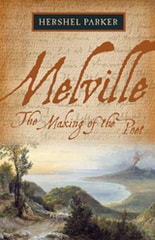
Melville
The Making of the PoetHershel Parker
Northwestern University Press, 2007
“Who would have looked for philosophy in whales, or for poetry in blubber?” the London John Bull remarked in October of 1851. And yet, the reviewer went on, “few books which professedly deal in metaphysics, or claim the parentage of the muses, contain as much true philosophy and as much genuine poetry as the tale of the Pequod's whaling expedition.” A decade and a half before surprising the world with a book of Civil war poetry, Melville was already confident of what was “poetic” in his prose. As Hershel Parker demonstrates in this book, Melville was steeped in poetry long before he called himself a poet.
Here Parker, the dean of Melville studies, gives a compelling, in-depth account of how one of America’s greatest writers grew into the vocation of a poet. His work corrects two of the most pernicious misconceptions about Melville perpetuated by earlier critics: that he repudiated fiction writing after Pierre, and that he hadn’t begun writing poetry (let alone had a book of poems ready for publication) as early as 1860. In clearing up these misapprehensions, Parker gives a thorough and thoroughly involving account of Melville’s development as a poet. Parker demonstrates for the first time just how crucial poetry was to Melville from childhood to old age, especially its re-emergence in his life after 1849. Drawing on Melville's shrewd annotations of great British poets and on his probing, skeptical engagement with commentaries on poetry (particularly by the great Scots reviewers), Parker paints a richly textured portrait of a hitherto unseen side of Herman Melville.
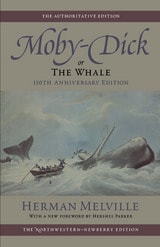
Moby-Dick, or The Whale
150th Anniversary EditionHerman Melville, edited by Harrison Hayford, Hershel Parker, and G. Thomas Tanselle
Northwestern University Press, 2001
This text of Moby-Dick is an Approved Text of the Center for Scholarly Editions (Modern Language Association of America).
Moby-Dick, or The Whale
Volume 6, Scholarly EditionHerman Melville, edited by Harrison Hayford, Hershel Parker, and G. Thomas Tanselle
Northwestern University Press, 1988
This scholarly edition is based on collations of both editions published during Melville's lifetime, it adopts 185 revisions and corrections from the English edition and incorporates 237 emendations by the series editors. This is an Approved Text of the Center for Editions of American Authors (Modern Language Association of America).
Omoo
A Narrative of Adventures in the South Seas, Volume Two, Scholarly EditionHerman Melville
Northwestern University Press, 1968
This scholarly edition aims to present a text as close to the author's intention as surviving evidence permits. Based on collations of all editions publishing during Melville's lifetime, it incorporates author corrections and many emendations made by the present editors. This edition of Omoo is an Approved Text of the Center for Editions of American Authors (Modern Language Association of America).
Pierre, or The Ambiguities
Volume SevenHerman Melville
Northwestern University Press, 1995
This scholarly edition aims to present a text as close to the author's intention as the surviving evidence permits. Based on collations of the two issues and the two impressions of the single edition publishing in Melville's lifetime, it incorporates necessary emendations made by the series editors. This text of Pierre is an Approved Text of the Center for Editions of American Authors (Modern Language Association of America).
Pierre, or The Ambiguities
Volume Seven, Scholarly EditionHerman Melville
Northwestern University Press, 1971
This scholarly edition aims to present a text as close to the author's intention as the surviving evidence permits. Based on collations of the two issues and the two impressions of the single edition publishing in Melville's lifetime, it incorporates necessary emendations made by the series editors. This text of Pierre is an Approved Text of the Center for Editions of American Authors (Modern Language Association of America).
Reading Billy Budd
Hershel Parker
Northwestern University Press, 1990
Redburn
Works of Herman Melville Volume FourHerman Melville
Northwestern University Press, 1969
Melville so disliked the novel that he submitted it to his publisher without polishing it. This scholarly edition corrects a number of errors that have persisted in subsequent editions. Based on collations of the editions published during his lifetime, it incorporates corrections made in the English edition and emendations made by the present editors.
As with all the books in the Northwestern-Newberry series, this edition of Redburn is an Approved Text of the Center for Editions of American Authors (Modern Language Association of America).
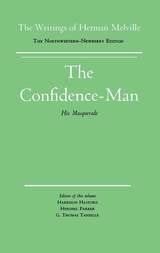
The Confidence-Man
Volume Ten, Scholarly EditionHerman Melville
Northwestern University Press, 1984
This scholarly edition includes a Historical Note offering a detailed account of the novel's composition, publication, reception, and subsequent critical history. In addition the editors present the twenty-six surviving manuscript leaves and scraps with full transcriptions and analytical commentary.
This scholarly edition aims to present a text as close to the author's intention as surviving evidence permits. Based on collations of both editions publishing during Melville's lifetime, it incorporates 138 emendations made by the present editors. It is an Approved Text of the Center for Editions of American Authors (Modern Language Association of America).
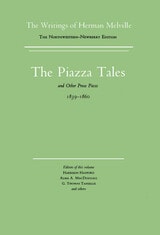
The Piazza Tales and Other Prose Pieces, 1839-1860
Volume Nine, Scholarly EditionHerman Melville
Northwestern University Press, 1987
This scholarly edition presents texts as close to the author's intentions as surviving evidence permits. Based on surviving manuscripts, on original newspaper and magazine printings, and on collations of magazine printings with the book of editions of The Piazza Tales, the text incorporates over 800 emendations by the editors and over 200 from later printings during Melville's lifetime.
This edition is an Approved Text of the Center for Editions of American Authors (Modern Language Association of America).
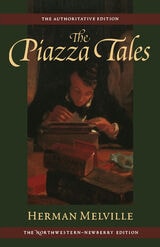
The Piazza Tales
Volume NineHerman Melville
Northwestern University Press, 1996
This scholarly edition presents texts as close to the author's intentions as surviving evidence permits. Based on surviving manuscripts, on original newspaper and magazine printings, and on collations of magazine printings with the book of editions of The Piazza Tales, the text incorporates over 800 emendations by the editors and over 200 from later printings during Melville's lifetime.
This edition is an Approved Text of the Center for Editions of American Authors (Modern Language Association of America).
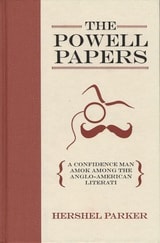
The Powell Papers
A Confidence Man Amok Among the Anglo-American LiteratiHershel Parker
Northwestern University Press, 2011
In 1849—months before the term “confidence man” was coined to identify a New York crook—Thomas Powell (1809–1887), a spherical, monocled, English poetaster, dramatist, journalist, embezzler, and forger, landed in Manhattan. Powell in London had capped a career of grand theft and literary peccadilloes by feigning a suicide attempt and having himself committed to a madhouse, after which he fled England. He had been an intimate of William Wordsworth, Elizabeth Barrett, Robert Browning, Charles Dickens, and a crowd of lesser literary folk.
Thoughtfully bearing what he presented as a volume of Tennyson with a few trifling revisions in the hand of the poet, Powell was embraced by the slavishly Anglophile New York literary establishment, including a young Herman Melville. In two pot-boilers—The Living Authors of England (1849) and The Living Authors of America (1850)—Powell denounced the most revered American author, Washington Irving, for plagiarism; provoked Charles Dickens to vengeful trans-Atlantic outrage and then panic; and capped his insolence by identifying Irving and Melville as the two worst “enemies of the American mind.” For almost four more decades he sniped at Dickens, put words in Melville’s mouth, and survived even the most conscientious efforts to expose him. Long fascinated by this incorrigible rogue, Hershel Parker in The Powell Papers uses a few familiar documents and a mass of freshly discovered material (including a devastating portrait of Powell in a serialized novel) to unfold a captivating tale of skullduggery through the words of great artists and then-admired journalists alike.
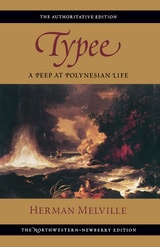
Typee
A Peep at Polynesian LifeHerman Melville
Northwestern University Press, 2003
This scholarly edition is based on collations of all editions published during his lifetime, incorporating many authorial readings that have often been omitted and some that have been misprinted in all previous editions. This edition is an Approved Text of the Center for Editions of American Authors (Modern Language Association of America).
Typee
Volume One, Scholarly EditionHerman Melville
Northwestern University Press, 1968
This scholarly edition is based on collations of all editions published during his lifetime, incorporating many authorial readings that have often been omitted and some that have been misprinted in all previous editions. This edition is an Approved Text of the Center for Editions of American Authors (Modern Language Association of America).
White Jacket, or The World in a Man-of-War
Volume Five, Scholarly EditionHerman Melville
Northwestern University Press, 1970
Already that same summer Melville had written Redburn, and he regarded the books as "two jobs, which I have done for money--being forced to it, as other men are to sawing wood." The reviewers were not as hard on White-Jacket as Melville himself was. The English liked its praise of British seamen. The Americans were more interested in Melville's attack on naval abuses, particularly flogging, and his advocacy of humanitarian causes. Soon Melville was acclaimed the best sea writer of the day.
Part autobiography, part epic fiction, White-Jacket remains a brilliantly imaginative social novel by one of the great writers of the sea. This text of the novel is an Approved Text of the Center for Editions of American Authors (Modern Language Association of America).