Results by title
7 books match the query 'Parmenides'
A Study of Dialectic in Plato's Parmenides
Eric Sanday
Northwestern University Press, 2014
After Parmenides
Idealism, Realism, and Epistemic ConstructivismTom Rockmore
University of Chicago Press, 2021
In After Parmenides, Tom Rockmore takes us all the way back to the beginning of Western philosophy, when Parmenides asserted that thought and being are the same. This idea created a division between what the mind constructs as knowable entities and the idea that there is also a mind-independent real, which we can know or fail to know. Rockmore argues that we need to give up on the idea of knowing the real as it is, and instead focus on the objects of cognition that our mind constructs. Though we cannot know mind-independent objects as they “really” are, we can and do know objects as they appear to us.
After Parmenides charts the continual engagement with these ideas of the real and the knowable throughout philosophical history from Plato and Aristotle to Descartes, Kant, Fichte, Hegel, Schopenhauer, Marx, and others. This ambitious book shows how new connections can be made in the history of philosophy when it is reread through a new lens.
How Socrates Became Socrates
A Study of Plato’s “Phaedo,” “Parmenides,” and “Symposium”Laurence Lampert
University of Chicago Press, 2021
In addition to a careful and precise analysis of Plato’s Phaedo,Parmenides, and Symposium, Lampert shows that properly entwined, Plato’s three dialogues fuse to portray a young thinker entering philosophy’s true radical power. Lampert reveals why this radicality needed to be guarded and places this discussion within the greater scheme of the politics of philosophy.
Parmenides, Venerable and Awesome. Plato, Theaetetus 183e
Proceedings of the International SymposiumCordero, Néstor-Luis
Parmenides Publishing, 2012
In October of 2007, the Universidad Nacional de San Martín (Argentina) hosted an International Symposium on the philosophy of Parmenides to celebrate the creation of the University’s new Center for the Study of Ancient Philosophy. The event—co-organized by the HYELE Institute for Comparative Studies (Switzerland) and Parmenides Publishing—brought together scholars from around the world to present their latest work and participate in discussion. These Proceedings present the collected papers that were given—all fully translated into English—and edited by Néstor-Luis Cordero.
During the two years leading up to the International Symposium, no fewer than seven books on Parmenides were published. This revival and resurgence of interest in Parmenides and the critical reviews of traditional interpretations of his poem made this the perfect time for a global conference dedicated to the renowned figure known as the true father of philosophy.
The Symposium on Parmenides united the world's foremost Parmenidean scholars, with many participants having written one, if not several books on Parmenides. The proceedings volume therefore represents the most cutting-edge and in-depth scholarship on Parmenides available today, and will be a great and timely enrichment to the field of Presocratic Philosophy.
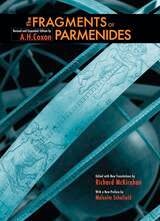
The Fragments of Parmenides
A Critical Text With Introduction and Translation, the Ancient Testimonia and a CommentaryA. H, Coxon
Parmenides Publishing, 2009
With a New Preface by Malcolm Schofield
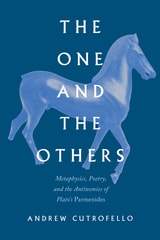
The One and the Others
Metaphysics, Poetry, and the Antinomies of Plato’s "Parmenides"Andrew Cutrofello
Northwestern University Press, 2026
At the end of Plato’s Parmenides, Parmenides concludes that “whether ‘the One’ is or is not, it and ‘the Others’ both are and are not, and both appear and do not appear, all things in all ways.” Throughout the history of philosophy various attempts have been made to make sense of Plato’s puzzling dialectical exercise. In this ambitious book Andrew Cutrofello shows how Kant and Hegel extended it, how contemporary philosophers, including Graham Priest and Alain Badiou, have reinterpreted it, and how poets such as Dante, Shakespeare, Blake, Wordsworth, and Susan Howe have channeled it. What emerges is an original conception of the history of metaphysics as a series of antinomies, and of metaphysical poetry as a type of antinomianism.
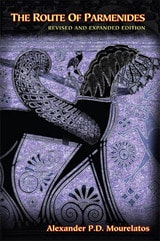
The Route of Parmenides
A new revised edition with a new introduction, three additional essays and a previously unpublished paper by Gregory VlastosAlexander P. D. Mourelatos
Parmenides Publishing, 2008