Results by title
10 books match the query 'Patronage, Political'
A Unified Theory of Collective Action and Social Change
Luis Fernando Medina
University of Michigan Press, 2007
The notion that groups form and act in ways that respond to objective, external costs and benefits has long been the key to accounting for social change processes driven by collective action. Yet this same notion seems to fall apart when we try to explain how collectivities emerge out of the choices of individuals. This book overcomes that dilemma by offering an analysis of collective action that, while rooted in individual decision making, also brings out the way in which objective costs and benefits can impede or foster social coordination. The resulting approach enables us to address the causes and consequences of collective action with the help of the tools of modern economic theory. To illustrate this, the book applies the tools it develops to the study of specific collective action problems such as clientelism, focusing on its connections with economic development and political redistribution; and wage bargaining, showing its economic determinants and its relevance for the political economy of the welfare state.
"Medina's study is a great step forward in the analytics of collective action. He shows the inadequacies of currently standard models and shows that straightforward revisions reconcile rational-choice and structural viewpoints. It will influence all future work."
—Kenneth Arrow, Stanford University
"Olson, Schelling, and now Medina. A Unified Theory deepens our understanding of collective action and contributes to the foundations of our field. A major work."
—Robert H. Bates, Harvard University
"Medina thinks that the main problem of social action is not whether or not to cooperate but how to do it. To this end he has produced an imaginative approach to analyzing strategic coordination problems that produces plausible predictions in a range of circumstances."
—John Ferejohn, Stanford University
Luis Fernando Medina is Associate Professor in the Department of Politics at the University of Virginia.
Corrupt Illinois
Patronage, Cronyism, and CriminalityThomas J. Gradel and Dick Simpson
University of Illinois Press, 2015
In Corrupt Illinois, veteran political observers Thomas J. Gradel and Dick Simpson take aim at business-as-usual. Naming names, the authors lead readers through a gallery of rogues and rotten apples to illustrate how generations of chicanery have undermined faith in, and hope for, honest government. From there, they lay out how to implement institutional reforms that provide accountability and eradicate the favoritism, sweetheart deals, and conflicts of interest corroding our civic life.
Corrupt Illinois lays out a blueprint to transform our politics from a pay-to-play–driven marketplace into what it should be: an instrument of public good.
Divide and Pacify
Strategic Social Policies and Political Protests in Post-Communist DemocraciesPieter Vanhuysse
Central European University Press, 2006
Despite dramatic increases in poverty, unemployment, and social inequalities, the Central and Eastern European transitions from communism to market democracy in the 1990s have been remarkably peaceful. This book proposes a new explanation for this unexpected political quiescence. It shows how reforming governments in Poland, Hungary and the Czech Republic have been able to prevent massive waves of strikes and protests by the strategic use of welfare state programs such as pensions and unemployment benefits.
Divide and Pacify explains how social policies were used to prevent massive job losses with softening labor market policies, or to split up highly aggrieved groups of workers in precarious jobs by sending some of them onto unemployment benefits and many others onto early retirement and disability pensions. From a narrow economic viewpoint, these policies often appeared to be immensely costly or irresponsibly populist. Yet a more inclusive social-scientific perspective can shed new light on these seemingly irrational policies by pointing to deeper political motives and wider sociological consequences.
Lincoln's Political Generals
David Work
University of Illinois Press, 2012
As the war proceeded, the value of the political generals became a matter of serious dispute. Could politicians make the shift from a political campaign to a military one? Could they be trusted to fight? Could they avoid destructive jealousies and the temptations of corruption? And with several of the generals being Irish or German immigrants, what effect would ethnic prejudices have on their success or failure?
In this book, David Work examines Lincoln's policy of appointing political generals to build a national coalition to fight and win the Civil War. Work follows the careers of sixteen generals through the war to assess their contributions and to ascertain how Lincoln assessed them as commander-in-chief. Eight of the generals began the war as Republicans and eight as Democrats. Some commanded armies, some regiments. Among them were some of the most famous generals of the Union--such as Francis P. Blair Jr., John A. Dix, John A. Logan, James S. Wadsworth--and others whose importance has been obscured by more dramatic personalities.
Work finds that Lincoln's policy was ultimately successful, as these generals provided effective political support and made important contributions in military administration and on the battlefield. Although several of them proved to be poor commanders, others were effective in exercising influence on military administration and recruitment, slavery policy, and national politics.
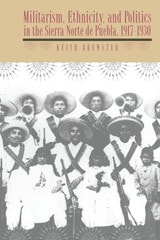
Militarism, Ethnicity, and Politics in the Sierra Norte de Puebla, 1917-1930
Keith Brewster
University of Arizona Press, 2003
Gabriel Barrios Cabrera, leader of the Brigada Serrana, rose from rural obscurity in the tiny village of Cuacuila to a position of unprecedented military strength during the Revolution, and throughout the 1920s he and his brother Demetrio came to enjoy the confidence of the nation's presidents. This work provides an in-depth look at how a local political boss held on to power. Keith Brewster reveals how the story of the Sierra is inextricably linked to that of the Barrios Cabrera family, and he investigates the ways in which this interconnection developed.
Brewster argues that Barrios owed his long prominence to his sensitivity to the region's culture, but also shows that the extent of his power was exaggerated by both contemporaries and historians. Barrios was able to develop a working relationship with the federal government by endorsing its objectives and convincing them of his own indispensability, but his authority depended on the weakness of the federal government and on infighting within the Puebla state government; once both governments stabilized, Barrios quickly lost his grip on power.
Masterfully blending archival sources and oral history, Brewster captures life in the Sierra during the 1920s and examines the decision-making processes that determined how communities responded to new pressures, such as requests for soldiers or support for development projects. He shows that subaltern groups were able to shape and even resist state reforms, mustering evidence that the Sierra's indigenous communities drove hard bargains over issues affecting their everyday lives. Although many communities used Barrios as an intermediary, Brewster reveals that they did not universally accept his legitimacy but simply used his connections to pursue their own local agendas.
Brewster depicts the Sierra de Puebla of the 1920s as a scene of shifting balances of power where political, economic, social, and ethnic factors combined to produce the temporary ascendancy of different interest groups beyond and within the region. His study forces us to question assumptions about how power was exercised at the local and regional levels in postrevolutionary Mexico and will be of lasting interest to all concerned with the dynamics of caciquismo and the evolution of the Mexican political system.
Political Monopolies in American Cities
The Rise and Fall of Bosses and ReformersJessica Trounstine
University of Chicago Press, 2008
Situating her in-depth studies of Chicago and San Jose in the broad context of data drawn from more than 240 cities over the course of a century, she finds that the answer—a resounding yes—illuminates the nature of political power. Both political machines and reform governments, she reveals, bias the system in favor of incumbents, effectively establishing monopolies that free governing coalitions from dependence on the support of their broader communities. Ironically, Trounstine goes on to show, the resulting loss of democratic responsiveness eventually mobilizes residents to vote monopolistic regimes out of office. Envisioning an alternative future for American cities, Trounstine concludes by suggesting solutions designed to free urban politics from this damaging cycle.
Poor People's Politics
Peronist Survival Networks and the Legacy of EvitaJavier Auyero
Duke University Press, 2000
Looking closely at the slum-dwellers’ informal problem-solving networks, which are necessary for material survival, and the different meanings of Peronism within these networks, Auyero presents the first ethnography of urban clientelism ever carried out in Argentina. Revealing a deep familiarity with the lives of the urban poor in Villa Paraíso, a stigmatized and destitute shantytown of Buenos Aires, Auyero demonstrates the ways in which local politicians present their vital favors to the poor and how the poor perceive and evaluate these favors. Having penetrated the networks, he describes how they are structured, what is traded, and the particular way in which women facilitate these transactions. Moreover, Auyero proposes that the act of granting favors or giving food in return for votes gives the politicians’ acts a performative and symbolic meaning that flavors the relation between problem-solver and problem-holder, while also creating quite different versions of contemporary Peronism. Along the way, Auyero is careful to situate the emergence and consolidation of clientelism in historic, cultural, and economic contexts.
Poor People’s Politics reexamines the relationship between politics and the destitute in Latin America, showing how deeply embedded politics are in the lives of those who do not mobilize in the usual sense of the word but who are far from passive. It will appeal to a wide range of students and scholars of Latin American studies, sociology, anthropology, political science, history, and cultural studies.
Power, Patronage, and the Local State in Ghana
Barry Driscoll
Ohio University Press, 2023
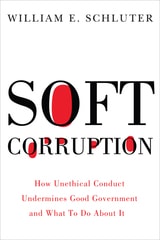
Soft Corruption
How Unethical Conduct Undermines Good Government and What To Do About ItSchluter, William E
Rutgers University Press, 2017
In this searing personal narrative, the former state senator recounts his fight to expose and reform these acts of government misconduct. Not afraid to cite specific cases of soft corruption in New Jersey politics, he paints a vivid portrait of public servants who care more about political power and personal gain than the public good. By recounting events that he witnessed firsthand in the Garden State, he provides dramatic illustrations of ills that afflict American politics nationwide.
As he identifies five main forms of soft corruption, Schluter diagnoses the state government’s ethical malaise, and offers concrete policy suggestions for how it might be cured. Not simply a dive through the muck of New Jersey politics, Soft Corruption is an important first step to reforming our nation’s political system, a book that will inspire readers to demand that our elected officials can and must do better.
Visit: www.softcorruption.com (http://www.softcorruption.com)
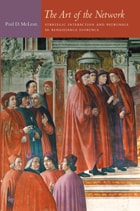
The Art of the Network
Strategic Interaction and Patronage in Renaissance FlorencePaul D. McLean
Duke University Press, 2007
McLean scrutinized thousands of letters to and from Renaissance Florentines. He describes the social protocols the letters reveal, paying particular attention to the means by which Florentines crafted credible presentations of themselves. The letters, McLean contends, testify to the development not only of new forms of self-presentation but also of a new kind of self to be presented: an emergent, “modern” conception of self as an autonomous agent. They also bring to the fore the importance that their writers attached to concepts of honor, and the ways that they perceived themselves in relation to the Florentine state.