Results by title
43 books match the query 'Petroleum industry and trade'
After Oil
Imre Szeman
West Virginia University Press, 2016
Energy plays a critical role in determining the shape, form and character of our daily existence, which is why a genuine shift in our energy usage demands a wholesale transformation of the petrocultures in which we live. After Oil provides readers with the resources to make this happen.

Artwash
Big Oil and the ArtsMel Evans
Pluto Press, 2015
Reflecting on the role and function of art galleries, Artwash considers how the association with oil money might impede these institutions in their cultural endeavors. Outside the gallery space, Mel Evans examines how corporate sponsorship of the arts can obscure the strategies of corporate executives to maintain brand identity and promote their public image through cultural philanthropy. Ultimately, Evans sounds a note of hope, presenting ways artists themselves have challenged the ethics of contemporary art galleries and examining how cultural institutions might change.
Big Oil Playground, Russian Bear Preserve or European Periphery?
The Russian Barents Sea Region towards 2015Bjørn Brunstad, Eivind Magnus, Philip Swanson, Geir Hønneland, and Indra Øverlan
Eburon Academic Publishers, 2005
The volume considers whether the international energy industry will transform Barents into a "big oil playground," if environmental protection rules will make it a "Russian bear preserve," or if integration into world trade will put it on the "European periphery." The result is a valuable resource for understanding the changing dynamics and challenges in modern public planning and a globalized economy.
Commodity Prices and Markets
Edited by Takatoshi Ito and Andrew K. Rose
University of Chicago Press, 2011
Fluctuations of commodity prices, most notably of oil, capture considerable attention and have been tied to important economic effects, such as inflation and low rates of economic growth. Commodity Prices and Markets advances our understanding of the consequences of these fluctuations, providing both general analysis and a particular focus on the countries of the Pacific Rim. The volume addresses three distinct subjects: the difficulties in forecasting commodity prices, the effects of exogenous commodity price shocks on the domestic economy, and the relationship between price shocks and monetary policy. The ability to forecast commodity prices is difficult but of great importance to businesses and governments, and this volume will be invaluable to professionals and policy makers interested in the field.
Crude Chronicles
Indigenous Politics, Multinational Oil, and Neoliberalism in EcuadorSuzana Sawyer
Duke University Press, 2004
Through her rich ethnography of indigenous marches, demonstrations, occupations, and negotiations, Sawyer tracks the growing sophistication of indigenous politics as Indians subverted, re-deployed, and, at times, capitulated to the dictates and desires of a transnational neoliberal logic. At the same time, she follows the multiple maneuvers and discourses that the multinational corporation and the Ecuadorian state used to circumscribe and contain indigenous opposition. Ultimately, Sawyer reveals that indigenous struggles over land and oil operations in Ecuador were as much about reconfiguring national and transnational inequality—that is, rupturing the silence around racial injustice, exacting spaces of accountability, and rewriting narratives of national belonging—as they were about the material use and extraction of rain-forest resources.
Energy without Conscience
Oil, Climate Change, and ComplicityDavid McDermott Hughes
Duke University Press, 2017
Fault Lines
Life and Landscape in Saskatchewan's Oil EconomyValerie Zink
University of Manitoba Press, 2016
Finding True North
First-Hand Stories of the Booms that Built Modern AlaskaMolly Rettig
University of Alaska Press, 2021
Melting sea ice and rumbling volcanoes. Sled dogs racing through unnamed valleys.
These were the images that came to mind when Molly Rettig moved to Fairbanks, Alaska to work as a reporter at the local newspaper. An avid environmentalist, she couldn’t wait to explore the vast, untamed spaces that had largely been paved over on the east coast. But when her 72-year-old neighbor, Clutch, invites her on a tour of his gold mine—an 800-foot tunnel blasted into the side of his house–she begins to question many of her ideas about Alaska, and about herself.
In Finding True North, Rettig takes us on a gripping journey through Alaska's past that brings alive the state's magnificent country and its quirky, larger-than-life characters. She meets a trapper who harvests all she needs from the land, a bush pilot who taught himself how to fly, and an archaeologist who helped build an oil pipeline through pristine wilderness. While she learns how airplanes, mines, and oil fields have paved the way for newcomers like herself, she also stumbles upon a bigger question: what has this quest for Alaska’s natural resources actually cost, and how much more is at stake?
This is a book about all the ways wild places teach us about ourselves. Rettig writes both playfully and honestly about how one place can be many things to many people—and how all of it can be true.
Fractured Communities
Risk, Impacts, and Protest Against Hydraulic Fracking in U.S. Shale RegionsLadd, Anthony E.
Rutgers University Press, 2017
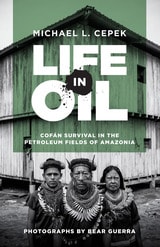
Life in Oil
Cofán Survival in the Petroleum Fields of AmazoniaBy Michael L. Cepek, Photographs by Bear Guerra
University of Texas Press, 2018
Oil is one of the world’s most important commodities, but few people know how its extraction affects the residents of petroleum-producing regions. In the 1960s, the Texaco corporation discovered crude in the territory of Ecuador’s indigenous Cofán nation. Within a decade, Ecuador had become a member of OPEC, and the Cofán watched as their forests fell, their rivers ran black, and their bodies succumbed to new illnesses. In 1993, they became plaintiffs in a multibillion-dollar lawsuit that aims to compensate them for the losses they have suffered. Yet even in the midst of a tragic toxic disaster, the Cofán have refused to be destroyed. While seeking reparations for oil’s assault on their lives, they remain committed to the survival of their language, culture, and rainforest homeland.
Life in Oil presents the compelling, nuanced story of how the Cofán manage to endure at the center of Ecuadorian petroleum extraction. Michael L. Cepek has lived and worked with Cofán people for more than twenty years. In this highly accessible book, he goes well beyond popular and academic accounts of their suffering to share the largely unknown stories that Cofán people themselves create—the ones they tell in their own language, in their own communities, and to one another and the few outsiders they know and trust. Their words reveal that life in oil is a form of slow, confusing violence for some of the earth’s most marginalized, yet resilient, inhabitants.
Lifeblood
Oil, Freedom, and the Forces of CapitalMatthew T. Huber
University of Minnesota Press, 2013
If our oil addiction is so bad for us, why don’t we kick the habit? Looking beyond the usual culprits—Big Oil, petro-states, and the strategists of empire—Lifeblood finds a deeper and more complex explanation in everyday practices of oil consumption in American culture. Those practices, Matthew T. Huber suggests, have in fact been instrumental in shaping the broader cultural politics of American capitalism.
How did gasoline and countless other petroleum products become so central to our notions of the American way of life? Huber traces the answer from the 1930s through the oil shocks of the 1970s to our present predicament, revealing that oil’s role in defining popular culture extends far beyond material connections between oil, suburbia, and automobility. He shows how oil powered a cultural politics of entrepreneurial life—the very American idea that life itself is a product of individual entrepreneurial capacities. In so doing he uses oil to retell American political history from the triumph of New Deal liberalism to the rise of the New Right, from oil’s celebration as the lifeblood of postwar capitalism to increasing anxieties over oil addiction.
Lifeblood rethinks debates surrounding energy and capitalism, neoliberalism and nature, and the importance of suburbanization in the rightward shift in American politics. Today, Huber tells us, as crises attributable to oil intensify, a populist clamoring for cheap energy has less to do with American excess than with the eroding conditions of life under neoliberalism.
Living the High Life in Minsk
Russian Energy Rents, Domestic Populism and Belarus' Impending CrisisMargarita M. Balmaceda
Central European University Press, 2014
Living the High Life in Minsk looks at the sources of stability and instability in post-Soviet authoritarian states through the case study of President Lukashenka’s firm hold on power in Belarus. In particular, it seeks to understand the role of energy relations, policies, and discourses in the maintenance of this power. The central empirical question Balmaceda seeks to answer is what has been the role of energy policies in the maintenance of Lukashenka’s power in Belarus? In particular, it analyzes the role of energy policies in the management of Lukashenka’s relationship with three constituencies crucial to his hold on power: Russian actors, the Belarusian nomenklatura, and the Belarusian electorate.
In terms of foreign relations, the book focuses on the factors explaining Lukashenka’s ability to project Belarus’ power in its relationship with Russia in such a way as to compensate for its objective high level of dependency, assuring high levels of energy subsidies and rents continuing well beyond the initial worsening of the relationship in c. 2004. In terms of domestic relations, Balmaceda examines Lukashenka’s specific use of those energy rents in such a way as to assure the continuing support of both the Belarusian nomenklatura and the Belarusian electorate.
Living with Oil
Promises, Peaks, and Declines on Mexico’s Gulf CoastBy Lisa Breglia
University of Texas Press, 2013
For decades, Mexico has been one of the world’s top non-OPEC oil exporters, but since the 2004 peak and subsequent decline of the massive offshore oilfield—Cantarell—the prospects for the country have worsened. Living with Oil takes a unique look at the cultural and economic dilemmas in this locale, focusing on residents in the fishing community of Isla Aguada, Campeche, who experienced the long-term repercussions of a 1979 oil spill that at its height poured out 30,000 barrels a day, a blowout eerily similar to the 2010 Deepwater Horizon disaster.
Tracing the interplay of the global energy market and the struggle it creates between citizens, the state, and multinational corporations, this study also provides lessons in the tug-of-war between environmentalism and the lure of profits. In Mexico, oil has held status as a symbol of nationalist pride as well as a key economic asset that supports the state’s everyday operations. Capturing these dilemmas in a country now facing a national security crisis at the hands of violent drug traffickers, cultural anthropologist Lisa Breglia covers issues of sovereignty, security, and stability in Mexico’s post-peak future.
The first in-depth account of the local effects of peak oil in Mexico, emphasizing the everyday lives and livelihoods of coastal Campeche residents, Living with Oil demonstrates important aspects of the political economy of energy while showing vivid links between the global energy marketplace and the individual lives it affects.
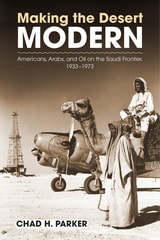
Making the Desert Modern
Americans, Arabs, and Oil on the Saudi Frontier, 1933–1973Chad Parker
University of Massachusetts Press, 2015
In 1933 American oilmen representing what later became the Arabian American Oil Company (Aramco) signed a concession agreement with the Saudi Arabian king granting the company sole proprietorship over the oil reserves in the country's largest province. As drilling commenced and wells proliferated, Aramco soon became a major presence in the region. In this book Chad H. Parker tells Aramco's story, showing how an American company seeking resources and profits not only contributed to Saudi “nation building” but helped define U.S. foreign policy during the early Cold War.
In the years following World War II, as Aramco expanded its role in Saudi Arabia, the idea of “modernization” emerged as a central component of American foreign policy toward newly independent states. Although the company engaged in practices supportive of U.S. goals, its own modernizing efforts tended to be pragmatic rather than policy-driven, more consistent with furthering its business interests than with validating abstract theories. Aramco built the infrastructure necessary to extract oil and also carved an American suburb out of the Arabian desert, with all the air-conditioned comforts of Western modern life. At the same time, executives cultivated powerful relationships with Saudi government officials and, to the annoyance of U.S. officials, even served the monarchy in diplomatic disputes. Before long the company became the principal American diplomatic, political, and cultural agent in the country, a role it would continue to play until 1973, when the Saudi government took over its operation.
Mexico and the United States in the Oil Controversy, 1917–1942
By Lorenzo Meyer; translated by Muriel Vasconcellos
University of Texas Press, 1977
From reviews of the Spanish edition:
“Meyer’s perceptive commentary on Mexican power politics presents new insights into the petroleum lobbies in Mexico City and Washington. With unbiased empathy he shows the validity of Mexico’s complaints about foreigners’ deriving an overabundance of profit from a nonrenewable natural resource. He understands United States history and never abuses his license to criticize.” —Hispanic American Historical Review
“This useful addition to the literature on twentieth-century Mexican–United States diplomatic relations is a scholarly work, worthy of consideration by all students of the subject.”—American Historical Review
Mexico and the United States in the Oil Controversy, 1917–1942 explores the relationship between the United States and Mexico during the first half of the twentieth century, with special attention to the Mexican nationalization of the oil industry. Relying on Mexican archival material never before analyzed, the author presents a unique perspective on the period following the Mexican Revolution and Mexico’s efforts to diminish its economic dependency on the United States. This work not only describes the political and economic struggle between the Mexican government and the U.S. oil companies but also serves to illustrate in general the nature of dependency between Latin American countries and the United States. It will be of interest not only to Mexican specialists but also to diplomatic and economic historians.
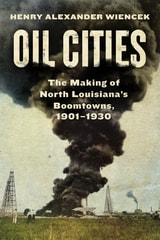
Oil Cities
The Making of North Louisiana’s Boomtowns, 1901-1930Henry Alexander Wiencek
University of Texas Press, 2024
How international oil companies navigated the local, segregated landscape of north Louisiana in the first decades of the twentieth century.
In 1904, prospectors discovered oil in the rural parishes of North Louisiana just outside Shreveport. As rural cotton fields gave way to dense, industrial centers of energy extraction, migrants from across the US—and the world—rushed to take a share of the boom. The resulting boomtowns, most notoriously Oil City, quickly gained a reputation for violence, drinking, and rough living. Meanwhile, North Louisiana’s large Black population endured virulent white supremacy in the oil fields and the courtrooms to earn a piece of the boom, including one Black woman who stood to become the wealthiest oil heiress in America.
In Oil Cities, Henry Wiencek uncovers what life was like amidst the tent cities, saloons, and oil derricks of North Louisiana’s oil boomtowns, tracing the local experiences of migrants, farmers, sex workers, and politicians as they navigated dizzying changes to their communities. This first historical monograph on the region’s dramatic oil boom reveals a contested history, in which the oil industry had to adapt its labor, tools, and investments to meet North Louisiana’s unique economic, social, political, and environmental dynamics.

Oil Culture
Ross Barrett
University of Minnesota Press, 2014
In the 150 years since the birth of the petroleum industry oil has saturated our culture, fueling our cars and wars, our economy and policies. But just as thoroughly, culture saturates oil. So what exactly is “oil culture”? This book pursues an answer through petrocapitalism’s history in literature, film, fine art, wartime propaganda, and museum displays. Investigating cultural discourses that have taken shape around oil, these essays compose the first sustained attempt to understand how petroleum has suffused the Western imagination.
The contributors to this volume examine the oil culture nexus, beginning with the whale oil culture it replaced and analyzing literature and films such as Giant, Sundown, Bernardo Bertolucci’s La Via del Petrolio, and Ben Okri’s “What the Tapster Saw”; corporate art, museum installations, and contemporary photography; and in apocalyptic visions of environmental disaster and science fiction. By considering oil as both a natural resource and a trope, the authors show how oil’s dominance is part of culture rather than an economic or physical necessity. Oil Culture sees beyond oil capitalism to alternative modes of energy production and consumption.
Contributors: Georgiana Banita, U of Bamberg; Frederick Buell, Queens College; Gerry Canavan, Marquette U; Melanie Doherty, Wesleyan College; Sarah Frohardt-Lane, Ripon College, Matthew T. Huber, Syracuse U; Dolly Jørgensen, Umeå U; Stephanie LeMenager, U of Oregon; Hanna Musiol, Northeastern U; Chad H. Parker, U of Louisiana at Lafayette; Ruth Salvaggio, U of North Carolina, Chapel Hill; Heidi Scott, Florida International U; Imre Szeman, U of Alberta; Michael Watts, U of California, Berkeley; Jennifer Wenzel, Columbia University; Sheena Wilson, U of Alberta; Rochelle Raineri Zuck, U of Minnesota Duluth; Catherine Zuromskis, U of New Mexico.

Oil Wars
Yahia Said
Pluto Press, 2007
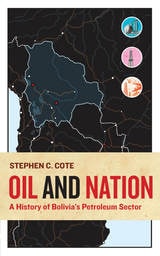
Oil and Nation
A History of Bolivia's Petroleum SectorStephen C. Cote
West Virginia University Press, 2016
The book advances chronologically from Bolivia’s earliest petroleum pioneers in the nineteenth century until the present, inserting oil into historical debates about Bolivian ethnic, racial, and environmental issues, and within development strategies by different administrations. While Bolivia is best known for its tin mining, Oil and Nation makes the case that nationalist reformers viewed hydrocarbons and the state oil company as a way to modernize the country away from the tin monoculture and its powerful backers and toward an oil-powered future.
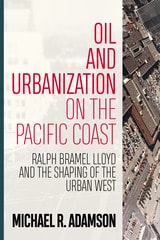
Oil and Urbanization on the Pacific Coast
Ralph Bramel Lloyd and the Shaping of the Urban WestMichael R. Adamson
West Virginia University Press, 2018
Oil and Urbanization on the Pacific Coast tells the story of oilman Ralph Bramel Lloyd, a small business owner who drove the development of one of America’s largest oil fields. Lloyd invested his petroleum earnings in commercial real estate—much of it centered around automobiles and the fuel they require—in several western cities, notably Portland, Oregon. Putting the history of extractive industry in dialogue with the history of urban development, Michael R. Adamson shows how energy is woven into the fabric of modern life, and how the “energy capital” of Los Angeles exerted far-flung influence in the US West.
A contribution to the relatively understudied history of small businesses in the United States, Oil and Urbanization on the Pacific Coast explores issues of interest to multiple audiences, such as the competition for influence over urban development waged among local growth machines and outside corporate interests; the urban rivalries of a region; the importance of public capital in mobilizing the commercial real estate sector during the Great Depression and World War II; and the relationships among owners, architects, and contractors in the execution of commercial building projects.
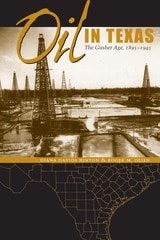
Oil in Texas
The Gusher Age, 1895-1945By Diana Davids Hinton and Roger M. Olien
University of Texas Press, 2002
As the twentieth century began, oil in Texas was easy to find, but the quantities were too small to attract industrial capital and production. Then, on January 10, 1901, the Spindletop gusher blew in. Over the next fifty years, oil transformed Texas, creating a booming economy that built cities, attracted out-of-state workers and companies, funded schools and universities, and generated wealth that raised the overall standard of living—even for blue-collar workers. No other twentieth-century development had a more profound effect upon the state.
In this book, Roger M. Olien and Diana Davids Hinton chronicle the explosive growth of the Texas oil industry from the first commercial production at Corsicana in the 1890s through the vital role of Texas oil in World War II. Using both archival records and oral histories, they follow the wildcatters and the gushers as the oil industry spread into almost every region of the state. The authors trace the development of many branches of the petroleum industry—pipelines, refining, petrochemicals, and natural gas. They also explore how overproduction and volatile prices led to increasing regulation and gave broad regulatory powers to the Texas Railroad Commission.
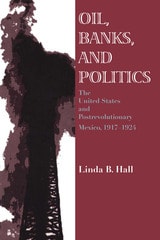
Oil, Banks, and Politics
The United States and Postrevolutionary Mexico, 1917–1924By Linda B. Hall
University of Texas Press, 1995
Mexico was second only to the United States as the world's largest oil producer in the years following the Mexican Revolution. As the revolutionary government became institutionalized, it sought to assure its control of Mexico's oil resources through the Constitution of 1917, which returned subsoil rights to the nation. This comprehensive study explores the resulting struggle between oil producers, many of which were U.S. companies, and the Mexican government.
Linda Hall goes beyond the diplomacy to look at the direct impact of a powerful, highly profitable foreign-controlled industry on a government and a nation trying to recover from a major civil war. She draws on extensive research in Mexican archives, including both government sources and the private papers of Presidents Alvaro Obregón and Plutarco Elías Calles, as well as U.S. government and private sources.
Since the North American Free Trade Agreement has expanded United States business ties to Mexico, this study of a crucial moment in U.S.-Mexican business relations will be of interest to a wide audience in business, diplomatic, and political history.
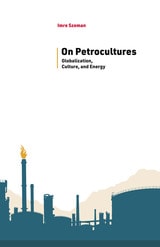
On Petrocultures
Globalization, Culture, and EnergyImre Szeman
West Virginia University Press, 2019
On Petrocultures brings together key essays by Imre Szeman, a leading scholar in the field of energy humanities and a critical voice in debates about globalization and neoliberalism. Szeman’s most important and influential essays, in dialogue with exciting new pieces written for the book, investigate ever-evolving circuits of power in the contemporary world, as manifested in struggles over space and belonging, redefinitions of work and individual autonomy, and the deep links between energy use and climate change.
These essays explore life lived in the twenty-first century by examining critically the vocabulary through which capitalism makes sense of itself, focusing on concepts like the nation, globalization, neoliberalism, creativity, and entrepreneurship. At the heart of the volume is the concept of “petrocultures,” which demands that we understand a fundamental fact of modern life: we are shaped by and through fossil fuels. Szeman argues that we cannot take steps to address global warming without fundamentally changing the social, cultural, and political norms and expectations developed in conjunction with the energy riches of the past century. On Petrocultures maps the significant challenge of our dependence on fossil fuels and probes ways we might begin to leave petrocultures behind.
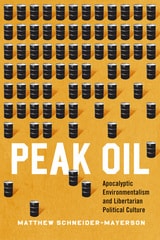
Peak Oil
Apocalyptic Environmentalism and Libertarian Political CultureMatthew Schneider-Mayerson
University of Chicago Press, 2015
In Peak Oil, Matthew Schneider-Mayerson takes readers deep inside the world of “peakists,” showing how their hopes and fears about the postcarbon future led them to prepare for the social breakdown they foresee—all of which are fervently discussed and debated via websites, online forums, videos, and novels. By exploring the worldview of peakists, and the unexpected way that the fear of peak oil and climate change transformed many members of this left-leaning group into survivalists, Schneider-Mayerson builds a larger analysis of the rise of libertarianism, the role of oil in modern life, the political impact of digital technologies, the racial and gender dynamics of post-apocalyptic fantasies, and the social organization of environmental denial.
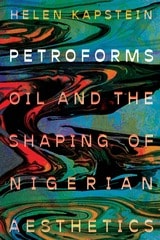
Petroforms
Oil and the Shaping of Nigerian AestheticsHelen Kapstein
West Virginia University Press, 2025
2026 PROSE Award Finalist, Humanities: Literature
Petroforms contributes a much-needed theory of form and genre to the cutting-edge field of petrocriticism, itself an offshoot of developments in postcolonial ecocriticism. Studies of resource fiction and inquiries in the energy humanities have recently taken their rightful place as necessary reflections on the role of the literary imagination in intervening in the Anthropocene as we find ourselves precariously placed in the face of a fossil fuel crisis, climate change, and mass extinctions.
With Petroforms, Helen Kapstein undertakes close readings of a range of Nigerian aesthetic forms: short stories, romance novels, documentary film, the “Nollywood” film industry, fine art sculpture, and poetry. She uses these forms to argue that the demands of paying attention to petroleum extraction, production, consumption, and distribution in the creation of resource fictions must necessarily alter and affect conventional forms and structures. What results is a new set of genre-bending forms, like documentary film that we can read as horror, in response to the forceful and fluid demands of the petroleum industry and its master narrative.
Nigeria is one of the world’s largest oil-producing nations, in which that production is concentrated in the Niger Delta, resulting in a local environment that has been steadily degraded by oil spills, flares, pollution, and contamination, and a local culture shaped by false scarcity in a space of abundance, murderous politics, and escalating violence. At the same time as the Niger Delta grounds Kapstein’s argument in its own political realities and cultural responses, Nigeria’s participation in a global economy of petrodependency allows her theory of petroforms to be extended and applied more generally.
What Peter Hitchcock calls “oil’s generative law” is that it is “everywhere and obvious, it must be opaque or otherwise fantastic.” He means the coexistence of oil’s taken-for-granted qualities is something constitutive of every level of everyday life and its spectacular displays—gushers, spills, explosions. Oil’s nature, the fact that it is everywhere, unctuously oozing into every corner of everyday life, means that it constantly spills over out of our existing forms, genres, and systems, demanding accommodation. To try to contain it, we create new forms. Thus, a petroform is simultaneously reactionary (a necessary response to oil’s pressures, a by-product of the commodity itself) and resistant (an attempt at containment, at generating a retort to the very thing that shapes it). Each form figures oil and then configures and reconfigures itself in reaction to it.
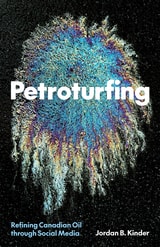
Petroturfing
Refining Canadian Oil through Social MediaJordan B. Kinder
University of Minnesota Press, 2024
How social media has become a critical tool for advancing the interests of the Canadian oil industry
Petroturfing presents an incisive look into how Canada’s pro-oil movement has leveraged social media to rebrand the extractive economy as a positive force. Adapting its title from the concept of astroturfing, which refers to the practice of disguising political and corporate media campaigns as grassroots movements, the book exposes the consequences of this mutually informed relationship between social media and environmental politics.
Since the early 2010s, an increasingly influential network of pro-oil groups, organizations, and campaigns has harnessed social media strategies originally developed by independent environmental organizations in order to undermine resistance to the fossil fuel industry. Situating these actions within the broader oil culture wars that have developed as an outgrowth of contemporary right-wing media, Petroturfing details how this coalition of groups is working to reform the public view of oil extraction as something socially, economically, and ecologically beneficial.
By uncovering these concerted efforts to influence the “energy consciousness,” Jordan B. Kinder reveals the deep divide between Canada’s environmentally progressive reputation and the economic interests of its layers of government and private companies operating within its borders. Drawing attention to the structures underlying online political expression, Petroturfing highlights the limitations of social media networks in the work of promoting environmental justice and contributing to a more equitable future.

Reckoning with Harm
The Toxic Relations of Oil in AmazoniaAmelia Fiske
University of Texas Press, 2023
2025 Margaret Mead Award, Society for Applied Anthropology (SfAA) and the American Anthropological Association (AAA)
An ethnography of the Ecuadorian Amazon that demonstrates the need for a relational, place-based, contingent understanding of harm and toxicity.
Reckoning with Harm is a striking ethnographic analysis of the harm resulting from oil extraction. Covering fifty years of settler colonization and industrial transformation of the Ecuadorian Amazon, Amelia Fiske interrogates the relations of harm. She moves between forest-courtrooms and oily waste pits, farms and toxic tours, to explore both the ways in which harm from oil is entangled with daily life and the tensions surrounding efforts to verify and redress it in practice. Attempts to address harm from the oil industry in Ecuador have been consistently confounded by narrow, technocratic understandings of evidence, toxicity, and responsibility. Building on collaborators’ work to contest state and oil company insistence that harm is controlled and principally chemical in nature, Fiske shows that it is necessary to refigure harm as relational in order to reckon with unremediated contamination of the past while pushing for broad forms of accountability in the present. She theorizes that harm is both a relationship and an animating feature of relationships in this place, a contingent understanding that is needed to contemplate what comes next when living in a toxic world.
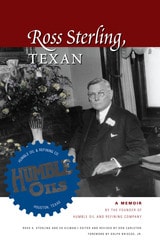
Ross Sterling, Texan
A Memoir by the Founder of Humble Oil and Refining CompanyBy Ross S. Sterling and Ed Kilman
University of Texas Press, 2007
Born on a farm near Anahuac, Texas, in 1875 and possessed of only a fourth-grade education, Ross Sterling was one of the most successful Texans of his generation. Driven by a relentless work ethic, he become a wealthy oilman, banker, newspaper publisher, and, from 1931 to 1933, one-term governor of Texas. Sterling was the principal founder of the Humble Oil and Refining Company, which eventually became the largest division of the ExxonMobil Corporation, as well as the owner of the Houston Post.
Eager to "preserve a narrative record of his life and deeds," Ross Sterling hired Ed Kilman, an old friend and editorial page editor of the Houston Post, to write his biography. Though the book was nearly finished before Sterling's death in 1949, it never found a publisher due to Kilman's florid writing style and overly hagiographic portrayal of Sterling.
In this volume, by contrast, editor Don Carleton uses the original oral history dictated by Ross Sterling to Ed Kilman to present the former governor's life story in his own words. Sterling vividly describes his formative years, early business ventures, and active role in developing the Texas oil industry. He also recalls his political career, from his appointment to the Texas Highway Commission to his term as governor, ending with his controversial defeat for reelection by "Ma" Ferguson. Sterling's reminiscences constitute an important primary source not only on the life of a Texan who deserves to be more widely remembered, but also on the history of Houston and the growth of the American oil industry.
Settling the Boom
The Sites and Subjects of Bakken OilMary E. Thomas
University of Minnesota Press, 2023
Examines how settler colonial and sexist infrastructures and narratives order a resource boom
Over the past decade, new oil plays have unsettled U.S. energy landscapes and imaginaries. Settling the Boom studies how the disruptive forces of an oil boom in the northern Great Plains are contained through the extension of settler temporalities, reassertions of heteropatriarchy, and the tethering of life to the volatility of oil and its cruel optimisms.
This collection reveals the results of sustained research in Williston, North Dakota, the epicenter of the “Bakken Boom.” While the boom brought a rapid influx of capital and workers, the book questions simple timelines of before and after. Instead, Settling the Boom demonstrates how the unsettling forces of an oil play resolve through normative narratives and material and affective infrastructures that support settler colonialism’s violent extension and its gendered orders of time and space. Considering a wide range of evidence, from urban and regional policy, interviews with city officials, media, photography, and film, these essays analyze the ongoing material, aesthetic, and narrative ways of life and land in the Bakken.
Contributors: Morgan Adamson, Macalester College; Kai Bosworth, Virginia Commonwealth U; Thomas S. Davis, Ohio State U; Jessica Lehman, Durham U.
The Credit Crunch
Housing Bubbles, Globalisation and the Worldwide Economic CrisisGraham Turner
Pluto Press, 2008
This book argues that the current financial turmoil signals a crisis in globalisation that will directly challenge the free market economic model.
Graham Turner shows that the housing bubbles in the West were deliberately created to mask the damage inflicted by companies shifting production abroad in an attempt to boost profits. As these bubbles burst, economic growth in many developed countries will inevitably tumble. The Japanese crisis of the 1990s shows that banks and governments may struggle to contain the fallout. The problem has not been limited to the US, UK and Europe: housing bubbles have become endemic across wide swathes of emerging market economies. As the West slides, these countries will see an implosion of their credit bubbles too, shaking their faith in the free market.
Turner is an experienced and successful economic forecaster, whose opinions are sought by large international banks and top financial journalists. Drawing from his first hand experience of the Japanese property crash of the 1990s, he presents his analysis in a clear and persuasive style, showing that the end of housing market growth spells disaster for neoliberal globalisation.
The Enduring Legacy
Oil, Culture, and Society in VenezuelaMiguel Tinker Salas
Duke University Press, 2009
North American and British petroleum companies, seeking to maintain their stakes in Venezuela, promoted the idea that their interests were synonymous with national development. They set up oil camps—residential communities to house their workers—that brought Venezuelan employees together with workers from the United States and Britain, and eventually with Chinese, West Indian, and Mexican migrants as well. Through the camps, the companies offered not just housing but also schooling, leisure activities, and acculturation into a structured, corporate way of life. Tinker Salas contends that these practices shaped the heart and soul of generations of Venezuelans whom the industry provided with access to a middle-class lifestyle. His interest in how oil suffused the consciousness of Venezuela is personal: Tinker Salas was born and raised in one of its oil camps.
The Licit Life of Capitalism
US Oil in Equatorial GuineaHannah Appel
Duke University Press, 2019
The Magical State
Nature, Money, and Modernity in VenezuelaFernando Coronil
University of Chicago Press, 1997
The Mexican Petroleum Industry in the Twentieth Century
Edited by Jonathan C. Brown and Alan Knight
University of Texas Press, 1992
Mexico's petroleum industry has come to symbolize the very sovereignty of the nation itself. Politicians criticize Pemex, the national oil company, at their peril, and President Salinas de Gortari has made clear that the free trade negotiations between Mexico and the United States will not affect Pemex's basic status as a public enterprise. How and why did the petroleum industry gain such prominence and, some might say, immunity within Mexico's political economy?
The Mexican Petroleum Industry in the Twentieth Century, edited by Jonathan C. Brown and Alan Knight, seeks to explain the impact of the oil sector on the nation's economic, political, and social development. The book is a multinational effort—one author is Australian, two British, three North American, and five Mexican. Each contributing scholar has researched and written extensively about Mexico and its oil industry.
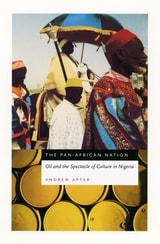
The Pan-African Nation
Oil and the Spectacle of Culture in NigeriaAndrew Apter
University of Chicago Press, 2005
According to Apter, FESTAC expanded the horizons of blackness in Nigeria to mirror the global circuits of its economy. By showcasing masks, dances, images, and souvenirs from its many diverse ethnic groups, Nigeria forged a new national culture. In the grandeur of this oil-fed confidence, the nation subsumed all black and African cultures within its empire of cultural signs and erased its colonial legacies from collective memory. As the oil economy collapsed, however, cultural signs became unstable, contributing to rampant violence and dissimulation.
The Pan-African Nation unpacks FESTAC as a historically situated mirror of production in Nigeria. More broadly, it points towards a critique of the political economy of the sign in postcolonial Africa.
The Petro-state Masquerade
Oil, Sovereignty, and Power in Trinidad and TobagoRyan Cecil Jobson
University of Chicago Press, 2024
Examining the past, present, and future of Trinidad and Tobago’s oil and gas industries, anthropologist Ryan Cecil Jobson traces how a model of governance fashioned during prior oil booms is imperiled by declining fossil fuel production and a loss of state control. Despite the twin-island nation’s increasingly volatile and vulnerable financial condition, however, government officials continue to promote it as a land of inexhaustible resources and potentially limitless profits.
The result is what Jobson calls a “masquerade of permanence” whereby Trinbagonian state actors represent the nation as an interminable reserve of hydrocarbons primed for multinational investment. In The Petro-state Masquerade, Jobson examines the gulf between this narrative crafted by the postcolonial state and the vexed realities of its dwindling petroleum-fueled aspirations. After more than a century of commercial oil production, Trinidad and Tobago instructs us to regard the petro-state as less a permanent form than a fragile relation between fossil fuels and sovereign authority. Foregrounding the concurrent masquerades of oil workers, activists, and Carnival revelers, Jobson argues that the promise of decolonization lies in the disarticulation of natural resources, capital, and political power by ordinary people in the Caribbean.
The Political Economy of Pipelines
A Century of Comparative Institutional DevelopmentJeff D. Makholm
University of Chicago Press, 2012
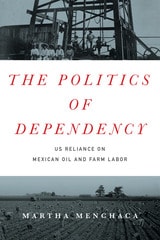
The Politics of Dependency
US Reliance on Mexican Oil and Farm LaborBy Martha Menchaca
University of Texas Press, 2016
The United States and Mexico trade many commodities, the most important of which are indispensable sources of energy—crude oil and agricultural labor. Mexican oil and workers provide cheap and reliable energy for the United States, while US petro dollars and agricultural jobs supply much-needed income for the Mexican economy. Mexico’s economic dependence on the United States is well-known, but The Politics of Dependency makes a compelling case that the United States is also economically dependent on Mexico.
Expanding dependency theory beyond the traditional premise that weak countries are dominated by powerful ones, Martha Menchaca investigates how the United States and Mexico have developed an asymmetrical codependency that disproportionally benefits the United States. In particular, she analyzes how US foreign policy was designed to enable the US government to help shape the development of Mexico’s oil industry, as well as how migration from Mexico to the United States has been regulated by the US Congress to ensure that American farmers have sufficient labor. This unprecedented dual study of energy sectors that are usually examined in isolation reveals the extent to which the United States has become economically dependent on Mexico, even as it remains the dominant partner in the relationship. It also exposes the long-term effects of the agricultural policies of NAFTA, which led to the unemployment of millions of agricultural workers in Mexico, a large percentage of whom relocated to the United States.
The Scramble for African Oil
Oppression, Corruption and War for Control of Africa's Natural ResourcesDouglas A. Yates
Pluto Press, 2012
Africa is often seen as a place to be pitied or feared as an area of instability. This book challenges these complacent assumptions, showing how our demand for oil contributes to the chronic problems plaguing the continent.
Douglas A. Yates shows how the 'scramble' by the great powers for African oil has fed corruption and undermined democracy. Yates documents how Africans have refused to remain passive in the face of such developments, forming movements to challenge this new attempt at domination.
This book is an urgent challenge to our understanding of Africa, raising questions about the consequences of our reliance on foreign resources. It will be vital reading for all those studying development and global political economy.
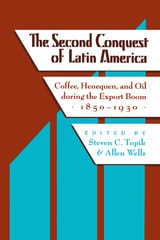
The Second Conquest of Latin America
Coffee, Henequen, and Oil during the Export Boom, 1850-1930Edited by Steven C. Topik and Allen Wells
University of Texas Press, 1997
Between 1850 and 1930, Latin America's integration into the world economy through the export of raw materials transformed the region. This encounter was nearly as dramatic as the conquistadors' epic confrontation with Native American civilizations centuries before. An emphasis on foreign markets and capital replaced protectionism and self-sufficiency as the hemisphere's guiding principles. In many ways, the means employed during this period to tie Latin America more closely to western Europe and North America resemble strategies currently in vogue. Much can be learned from analyzing the first time that Latin Americans embraced export-led growth.
This book focuses on the impact of three key export commodities: coffee, henequen, and petroleum. The authors concentrate on these rather than on national economies because they illustrate more concretely the interaction between the environment, natural and human resources, and the world economy. By analyzing how different products spun complex webs of relationships with their respective markets, the essays in this book illuminate the tensions and contradictions found in the often conflictive relationship between the local and the global, between agency and the not-so-invisible hand. Ultimately, the contributors argue that the results of the "second conquest" were not one-sided as Latin Americans and foreigners together forged a new economic order—one riddled with contradictions that Latin America is still attempting to resolve today.
The Small Matter of Suing Chevron
Suzana Sawyer
Duke University Press, 2022
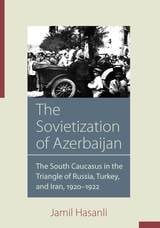
The Sovietization of Azerbaijan
The South Caucasus in the Triangle of Russia, Turkey, and Iran, 1920–1922Jamil Hasanli
University of Utah Press, 2017
World War I and the fall of tsarist Russia brought brief independence to Azerbaijan, but by 1920 the Bolshevik revolution pushed south with the twofold purpose of accessing the oil-rich fields near Baku on the Caspian Sea and spreading communism into the Caucasus. Azerbaijan, the richest and earliest significant source of oil in the world, was the first republic in the South Caucasus occupied by the Red Army, which then advanced into neighboring Armenia and Georgia. Pulling from confidential, newly accessed archives, Hasanli describes Soviet Russia’s aggressive policy toward the three South Caucasian nations, which led to their absorption into the USSR by the end of 1922.
The book highlights the Caucasian peoples’ struggle to retain political independence against Soviet Russia and an international cast that included European powers wanting to retain petroleum concessions; Kemalist Turkey, which claimed special ties to the Turkic Azeris; and Iran, which controlled South Azerbaijan and was thus a possible route of expansion eastward for Bolshevik movement. The author also considers the impact on Azerbaijani-Armenian relations of the first two years of Sovietization and explains how Azerbaijan provided space for Bolshevik experiments. Throughout his book, Hasanli illuminates the tragedy of the complex, confused period of Sovietization of the South Caucasus.
Toxic and Intoxicating Oil
Discovery, Resistance, and Justice in Aotearoa New ZealandPatricia Widener
Rutgers University Press, 2021