Results by title
9 books match the query 'Political scientists'
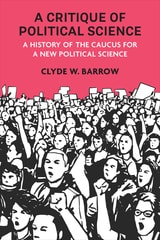
A Critique of Political Science
A History of the Caucus for a New Political ScienceClyde W. Barrow
University of Michigan Press, 2026
A Critique of Political Science distinguishes between the discipline of political science (methods and concepts) and the profession of political science (persons and institutions) to move disciplinary history beyond its current form as intellectual history toward a politics of political science. The book argues that understanding the development of a discipline requires the same type of theoretical analysis that political scientists apply to other political institutions. By examining universities and professional associations as political institutions, this approach puts political struggles and ideological conflict at the very core of disciplinary history. In reviewing 50 years of debate, controversy, and in-fighting in the political science profession, the book serves as a critique of the profession and the discipline of political science, which remains woefully disengaged from the concerns of ordinary citizens, particularly the working class and the poor throughout the world.
An Imaginative Whig
Reassessing the Life and Thought of Edmund BurkeEdited & Intro by Ian Crowe
University of Missouri Press, 2005
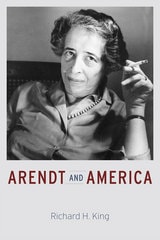
Arendt and America
Richard H. King
University of Chicago Press, 2015
Situating Arendt within the context of U.S. intellectual, political, and social history, King reveals how Arendt developed a fascination with the political thought of the Founding Fathers. King also re-creates her intellectual exchanges with American friends and colleagues, such as Dwight Macdonald and Mary McCarthy, and shows how her lively correspondence with sociologist David Riesman helped her understand modern American culture and society. In the last section of Arendt and America, King sets out the context in which the Eichmann controversy took place and follows the debate about “the banality of evil” that has continued ever since. As King shows, Arendt’s work, regardless of focus, was shaped by postwar American thought, culture, and politics, including the Civil Rights Movement and the Cold War.
For Arendt, the United States was much more than a refuge from Nazi Germany; it was a stimulus to rethink the political, ethical, and historical traditions of human culture. This authoritative combination of intellectual history and biography offers a unique approach for thinking about the influence of America on Arendt’s ideas and also the effect of her ideas on American thought.
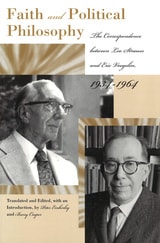
Faith and Political Philosophy
The Correspondence Between Leo Strauss and Eric Voegelin, 1934-1964Edited & Intro by Peter Emberley & Barry Cooper
University of Missouri Press, 2004
Faith and Political Philosophy consists of fifty-three letters between Leo Strauss and Eric Voegelin, two of the most important political theorists of the twentieth century. In this correspondence, Strauss and Voegelin explore the nature of their similarities and differences, offering insightful observations about one another's work, about the state of the discipline, and about the influences working on them. The letters shed light on many assumptions made in their published writings, often with an openness that removes all vestiges of uncertainty.
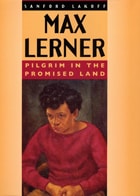
Max Lerner
Pilgrim in the Promised LandSanford Lakoff
University of Chicago Press, 1998
Politically, Lerner went through a series of metamorphoses. During the 1930s, he was an anti-fascist "popular front progressive" writing for the Nation and the New Republic. From the 1940s through the 1970s, he became the country's leading liberal columnist—first with the lively but short-lived PM, then for the New York Post. In the 1980s, however, he was repelled by the New Left and the counterculture and joined the ranks of the neoconservatives, scandalizing some readers but insisting he owed it to them to tell the truth as he saw it.
This riveting biography begins with Lerner's own gripping account of the hardships his family endured in emigrating from Russia and his own boyhood triumphs and frustrations. Sanford Lakoff traces Lerner's American pilgrimage from his education at Yale, where he felt the bitter sting of anti-Semitism, through his years as a radical inspired by Thorstein Veblen, into mellower maturity as a widely read columnist, an inspiring teacher, the author of America as a Civilization, a much-loved father, and—to the end—an unapologetic romantic, who liked to say that he never learned anything worth knowing except from women.
Robert B. Heilman and Eric Voegelin
A Friendship in Letters, 1944-1984Edited & Intro by Charles R. Embry & Foreword by Champlin B. Heilman
University of Missouri Press, 2004
Heilman and Voegelin first became acquainted around 1941, when Voegelin delivered a guest lecture for the political science department at Louisiana State University. At that time, Heilman was teaching in the English department at LSU along with Robert Penn Warren and Cleanth Brooks. What began as simple exchanges after Voegelin moved to LSU soon grew into full-fledged correspondence—beginning with an eight-page letter by Voegelin commenting on Heilman’s manuscripton Shakespeare’s King Lear. Their correspondence lasted until four months before Voegelin’s death in January 1985.
These letters represent Voegelin’s most prolonged correspondence with a native-born American scholar and provide readers with an insight into Voegelin as a literary critic. While Voegelin’s analysis of Henry James’s The Turn of the Screw is well known, these letters reveal the context from which the analysis grew. Additional comments by Voegelin on Mann, Eliot, Shakespeare, Homer, Proust, Flaubert, and other significant writers are uncovered throughout his exchanges with Heilman.
Readers will appreciate not only Heilman’s elegant style but also his efforts to clarify for himself the meaning and implications of Voegelin’s developing philosophy. Heilman’s questions are often ones that readers of Voegelin continue to ask today. In his queries, as well as in the exposition of his theories of tragedy and melodrama, human nature, and expressionist drama, Heilman displays a canny perception of the philosophical issues and problems of modernity that sustained their interdisciplinary discussion. The letters exchanged by Robert B. Heilman and Eric Voegelin demonstrate the warm friendship these two scholars shared and illuminate many of the turns and transformations in their work as they developed as thinkers.
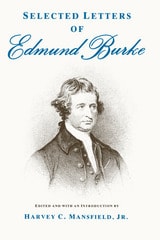
Selected Letters of Edmund Burke
Edmund Burke
University of Chicago Press, 1984
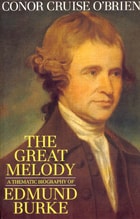
The Great Melody
A Thematic Biography of Edmund BurkeConor Cruise O'Brien
University of Chicago Press, 1992
"In bringing Burke to our attention, Mr. O'Brien has brought back a lost treasure. The Great Melody is a brilliant work of narrative sweep and analytical depth. Conor Cruise O'Brien on Edmund Burke is a literary gift to political thought."—John Patrick Diggins, New York Times Book Review
"Serious readers of history are in for a treat: a book by the greatest living Irishman on the greatest Irishman who ever lived. . . . O'Brien's study is not merely a reconstruction of a fascinating man and period. It is also a tract for the times. . . . I cannot remember another time when I finished a book of more than 600 pages wishing it were longer."—Paul Johnson, The Independent
"The Great Melody combines superb biography and fascinating history with a profound understanding of political philosophy."—Former President Richard Nixon

Yo Soy
From a Migrant Field Worker to a University ProfessorRoberto E. Villarreal
University of North Texas Press, 2025