Results by title
11 books match the query 'Portuguese'
Almost Gone
Brian Sousa
Tagus Press, 2013
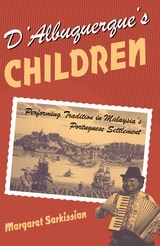
D'Albuquerque's Children
Performing Tradition in Malaysia's Portuguese SettlementMargaret Sarkissian
University of Chicago Press, 2000
Using historical and ethnographic data, Margaret Sarkissian reveals that this music and dance draws on an eclectic array of influences that span the Portuguese diaspora (one song conjures up images of Lucille Ball impersonating Carmen Miranda on "I Love Lucy"). Ironically, she shows, what began as a literate tradition in the 1950s has now become an oral one so deeply rooted in Settlement life that the younger generation, like the tourists, now see it as an unbroken heritage stretching back almost 500 years. A fascinating case of "orientalism in reverse," D'Albuquerque's Children illuminates the creative ways in which one community has adapted to life in a postcolonial world.
Literary Histories in Portuguese
João Cezar De Castro Rocha
Tagus Press, 2014
Pois não
Brazilian Portuguese Course for Spanish Speakers, with Basic Reference GrammarBy Antônio Roberto Monteiro Simões
University of Texas Press, 2008
Spanish speakers can learn Brazilian Portuguese much more rapidly than any other language, and thousands of students have used Antônio Simões's text/workbook Com licença: Brazilian Portuguese for Spanish Speakers to make the transition between the two languages. Recognizing the need for a text that incorporates current cultural references and the latest language pedagogy, Simões now offers Pois não: Brazilian Portuguese Course for Spanish Speakers, with Basic Reference Grammar.
Pois não contrasts Portuguese and Spanish, which accomplishes two main goals. It teaches the equivalent of one year of college Portuguese in one semester, three times a week, to Spanish speakers who also have a solid understanding of English. Additionally, the book serves as a basic reference guide to Brazilian Portuguese for the same audience.
Pois não can be used by students in the classroom or by independent learners. Users of the book may focus on the drills alone, concentrate on both the explanations and drills, or use the book as a reference for consultation only. Answers to all of the exercises are included in the book. Audio and video recordings by native Brazilian speakers of dialogues that appear in the book can be downloaded at https://utexas.box.com/v/PoisNaoAudio.
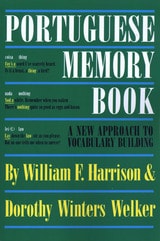
Portuguese Memory Book
A New Approach to Vocabulary BuildingBy William F. Harrison and Dorothy Winters Welker
University of Texas Press, 1996
Mnemonics is an age-old device for remembering names, numbers, and many other things. The Portuguese Memory Book, by William F. Harrison and Dorothy Welker, makes use of this reliable memory help in a series of mnemonic jingles that are by turns playful, sardonic, touching, and heroic to help both students and independent learners acquire and remember Portuguese vocabulary.
The mnemonic jingles present both the sound of the Portuguese word (indicated by syllables in underlined boldface type) and its English meaning (given by a word or phrase in boldface type):
noite (f.) night
Don't annoy Chihuahuas in the night.
If you ignore their bark, you'll feel their bite.
This innovative approach to vocabulary building is simple, effective, and entertaining. The authors also include a general pronunciation guide to Brazilian Portuguese, particularly to the Carioca dialect of Rio de Janeiro.
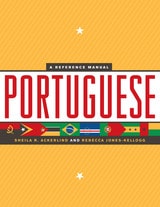
Portuguese
A Reference ManualBy Sheila R. Ackerlind and Rebecca Jones-Kellogg
University of Texas Press, 2011
An essential, comprehensive guide for all who are interested in learning the Portuguese language and mastering its complexities, Portuguese: A Reference Manual supplements the phonetic and grammatical explanations offered in basic textbooks. While the Manual focuses on Brazilian Portuguese, it incorporates European Portuguese variants and thus provides a more complete description of the language. Accessible to non-linguists and novice language learners, as well as informative for instructors of Portuguese and specialists in other languages, this guide incorporates the Orthographic Accord (in effect since 2009–2010), which attempts to standardize Portuguese orthography.
The Manual reflects the language as it is currently taught at both the undergraduate and graduate levels by providing detailed explanations of the sound and writing systems and the grammar of the principal Portuguese dialects. A reference guide rather than a textbook, the Manual also provides extensive verb charts, as well as comparisons of Portuguese with English and Spanish.
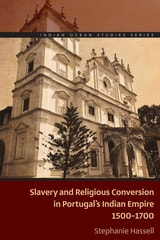
Slavery and Religious Conversion in Portugal's Indian Empire, 1500-1700
Stephanie Hassell
Ohio University Press, 2025
In the sixteenth and seventeenth centuries, enslaved Africans and Asians were part of the larger Portuguese project of building and maintaining a Catholic empire in the Indian Ocean. Both the Church and the Crown influenced the owner-slave relationship across households, the most basic organizational unit of power over the populace. Responsible for their enslaved dependents’ conversion to Catholicism, slaveholders became religious stewards whose spiritual duties toward their slaves helped expand the Christian population. This converted population was part of the imperial security apparatus, which conceptualized enslaved Catholics as loyal allies against neighboring Muslim states. They became members of the broader colonial community in which Catholicism also conveyed rights, enabled agency, and provoked household struggles between owners and slaves. Thus, the making of a Catholic empire was a contested process tied to the complex relationships between enslaved individuals, their enslavers, and the Church. The Portuguese Inquisition was a hybrid ecclesiastical and state institution, and its records detail the Crown’s commitment to the creation of a worldwide Catholic empire. Accordingly, inquisitorial encounters brought conversion, slavery, and empire into one field of vision. The Portuguese Inquisition had only one overseas tribunal, located in Goa, India. While most trial records of the Goa Tribunal were destroyed, author Stephanie Hassell has utilized extant sixteenth- and seventeenth-century cases featuring enslaved defendants and witnesses. Her use of thousands of case summaries provides a broader inquisitorial context by showing how prosecutorial trends reflected the anxieties of the Portuguese imperial state. Parish records, ecclesiastical council records, and municipal council records likewise emphasize the significance of religious conversion.

Spain and Portugal in the New World, 1492-1700
Lyle N. McAlister
University of Minnesota Press, 1984
Spain and Portugal in the New World, 1492-1700 was first published in 1984. Minnesota Archive Editions uses digital technology to make long-unavailable books once again accessible, and are published unaltered from the original University of Minnesota Press editions.
Spanish and Portuguese expansion substantially altered the social, political, and economic contours of the modern world. In his book, Lyle McAlister provides a narrative and interpretive history of the exploration and settlement of the Americas by Spain and Portugal.
McAlister divides this period (and the book) into three parts. First, he describes the formation of Old World societies with particular attention to those features that influenced the directions and forms of overseas expansion. Second, he traces the dynamic processes of conquest and colonization that between 1492 and about 1570 firmly established Spanish and Portuguese dominion in the New World. The third part deals with colonial growth and consolidation down to about 1700. McAlister's main themes are: the post-conquest territorial expansion that established the limits of what later came to be called Latin America, the emergence of distinctively Spanish and Portuguese American societies and economies, the formation of systems of imperial control and exploitation, and the ways in which conflicts between imperial and American interests were reconciled.
This comprehensive history, with its extensive bibliographic essay and attention to historiographic issues, will be a standard reference for students and scholars of the period.
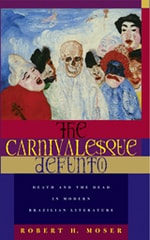
The Carnivalesque Defunto
Death and the Dead in Modern Brazilian LiteratureRobert H. Moser
Ohio University Press, 2008
Robert H. Moser details the emergence of a prominent motif in modern Brazilian literature, namely the carnivalesque defunto (the dead) that, in the form of a protagonist or narrator, returns to beseech, instruct, chastise, or even seduce the living. Drawing upon the works of esteemed Brazilian writers such as Machado de Assis, Érico Veríssimo, and Jorge Amado, Moser demonstrates how the defunto, through its mocking laughter and Dionysian resurrection, simultaneously subverts and inverts the status quo, thereby exposing underlying points of tension within Brazilian social and political history.
Incorporating elements of both a celestial advocate and an untrustworthy specter, the defunto also serves as a metaphor for one of modern Brazil’s greatest dilemmas: reconciling the past with the present.
The Carnivalesque Defunto offers a comparative framework by juxtaposing the Brazilian literary ghost with other Latin American, Caribbean, and North American examples. It also presents a cross-disciplinary approach toward understanding the complex relationship forged between Brazil’s spiritual traditions and literary expressions.

The Portuguese-Speaking Diaspora
Seven Centuries of Literature and the ArtsBy Darlene J. Sadlier
University of Texas Press, 2016
Long before the concept of “globalization,” the Portuguese constructed a vast empire that extended into Africa, India, Brazil, and mid-Atlantic territories, as well as parts of China, Southeast Asia, and Japan. Using this empire as its starting point and spanning seven centuries and four continents, The Portuguese-Speaking Diaspora examines literary and artistic works about the ensuing diaspora, or the dispersion of people within the Portuguese-speaking world, resulting from colonization, the slave trade, adventure seeking, religious conversion, political exile, forced labor, war, economic migration, and tourism.
Based on a broad array of written and visual materials, including historiography, letters, memoirs, plays, poetry, fiction, cartographic imagery, paintings, photographs, and films, The Portuguese-Speaking Diaspora is the first detailed analysis of the different and sometimes conflicting cultural productions of the imperial diaspora in its heyday and an important context for understanding the more complex and broader-based culture of population travel and displacement from the former colonies to present-day “homelands.” The topics that Darlene J. Sadlier discusses include exploration and settlement by the Portuguese in different parts of the empire; the Black Atlantic slave trade; nineteenth-century travel and Orientalist imaginings; the colonial wars; and the return of populations to Portugal following African independence. A wide-ranging study of the art and literature of these and other diasporic movements, this book is a major contribution to the growing field of Lusophone studies.
Translating from the Portuguese
A Life TranslatedElizabeth Lowe
Tagus Press, 2025
Elizabeth Lowe charts her journey to becoming a translator through a series of vignettes relating her life as a “third-culture kid” and living and working abroad in a kaleidoscope of cultures and languages. She lived in Germany as a young child immediately after the Second World War while her father worked in the Nuremberg trials and as a newly married military spouse during the Vietnam War; she lived in Haiti just prior to Papa Doc's consolidation of power, in Brazil when the military dictatorship seized the country in its two-decade vise, at the University of Coimbra, Portugal during Salazar, and Colombia at the height of the guerrilla conflicts, and in Miami during the heyday of the cartels. The book is a reflection on translation as an art, on five decades teaching languages, literatures, and translation, and on her close relationship with writers from the Lusophone world. It explores theoretical aspects of translation as well as practical challenges faced by translators, especially those working in Portuguese literature. Lowe offers intimate insights into the creative process of the writers she translates and her own philosophy of literary translation.