Results by title
14 books match the query 'Professional sports'
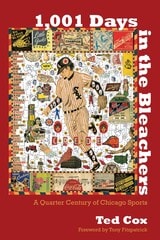
1,001 Days in the Bleachers
A Quarter Century of Chicago SportsTed Cox
Northwestern University Press, 2013
Loyal sports fans follow their teams through peaks and valleys, but in no other city have fans experienced the highs and lows of Chicagoans in the past generation. This collection of Ted Cox’s greatest hits writing "The Sports Section" for the Chicago Reader from 1983 to 2008 constitutes an intimate history of Chicago teams during these years. From the triumphs—the six titles won by the Bulls, the Super Bowl champion 1985 Bears, and the White Sox winning the World Series in 2005—to the regularly occurring collapses of the Cubs, Cox puts his audience on the scene. He evokes the fan’s experience with a level of vivid detail now nearly extinct from sports journalism. Cox writes like an ordinary observer who just happens to have excellent seats and easy access to the players and coaches. 1,001 Days in the Bleachers stands not only as a chronicle of Chicago’s teams but also as a portrait of the evolution of professional sports and their place in the life of the city.
Circling the Bases
Essays on the Challenges and Prospects of the Sports IndustryAuthored by Andrew Zimbalist
Temple University Press, 2010
In Circling the Bases, leading sports economist Andrew Zimbalist continues his discussion and analysis of the major issues and challenges confronting the sports industry in the second decade of the 21st century. Presenting a general overview of the sports business at both the college and professional levels, this volume places concerns such as the antitrust status of sports leagues, the stalled progress of gender equity in college sports, and the control of Performance Enhancing Drugs in historical context.
Zimbalist also provides a deeper understanding of how sports have fared and changed with the sharpening financial crisis and 2009 economic downturn—from the morphing role of salary caps and revenue distribution and the rapid escalation of college coaches' compensation to the financing of sports facilities and the economic impact of hosting the Olympic Games.
In Circling the Bases, Zimbalist continues to show how the business of sports is evolving and how the sports industry is becoming more closely linked with the corporate sector and thus more vulnerable to the vicissitudes of the U.S. and world economies. Zimbalist deftly shows how sports are facing the uncertainties of the future and what the implications are for sports fans, players, owners, and leagues.
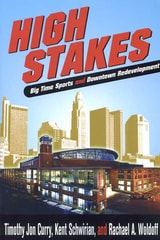
HIGH STAKES
BIGTIME SPORTS & DOWNTOWN REDEVELOPMENTTimothy Jon Curry, Kent Schwirian, and Rachael A. Woldoff
The Ohio State University Press, 2004

Kid on the Sandlot
Congress and Professional Sports, 1910–1992Stephen R. Lowe
University of Wisconsin Press, 1995
Lowe provides concise, interpretive narrative of Congress’s involvement in professional sports. Testimony is included from such colorful figures as Jackie Robinson, Casey Stengel, Pete Rozelle, Muhammad Ali, Sonny Liston, and Don King. Leading congressmen and senators are also included.

Phil Jasner "On the Case"
His Best Writing on the Sixers, the Dream Team, and BeyondAndy Jasner
Temple University Press, 2017
Allen Iverson loved Philadelphia Daily News basketball beat reporter Phil Jasner, calling him “the best” in the world of sports journalism. From 1981 until his death in 2010, Jasner was always “on the case,” going to great lengths to track athletes down for a quote or a story. He was most known for covering the team’s famous players, including World B. Free and Bobby Jones, Julius Erving and Moses Malone, Charles Barkley, and, of course, Iverson. His tremendous output was beloved by players and fans alike, earning him many honors, including inductions into six Halls of Fame.
Phil Jasner “On the Case” collects the best of Jasner’s writing throughout his illustrious career. Jasner wrote about baseball, the Eagles, and the Philadelphia Atoms’ soccer with the same insight and aplomb he showed in his coverage of The Big 5, the 76ers’ championship season in 1983, and the Dream Team. Lovingly assembled—each chapter is introduced by some of the most prominent figures Jasner covered, from Vince Papale, Doug Collins, and Billy Cunningham to Iverson and Barkley—this collection recounts a distinguished sportswriter’s remarkable career.
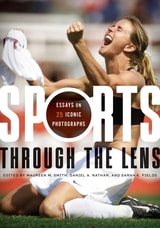
Sports through the Lens
Essays on 25 Iconic PhotographsEdited by Maureen M. Smith, Daniel A. Nathan, and Sarah K. Fields
University of Texas Press, 2024
2025 Anthology Award, North American Society for Sport History
The stories behind and legacies of important sports photos from the last 130 years.
Ever since photography and professional sports originated in the nineteenth century, photographers have shaped how we perceive sports. Sports through the Lens collects essays by twenty-five historians that consider what it means to capture and revisit a moment of cultural significance in sports, looking at each photo’s creation, its contexts, and how its meaning has shifted over time. Some essays provide fresh perspectives on such iconic images as Muhammad Ali standing over Sonny Liston at their 1965 rematch and Michael Jordan soaring at the 1988 NBA All-Star Game slam dunk competition; others introduce readers to the lesser-known stories of the first woman to officially run the Boston Marathon or the inaugural World Indigenous Games. The authors examine the photos' legacies alongside the artistry of both the athletes and the photographers. Reflecting on images of athletes from around the world engaged in sports from baseball to horse-racing to hockey, Sports through the Lens provides a wide-ranging meditation on the visual, historical, and cultural meaning of sports photographs.
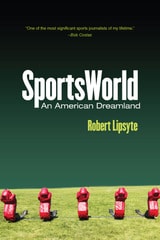
SportsWorld
An American DreamlandLipsyte, Robert
Rutgers University Press, 2018
In the America of 2017—where the SuperBowl is worth billions, athletes are penalized or forced out of sports for political and anti-racist activism, and Title IX is constantly questioned and undermined—Robert Lipsyte’s 1975 critique remains startlingly and intensely relevant.
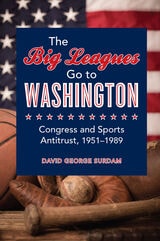
The Big Leagues Go to Washington
Congress and Sports Antitrust, 1951-1989David George Surdam
University of Illinois Press, 2015
In The Big Leagues Go to Washington, David Surdam chronicles the key issues that arose during the hearings and the ways opposing sides used economic data and theory to define what was right, what was feasible, and what was advantageous to one party or another. As Surdam shows, the hearings affected matters as fundamental to the modern game as broadcasting rights, player drafts and unions, league mergers, and the dominance of the New York Yankees. He also charts how lawmakers from the West and South pressed for the relocation of ailing franchises to their states and the ways savvy owners dodged congressional interference when they could and adapted to it when necessary.
The Bottom Line
Observations and Arguments on the Sports BusinessAndrew Zimbalist
Temple University Press, 2006
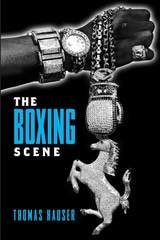
The Boxing Scene
Thomas Hauser
Temple University Press, 2008
Thomas Hauser has been called “one of boxing’s greatest writers. The Boxing Scene, Hauser’s provocative new anthology, contains all of his trademark insights and candor as he peels away layers of hypocrisy to reveal the men who make up the contemporary boxing landscape.
Hauser exposes the inner workings of HBO Sports; examines the phenomenon of mixed martial arts as it relates to boxing; and records the amusing encounter between his 81-year-old mother and larger-than-life boxing impresario Don King. The Boxing Scene also updates Hauser’s personal and professional thoughts on superstars like Oscar De La Hoya, Floyd Mayweather Jr., Ricky Hatton, Miguel Cotto, and Bernard Hopkins as well as fight promoter Bob Arum, announcer Bob Sheridan and a host of others.
The Boxing Scene recreates another year in professional boxing and adds to Hauser’s definitive record of the sport.

The Business of Professional Sports
Edited by Paul D. Staudohar and James A. Mangan
University of Illinois Press, 1991
Beyond the highly publicized heroics and foibles of players and teams, when the grandstands are empty and the scoreboards dark, there is a world of sport about which little is known by even the most ardent fan. It is the business world of sport; it is characterized by a thirst for power and money, and its players are just as active as those on the professional teams they oversee. In this collection, some of the best scholars in the field use examples from baseball, football, basketball, and hockey to illuminate the significant economic, legal, social, and historic aspects of the business of professional sports.
Contributors: Dennis A. Ahlburg, Rob B. Beamish, Joan M. Chandler, James B. Dworkin, Lawrence M. Kahn, Charles P. Korr, John J. MacAloon, David Mills, Roger G. Noll, Steven A. Reiss, Gary R. Roberts, Stephen F. Ross, Peter D. Sherer, Leigh Steinberg, and David G. Voigt,

The Fast Track
Inside the Surging Business of Women's SportsJane McManus
Temple University Press, 2025
Veteran sports journalist and academic Jane McManus examines both this upward trend and the forces that have held women’s sports back since the early 1970s when Title IX became law (and Billie Jean King soundly defeated Bobby Riggs). As the fervor for Caitlin Clark during the 2024 NCAA Women’s Basketball championship illustrates, there is big money to be made from broadcasting, merchandising, and investing in women’s sports.
The Fast Track chronicles how pioneering sponsorships, broadcast opportunities, and surges in ratings contradict the myths about disinterest. Interviews counter the resistance toward women’s leagues, reveal how women are covered in the media, and consider the possibilities for further investment. McManus also addresses racial inclusivity, transgender athletes, women’s health issues, and equal pay.
An essential road map to capitalize on untapped potential, The Fast Track provides a snapshot of where women’s sports as an industry and investment stand at this moment in time.
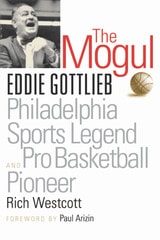
The Mogul
Eddie Gottlieb, Philadelphia Sports Legend and Pro Basketball PioneerRich Westcott
Temple University Press, 2008
Drawing upon sixty-plus interviews and many archival sources, well-known Philadelphia sports historian Rich Westcott vividly portrays Gottlieb's role in a pivotal era in city sports, in the process offering histories of the SPHAs, Warriors, and Stars and the role of Jews and African Americans in the city's sporting history.
The Sports Revolution
How Texas Changed the Culture of American AthleticsBy Frank Andre Guridy
University of Texas Press, 2021
The story of Texas’s impact on American sports culture during the civil rights and second-wave feminist movements, this book offers a new understanding of sports and society in the state and the nation as a whole.
In the 1960s and 1970s, America experienced a sports revolution. New professional sports franchises and leagues were established, new stadiums were built, football and basketball grew in popularity, and the proliferation of television enabled people across the country to support their favorite teams and athletes from the comfort of their homes. At the same time, the civil rights and feminist movements were reshaping the nation, broadening the boundaries of social and political participation. The Sports Revolution tells how these forces came together in the Lone Star State.
Tracing events from the end of Jim Crow to the 1980s, Frank Guridy chronicles the unlikely alliances that integrated professional and collegiate sports and launched women’s tennis. He explores the new forms of inclusion and exclusion that emerged during the era, including the role the Dallas Cowboys Cheerleaders played in defining womanhood in the age of second-wave feminism. Guridy explains how the sexual revolution, desegregation, and changing demographics played out both on and off the field as he recounts how the Washington Senators became the Texas Rangers and how Mexican American fans and their support for the Spurs fostered a revival of professional basketball in San Antonio. Guridy argues that the catalysts for these changes were undone by the same forces of commercialization that set them in motion and reveals that, for better and for worse, Texas was at the center of America’s expanding political, economic, and emotional investments in sport.