Results by title
10 books match the query 'Project management'
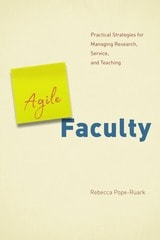
Agile Faculty
Practical Strategies for Managing Research, Service, and TeachingRebecca Pope-Ruark
University of Chicago Press, 2017
Agile work strategies are a staple of the software development world, developed out of the need to be flexible and responsive to fast-paced change at times when “business as usual” could not work. These techniques call for breaking projects into phases and short-term goals, managing assignments collectively, and tracking progress openly.
Agile Faculty is a comprehensive roadmap for scholars who want to incorporate Agile practices into all aspects of their academic careers, be it research, service, or teaching. Rebecca Pope-Ruark covers the basic principles of Scrum, one of the most widely used models, and then through individual chapters shows how to apply that framework to everything from individual research to running faculty committees to overseeing student class work. Practical and forward-thinking, Agile Faculty will help readers not only manage their time and projects but also foster productivity, balance, and personal and professional growth.
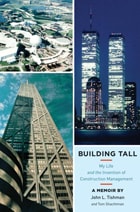
Building Tall
My Life and the Invention of Construction ManagementJohn L. Tishman and Tom Shachtman
University of Michigan Press, 2011
"John Tishman is a true pioneer in the Construction Management industry. Through his CM leadership, some of America's most well-known buildings have been brought to successful completion."
---Bruce D'Agostino, president and chief executive, Construction Management Association of America
"Building Tall will provide readers with insights into John Tishman's career as a visionary engineer, landmark builder, and great businessman. Responsible for some of the construction world's most magnificent projects, John is one of the preeminent alumni in the history of Michigan Engineering. His perspectives have helped me throughout my time as dean, and his impact will influence generations of Construction Management professionals and students."
---David C. Munson, Jr., Robert J. Vlasic Dean of Engineering, University of Michigan
In this memoir, University of Michigan graduate John L. Tishman recounts the experiences and rationale that led him to create the entirely new profession now recognized and practiced as Construction Management. It evolved from his work as the construction lead of the "owner/builder" firm Tishman Realty and Construction, and his personal role as hands-on Construction Manager in the building of an astonishing array of what were at the time the world's tallest and most complex projects. These include
- The world's first three 100-story towers---the original "twin towers" of the World Trade Center in Manhattan and the Hancock Tower in Chicago.
- The Epcot Center at Disney World.
- The Renaissance Center in Detroit.
- New York's Madison Square Garden.
Tishman interweaves the stories behind the construction of these and many other important buildings and projects with personal reminiscences of his dealings with Henry Ford, Jr., Disney's Michael Eisner, casino magnate Steve Wynn, and many others into a practical history of the field of Construction Management, which he pioneered.
This book will be of interest not only to a general public interested in the stories and personalities behind many of the most iconic construction projects of the post–World War II period in the United States but to students of engineering and architecture and members of the new field of Construction Management.

Launching Large-Scale Library Initiatives
Innovation and CollaborationValerie Horton
American Library Association, 2021
The necessity for library leaders to demonstrate that libraries are innovative, collaborative, and can provide eye-catching, transformational services and programs to their communities cannot be understated. But libraries do not suffer from a lack of big ideas. What library workers really need is a roadmap for making those impactful ideas become reality. Based in part on her extensive experience coordinating large-scale initiatives, this guide from ASCLA Leadership and Professional Achievement Award-winning consultant Horton will walk you through formulating and shaping your ideas into sellable, actionable projects. You’ll learn
- techniques drawn from project management experts and researchers from many fields;
- why Big Hairy Audacious Goals (BHAG) are worth your time and effort;
- guidance on upscaling your idea into a project or service that can be launched at a statewide, community wide, or library consortium level;
- several case studies of large-scale library projects, with analysis of why they were successful;
- how to successfully combine foundational principles of innovation with practical methods for collaboration;
- methods for extending your reach beyond your usual sphere to partner with other libraries and organizations;
- how to sharpen your skills of persuasion;
- no-nonsense advice on leading teams of disparate individuals; and
- evaluative tips for affirming the project is on the right track and then correcting course as needed.

Managing Complexity in Software Engineering
R.J. Mitchell
The Institution of Engineering and Technology, 1990
PMP Certification
A Beginner's Guide, Fourth EditionGeorge G. Angel
University Press of Colorado, 2023
This beginner’s guide will teach you real-world project management skills for any project and will help prepare you to become a certified Project Management Professional (PMP) or Certified Associate Project Manager (CAPM).
This fourth edition provides up-to-date information on how to effectively manage projects, programs, and portfolios to achieve organizational success. It includes tips and sample questions at the end of each chapter as well as a mock exam to help prepare you for the Project Management Institute (PMI) certification exams.
This text follows the three PMI domains: People, Business Environment, and Processes. A case study with detailed real-world examples, sample templates, and actual project documents guides you through your own projects, from charter to close, using all five project groups (initiating, planning, executing, monitoring and controlling, and closing projects).
This edition takes the standard processes and framework for traditional projects introduced in PMI’s sixth edition Project Management Body of Knowledge (PMBOK) and adds the new focus on Agile (adaptive) project management methods, tools, and techniques in PMBOK’s seventh edition to enhance your knowledge and ability to handle a wide range of projects.
PMP Certification
A Beginner's Guide, Third EditionGeorge G. Angel
University Press of Colorado, 2017
This accessible guide bridges the gap between being a project manager and becoming a globally recognized Project Management Professional (PMP). Aligned with A Guide to the Project Management Body of Knowledge (PMBOK® Guide), Sixth Edition, this book explains the Project Management Institute’s worldwide standard methods, five process groups, ten knowledge areas, and forty-nine processes and includes many tips to help prepare for the latest PMP exam.
Angel includes proven strategies for improving project efficiency and effectiveness, balancing constraints, communicating timely and accurate project status, and successfully bringing a project to completion. Real-world case studies followed throughout the book provide examples, checklists, and proven project results. Designed for easy learning, the book contains chapter-opening lists of specific skills covered in the chapter, Q&A sections filled with bonus information and helpful tips, real-world experiences that show how to apply particular skills, and reminders to help in preparation for the PMP exam.

PMP Certification
A Beginner's Guide, Third EditionGeorge G. Angel
University Press of Colorado, 2017
This accessible guide bridges the gap between being a project manager and becoming a globally recognized Project Management Professional (PMP). Aligned with A Guide to the Project Management Body of Knowledge (PMBOK® Guide), Sixth Edition, this book explains the Project Management Institute’s worldwide standard methods, five process groups, ten knowledge areas, and forty-nine processes and includes many tips to help prepare for the latest PMP exam.
Angel includes proven strategies for improving project efficiency and effectiveness, balancing constraints, communicating timely and accurate project status, and successfully bringing a project to completion. Real-world case studies followed throughout the book provide examples, checklists, and proven project results. Designed for easy learning, the book contains chapter-opening lists of specific skills covered in the chapter, Q&A sections filled with bonus information and helpful tips, real-world experiences that show how to apply particular skills, and reminders to help in preparation for the PMP exam.
Project Management in Libraries
On Time, On Budget, On TargetCarly Wiggins Searcy
American Library Association, 2018
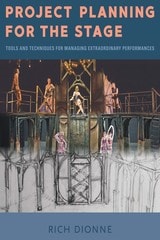
Project Planning for the Stage
Tools and Techniques for Managing Extraordinary PerformancesRich Dionne
Southern Illinois University Press, 2018
Project Planning for the Stage is organized into four sections corresponding to the life cycle of a theatre production: defining the goals and scope of the production and assembling the crew; planning, estimating, and scheduling; executing and managing; and closing and strike. Each section focuses on relevant concepts and skills and outlines the application of effective project-planning procedures and techniques—including critical path analysis and Gantt charts.
This book will be a valuable addition to the libraries of technical managers in live entertainment. Technical directors, costume shop managers, master electricians, properties masters, and video supervisors—anyone managing even part of a production—need to understand project-planning concepts such as the boundaries of authority and responsibility, parametric and bottom-up estimates, and precedence diagrams. The incredibly useful and powerful tools outlined in this book allow any technical manager to deliver the best possible outcome for a production.
Troubled IT Projects
Prevention and turnaroundJohn M. Smith
The Institution of Engineering and Technology, 2001