Results by title
119 books match the query 'Protest movements' and 10 start with a

A Guerrilla Guide to Refusal
Andrew Culp
University of Minnesota Press, 2022
A field guide to a nonfascist life at the end of the world as we know it
A Guerrilla Guide to Refusal is an unexpected approach to philosophy from a guerrilla-logic point of view. Harnessing critical theory to creatively reimagine counterinsurgency, guerrilla warfare, and interventions beyond the political mainstream, it takes us on a journey through anarchist infowar, queer outlaws, and black insurgency—through a subterranean network of communiques, military documents, contemporary art, political slogans, adversarial blogs, and captive media. In doing so, it provides powerful new insight into contemporary political movements that pose no demands, refuse labels, and offer no solutions.
Written to both inspire and provoke, A Guerrilla Guide to Refusal urges us to think through the refusal to participate in politics as usual. Author Andrew Culp demonstrates how evasion can combatively deny the existing order its power. Focusing on punk cinema, anarchist pamphlets, feminist art projects, hacker manifestos, and guerrilla manuals, he foregrounds invisibility as a novel force of disruption. He draws on concepts of criminality, fugitivity, and anonymity to bring a more nuanced understanding of how power makes things—and people—visible.
The book’s unique format is that of a theoretical manual, comprising freestanding segments instead of blueprints. Poised to reach beyond the academy into activist circles, this potent theory-in-action intervention forces us to reconsider the terrain upon which our struggles against patriarchy, anti-Blackness, capitalism, and the state operate.
A Voice but No Power
Organizing for Social Justice in MinneapolisDavid Forrest
University of Minnesota Press, 2022
Examining the work of social justice groups in Minneapolis following the 2008 recession
Since the Great Recession, even as protest and rebellion have occurred with growing frequency, many social justice organizers continue to displace as much as empower popular struggles for egalitarian and emancipatory change. In A Voice but No Power, David Forrest explains why this is the case and explores how these organizers might better reach their potential as advocates for the abolition of exploitation, discrimination, and other unjust conditions.
Through an in-depth study of post-2008 Minneapolis—a center of progressive activism—Forrest argues that social justice organizers so often fall short of their potential largely because of challenges they face in building what he calls “contentious identities,” the public identities they use to represent their constituents and counteract stigmatizing images such as the “welfare queen” or “the underclass.” In the process of assembling, publicizing, and legitimating contentious identities, he shows, these organizers encounter a series of political hazards, each of which pushes them to make choices that weaken movements for equality and freedom. Forrest demonstrates that organizers can achieve better outcomes, however, by steadily working to remake their hazardous political terrain.
The book’s conclusion reflects on the 2020 uprising that followed the police killing of George Floyd, assessing what it means for the future of social justice activism. Ultimately, Forrest’s detailed analysis contributes to leading theories about organizing and social movements and charts possibilities for further emboldening grassroots struggles for a fairer society.

A Woman in the Crossfire
Diaries of the Syrian RevolutionSamar Yazbek
Haus Publishing, 2012
Abolition Revolution
Aviah Day
Pluto Press, 2022
George Floyd's murder in Minneapolis triggered abolitionist shockwaves. Calls to defund the police found receptive ears around the world. Shortly after, Sarah Everard's murder by a serving police officer sparked a national abolitionist movement in Britain. But to abolish the police, prisons and borders, we must confront the legacy of Empire.
Abolition Revolution is a guide to abolitionist politics in Britain, drawing out rich histories of resistance from rebellion in the colonies to grassroots responses to carceral systems today. The authors argue that abolition is key to reconceptualising revolution for our times - linking it with materialist feminisms, anti-capitalist class struggle, internationalist solidarity and anti-colonialism.
Perfect for reading groups and activist meetings, this is an invaluable book for those new to abolitionist politics - whilst simultaneously telling a passionate and authoritative story about the need for abolition and revolution in Britain and globally.
Acts of Authority/Acts of Resistance
Theater and Politics in Colonial and Postcolonial IndiaNandi Bhatia
University of Michigan Press, 2004
Nandi Bhatia argues that Indian theater was a significant force in the struggle against oppressive colonial and postcolonial structures, as it sought to undo various schemes of political and cultural power through its engagement with subjects derived from mythology, history, and available colonial models such as Shakespeare. Bhatia's attention to local histories within a postcolonial framework places performance in a global and transcultural context. Drawing connections between art and politics, between performance and everyday experience, Bhatia shows how performance often intervened in political debates and even changed the course of politics.
One of the first Western studies of Indian theater to link the aesthetics and the politics of that theater, Acts of Authority/Acts of Resistance combines in-depth archival research with close readings of dramatic texts performed at critical moments in history. Each chapter amplifies its themes against the backdrop of specific social conditions as it examines particular dramatic productions, from The Indigo Mirror to adaptations of Shakespeare plays by Indian theater companies, illustrating the role of theater in bringing nationalist, anticolonial, and gendered struggles into the public sphere.
Nandi Bhatia is Associate Professor of English at the University of Western Ontario.
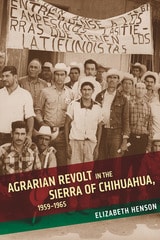
Agrarian Revolt in the Sierra of Chihuahua, 1959–1965
Elizabeth Henson
University of Arizona Press, 2019
Thousands of students joined the campesino protests in long-distance marches, land invasions, and direct actions that transcended political parties and marked the participants’ emergence as political subjects. The Popular Guerrilla Group (GPG) took shape from sporadic armed conflicts in the sierra. Early victories in the field encouraged the GPG to pursue more ambitious targets, and on September 23, 1965, armed farmers, agricultural workers, students, and teachers attacked an army base in Madera, Chihuahua. This bold move had deadly consequences.
With a sympathetic yet critical eye, historian Elizabeth Henson argues that the assault undermined and divided the movement that had been in its cradle, sacrificing the most militant, audacious, and serious of a generation at a time when such sacrifices were more frequently observed. Henson shows how local history merged with national tensions over one-party rule, the unrealized promises of the Mexican Revolution, and international ideologies.
An Anti-Bolshevik Alternative
The White Movement and the Civil War in the Russian NorthLiudmila Novikova, Translated by Seth Bernstein
University of Wisconsin Press, 2018
Novikova draws on declassified archives and sources in both Russia and the West to reveal the White movement in the north as a complex social and political phenomenon with a distinct regional context. She documents the politics of the Northern Government and its relations with the British and American forces who had occupied the ports of Murmansk and Arkhangelsk at the end of World War I. As the civil war continued, the increasing involvement of the local population transformed the conflict into a ferocious "people's war" until remaining White forces under General Yevgeny Miller evacuated the region in February 1920.
Arkansas’s Gilded Age
The Rise, Decline, and Legacy of Populism and Working-Class ProtestMatthew Hild
University of Missouri Press, 2018
The story of farmer and labor protest in Arkansas during the late nineteenth century offers lessons relevant to contemporary
working-class Americans in what some observers have called the “new Gilded Age.”

Arms and the People
Popular Movements and the Military from the Paris Commune to the Arab SpringEdited by Mike Gonzalez and Houman Barekat
Pluto Press, 2012
Arms and the People explores the impact of profound social polarisation on the internal cohesion of the state’s ‘armed bodies of men’ and on the contested loyalties of soldiers. The different contributors examine a series of historical moments in which a crisis in the military institution has reflected a deeper social crisis which has penetrated that institution and threatened to disable it.
With a range of international contributors who have either studied or been directly involved in such social upheavals, Arms and the People is a pioneering contribution to the study of revolutionary change and will appeal to students and academics in history, politics and sociology.
Articulating Dissent
Protest and the Public SpherePollyanna Ruiz
Pluto Press, 2014
Articulating Dissent analyses the new communicative strategies of coalition protest movements and how these impact on a mainstream media unaccustomed to fractured articulations of dissent.
Pollyanna Ruiz shows how coalition protest movements against austerity, war and globalisation build upon the communicative strategies of older single issue campaigns such as the anti-criminal justice bill protests and the women’s peace movement. She argues that such protest groups are dismissed in the mainstream for not articulating a ‘unified position’ and explores the way in which contemporary protesters stemming from different traditions maintain solidarity.
Articulating Dissent investigates the ways in which this diversity, so inherent in coalition protest, affects the movement of ideas from the political margins to the mainstream. In doing so this book offers an insightful and original analysis of the protest coalition as a developing political form.