Results by title
19 books match the query 'Public Speaking & Speech Writing'
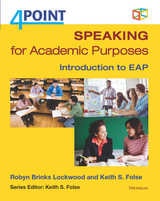
4 Point Speaking for Academic Purposes
Introduction to EAPRobyn Brinks Lockwood and Keith S. Folse
University of Michigan Press, 2017
The 4 Point series is designed for English language learners whose primary goal is to succeed in an academic setting. Academic English learners need skills-based books that focus on reading, listening, and speaking, as well as the two primary language bases of vocabulary and grammar. The ultimate goal is to help your students improve these skills and earn a 4.0 (GPA).
The Introduction to English for Academic Purposes (EAP) level is designed for students in academic programs who need a more general introduction to authentic academic content. The discrete skills volumes are designed for programs and courses that want to more intensively focus on key strategies and authentic academic content in one skill area.
Each 4 Point volume covers academic skills while providing reinforcement and systematic recycling of key vocabulary issues and further exposure to grammar issues. These volumes focus very heavily on vocabulary because language learners know that they are way behind their native-speaker counterparts when it comes to vocabulary. Each book highlights key vocabulary items, including individual words, compound words, phrasal verbs, short phrases, idioms, metaphors, collocations and longer set lexical phrases.
Speaking for Academic Purposes is an introductory textbook containing English for Academic Purposes content. Each unit includes activities to strengthen a range of speaking skills, notably: understanding classroom discourse, using academic language functions, recognizing signal words and phrases, and synthesizing information. These activities are presented within the context of one field of academic study (Architecture, Marketing, Earth Science, U.S. History, Chemistry, and Fine Arts) per unit.
Unique to this speaking text are six videos showing common student interactions. Access to the videos is free.
Each unit includes three academic speaking strategies (including one specific to making presentations) and tasks that involve participating in group discussions, interacting with native speakers, and making a presentation. The goal is to provide students with a variety of strategies/tools to master academic situations in which they need to participate.
Argumentation Theory and the Rhetoric of Assent
David Williams
University of Alabama Press, 1990
The eleven essays coalesce around the general question of "When, if ever, is assent justified?" And, as Professor Cox astutely notes in his introduction, such a question immediately leads into considerations of argument and power. In these considerations, many differing perspectives are represented in this volume: aesthetic and symbolist approaches, rationalistic and formalistic approaches, field theory perspectives, orientations toward various conceptualizations of a public sphere, etc.
Argumentation Theory and the Rhetoric of Assent is intended not as a primer on argument theory but rather as a look at American approaches to a philosophy of argumentation and argument criticism. As such, the essays probe the implications of both current practices and theoretical approaches: the objective is not to map the terrain argumentation theory has traversed in recent years but rather to plot a route for the direction in which argumentation studies should move. The concluding essays by James Arnt Aune and G. Thomas Goodnight confront these concerns explicitly.
Averroes’ Middle Commentary on Aristotle’s Rhetoric
Arabic-English Translation, with Notes and IntroductionLahcen El Yazghi Ezzaher
Southern Illinois University Press, 2023
Abū al-Walīd Muḥammad ibn Aḥmad ibn Rushd (d. 1198 AD), known as Averroes in the West, wrote one of the most significant medieval Arabic commentaries on Aristotle’s famous treatise, Rhetoric. Averroes worked within a tradition that included the Muslim philosophers Al-Farabi (d. 950) and Avicenna (d. 1037), who together built an early canon introducing Aristotle’s writings to the academies of medieval Europe. Here, for the first time, Lahcen El Yazghi Ezzaher translates Averroes’ Middle Commentary into English, with analysis highlighting its shaping of philosophical thought.
Ibn Rushd was born into a prominent family living in Córdoba and Seville during the reign of the Almoḥad dynasty in the Maghreb and al-Andalus. At court, he received support to write a body of rhetorical commentaries extending the work of his Arabic-Muslim predecessors, a critical step in fostering Aristotle’s influence on European scholasticism and Western education. Ezzaher’s meticulous translation of Averroes’ Middle Commentary reflects the depth and breadth of this engagement, incorporating a discussion of the Arabic-Muslim commentary tradition and Averroes’ contribution to it. His research illuminates the complexity of Averroes’ position, articulating the challenges Muslim scholars faced in making non-Muslim texts available to their community. Through his work, we see how people at different historical moments have adapted intellectual concepts to preserve rhetoric’s vitality and relevance in new contexts.
Averroes’ Middle Commentary exemplifies the close connections between ancient Greece and medieval Muslim scholarship and the ways Muslim scholars navigated an appreciation for Aristotelian philosophy alongside a commitment to their cultural and religious systems.
Cicero on Oratory and Orators
Translated by J.S. Watson. Introduction by Ralph A. Micken. Foreword by David Potter. Preface by Richard Leo Enos
Southern Illinois University Press, 1986
Contains Cicero’s De Oratore and Brutus, influential sources over the centuries for ideas on rhetoric and training for public leadership.
The De Oratore, written in 55 B.C., argues that rhetoric is socially significant because states are established and maintained through the leadership of eloquent men.
The three books of dialogues in this volume feature discussions between well-known figures in Roman history, including Lucius Crassus, Marcus Antonius, Quintus Lutatius Catulus, Quintus Marcius Scaevola, Caius Aurelius Cotta, Julius Caesar Strabo Vopicus, and Publius Sulpicus Rufus.
The Brutus continues the theme of the dialogues, giving a history of eminent orators whose performances exemplify the Ciceronian theory that rhetoric finally adds up to leadership.
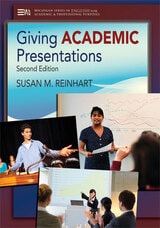
Giving Academic Presentations, Second Edition
Susan M. Reinhart
University of Michigan Press, 2013
Giving Academic Presentations provides guidance on academic-style presentations for university students. A goal of the text is to make presenters aware that giving an effective academic presentation requires mastery of a broad range of skills.
The presentation genres addressed in the book are: making introductions, describing and comparing objects, explaining a process, defining a concept, and giving a problem-solution speech. Among the many academic skills and concepts addressed in the book are:
- Examination of major speech types and the accompanying organizational strategies
- Discussion of speech overviews and suggestions for designing them and creating visuals to accompany them
- Suggestions for speaker-listener interaction including checking for understanding, soliciting questions from the audience, preparing for and responding to questions, and interrupting the speaker to ask questions or request clarification
- Discussion of the importance of using evidence in academic speaking and the advantages of using certain types of evidence
- Suggestions of ways to qualify claims and strategies for making weaker or stronger claims
- Strategies and practice to improve pausing, stress, and intonation
- Practical advice about preparing and practicing speeches
- Opportunities for presenters to evaluate their own and others’ work
The Second Edition includes many new tasks and additional speeches; more attention to working with and using visuals; information about computer projection and using PowerPoint; and new sections on presenting biographical information, referring to handouts, and giving research presentations.
Good with Words
Speaking and PresentingPatrick Barry
Michigan Publishing Services, 2021
This book is designed to help you find out. Based on an award-winning course and workshop series at the University of Michigan taken by students training to enter a wide range of fields—law, business, medicine, social work, public policy, design, engineering, and many more—it removes the guesswork from figuring out how to communicate clearly and compellingly. All of us have ideas that are worth sharing. Why not learn how to convey yours in a way that people will appreciate, enjoy, and remember?
Handbook for Science Public Information Officers
W. Matthew Shipman
University of Chicago Press, 2015
W. Matthew Shipman’s Handbook for Science Public Information Officers covers all aspects of communication strategy and tactics for members of this growing specialty. It includes how to pitch a story, how to train researchers to navigate interviews, how to use social media effectively, and how to respond to a crisis. The handbook offers a wealth of practical advice while teaching science PIOs how to think critically about what they do and how they do it, so that they will be prepared to take advantage of any situation, rather than being overwhelmed by it.
For all science communicators—whether they’re starting their careers, crossing over from journalism or the research community, or professional communicators looking to hone their PIO skills—Shipman’s Handbook for Science Public Information Officers will become their go-to reference.
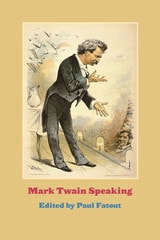
Mark Twain Speaking
Paul Fatout
University of Iowa Press, 1976
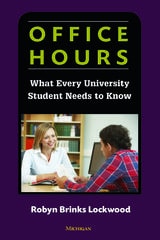
Office Hours
What Every University Student Needs to KnowRobyn Brinks Lockwood
University of Michigan Press, 2019
This task-based book also describes the five moves, or parts, of an office hour interaction and provides many examples and tasks to help guide students through this important communicative aspect of academic life. It seeks to ensure that every office hour interaction ends on a positive note.
Reflection questions for new teaching assistants are included throughout, making this ideal for TA workshops. Four analysis tasks are included to accompany the four videos that explore various student-professor interactions. The videos are available online at www.press.umich.edu/elt/compsite/officehours.
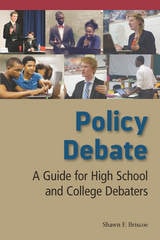
Policy Debate
A Guide for High School and College DebatersShawn F. Briscoe
Southern Illinois University Press, 2017
Briscoe addresses all aspects of policy debate, including stock issues, judging paradigms and effective engagement with judges, the responsibilities of both affirmative and negative teams, and the evaluation of policy proposals through the use of disadvantages, counterplans, and critical argumentation. In addition, Briscoe helps debaters better establish their credibility, improve their cross-examination skills, and understand the specialized notetaking method called flowing. The book models for readers how to effectively cross-examine an opposing team, features a transcript of a mock debate designed to help clarify the lessons taught in previous chapters, and includes a glossary of key terms. Briscoe also considers contemporary trends in the debate community, exploring the evolution of policy debate and the rise of performance-based approaches, while providing insight into how best to engage with performance teams.
Offering a unique approach presented by a seasoned debate coach, Policy Debate: A Guide for High School and College Debaters goes beyond the basics to explore how policy is an ever-evolving form of debate. This attention to the progression of policy styles will make readers better at adapting to opponents during a debate and will make them more adept at arguing against a wider range of cases.
Prophets, Gurus, and Pundits
Rhetorical Styles and Public EngagementAnna M. Young
Southern Illinois University Press, 2014
In Prophets, Gurus, and Pundits, author Anna M. Young proposes that the difficulty of bridging the gap between intellectuals and the public is not a failure of ideas; rather, it is an issue of rhetorical strategy. By laying a rhetorical foundation and presenting analytical case studies of contemporary “public intellectuals,” Young creates a training manual for intellectuals who seek to connect with a public audience and effect change writ large.
Young begins by defining key aspects of rhetorical style before moving on to discuss the specific ways in which intellectuals may present ideas to a general audience in order to tackle large-scale social problems. Next, she defines the ways in which five crucial turning points in our nation—the rise of religious fundamentalism, a growing lack of trust in our institutions, the continued destruction of the environment, the ubiquity of media and information in our daily lives, and the decline of evidence-based reasoning—have set the stage for opportunities in the current public-intellectual dialogue.
Via case studies of such well-known personalities as Deepak Chopra and Professor Cornel West, Young goes on to reveal the six types of public intellectuals who achieve success in presenting scholarly ideas to audiences at large:
The Prophet presents the public’s sins for contemplation, then offers a path to redemption.
The Guru shepherds his or her flock to enlightenment and a higher power.
The Sustainer draws upon our natural and human resources to proffer solutions for social, political, and ecological systems.
The Pundit utilizes wit and brevity to bring crucial issues to the attention of the public.
The Narrator combines a variety of perspectives to create a story the average person can connect with and understand.
The Scientist taps into the dreams of the public to offer ideas from above and beyond the typical scope of public discourse.
At once a rallying cry and roadmap, The Politics of Thinking Out Loud draws upon rhetorical expertise and analysis of contemporary public intellectuals to offer a model for scholars to effectively engage the public—and in doing so, perhaps forever change the world in which we live.

Quintilian on the Teaching of Speaking and Writing
Translations from Books One, Two and Ten of the Institutio oratoriaJames J. Murphy
Southern Illinois University Press, 1987
Quintilian’s method is based on the interrelationship between speaking, reading, and writing. Murphy lists and defines the main elements that appear in the Institutio oratorio. Each of these elements—Precept, Imitation, Composition Exercises, Declamation, and Sequencing—is further subdivided according to goals and exercises.
The first two books of the Institutio oratorio concern the early education of the orator, with the focus on the interplay between seen-language and heard-language. Book Ten is an adult’s commentary on the instruction of rhetoric. It involves itself primarily with facilitas, the readiness to use language in any situation.
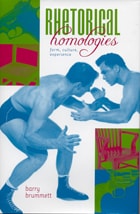
Rhetorical Homologies
Form, Culture, ExperienceBarry Brummett
University of Alabama Press, 2009
A highly developed study of the relationships between rhetoric and public culture.
One of the most widely used ideas in scholarship of the humanities and social sciences is that of homology: a formal pattern structuring different kinds of texts, ideas, and experiences. Rhetorical Homologies explores the central meaning of this form in a variety of discourses and also examines the kind of homologies that shape audience responses to personal, public, and political issues. Barry Brummett is most interested in homologies among very different orders of experience and texts: experiences on the battlefield that are homologous to those at a dining room table, for instance. What the common patterns that underlie such cases mean, why they are interesting, and why homology is rhetorical are the subjects of this study.
Brummett focuses on a wide range of topics, from the homologies between rhetoric and weapons throughout history to the homology of ritual injuries as manifested in representations of Christian martyrs, Laurel and Hardy films, the African-American practice of playing the dozens, and televised professional wrestling. Brummett also explores the homology of the Wise Woman, using rhetorical representations of Sojourner Truth and Oprah Winfrey. In a concluding chapter, Brummett argues that the idea of homology is important in understanding how social life is organized in general and that the centrality of discourse in organizing experience makes rhetorical homologies an important perspective for general knowledge beyond the boundaries of this study.

Rhetorical Questions
Studies of Public DiscourseEdwin Black
University of Chicago Press, 1992
Locating rhetorical studies at the confluence of literature and politics, Black focuses on the ideological component of seemingly literary texts and the use of literary devices to advance political advocacy. The essays collected here range in subject matter from nineteenth-century oratory to New York Times editorials to the rhetoric of Richard Nixon. Unifying the collection are the concerns of secrecy and disclosure, identity, opposition, the scope of argument in public persuasion, and the historical mutability of rhetorical forms.
Speaking in Social Contexts
Communication for Life and Study in the U.S.Robyn Brinks Lockwood
University of Michigan Press, 2018
The text provides language to use for a variety of functions as they might related to life on a university campus: offering greetings and goodbyes, making introductions, giving opinions, agreeing and disagreeing, using the phone, offering assistance, asking for advice, accepting and declining invitations, giving and receiving compliments, complaining, giving congratulations, expressing condolences, and making small talk. Users are also taught to think beyond the words and to interpret intonation and stress (how things sound).
Each of the 10 units includes discussion prompts, language lessons, practice activities, get acquainted tasks (interacting with native speakers), and analysis opportunities (what did they discover and what can they apply?).
The Will of a People
A Critical Anthology of Great African American SpeechesEdited with Introductions by Richard W. Leeman and Bernard K. Duffy
Southern Illinois University Press, 2012
Normal0falsefalsefalseEN-USX-NONEX-NONE
Drawing upon nearly two hundred years of recorded African American oratory, The Will of a People: A Critical Anthology of Great African American Speeches,edited by Richard W. Leeman and Bernard K. Duffy, brings together in one unique volume some of this tradition’s most noteworthy speeches, each paired with an astute introduction designed to highlight its most significant elements.
Arranged chronologically, from Maria Miller Stewart’s 1832 speech “Why Sit Ye Here and Die?” to President Barack Obama’s 2009 inaugural address, these orations are tied to many of the key themes and events of American history, as well as the many issues and developments in American race relations. These themes, events, and issues include the changing roles of women, Native American relations, American “manifest destiny,” abolitionism, the industrial revolution, Jim Crow, lynching, World War I and American self-determination, the rise of the New Deal and government social programs, the Civil Rights Movement and desegregation, the Vietnam War, Nixon and Watergate, gay and lesbian rights, immigration, and the rise of a mediated culture. Leeman and Duffy have carefully selected the most eloquent and relevant speeches by African Americans, including those by Sojourner Truth, Frederick Douglass, Frances Ellen Watkins Harper, Ida B. Wells-Barnett, Booker T. Washington, Mary Church Terrell, W. E. B. Du Bois, Marcus Garvey, Martin Luther King Jr., Malcolm X, Stokely Carmichael, Barbara Jordan, Jesse Jackson, and Marian Wright Edelman, many of which have never received significant scholarly attention.
The Will of a People is the first book to pair the full texts of the most important African American orations with substantial introductory essays intended to guide the reader’s understanding of the speaker, the speech, its rhetorical interpretation, and the historical context in which it occurred. Broadly representative of the African American experience, as well as what it means to be American, this valuable collectionwill serve as an essential guide to the African American oratory tradition.
Three Arabic Treatises on Aristotle’s Rhetoric
The Commentaries of al-Farabi, Avicenna, and AverroesTranslated, with introduction and notes, by Lahcen Elyazghi Ezzaher
Southern Illinois University Press, 2015
Winner, 2018 MLA Aldo and Jeanne Scaglione Prize for a Translation of a Scholarly Study of Literature
It is increasingly well documented that western rhetoric’s journey from pagan Athens to the medieval academies of Christian Europe was significantly influenced by the intellectual thought of the Muslim Near East. Lahcen Elyazghi Ezzaher contributes to the contemporary chronicling of this influence in Three Arabic Treatises on Aristotle’s Rhetoric: The Commentaries of al-Farabi, Avicenna, and Averroes, offering English translations of three landmark medieval Arabic commentaries on Aristotle's famous rhetorical treatise together in one volume for the first time. Elegant and practical, Elyazghi Ezzaher’s translations give English-speaking scholars and students of rhetoric access to key medieval Arabic rhetorical texts while elucidating the unique and important contribution of those texts to the revival of European interest in the rhetoric and logic of Aristotle, which in turn influenced the rise of universities and the shaping of Western intellectual life.
With a focus on Book I of Aristotle’s Rhetoric, the commentaries ofal-Farabi, Avicenna, and Averroes translated by Elyazghi Ezzaher are paramount examples of an extensive Arabic-Muslim tradition of textual commentary while also serving as rich corollaries to the medieval Greek and Latin rhetorical commentaries produced in Europe. Elyazghi Ezzaher’s translations are each accompanied by insightful scholarly introductions and notes that contextualize—both historically and culturally—these immensely significant works while highlighting a comparative, multidisciplinary approach to rhetorical scholarship that offers new perspectives on one of the field’s foundational texts.
A remarkable addition to rhetorical studies, Three Arabic Treatises on Aristotle’s Rhetoric: The Commentaries of al-Farabi, Avicenna, and Averroes not only provides vibrant English translations of essential medieval Arabic rhetorical texts but also challenges scholars and students of rhetoric to consider their own historical, cultural, and linguistic relationships to the texts and objects they study.
Transcending the Game
Debate, Education, and SocietyEdited by Shawn F. Briscoe
Southern Illinois University Press, 2024
A pathway to community, growth, and change
This collection of inclusive essays explores the role of debate in understanding and critiquing injustice and inequality. Edited by Shawn F. Briscoe, these essays closely examine multiple approaches to debate, considering their respective merits and controversies. This detailed compilation analyzes how debate methodologies are useful in everyday life and whether certain approaches have any value at all.
Briscoe provides an in-depth look into the varying styles of debate and contributes to a greater understanding of argument theory by discussing three stylistic approaches: audience-centered, technical/progressive, and nontraditional/performative. The book demonstrates that all three approaches offer students opportunity to engage in a socioemotional learning space, a discipline that prepares students for undergraduate and graduate work, a study that prepares participants for future careers, and a field that investigates current controversies and how to tackle them. Briscoe offers compelling narratives from BIPOC, LGBTQIA, and women authors that explore the personal impact of debate on social equality within this academic discipline, our educational system, and society.
The diversity in gender and race of the contributing authors allows for a multitude of perspectives on the complex styles, benefits, and issues discussed in Transcending the Game. Briscoe peels back the mystery that shrouds the benefits of academic, competitive debate from outsiders and insiders alike. A myriad of personal narratives tell stories about the role of debate in their lives; challenge the unproductive discourse in debate, education, and society; and offer diverse insight into why we debate.
You're On!
101 Tips to improve your public speaking skillsRuth Stotter
Parkhurst Brothers, Inc., 2016