Results by title
38 books match the query 'Public spaces'
Against the Commons
A Radical History of Urban PlanningÁlvaro Sevilla-Buitrago
University of Minnesota Press, 2022
An alternative history of capitalist urbanization through the lens of the commons
Characterized by shared, self-managed access to food, housing, and the basic conditions for a creative life, the commons are essential for communities to flourish and protect spaces of collective autonomy from capitalist encroachment. In a narrative spanning more than three centuries, Against the Commons provides a radical counterhistory of urban planning that explores how capitalism and spatial politics have evolved to address this challenge.
Highlighting episodes from preindustrial England, New York City and Chicago between the 1850s and the early 1900s, Weimar-era Berlin, and neoliberal Milan, Álvaro Sevilla-Buitrago shows how capitalist urbanization has eroded the egalitarian, convivial life-worlds around the commons. The book combines detailed archival research with provocative critical theory to illuminate past and ongoing struggles over land, shared resources, public space, neighborhoods, creativity, and spatial imaginaries.
Against the Commons underscores the ways urbanization shapes the social fabric of places and territories, lending particular awareness to the impact of planning and design initiatives on working-class communities and popular strata. Projecting history into the future, it outlines an alternative vision for a postcapitalist urban planning, one in which the structure of collective spaces is ultimately defined by the people who inhabit them.
Ancient Origins of the Mexican Plaza
From Primordial Sea to Public SpaceBy Logan Wagner, Hal Box, and Susan Kline Morehead
University of Texas Press, 2013
The plaza has been a defining feature of Mexican urban architecture and culture for at least 4,000 years. Ancient Mesoamericans conducted most of their communal life in outdoor public spaces, and today the plaza is still the public living room in every Mexican neighborhood, town, and city—the place where friends meet, news is shared, and personal and communal rituals and celebrations happen. The site of a community’s most important architecture—church, government buildings, and marketplace—the plaza is both sacred and secular space and thus the very heart of the community.
This extensively illustrated book traces the evolution of the Mexican plaza from Mesoamerican sacred space to modern public gathering place. The authors led teams of volunteers who measured and documented nearly one hundred traditional Mexican town centers. The resulting plans reveal the layers of Mesoamerican and European history that underlie the contemporary plaza. The authors describe how Mesoamericans designed their ceremonial centers as embodiments of creation myths—the plaza as the primordial sea from which the earth emerged. They discuss how Europeans, even though they sought to eradicate native culture, actually preserved it as they overlaid the Mesoamerican sacred plaza with the Renaissance urban concept of an orthogonal grid with a central open space. The authors also show how the plaza’s historic, architectural, social, and economic qualities can contribute to mainstream urban design and architecture today.
Branching Out
The Public History of TreesEdited by Leah S. Glaser and Philip Levy
University of Massachusetts Press, 2025
Trees are not just natural resources; they are also cultural ones that present unique challenges and opportunities for public historians. Trees can serve as important objects of memory, recalling past triumphs or tragedies. They can be the last living witness to important events or community stories. Trees can also be objects of preservation, sometimes as individuals, other times as stands or even forests, all of which can take on historical significance for people, sites, and institutions. But as living entities they defy the kind of permanent legal preservation applicable to buildings and other non-living historical objects. Furthermore, their organic fragility can actually make them significant problems for historical sites and local preservation activities. For example, communities have had to cope with extensive tree loss from storm and fire damage, and dying trees can drop limbs or topple over, creating considerable danger to people and resources. Climate-change-driven increasing storm intensity has also highlighted the ways that trees—however historical or beloved—can become considerable threats.
The fourteen new essays in this volume explore the many ways that trees are an integral part of public history practice and sites. The authors draw on a range of approaches and historiographies to look at how memories of race-based hate, patriotic stories, community identities, and changed places have all centered on trees. In addition to contributions from the volume editors, this collection features scholarship by Sonja Dümpelmann Andrew Hurley, Carolyn M. Barske Crawford, Brian Dempsey, Liz Sargent, Sasha Coles, Mariaelena DiBenigno, Evan Haefeli, Krista McCracken, Alena Pirok, Christian Kosmas Mayer Alaina Scapicchio, and David Glassberg.
Breaking the Gender Code
Women and Urban Public Space in the Twentieth-Century United StatesGeorgina Hickey
University of Texas Press, 2023
A history of the activism that made public spaces in American cities more accessible to women.
From the closing years of the nineteenth century, women received subtle—and not so subtle—messages that they shouldn’t be in public. Or, if they were, that they were not safe. Breaking the Gender Code tells the story of both this danger narrative and the resistance to it.
Historian Georgina Hickey investigates challenges to the code of urban gender segregation in the twentieth century, focusing on organized advocacy to make the public spaces of American cities accessible to women. She traces waves of activism from the Progressive Era, with its calls for public restrooms, safe and accessible transportation, and public accommodations, through and beyond second-wave feminism, and its focus on the creation of alternative, women-only spaces and extensive anti-violence efforts. In doing so, Hickey explores how gender segregation intertwined with other systems of social control, as well as how class, race, and sexuality shaped activists' agendas and women's experiences of urban space. Drawing connections between the vulnerability of women in public spaces, real and presumed, and contemporary debates surrounding rape culture, bathroom bills, and domestic violence, Hickey unveils both the strikingly successful and the incomplete initiatives of activists who worked to open up public space to women.
Cartographies of Madrid
Contesting Urban Space at the Crossroads of the Global South and Global NorthSilvia Bermudez
Vanderbilt University Press, 2018
Scholars, investigative journalists, political activists, and a filmmaker combine to document the vast array of Madrid's grassroots movements.
Contested Histories in Public Space
Memory, Race, and NationDaniel J. Walkowitz and Lisa Maya Knauer, eds.
Duke University Press, 2009
Several contributors examine how the experiences of indigenous groups and the imperial past are incorporated into public histories in British Commonwealth nations: in Te Papa, New Zealand’s national museum; in the First Peoples’ Hall at the Canadian Museum of Civilization; and, more broadly, in late-twentieth-century Australian culture. Still others focus on the role of governments in mediating contested racialized histories: for example, the post-apartheid history of South Africa’s Voortrekker Monument, originally designed as a tribute to the Voortrekkers who colonized the country’s interior. Among several essays describing how national narratives have been challenged are pieces on a dispute over how to represent Nepali history and identity, on representations of Afrocuban religions in contemporary Cuba, and on the installation in the French Pantheon in Paris of a plaque honoring Louis Delgrès, a leader of Guadeloupean resistance to French colonialism.
Contributors. Paul Amar, Paul Ashton, O. Hugo Benavides, Laurent Dubois, Richard Flores, Durba Ghosh, Albert Grundlingh, Paula Hamilton, Lisa Maya Knauer, Charlotte Macdonald, Mark Salber Phillips, Ruth B. Phillips, Deborah Poole, Anne M. Rademacher, Daniel J. Walkowitz
Creating the Hudson River Park
Environmental and Community Activism, Politics, and GreedTom Fox
Rutgers University Press, 2024
The 4-mile-long, 550-acre Hudson River Park is nearing completion and is the largest park built in Manhattan since Central Park opened more than 150 years ago. It has transformed a derelict waterfront, protected the Hudson River estuary, preserved commercial maritime activities, created new recreational opportunities for millions of New Yorkers, enhanced tourism, stimulated redevelopment in adjacent neighborhoods, and set a precedent for waterfront redevelopment. The Park attracts seventeen million visitors annually. Creating the Hudson River Park is a first-person story of how this park came to be. Working together over three decades, community groups, civic and environmental organizations, labor, the real estate and business community, government agencies, and elected officials won a historic victory for environmental preservation, the use and enjoyment of the Hudson River, and urban redevelopment. However, the park is also the embodiment of a troubling trend toward the commercialization of America’s public parks.
After the defeat of the $2.4 billion Westway plan to fill 234 acres of the Hudson in 1985, the stage was set for the revitalization of Manhattan’s West Side waterfront. Between 1986 and 1998 the process focused on the basics like designing an appropriate roadway, removing noncompliant municipal and commercial activities from the waterfront, implementing temporary improvements, developing the Park’s first revenue-producing commercial area at Chelsea Piers, completing the public planning and environmental review processes, and negotiating the 1998 Hudson River Park Act that officially created the Park. From 1999 to 2009 planning and construction were funded with public money and focused on creating active and passive recreation opportunities on the Tribeca, Greenwich Village, Chelsea, and Hell’s Kitchen waterfronts.
However, initial recommendations to secure long term financial support for the Park from the increase in adjacent real estate values that resulted from the Park’s creation were ignored. City and state politicians had other priorities and public funding for the Park dwindled. The recent phase of the project, from 2010 to 2021, focused on “development” both in and adjacent to the Park. Changes in leadership, and new challenges provide an opportunity to return to a transparent public planning process and complete the redevelopment of the waterfront for the remainder of the 21st-century. Fox’s first-person perspective helps to document the history of the Hudson River Park, recognizes those who made it happen and those who made it difficult, and provides lessons that may help private citizens and public servants expand and protect the public parks and natural systems that are so critical to urban well-being.
Curating the Commons
Socially Engaged Public ArtKatia Arfara
University of Michigan Press, 2025
By sharing critical insights, Arfara immerses the reader in the working processes of artists and collectives, showing how public art can address ecosocial concerns in aesthetic forms. Curating the Commons offers a grounded perspective on the making of cutting-edge, socially engaged public artworks and contributes to the larger effort to craft more-than-human narratives in response to global events.
Cybering Democracy
Public Space And The InternetDiana Saco
University of Minnesota Press, 2002
Reconceptualizes the relationship between participatory democracy, technology, and space
The Internet has been billed by some proponents as an "electronic agora" ushering in a "new Athenian age of democracy." That assertion assumes that cyberspace’s virtual environment is compatible with democratic practice. But the anonymous sociality that is intrinsic to the Internet seems at odds with theories of democracy that presuppose the possibility, at least, of face-to-face meetings among citizens. The Internet, then, raises provocative questions about democratic participation: Must the public sphere exist as a physical space? Does citizenship require a bodily presence?
In Cybering Democracy, Diana Saco boldly reconceptualizes the relationship between democratic participation and spatial realities both actual and virtual. She argues that cyberspace must be viewed as a produced social space, one that fruitfully confounds the ordering conventions of our physical spaces. Within this innovative framework, Saco investigates recent and ongoing debates over cryptography, hacking, privacy, national security, information control, and Internet culture, focusing on how different online practices have shaped this particular social space. In the process, she highlights fundamental issues about the significance of corporeality in the development of civic-mindedness, the exercise of citizenship, and the politics of collective action.
Democracy's Lot
Rhetoric, Publics, and the Places of InventionCandice Rai
University of Alabama Press, 2016
Candice Rai’s Democracy’s Lot is an incisive exploration of the limitations and possibilities of democratic discourse for resolving conflicts in urban communities. Rai roots her study of democratic politics and publics in a range of urban case studies focused on public art, community policing, and urban development. These studies examine the issues that erupted within an ethnically and economically diverse Chicago neighborhood over conflicting visions for a vacant lot called Wilson Yard. Tracing how residents with disparate agendas organized factions and deployed language, symbols, and other rhetorical devices in the struggle over Wilson Yard’s redevelopment and other contested public spaces, Rai demonstrates that rhetoric is not solely a tool of elite communicators, but rather a framework for understanding the agile communication strategies that are improvised in the rough-and-tumble work of democratic life.
Wilson Yard, a lot eight blocks north of Wrigley Field in Chicago’s gentrifying Uptown neighborhood, is a diverse enclave of residents enlivened by recent immigrants from Guatemala, Mexico, Vietnam, Ethiopia, and elsewhere. The neighborhood’s North Broadway Street witnesses a daily multilingual hubbub of people from a wide spectrum of income levels, religions, sexual identifications, and interest groups. When a fire left the lot vacant, this divided community projected on Wilson Yard disparate and conflicting aspirations, the resolution of which not only determined the fate of this particular urban space, but also revealed the lot of democracy itself as a process of complex problem-solving. Rai’s detailed study of one block in an iconic American city brings into vivid focus the remarkable challenges that beset democratic urban populations anywhere on the globe—and how rhetoric supplies a framework to understand and resolve those challenges.
Based on exhaustive field work, Rai uses rhetorical ethnography to study competing publics, citizenship, and rhetoric in action, exploring “rhetorical invention,” the discovery or development by individuals of the resources or methods of engaging with and persuading others. She builds a case for democratic processes and behaviors based not on reflexive idealism but rather on the hard work and practice of democracy, which must address apathy, passion, conflict, and ambivalence.
How Green Became Good
Urbanized Nature and the Making of Cities and CitizensHillary Angelo
University of Chicago Press, 2021
Indigenous Activism in the Midwest
Refusal, Resurgence, and Resisting Settler ColonialismMargret McCue-Enser
Michigan State University Press, 2025
Learning from Bryant Park
Revitalizing Cities, Towns, and Public SpacesAndrew M. Manshel
Rutgers University Press, 2020
In this new book, Andrew M. Manshel draws from both urbanist theory and his first-hand experiences as a urban public space developer and manager who worked on Bryant Park and later applied its strategies to an equally successful redevelopment project in a very different New York neighborhood: Jamaica, Queens. He candidly describes what does (and doesn’t) work when coordinating urban redevelopment projects, giving special attention to each of the many details that must be carefully observed and balanced, from encouraging economic development to fostering creative communities to delivering appropriate services to the homeless. Learning from Bryant Park is thus essential reading for anyone who cares about giving new energy to downtowns and public spaces.
Making a Scene
Urban Landscapes, Gentrification, and Social Movements in SwedenKimberly A. Creasap
Temple University Press, 2022
In the three largest cities in Sweden, social movement “scenes”—networks of social movement actors and the places they inhabit—challenge threats such as gentrification. The geography of the built environment influences their ability to lay claim to urban space and to local political processes. In Making a Scene, Kimberly Creasap emphasizes that it is the centrality, concentration, and visibility of these scenes that make them most effective. Whereas some scenes become embedded as part of everyday life—as in Malmö—in contrast, scenes in Göteborg and Stockholm often fail to become part of the fabric of urban neighborhoods.
Creasap investigates key spaces for scenes, from abandoned industrial areas and punk clubs to street festivals, bookstores, and social centers, to show how activists create sites and develop structures of resistance that are anti-capitalist, anti-fascist, anti-gentrification, queer, and feminist. She also charts the relationship between scenes and city spaces to show these autonomous social movements create their own cultural landscapes. Making a Scene encourages critical thinking about spatiality and place in the sociology of social movements and the role of social movements as important actors in urban development.
Materializing Identities in Socialist and Post-Socialist Cities
Edited by Jaroslav Ira and Jirí Janác
Karolinum Press, 2017
Medieval Practices Of Space
Barbara A. Hanawalt
University of Minnesota Press, 2000
Interprets space and place in the medieval era.
Interprets space and place in the medieval era.
A glance at medieval maps tells us that cartographers of the Middle Ages divided space differently than we do today. In the great mappae mundi, for instance, Jerusalem takes center stage, with an image of the crucified Christ separating one place from another. The architects of medieval cathedrals manipulated space to clarify the roles and status of all who entered. Even in the most everyday context, space was allotted according to gender and class and was freighted with infinitely subtle meanings. The contributors to this volume cross disciplinary and theoretical boundaries to read the words, metaphors, images, signs, poetic illusions, and identities with which medieval men and women used space and place to add meaning to the world.Contributors: Kathleen Biddick, U of Notre Dame; Charles Burroughs, SUNY, Binghamton; Michael Camille, U of Chicago; Tom Conley, Harvard U; Donnalee Dox, U of Arizona; Jody Enders, U of California, Santa Barbara; Valerie K. J. Flint, U of Hull, UK; Andrzej Piotrowski, U of Minnesota; Daniel Lord Smail, Fordham U.Barbara A. Hanawalt is King George III Professor of British History at Ohio State University. Michal Kobialka is associate professor of theatre at University of Minnesota.
Parlor and Kitchen
Housing and Domestic Culture in Budapest, 1870-1940Gábor Gyáni
Central European University Press, 2002
Besides Berlin, Budapest was the fastest-growing capital city in Europe at the end of the nineteenth century. Parlor and Kitchen, the work of a microhistorian and historical anthropologist, describes the development of private spaces in this newly emerged metropolis.
Author Gábor Gyáni has chosen two distinct groups of contemporary society: the upper middle class and the working class, to present their homes, domestic culture and attitudes. At the same time the book offers a panoramic view of the everyday life of the entire society, on social segregation and mobility. Behind the visual details the author reveals a great deal about the value systems of the groups of society investigated.
Reconstructing minute details as well as case studies, the author has relied on archival sources, private documents, and statistical data. The text is accompanied by contemporary photographs, maps and blueprints.
This enlightening and interesting volume will be of interest not only to historians, anthropologists and sociologists, but also to the general reader with an interest in urban history.
Gábor Gyáni is founder and editor of the quarterly Budapest Review of Books. He is President of the Hungarian-American Historians' Committee and Secretary of the Urban History Workshop of the Hungarian Academy of Sciences.
A student of the late professor Péter Hanák, Gyáni is active in research into the urban and social history of modern Hungary and the theory and methodology of history writing.
Performance in the Zócalo
Constructing History, Race, and Identity in Mexico's Central Square from the Colonial Era to the PresentAna Martínez
University of Michigan Press, 2020
A saying in Mexico City is “quien domina el centro, domina el país” (whoever dominates the center, dominates the country) as the Zócalo continues to act as the performative embodiment of Mexican society. This book highlights how particular performances build upon each other by recycling past architectures and performative practices for new purposes. Ana Martínez discusses the singular role of collective memory in creating meaning through space and landmarks, providing a new perspective and further insight into the problem of Mexico’s relationship with its own past. Rather than merely describe the commemorations, she traces the relationship between space and the invention of a Mexican imaginary. She also explores how indigenous communities, Mexico’s alienated subalterns, performed as exploited objects, exotic characters, and subjects with agency. The book’s dual purposes are to examine the Zócalo as Mexico’s central site of performance and to unmask, without homogenizing, the official discourse regarding Mexico’s natives. This book will be of interest for students and scholars in theater studies, Mexican Studies, Cultural Geography, Latinx and Latin American Studies.
Physical Space and Spatiality in Muslim Societies
Notes on the Social Production of CitiesMahbub Rashid
University of Michigan Press, 2021
Mahbub Rashid embarks on a fascinating journey through urban space in all of its physical and social aspects, using the theories of Foucault, Bourdieu, Lefebvre, and others to explore how consumer capitalism, colonialism, and power disparity consciously shape cities. Using two Muslim cities as case studies, Algiers (Ottoman/French) and Zanzibar (Ottoman/British), Rashid shows how Western perceptions can only view Muslim cities through the lens of colonization—a lens that distorts both physical and social space. Is it possible, he asks, to find a useable urban past in a timeline broken by colonization? He concludes that political economy may be less relevant in premodern cities, that local variation is central to the understanding of power, that cities engage more actively in social reproduction than in production, that the manipulation of space is the exercise of power, that all urban space is a conscious construct and is therefore not inevitable, and that consumer capitalism is taking over everyday life. Ultimately, we reconstruct a present from a fragmented past through local struggles against the homogenizing power of abstract space.
Public Pages
Reading Along the Latin American StreetscapeBy Marcy Schwartz
University of Texas Press, 2018
Public reading programs are flourishing in many Latin American cities in the new millennium. They defy the conception of reading as solitary and private by literally taking literature to the streets to create new communities of readers. From institutional and official to informal and spontaneous, the reading programs all use public space, distribute creative writing to a mass public, foster collective rather than individual reading, and provide access to literature in unconventional arenas.
The first international study of contemporary print culture in the Americas, Public Pages reveals how recent cultural policy and collective literary reading intervene in public space to promote social integration in cities in Colombia, Argentina, Brazil, Mexico, and Chile. Marcy Schwartz looks at broad institutional programs such as UNESCO World Book Capital campaigns and the distribution of free books on public transportation, as well as local initiatives that produce handmade books out of recycled materials (known as cartoneras) and display banned books at former military detention centers. She maps the connection between literary reading and the development of cultural citizenship in Latin America, with municipalities, cultural centers, and groups of ordinary citizens harnessing reading as an activity both social and literary. Along with other strategies for reclaiming democracy after decades of authoritarian regimes and political violence, as well as responding to neoliberal economic policies, these acts of reading collectively in public settings invite civic participation and affirm local belonging.
Public Space And Democracy
Marcel Henaff
University of Minnesota Press, 2001
Rethinking Urban Parks
Public Space and Cultural DiversityBy Setha Low, Dana Taplin, and Suzanne Scheld
University of Texas Press, 2005
Urban parks such as New York City's Central Park provide vital public spaces where city dwellers of all races and classes can mingle safely while enjoying a variety of recreations. By coming together in these relaxed settings, different groups become comfortable with each other, thereby strengthening their communities and the democratic fabric of society. But just the opposite happens when, by design or in ignorance, parks are made inhospitable to certain groups of people.
This pathfinding book argues that cultural diversity should be a key goal in designing and maintaining urban parks. Using case studies of New York City's Prospect Park, Orchard Beach in Pelham Bay Park, and Jacob Riis Park in the Gateway National Recreation Area, as well as New York's Ellis Island Bridge Proposal and Philadelphia's Independence National Historical Park, the authors identify specific ways to promote, maintain, and manage cultural diversity in urban parks. They also uncover the factors that can limit park use, including historical interpretive materials that ignore the contributions of different ethnic groups, high entrance or access fees, park usage rules that restrict ethnic activities, and park "restorations" that focus only on historical or aesthetic values. With the wealth of data in this book, urban planners, park professionals, and all concerned citizens will have the tools to create and maintain public parks that serve the needs and interests of all the public.
Return to the Center
Culture, Public Space, and City Building in a Global EraBy Lawrence A. Herzog
University of Texas Press, 2006
The redesign and revitalization of traditional urban centers is the cutting edge of contemporary urban planning, as evidenced by the intense public and professional attention to the rebuilding of city cores from Berlin to New York City's "Ground Zero." Spanish and Latin American cities have never received the recognition they deserve in the urban revitalization debate, yet they offer a very relevant model for this "return to the center." These cultures have consistently embraced the notion of a city whose identity is grounded in its organic public spaces: plazas, promenades, commercial streets, and parks that invite pedestrian traffic and support a rich civic life. This groundbreaking book explores Spanish, Mexican, and Mexican-American border cities to learn what these urban areas can teach us about effectively using central public spaces to foster civic interaction, neighborhood identity, and a sense of place.
Herzog weaves the book around case studies of Madrid and Barcelona, Spain; Mexico City and Querétaro, Mexico; and the Tijuana-San Diego border metropolis. He examines how each of these urban areas was formed and grew through time, with attention to the design lessons of key public spaces. The book offers original and incisive discussions that challenge current urban thinking about politics and public space, globalization, and the future of privatized communities, from gated suburbs to cyberspace. Herzog argues that well-designed, human-scaled city centers are still vitally necessary for maintaining community and civic life. Applicable to urban renewal projects around the globe, Herzog's book will be important reading for planners, architects, designers, and all citizens interested in creating more livable cities.
Rites of Place
Public Commemoration in Russia and Eastern EuropeJulie Buckler and Emily D Johnson
Northwestern University Press, 2013
Ranging widely across time and geography, Rites of Place is to date the most comprehensive and diverse example of memory studies in the field of Russian and East European studies. Leading scholars consider how public rituals and the commemoration of historically significant sites facilitate a sense of community, shape cultural identity, and promote political ideologies. The aims of this volume take on unique importance in the context of the tumultuous events that have marked Eastern European history—especially the revolutions of 1905 and 1917, World War II, and the collapse of the Soviet Union. With essays on topics such as the founding of St. Petersburg, the battle of Borodino, the Katyn massacre, and the Lenin cult, this volume offers a rich discussion of the uses and abuses of memory in cultures where national identity has repeatedly undergone dramatic shifts and remains riven by internal contradictions.
Rome
A City out of PrintRose Marie San Juan
University of Minnesota Press, 2001
Sidewalk City
Remapping Public Space in Ho Chi Minh CityAnnette Miae Kim
University of Chicago Press, 2015
With Sidewalk City, Annette Miae Kim provides the first multidisciplinary case study of sidewalks in a distinctive geographical area. She focuses on Ho Chi Minh City, Vietnam, a rapidly growing and evolving city that throughout its history, her multicultural residents have built up alternative legitimacies and norms about how the sidewalk should be used. Based on fieldwork over 15 years, Kim developed methods of spatial ethnography to overcome habitual seeing, and recorded both the spatial patterns and the social relations of how the city’s vibrant sidewalk life is practiced.
In Sidewalk City, she transforms this data into an imaginative array of maps, progressing through a primer of critical cartography, to unveil new insights about the importance and potential of this quotidian public space. This richly illustrated and fascinating study of Ho Chi Minh City’s sidewalks shows us that it is possible to have an aesthetic sidewalk life that is inclusive of multiple publics’ aspirations and livelihoods, particularly those of migrant vendors.
St. Louis
Evolution Of American Urban LandscapeERIC SANDWEISS
Temple University Press, 2001
In this book, Eric Sandweiss scrutinizes the everyday landscape -- streets, houses, neighborhoods, and public buildings -- as it evolved in a classic American city. Bringing to life the spaces that most of us pass without noticing, he reveals how the processes of dividing, trading, improving, and dwelling upon land are acts that reflect and shape social relations. From its origins as a French colonial settlement in the eighteenth century to the present day, St. Louis offers a story not just about how our past is diagrammed in brick and asphalt, but also about the American city's continuing viability as a place where the balance of individual rights and collective responsibilities can be debated, demonstrated and adjusted for generations to come.
The City Creative
The Rise of Urban Placemaking in Contemporary AmericaMichael H. Carriere and David Schalliol
University of Chicago Press, 2021
Spanning the 1950s to the post-recession 2010s, The City Creative highlights the roles of such prominent individuals and organizations as Jane Jacobs, Christopher Alexander, Richard Sennett, Project for Public Spaces, and the National Endowment for the Arts in the development of urban placemaking, both in the abstract and on the ground. But that’s only half the story. Bringing the narrative to the present, Michael H. Carriere and David Schalliol also detail placemaking interventions at more than 200 sites in more than 40 cities, combining archival research, interviews, participant observation, and Schalliol’s powerful documentary photography. Carriere and Schalliol find that while these formal and informal placemaking interventions can bridge local community development and regional economic plans, more often than not, they push the boundaries of mainstream placemaking. Rather than simply stressing sociability or market-driven economic development, these initiatives offer an alternative model of community-led progress with the potential to redistribute valuable resources while producing tangible and intangible benefits for their communities. The City Creative provides a kaleidoscopic overview of how these initiatives grow, and sometimes collapse, illustrating the centrality of placemaking in the evolution of the American city and how it can be reoriented to meet demands for a more equitable future.
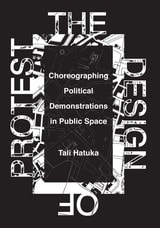
The Design of Protest
Choreographing Political Demonstrations in Public SpaceBy Tali Hatuka
University of Texas Press, 2018
Public protests are a vital tool for asserting grievances and creating temporary, yet tangible, communities as the world becomes more democratic and urban in the twenty-first century. While the political and social aspects of protest have been extensively studied, little attention has been paid to the physical spaces in which protests happen. Yet place is a crucial aspect of protests, influencing the dynamics and engagement patterns among participants. In The Design of Protest, Tali Hatuka offers the first extensive discussion of the act of protest as a design: that is, a planned event in a space whose physical geometry and symbolic meaning are used and appropriated by its organizers, who aim to challenge socio-spatial distance between political institutions and the people they should serve.
Presenting case studies from around the world, including Tiananmen Square in Beijing; the National Mall in Washington, DC; Rabin Square in Tel Aviv; and the Plaza de Mayo in Buenos Aires, Hatuka identifies three major dimensions of public protests: the process of planning the protest in a particular place; the choice of spatial choreography of the event, including the value and meaning of specific tactics; and the challenges of performing contemporary protests in public space in a fragmented, complex, and conflicted world. Numerous photographs, detailed diagrams, and plans complement the case studies, which draw upon interviews with city officials, urban planners, and protesters themselves.
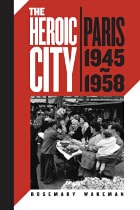
The Heroic City
Paris, 1945-1958Rosemary Wakeman
University of Chicago Press, 2009
The Heroic City is a sparkling account of the fate of Paris’s public spaces in the years following Nazi occupation and joyful liberation. Countering the traditional narrative that Paris’s public landscape became sterile and dehumanized in the 1940s and ’50s, Rosemary Wakeman instead finds that the city’s streets overflowed with ritual, drama, and spectacle. With frequent strikes and protests, young people and students on parade, North Africans arriving in the capital of the French empire, and radio and television shows broadcast live from the streets, Paris continued to be vital terrain.
Wakeman analyzes the public life of the city from a variety of perspectives. A reemergence of traditional customs led to the return of festivals, street dances, and fun fairs, while violent protests and political marches, the housing crisis, and the struggle over decolonization signaled the political realities of postwar France. The work of urban planners and architects, the output of filmmakers and intellectuals, and the day-to-day experiences of residents from all walks of life come together in this vibrant portrait of a flamboyant and transformative moment in the life of the City of Light.
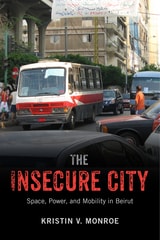
The Insecure City
Space, Power, and Mobility in BeirutMonroe, Kristin V
Rutgers University Press, 2016
Download open access ebook here.
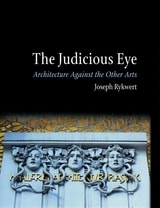
The Judicious Eye
Architecture Against the Other ArtsJoseph Rykwert
University of Chicago Press, 2008
Joseph Rykwert locates the first major shift during the Enlightenment, when key philosophers drew implied and explicit distinctions between the visual arts and architecture. As time progressed, architects came to see themselves as part of an established profession, while visual artists increasingly moved toward society’s margins, deepening the chasm between them. Detailing the eventual attempts to heal this breach, Rykwert concludes in the mid-twentieth century, when the artistic avant-garde turned to architects in its battle against a stagnant society. The Judicious Eye, then, provides a necessary foundation for understanding architecture and visual art in the twenty-first century, as they continue to break new ground by growing closer to their intertwined roots.
The Los Angeles Plaza
Sacred and Contested SpaceBy William David Estrada
University of Texas Press, 2008
2008 — Gold Award in Californiana – California Book Awards – Commonwealth Club of California
2010 — NACCS Book Award – National Association for Chicana and Chicano Studies
City plazas worldwide are centers of cultural expression and artistic display. They are settings for everyday urban life where daily interactions, economic exchanges, and informal conversations occur, thereby creating a socially meaningful place at the core of a city.
At the heart of historic Los Angeles, the Plaza represents a quintessential public space where real and imagined narratives overlap and provide as many questions as answers about the development of the city and what it means to be an Angeleno. The author, a social and cultural historian who specializes in nineteenth- and early twentieth-century Los Angeles, is well suited to explore the complex history and modern-day relevance of the Los Angeles Plaza. From its indigenous and colonial origins to the present day, Estrada explores the subject from an interdisciplinary and multiethnic perspective, delving into the pages of local newspapers, diaries and letters, and the personal memories of former and present Plaza residents, in order to examine the spatial and social dimensions of the Plaza over an extended period of time.
The author contributes to the growing historiography of Los Angeles by providing a groundbreaking analysis of the original core of the city that covers a long span of time, space, and social relations. He examines the impact of change on the lives of ordinary people in a specific place, and how this change reflects the larger story of the city.
The Radical Bookstore
Counterspace for Social MovementsKimberley Kinder
University of Minnesota Press, 2021
Examines how radical bookstores and similar spaces serve as launching pads for social movements
How does social change happen? It requires an identified problem, an impassioned and committed group, a catalyst, and a plan. In this deeply researched consideration of seventy-seven stores and establishments, Kimberley Kinder argues that activists also need autonomous space for organizing, and that these spaces are made, not found. She explores the remarkably enduring presence of radical bookstores in America and how they provide infrastructure for organizing—gathering places, retail offerings that draw new people into what she calls “counterspaces.”
Kinder focuses on brick-and-mortar venues where owners approach their businesses primarily as social movement tools. These may be bookstores, infoshops, libraries, knowledge cafes, community centers, publishing collectives, thrift stores, or art installations. They are run by activist-entrepreneurs who create centers for organizing and selling books to pay the rent. These spaces allow radical and contentious ideas to be explored and percolate through to actual social movements, and serve as crucibles for activists to challenge capitalism, imperialism, white privilege, patriarchy, and homophobia. They also exist within a central paradox: participating in the marketplace creates tensions, contradictions, and shortfalls. Activist retail does not end capitalism; collective ownership does not enable a retreat from civic requirements like zoning; and donations, no matter how generous, do not offset the enormous power of corporations and governments.
In this timely and relevant book, Kinder presents a necessary, novel, and apt analysis of the role these retail spaces play in radical organizing, one that demonstrates how such durable hubs manage to persist, often for decades, between the spikes of public protest.
The Remembered and Forgotten Jewish World
Jewish Heritage in Europe and the United StatesDaniel J. Walkowitz
Rutgers University Press, 2018
The Remembered and Forgotten Jewish World investigates the politics of heritage tourism and collective memory. In an account that is part travelogue, part social history, and part family saga, acclaimed historian Daniel J. Walkowitz visits key Jewish museums and heritage sites from Berlin to Belgrade, from Krakow to Kiev, and from Warsaw to New York, to discover which stories of the Jewish experience are told and which are silenced. As he travels to thirteen different locations, participates in tours, displays, and public programs, and gleans insight from local historians, he juxtaposes the historical record with the stories presented in heritage tourism. What he finds raises provocative questions about the heritage tourism industry and its role in determining how we perceive Jewish history and identity. This book offers a unique perspective on the importance of collective memory and the dangers of collective forgetting.
Unlearning the City
Infrastructure in a New Optical FieldSwati Chattopadhyay
University of Minnesota Press, 2012
Cities are more than concrete and steel infrastructure. But modern urban theory does not have the language to describe and debate the vital component of urban life that is lived on the streets of cities and towns. Swati Chattopadhyay has written a nuanced argument for a new vocabulary of the city in Unlearning the City, proposing a way of analyzing the materiality of the urban that captures the ever-changing element of human experience.
Urban life is intrinsically messy and usually refuses to conform to the rigid views laid down in much of urban studies theory. Chattopadhyay looks at urban life in India with a fresh perspective that incorporates the everyday and the unstructured. As the first to apply the theories of subalternity for an understanding of urban history, Chattopadhyay provides an in-depth study of vehicular art, street cricket, political wall writing, and religious festivities that link the visual and spatial attributes of these popular cultural forms with the imagination and practices of urban life. She contends that these practices have a direct impact on the configuration and knowledge of public space, and the political potential of the people inhabiting cities.
Unlearning the City uses the popular culture of Indian cities to question the dominant conception of urban infrastructure and encourage a conceptual realignment in how the city is seen, discussed, and even experienced.
Violent Acts and Urban Space in Contemporary Tel Aviv
Revisioning MomentsBy Tali Hatuka
University of Texas Press, 2010
Violent acts over the past fifteen years have profoundly altered civil rituals, cultural identity, and the meaning of place in Tel Aviv. Three events in particular have shed light on the global rule of urban space in the struggle for territory, resources, and power: the assassination of Prime Minister Rabin in 1995 in the city council square; the suicidal bombing at the Dolphinarium Discothèque along the shoreline in 2001; and bombings in the Neve Shaanan neighborhood in 2003.
Tali Hatuka uses an interdisciplinary framework of urban theory and sociopolitical theory to shed light on the discourse regarding violent events to include an analysis of the physical space where these events take place. She exposes the complex relationships among local groups, the state, and the city, challenging the national discourse by offering a fresh interpretation of contesting forces and their effect on the urban environment.
Perhaps the most valuable contribution of this book is its critical assessment of the current Israeli reality, which is affected by violent events that continually alter the everyday life of its citizens. Although these events have been widely publicized by the media, there is scant literature focusing on their impact on the urban spaces where people live and meet. In addition, Hatuka shows how sociopolitical events become crucial defining moments in contemporary lived experience, allowing us to examine universal questions about the way democracy, ideology, and memory are manifested in the city.

Women and the Everyday City
Public Space in San Francisco, 1890–1915Jessica Ellen Sewell
University of Minnesota Press, 2011
Focusing on women's everyday use of streetcars, shops, restaurants, and theaters, Sewell reveals the impact of women on these public places-what women did there, which women went there, and how these places were changed in response to women's presence. Using the diaries of three women in San Francisco-Annie Haskell, Ella Lees Leigh, and Mary Eugenia Pierce, who wrote extensively on their everyday experiences-Sewell studies their accounts of day trips to the city and combines them with memoirs, newspapers, maps, photographs, and her own observations of the buildings that exist today to build a sense of life in San Francisco at this pivotal point in history.