Results by title
45 books match the query 'Question'
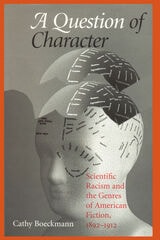
A Question of Character
Scientific Racism and the Genres of American Fiction, 1892-1912Catherine Ann Boeckmann
University of Alabama Press, 2005
Boeckmann links character, literary genre, and science, revealing how major literary works both contributed to and disrupted the construction of race in turn-of-the-century America.
In A Question of Character, Cathy Boeckmann establishes a strong link between racial questions and the development of literary traditions at the end of the 19th century in America. This period saw the rise of "scientific racism," which claimed that the races were distinguished not solely by exterior appearance but also by a set of inherited character traits. As Boeckmann explains, this emphasis on character meant that race was not only a thematic concern in the literature of the period but also a generic or formal one as well.
Boeckmann explores the intersections between race and literary history by tracing the language of character through both scientific and literary writing. Nineteenth-century pseudo-sciences such as phrenology and physiognomy had a vocabulary for discussing racial character that overlapped conceptually with the conventions for portraying race in literature. Through close readings of novels by Thomas Dixon, Mark Twain, William Dean Howells, Charles Chesnutt, and James Weldon Johnson—each of which deals with a black character "passing" as white—Boeckmann shows how this emphasis on character relates to the shift from romantic and sentimental fiction to realism. Because each of these genres had very specific conventions regarding the representation of character, genres often dictated how races could be depicted.
A Question of Class
The Redneck Stereotype in Southern FictionDuane Carr
University of Wisconsin Press, 1997

A Question of Identity
Women, Science, and LiteratureEdited by Marina Benjamin
Rutgers University Press, 1993
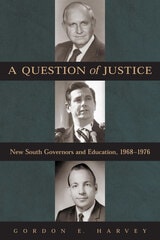
A Question of Justice
New South Governors and Education, 1968-1976Gordon E. Harvey
University of Alabama Press, 2005
The governors who used education to transform the modern South.
In southern politics, 1970 marked a watershed. A group of southern governors entered office that year and changed both the way the nation looked at the South and the way the constituents of those states viewed themselves. Reubin Askew in Florida, John West in South Carolina, Jimmy Carter in Georgia, and Albert Brewer in Alabama all represented a new breed of progressive moderate politician that helped demolish Jim Crow segregation and the dual economies, societies, and educational systems notorious to the Sunbelt South. Historian Gordon Harvey explores the political lives and legacies of three of these governors, examining the conditions that led to such a radical change in political leadership, the effects their legislative agendas had on the identity of their states, and the aftermath of their terms in elected office.
A common thread in each governor's agenda was educational reform. Albert Brewer's short term as Alabama governor resulted in a sweeping education package that still stands as the most progressive the state has seen. Reubin Askew, far more outspoken than Brewer, won the Florida gubernatorial election through a campaign that openly promoted desegregation, busing, and tax reform as a means of equal school funding. John West's commitment to a policy of inclusion helped allay fears of both black and white parents and made South Carolina's one of the smoothest transitions to integrated schools.
As members of the first generation of New South governors, Brewer, Askew, and West played the role of trailblazers. Their successful assaults on economic and racial injustice in their states were certainly aided by such landmark events as Brown v. Board of Education, the civil rights movement, and the expansion of voting rights-all of which sounded the death knell for the traditional one-party segregated South. But in this critical detailing of their work for justice, we learn how these reform-minded men made education central to their gubernatorial terms and, in doing so, helped redefine the very character of the place they called home.

A Question of Quality
Popularity and Value in Modern Creative WritingEdited by Louis Filler
University of Wisconsin Press, 1976
The subjects treated in this symposium have one major characteristic in common, that they have recently, or relatively recently, enjoyed high popularity among readers. Also, they have received from substantial to torrents of comment.
A Question of Seeing
PoemsDonald Finkel
University of Arkansas Press, 1998
In lines electrified with lyricism and wit, Donald Finkel carves a clearing out of the backyard brush and the intellectual brambles of existence.
Whether he writes a short lyric or a long experimental series, Finkel relies on concrete images—a breeze through grass, a cigarette in a piano player’s hand—to ground his central questions about the clash of order and chaos in our everyday lives.
He delights in naming weeds and towering trees, cars and streets. Yet, in each poem, there is a constant tension between the actual wind and the words we must use to convey the wind’s force.
Working fluently in formal lines and in free verse, he can write with equal authority of butchers or great painters, aged bookkeepers or schizophrenics, Greek gods or house cats. In this new collection, Finkel has given us the priceless keepsakes, the best gifts from the clearing his words have won.
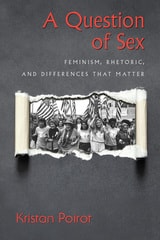
A Question of Sex
Feminism, Rhetoric, and Differences That MatterKristan Poirot
University of Massachusetts Press, 2014
Poirot focuses on five case studies—the circulation of Sojourner Truth's "Ain't I a Woman?" in early and contemporary feminist contexts; the visual rhetorics of the feminist self-help health movement; the public discourse of Elizabeth Cady Stanton and early nineteenth-century ideas about suffrage, sex, and race; the conflicts over lesbian sexuality in the 1960s and 1970s; and the discourse that surrounds twenty-first-century SlutWalks. In the process, Poirot rethinks the terms through which we understand U.S. feminist movements to explore the ways feminism has questioned sexed distinctions and practices over time. She emphasizes the importance of reading feminist engagements with sex as rhetorical endeavors—practices that are shaped by the instrumental demands of movements, the exigent situations that call for feminists to respond, and the enduring philosophical traditions that circulate in U.S. political contexts., reviewing a previous edition or volume
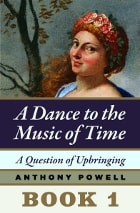
A Question of Upbringing
Book 1 of A Dance to the Music of TimeAnthony Powell
University of Chicago Press, 1995
Anthony Powell’s universally acclaimed epic A Dance to the Music of Time offers a matchless panorama of twentieth-century London. Now, for the first time in decades, readers in the United States can read the books of Dance as they were originally published—as twelve individual novels—but with a twenty-first-century twist: they’re available only as e-books.
A Question of Upbringing (1951) introduces us to the young Nick Jenkins and his housemates at boarding school in the years just after World War I. Boyhood pranks and visits from relatives bring to life the amusements and longueurs of schooldays even as they reveal characters and traits that will follow Jenkins and his friends through adolescence and beyond: Peter Templer, a rich, passionate womanizer; Charles Stringham, aristocratic and louche; and Kenneth Widmerpool, awkward and unhappy, yet strikingly ambitious. By the end of the novel, Jenkins has finished university and is setting out on a life in London; old ties are fraying, new ones are forming, and the first steps of the dance are well underway.
"Anthony Powell is the best living English novelist by far. His admirers are addicts, let us face it, held in thrall by a magician."—Chicago Tribune
"A book which creates a world and explores it in depth, which ponders changing relationships and values, which creates brilliantly living and diverse characters and then watches them grow and change in their milieu. . . . Powell's world is as large and as complex as Proust's."—Elizabeth Janeway, New York Times
"One of the most important works of fiction since the Second World War. . . . The novel looked, as it began, something like a comedy of manners; then, for a while, like a tragedy of manners; now like a vastly entertaining, deeply melancholy, yet somehow courageous statement about human experience."—Naomi Bliven, New Yorker
“The most brilliant and penetrating novelist we have.”—Kingsley Amis
“There is no other work in the annals of European fiction that attempts meticulously to recreate half a century of history, decade by decade, with anything like the emotional precision or details of Powell’s twelve volumes. Neither Balzac’s panorama of the Restoration, nor Zola’s chronicles of the Second Empire, nor Proust’s reveries in the Belle Epoque can match a comparable span of time, an attention to variations within it, or a compositional intricacy capable of uniting them into a single narrative. . . . The elegance of this artifice was only compatible with comedy.”—Perry Anderson
A Question of Voice
Philosophy and the Search for LegitimacyRon Scapp
University of Michigan Press, 2020
Being after Rousseau
Philosophy and Culture in QuestionRichard L. Velkley
University of Chicago Press, 2002
The Rousseauian tradition begins, for Velkley, with Rousseau's criticism of modern political philosophy. Although the German Idealists such as Schelling accepted much of Rousseau's critique, they believed, unlike Rousseau, that human wholeness could be attained at the level of society and history. Heidegger and Nietzsche questioned this claim, but followed both Rousseau and the Idealists in their vision of the philosopher-poet striving to recover an original wholeness that the history of reason has distorted.
Citizenship in Question
Evidentiary Birthright and StatelessnessBenjamin N. Lawrance and Jacqueline Stevens, editors
Duke University Press, 2017
Conceptualising "Home"
The Question of Belonging among Turkish Families in GermanyEsin Bozkurt
Campus Verlag, 2009
Critical Transitions
Writing and the Question of TransferChris M Anson
University Press of Colorado, 2017
Contributors: Linda Adler-Kassner, Chris M. Anson, Stuart Blythe, Scott Chien-Hsiung Chiu, Irene Clark, Nicolette Mercer Clement, Stacey M. Cozart, Gita DasBender, Christiane Donahue, Dana Lynn Driscoll, Dana R. Ferris, Gwen Gorzelsky, Regina A. McManigell Grijalva, Carol Hayes, Hogan Hayes, Tine Wirenfeldt Jensen, Ed Jones, Ketevan Kupatadze, Jessie L. Moore, Joe Paszek, Donna Qualley, Liane Robertson, Paula Rosinski, Kara Taczak, Elizabeth Wardle, Carl Whithaus, Gitte Wichmann-Hansen, Kathleen Blake Yancey
Culture and the Question of Rights
Forests, Coasts, and Seas in Southeast AsiaCharles Zerner, ed.
Duke University Press, 2003
Calling for radical redefinitions of development and ownership and for new understandings of the translation of culture and rights in politically dangerous contexts—natural resource frontiers—this volume links social injustice and the degradation of Southeast Asian environments. Charles Zerner and his colleagues show how geographical areas once viewed as wild and undeveloped are actually cultural artifacts shaped by complex interactions with human societies. Drawing on richly varied sources of evidence and interpretation—from trance dances, court proceedings, tree planting patterns, marine and forest rituals, erotic poems, and codifications of customary law, Culture and the Question of Rights reveals the ironies, complexities, and histories of contemporary communities’ struggles to retain their gardens, forests, fishing territories, and graveyards. The contributors examine how these cultural activities work to both construct and to lay claim to nature. These essays open up new avenues for negotiating indigenous rights against a background of violence, proliferating markets, and global ideas of biodiversity and threatened habitat.
Contributors. Jane Atkinson, Don Brenneis, Stephanie Fried, Nancy Peluso, Marina Roseman, Anna Tsing, Charles Zerner

Dracula's Crypt
Bram Stoker, Irishness, and the Question of BloodJoseph Valente
University of Illinois Press, 2001
An ingenious reappraisal of a classic text, Dracula's Crypt presents Stoker's novel as a subtly ironic commentary on England's preoccupation with racial purity. Probing psychobiographical, political, and cultural elements of Stoker's background and milieu, Joseph Valente distinguishes Stoker's viewpoint from that of his virulently racist, hypermasculine vampire hunters, showing how the author's dual Anglo-Celtic heritage and uncertain status as an Irish parvenu among London's theatrical elite led him to espouse a progressive racial ideology at odds with the dominant Anglo-Saxon supremacism. In the light of Stoker's experience, the shabby-genteel Count Dracula can be seen as a doppelgänger, an ambiguous figure who is at once the blood-conscious landed aristocrat and the bloodthirsty foreign invader.
Stoker also confronts gender ideals and their implications, exposing the "inner vampire" in men like Jonathan Harker who dominate and absorb the women who become their wives. Ultimately, Valente argues, the novel celebrates a feminine heroism, personified by Mina Harker, that upholds an ethos of social connectivity against the prevailing obsession with blood as a vehicle of identity.
Revealing a profound and heretofore unrecognized ethical and political message, Dracula's Crypt maintains that the real threat delineated in Dracula is not racial degeneration but the destructive force of racialized anxiety itself. Stoker's novel emerges as a powerful critique of the very anxieties it has previously been taken to express: anxieties concerning the decline of the British empire, the deterioration of Anglo-Saxon culture, and the contamination of the Anglo-Saxon race.
Empire in Question
Reading, Writing, and Teaching British ImperialismAntoinette Burton
Duke University Press, 2011

Global Governance in Question
Empire, Class and the New Common Sense in Managing North-South RelationsSusanne Soederberg
Pluto Press, 2006
William I. Robinson, University of California-Santa Barbara
"[An] acute and revealing examination of the economic difficulties facing the American empire."
Ronnie D. Lipschutz, Professor of Politics, University of California, Santa Cruz
"Indispensable for students of international polical economy and a must for political activists." Professor Elmar Altvater, Department of Political Science, Free University, Berlin
Like many buzzwords, 'global governance' is as poorly understood as it is popular. In contrast to most mainstream accounts, this book examines global economic governance as an integral moment of contemporary capitalism -- presenting a critical insight into its real nature and the interests that it serves.
This book begins by asking what has not been discussed in the mainstream debates and why. Drawing on a Marxist perspective, Soederberg explores neglected issues including transnational debt and the increasingly coercive nature of US aid to so-called Œfailed states'. Soederberg argues that mainstream understandings fail to engage with the wider contradictions that characterise global capitalism. In consequence, there is no explanation of the changing nature of American empire and capitalist power in the world. Furthermore, Soederberg argues that global governance acts to normalise and legitimise increasingly austere forms of capitalist expansion, which may be regarded as a deepening and broadening of neoliberalism.
Susanne Soederberg is a Canada Research Chair in Global Political Economy and Associate Professor in International Development Studies at Queen's University, Kingston, Canada. She is author of The Politics of the New International Financial Architecture: Reimposing Neoliberal Domination in the Global South (Zed, 2005).
Heidegger
The Question of Being and HistoryJacques Derrida
University of Chicago Press, 2016
Derrida performs an almost surgical reading of the notoriously difficult text, marrying pedagogical clarity with patient rigor and acting as a lucid guide through the thickets of Heidegger’s prose. At this time in intellectual history, Heidegger was still somewhat unfamiliar to French readers, and Being and Time had only been partially translated into French. Here Derrida mostly uses his own translations, giving his own reading of Heidegger that directly challenges the French existential reception initiated earlier by Sartre. He focuses especially on Heidegger’s Destruktion (which Derrida would translate both into “solicitation” and “deconstruction”) of the history of ontology, and indeed of ontology as such, concentrating on passages that call for a rethinking of the place of history in the question of being, and developing a radical account of the place of metaphoricity in Heidegger’s thinking.
This is a rare window onto Derrida’s formative years, and in it we can already see the philosopher we’ve come to recognize—one characterized by a bravura of exegesis and an inventiveness of thought that are particularly and singularly his.
How “Indians” Think
Colonial Indigenous Intellectuals and the Question of Critical Race TheoryGonzalo Lamana
University of Arizona Press, 2019
If at First You Don't Succeed?
Writing, Rhetoric, and the Question of FailureSteven J. Corbett
University Press of Colorado, 2025
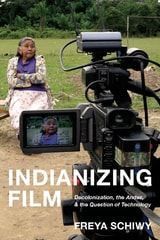
Indianizing Film
Decolonization, the Andes, and the Question of TechnologySchiwy, Freya
Rutgers University Press, 2009
Schiwy argues that instead of solely creating entertainment through their work indigenous media activists are building communication networks that encourage interaction between diverse cultures. As a result, mainstream images are retooled, permitting communities to strengthen their cultures and express their own visions of development and modernization. Indianizing Film encourages readers to consider how indigenous media contributes to a wider understanding of decolonization and anticolonial study against the universal backdrop of the twenty-first century.
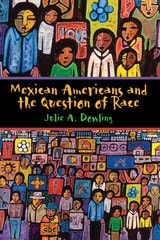
Mexican Americans and the Question of Race
By Julie A. Dowling
University of Texas Press, 2014
Honorable Mention, Oliver Cromwell Cox Book Award, presented by the Racial and Ethnic Minorities Section of the American Sociological Association, 2015
With Mexican Americans constituting a large and growing segment of U.S. society, their assimilation trajectory has become a constant source of debate. Some believe Mexican Americans are following the path of European immigrants toward full assimilation into whiteness, while others argue that they remain racialized as nonwhite. Drawing on extensive interviews with Mexican Americans and Mexican immigrants in Texas, Dowling’s research challenges common assumptions about what informs racial labeling for this population. Her interviews demonstrate that for Mexican Americans, racial ideology is key to how they assert their identities as either in or outside the bounds of whiteness. Emphasizing the link between racial ideology and racial identification, Dowling offers an insightful narrative that highlights the complex and highly contingent nature of racial identity.
Of Spirit
Heidegger and the QuestionJacques Derrida
University of Chicago Press, 1989
"Derrida's ruminations should intrigue anyone interested in Post-Structuralism. . . . . This study of Heidegger is a fine example of how Derrida can make readers of philosophical texts notice difficult problems in almost imperceptible details of those texts."—David Hoy, London Review of Books
"Will a more important book on Heidegger appear in our time? No, not unless Derrida continues to think and write in his spirit. . . . Let there be no mistake: this is not merely a brilliant book on Heidegger, it is thinking in the grand style."—David Farrell Krell, Research in Phenomenology
"The analysis of Heidegger is brilliant, provocative, elusive."—Peter C. Hodgson, Religious Studies Review
Of Spirit
Heidegger and the QuestionJacques Derrida
University of Chicago Press, 1990
"Derrida's ruminations should intrigue anyone interested in Post-Structuralism. . . . . This study of Heidegger is a fine example of how Derrida can make readers of philosophical texts notice difficult problems in almost imperceptible details of those texts."—David Hoy, London Review of Books
"Will a more important book on Heidegger appear in our time? No, not unless Derrida continues to think and write in his spirit. . . . Let there be no mistake: this is not merely a brilliant book on Heidegger, it is thinking in the grand style."—David Farrell Krell, Research in Phenomenology
"The analysis of Heidegger is brilliant, provocative, elusive."—Peter C. Hodgson, Religious Studies Review

Phenomenology for Actors
Theatre-Making and the Question of BeingDaniel Johnston
Intellect Books, 2021
In this book, Daniel Johnston examines how phenomenology can describe, analyze, and inspire theater-making. Each chapter introduces themes to guide the creative process through objects, bodies, spaces, time, history, freedom, and authenticity. Key examples in the work are drawn from Chekhov’s The Cherry Orchard, Sophocles’ Antigone, and Shakespeare’s Hamlet. Practical tasks throughout explore how the theatrical event can offer unique insights into being and existence, as Johnston’s philosophical perspective shines a light on broader existential issues of being. In this way, the book makes a bold contribution to the study of acting as an embodied form of philosophy and reveals how phenomenology can be a rich source of creativity for actors, directors, designers, and collaborators in the performance process.
Brimming with insight into the practice and theory of acting, this original new work stimulates new approaches to rehearsal and sees theater-making as capable of speaking back to philosophical discourse.
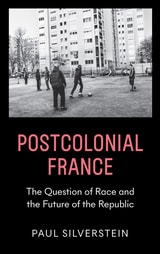
Postcolonial France
The Question of Race and the Future of the RepublicPaul Silverstein
Pluto Press, 2018
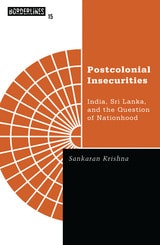
Postcolonial Insecurities
India, Sri Lanka, and the Question of NationhoodSankaran Krishna
University of Minnesota Press, 1999
An exploration of the connections between ethnicity and nation-building.
This ambitious work explores the vexed connections among nation-building, ethnic identity, and regional conflict by focusing on a specific event: Indian political and military intervention in the ethnic conflict between the Sinhalese and Tamils in Sri Lanka.
Drawing on interviews with leading players in the Indian–Sri Lankan debacle, Sankaran Krishna offers a persuasive analysis of this episode. The intervention serves as a springboard to a broader inquiry into the interworkings of nation building, ethnicity, and “foreign” policy. Krishna argues that the modernist effort to construct nation-states on the basis of singular notions of sovereignty and identity has reached a violent dead end in the postcolonial world of South Asia. Showing how the nationalist agenda that seeks to align territory with identity has unleashed a spiral of regional, statist, and insurgent violence, he makes an eloquent case for reimagining South Asia along postnational lines—as a “confederal” space.Postcolonial Insecurities counters the perception of “ethnicity” as an inferior and subversive principle compared with the progressive ideal of the “nation.” Krishna, in fact, shows ethnicity to be indispensable to the production and reproduction of the nation itself.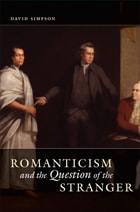
Romanticism and the Question of the Stranger
David Simpson
University of Chicago Press, 2012
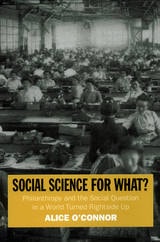
Social Science for What?
Philanthropy and the Social Question in a World Turned Rightside UpAlice O'Connor
Russell Sage Foundation, 2007
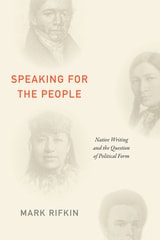
Speaking for the People
Native Writing and the Question of Political FormMark Rifkin
Duke University Press, 2021
Stately Bodies
Literature, Philosophy, and the Question of GenderAdriana Cavarero
University of Michigan Press, 2002
She examines bodily metaphor in political discourse and in fictional depictions of politics, including Sophocles' Antigone, Plato's Timaeus, Livy, John of Salisbury, Shakespeare's Hamlet, and Hobbes' Leviathan. An appendix explores two texts by women that disrupt these notions: Maria Zambrano's Tomb of Antigone and Ingeborg Bachmann's Undine Goes.
Cavarero exposes the problematic nature of the mind/body dualism that has been essential in Western thought. Her insight that the expelled, depoliticized body is a female one becomes an instrument for decoding many paradoxical tropes of the political body. For instance, Cavarero revisits Antigone as the tragedy in which a body that is displaced, bleeding, and matrilinear allows the construction of a political order where misogynous rationality rules. Throughout the book, Cavarero argues that women have been cast by male thinkers into the realm of the corporeal as nonpolitical, and also suggests that this nonpolitical position is also a source of knowledge and power, that politics is a masculine pursuit that should not be admired or envied.
Adriana Cavarero is Professor of Philosophy, University of Verona, and frequently is Visiting Professor. New York University. Her books Relating Narratives: Storytelling and Selfhood and In Spite of Plato: A Feminist Rewriting of Ancient Philosophy were published by Routledge.
Strategic Occidentalism
On Mexican Fiction, the Neoliberal Book Market, and the Question of World LiteratureIgnacio M. Sánchez Prado
Northwestern University Press, 2018
In the course of this analysis, Ignacio M. Sánchez Prado engages with theories of world literature, proposing that “world literature” is a construction produced at various levels, including the national, that must be studied from its material conditions of production in specific sites. In particular, he argues that Mexican writers have engaged in a “strategic Occidentalism” in which their idiosyncratic connections with world literature have responded to dynamics different from those identified by world-systems or diffusionist theorists.
Strategic Occidentalism identifies three scenes in which a cosmopolitan aesthetics in Mexican world literature has been produced: Sergio Pitol’s translation of Eastern European and marginal British modernist literature; the emergence of the Crack group as a polemic against the legacies of magical realism; and the challenges of writers like Carmen Boullosa, Cristina Rivera Garza, and Ana García Bergua to the roles traditionally assigned to Latin American writers in world literature.
The Bible on the Question of Homosexuality
Innocent Himbaza
Catholic University of America Press, 2012
The Capacity Contract
Intellectual Disability and the Question of CitizenshipStacy Clifford Simplican
University of Minnesota Press, 2015
In the first sustained examination of disability through the lens of political theory, The Capacity Contract shows how the exclusion of disabled people has shaped democratic politics. Stacy Clifford Simplican demonstrates how disability buttresses systems of domination based on race, sex, and gender. She exposes how democratic theory and politics have long blocked from political citizenship anyone whose cognitive capacity falls below a threshold level⎯marginalization with real-world repercussions on the implementation of disability rights today.
Simplican’s compelling ethnographic analysis of the self-advocacy movement describes the obstacles it faces. From the outside, the movement must confront stiff budget cuts and dwindling memberships; internally, self-advocates must find ways to demand political standing without reinforcing entrenched stigma against people with profound cognitive disabilities. And yet Simplican’s investigation also offers democratic theorists and disability activists a more emancipatory vision of democracy as it relates to disability⎯one that focuses on enabling people to engage in public and spontaneous action to disrupt exclusion and stigma.
Taking seriously democratic promises of equality and inclusion, The Capacity Contract rejects conceptions of political citizenship that privilege cognitive capacity and, instead, centers such citizenship on action that is accessible to all people.
The Maghrib in Question
Essays in History and HistoriographyEdited by Michel Le Gall and Kenneth Perkins
University of Texas Press, 1997
A wealth of historical writing dealing with the Maghrib (Morocco, Algeria, Tunisia, and Libya) has been published during the roughly forty years since European colonial control ended in the region. This book provides a "state of the field" survey of this postcolonial Maghribi historiography.
The book contains thirteen essays by leading Maghribi and North American scholars. The first section surveys the Maghrib as a whole; the second focuses on individual countries of the Maghrib; and the third explores theoretical issues and case studies. Cutting across chronological categories, the book encompasses historiographical writing dealing with all eras, from the ancient Maghrib to the contemporary period.
The Picture in Question
Mark Tansey and the Ends of RepresentationMark C. Taylor
University of Chicago Press, 1999

The Question of Embodiment, Volume 15
Elizabeth Weed and Ellen Rooney, eds.
Duke University Press, 0
Contributors. Anne Fausto-Sterling, Petra Kuppers, Jennifer Reardon, Gayle Salamon, Elizabeth A. Wilson
The Question of God in Heidegger's Phenomenology
George Kovacs
Northwestern University Press, 1990
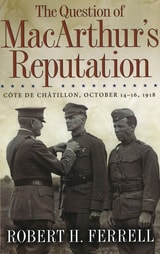
The Question of MacArthur's Reputation
Côte De Châtillon, October 14-16, 1918Robert H. Ferrell
University of Missouri Press, 2008
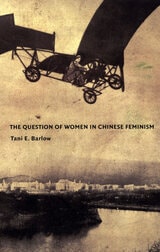
The Question of Women in Chinese Feminism
Tani E. Barlow
Duke University Press, 2004
The Question of the Commons
The Culture and Ecology of Communal ResourcesEdited by Bonnie J. McCay and James M. Acheson
University of Arizona Press, 1987
The Subject in Question
Early Contemporary Spanish Literature and ModernismC. Christopher Soufas
Catholic University of America Press, 2007

Till Day You Do Part Or A Question of Light
Peter Handke
Seagull Books, 2010
Described as an answer to or at least an echo of Samuel Beckett’s Krapp’s Last Tape?, Till Day You Do Part Or A Question of Light, by esteemed Austrian playwright and novelist Peter Handke, is a monologue delivered by the “she” in Beckett’s play. This unnamed female similarly recalls other significant women protagonists in Handke’s own work such as The Left-handed Woman. Handke prefaces the monologue in Till Day You Do PartOr a Question of Light with a description of two stone figures. While the male figure remains “as dead and gone as anyone can,” the female bursts into life, and her monologue gradually focuses on Krapp’s use of pauses and language to dominate the other characters in the Beckett play. Ultimately, however, her complaints and critique of Krapp become a declaration of her love for Krapp or at least an affirmation of their attachment, as the two of them are ultimately bound together, perhaps even inseparable.
Till Day You Do Part Or a Question of Light is Handke at his best, evidencing the great skill, psychological acumen, and vision for which his work has been celebrated.

Time & Eternity
The Question of Time in Church, Science and TheologyAntje Jackelen
Templeton Press, 2005
What is time? Is there a link between objective knowledge about time and subjective experience of time? And what is eternity? Does religion have the answer? Does science?
•Theological approaches to time and eternity, as well as a look at Trinitarian theology and its relation to time
•The discussion of scientific theories of time, including Newtonian, relativistic, quantum, and chaos theories
•The formulation of a "theology of time," a theological-mathematical model incorporating relational thinking oriented toward the future, the doctrine of trinity, and the notion of eschatology
Tomorrow Is the Question
New Directions in Experimental Music StudiesEdited by Benjamin Piekut
University of Michigan Press, 2014