Results by title
10 books match the query 'Ralph Waldo Emerson'
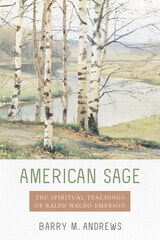
American Sage
The Spiritual Teachings of Ralph Waldo EmersonBarry M. Andrews
University of Massachusetts Press, 2021
Unitarian minister Barry M. Andrews has spent years studying Emerson, finding wisdom and guidance in his teachings and practices, and witnessing how the spiritual lives of others are enriched when they grasp the many meanings in his work. In American Sage, Andrews explores Emerson's writings, including his journals and letters, and makes them accessible to today's spiritual seekers. Written in everyday language and based on scholarship grounded in historical detail, this enlightening book considers the nineteenth-century religious and intellectual crosscurrents that shaped Emerson's worldview to reveal how his spiritual teachings remain timeless and modern, universal and uniquely American.
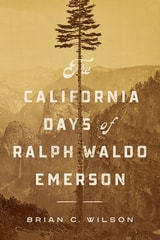
The California Days of Ralph Waldo Emerson
Brian C. Wilson
University of Massachusetts Press, 2022
In the spring of 1871, Ralph Waldo Emerson boarded a train in Concord, Massachusetts, bound for a month-and-a-half-long tour of California—an interlude that became one of the highlights of his life. On their journey across the American West, he and his companions would take in breathtaking vistas in the Rockies and along the Pacific Coast, speak with a young John Muir in the Yosemite Valley, stop off in Salt Lake City for a meeting with Brigham Young, and encounter a diversity of communities and cultures that would challenge their Yankee prejudices.
Based on original research employing newly discovered documents, The California Days of Ralph Waldo Emerson maps the public story of this group’s travels onto the private story of Emerson’s final years, as aphasia set in and increasingly robbed him of his words. Engaging and compelling, this travelogue makes it clear that Emerson was still capable of wonder, surprise, and friendship, debunking the presumed darkness of his last decade.
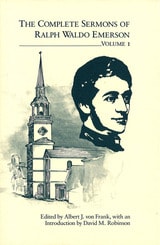
The Complete Sermons of Ralph Waldo Emerson, Volume 1
Ralph Waldo Emerson, Edited by Albert J. von Frank, Intro by David M. Robinson
University of Missouri Press, 1989
This inaugural volume of a four-volume set marks the beginning of the publication of all 180 of the extant sermons composed and delivered by Emerson between the start of his ministerial career in 1826 and his final retirement from the pulpit in 1838.
Edited from manuscripts in the Houghton Library, Harvard University, the sermons are presented in chronological order in a clear text approximating as nearly as possible the original version read by Emerson to his congregation. The historical introduction by David M. Robinson gives a significant appraisal of Emerson's life between 1826 and 1838 and of his absorption in and reaction against the religious culture of his time.
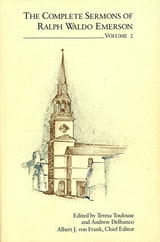
The Complete Sermons of Ralph Waldo Emerson, Volume 2
Ralph Waldo Emerson, Edited by Teresa Toulouse & Andrew H. Delbanco & Series Editor Albert J. von Frank
University of Missouri Press, 1990
Volume 2 includes a detailed chronology of the events in Emerson's life during the months between July 1829 and October 1830. Explanatory footnotes, textual endnotes, and a comprehensive index further add to this significant contribution to our understanding of one of America's foremost thinkers.
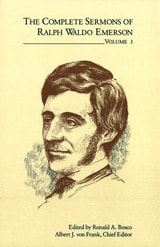
The Complete Sermons of Ralph Waldo Emerson, Volume 3
Ralph Waldo Emerson; Edited by Ronald A. Bosco; Chief Editor, Albert J. von Frank
University of Missouri Press, 1991
The forty-five sermons collected in Volume 3 were composed and first delivered between October 1830 and November 1831. During that time Emerson's first wife, Ellen Tucker Emerson, died of tuberculosis, a loss that deeply affected Emerson.
Transcribed and edited from manuscripts in Harvard's University's Houghton Library, the sermons are presented in a clear text approximating as nearly as possible the original version delivered to Emerson's congregation. As well as the detailed chronology, explanatory footnotes, and textual endnotes found in previous volumes, this one contains a comprehensive index.
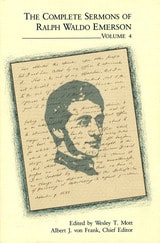
The Complete Sermons of Ralph Waldo Emerson, Volume 4
Ralph Waldo Emerson, Edited by Wesley T. Mott, Series Editor Albert J. von Frank
University of Missouri Press, 1992
The final volume in the series focuses on a crossroads in Emerson's life, the year 1832, when he resigned from his ministry at the Second Church of Boston. It includes a new and more accurate text of the single most important of Emerson's sermons, "The Lord's Supper Sermon." For the first time, this sermon has been transcribed from the manuscript Emerson actualy read from on the occasion of its only delivery. The sermon was not only pivotal in Emerson's career, it was historically important because of the controversy that ensued over formalism in religion.
Volume 4 presents annotated texts of eight occasional sermons in addition to twenty-seven regular sermons, and an annotated text of relevant portions of the official records of the Second Church of Boston during Emerson's ministry. The sermons-most appearing in print for the first time-provide a thorough understanding of the evolution of Emerson's thought in the years immediately preceding the 1836 publication of Nature, a treatise of central importance to nineteenth-century American literature.
Transcribed and edited from manuscripts in Harvard's University's Houghton Library, the sermons are presented in a clear text approximating as nearly as possible the original version delivered to Emerson's congregation. As well as the detailed chronology, explanatory footnotes, and textual endnotes found in previous volumes, this one contains a comprehensive index to the entire four-volume collection. Such outstanding textual scholarship makes this edition a unique entrance into the spiritual life of a man who so profoundly influenced American thought.
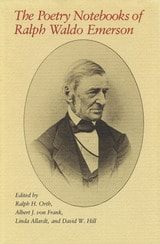
The Poetry Notebooks of Ralph Waldo Emerson
Ralph Waldo Emerson; Edited by Ralph H. Orth, Albert J. von Frank, Linda Allardt, & David W. Hill
University of Missouri Press, 1986
Published here in full are Ralph Waldo Emerson's nine poetry notebooks, the single greatest source of information about his creative habits in poetry. Emerson kept rough drafts, revised versions, and fair copies of hundreds of poems in these notebooks, so that the genesis and development of poems both famous and obscure can be traced closely. The notebooks have been remarkably little consulted, primarily because their unedited textual condition makes them difficult to use. This edition makes them accessible to scholars by presenting a faithful transcription of each notebook, a detailed analysis of the history of each poem, an introduction, and a cross-referenced index.
For this edition, the editors have followed the high standards of textual practice developed for Harvard University Press's edition of The Journals and Miscellaneous Notebooks of Ralph Waldo Emerson. That editorial approach makes possible a logical, clear presentation of material that Emerson often jotted down in segments or with multiple erasures and insertions.
Because it will allow scholars to examine as never before the many facets of Emerson the poet, The Poetry Notebooks of Ralph Waldo Emerson will be a major impetus to study of the man considered by many to be America's greates thinker.
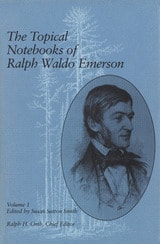
The Topical Notebooks of Ralph Waldo Emerson, Volume 1
Ralph Waldo Emerson, Edited by Susan Sutton Smith
University of Missouri Press, 1990
Published here for the first time are seven of Emerson's topical notebooks, which served as a source for his lectures, essays, and books of the 1850s, 1860s, and 1870s. Concerned primarily with nature, art, philosophy, American culture, and his comtemporaries, the notebooks presented in this first of a three-volume editions afford fascinating insight into Emerson's creative practices. They will offer new perspectives for future readings of his completed works.
The editors provide faithful transcriptions of the notebooks using the highest standards of textual practice. Their detailed annotations describe and comment on erased or revised passages, translate Greek and Latin quotations, and identify books and articles referred to in the texts of the notebooks. References to similar passages in Emerson's journals, lectures, and published works are also provided in the annotations.
Publication of these notebooks will inable scholars to trace ideas that have gone unnoticed previously. The Topical Notebooks of Ralph Waldo Emerson, Volume 1, offers valuable insight into the art and philosophy of one of America's foremost thinkers. These volumes will be an important addition to any personal or institutional library of nine-teenth-century American literature.
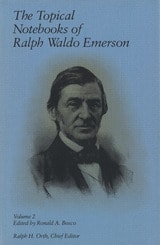
The Topical Notebooks of Ralph Waldo Emerson, Volume 2
Ralph Waldo Emerson; Edited by Ronald A. Bosco; Chief Editor, Ralph H. Orth
University of Missouri Press, 1993
Ralph Waldo Emerson, the magus of of American Transcendentalism, was an inveterate keeper of journals and notebooks, which he used as source and proving ground for his poems, lectures, and essays. This is the second in a three-volume edition that brings twelve of Emerson's topical notebooks and four other notebooks into print for the first time. These notebooks were Emerson's repositories for anecdotes, quotations, reminiscences, drafts of his poems, outlines for lectures, and observations on everything from daily life to profound cultural and philosophical issues.
Among the highlights of the five notebooks in Volume 2, "Orientalist" provides an unusual opportunity to view closely Emerson's adaptation of Eastern thought.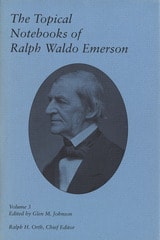
The Topical Notebooks of Ralph Waldo Emerson, Volume 3
Ralph Waldo Emerson; Edited by Glen M. Johnson; Series Editor, Ralph H. Orth
University of Missouri Press, 1994
"Ralph Orth...has been indefatigable in giving us volumes of the highest accuracy and usefulness," said American Renaissance Literary Report. Volume 3 completes the series that brings twelve of Emerson's topical notebooks and four other notebooks into print for the first time. In this final volume, Glen Martin Johnson presents four of the topical notebooks dating from the mid 1840s through the early 1870s, the end of Emerson's productive life. The notebooks include diverse material from which Emerson wrote his lectures, essays, and books.
Each of the four notebooks illustrates some of the many uses Emerson made of these collections of quotations and ideas: OP Gulistan is a compendium of biographical information and anecdotes about dozens of Emerson's acquaintances; S Salvage takes stock of and preserves parts of his earlier writings; ZO was used in preparing the lectures that became "Poetry and Imagination"; and ML was employed for extensive notes on the moral law and religion, and as a resource in preparing lectures and readings during the late 1860s.
The publication of these notebooks renders an invaluable service to the scholarly community and to students of American literature. Collectively, they dipict in great detail the subtle changes that occurred in Emerson's thought from the beginning until the end of his career to give a complete picture of the man and the writer. The younger Emerson, whose writing abounds with enthusiasm, became someone whose darker wisdom about inevitable limitations was expressed in essays such as "Fate" and "Illusions." The notebooks in this volume will allow us to better understand the last three decades of Emerson's career, which have remained less than fully explored.