Results by title
9 books match the query 'Record'
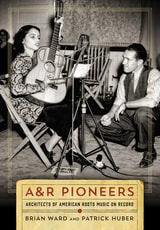
A&R Pioneers
Architects of American Roots Music on RecordBrian Ward
Vanderbilt University Press, 2018
A&R Pioneers offers the first comprehensive account of the diverse group of men and women who pioneered artists-and-repertoire (A&R) work in the early US recording industry. In the process, they helped create much of what we now think of as American roots music. Resourceful, innovative, and, at times, shockingly unscrupulous, they scouted and signed many of the singers and musicians who came to define American roots music between the two world wars. They also shaped the repertoires and musical styles of their discoveries, supervised recording sessions, and then devised marketing campaigns to sell the resulting records. By World War II, they had helped redefine the canons of American popular music and established the basic structure and practices of the modern recording industry. Moreover, though their musical interests, talents, and sensibilities varied enormously, these A&R pioneers created the template for the job that would subsequently become known as "record producer."
Without Ralph Peer, Art Satherley, Frank Walker, Polk C. Brockman, Eli Oberstein, Don Law, Lester Melrose, J. Mayo Williams, John Hammond, Helen Oakley Dance, and a whole army of lesser known but often hugely influential A&R representatives, the music of Bessie Smith and Bob Wills, of the Carter Family and Count Basie, of Robert Johnson and Jimmie Rodgers may never have found its way onto commercial records and into the heart of America's musical heritage. This is their story.
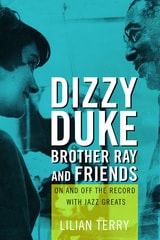
Dizzy, Duke, Brother Ray, and Friends
On and Off the Record with Jazz GreatsLillian Terry
University of Illinois Press, 2017
Drawing on Terry’s long friendships and professional associations, Dizzy, Duke, Brother Ray, and Friends offers readers a rare opportunity to hear intimate conversations with some of the world’s greatest musical figures. Dizzy Gillespie offers his thoughts on playing with “sanctified” rhythm and the all-important personal touch in performance. Duke Ellington discourses on jazz history and concludes an interview to sing a self-written ditty in Italian. Ray Charles gives candid thoughts on race and politics while taking charge of Terry’s tape recorder. Abbey Lincoln, Max Roach, Horace Silver, Bill Evans—all provide Terry and her readers with unforgettable encounters. The result is a collection of profiles, some stretching over a decade or more, that reveal these performers in ways that illuminate their humanity and expand our appreciation of their art.
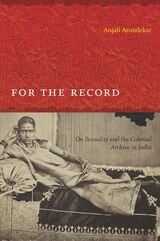
For the Record
On Sexuality and the Colonial Archive in IndiaAnjali Arondekar
Duke University Press, 2009
The logic and the interpretive resources of For the Record arise out of two entangled and minoritized historiographies: one in South Asian studies and the other in queer/sexuality studies. Focusing on late colonial India, Arondekar examines the spectacularization of sexuality in anthropology, law, literature, and pornography from 1843 until 1920. By turning to materials and/or locations that are familiar to most scholars of queer and subaltern studies, Arondekar considers sexuality at the center of the colonial archive rather than at its margins. Each chapter addresses a form of archival loss, troped either in a language of disappearance or paucity, simulacrum or detritus: from Richard Burton’s missing report on male brothels in Karáchi (1845) to a failed sodomy prosecution in Northern India, Queen Empress v. Khairati (1884), and from the ubiquitous India-rubber dildos found in colonial pornography of the mid-to-late nineteenth century to the archival detritus of Kipling’s stories about the Indian Mutiny of 1857.
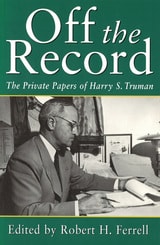
Off the Record
The Private Papers of Harry S. TrumanEdited by Robert H. Ferrell
University of Missouri Press, 1997
Gathered for the first time, Truman's private papers--diaries, letters, and memoranda--cover the period from his occupancy of the White House in 1945 to shortly before his death in 1972. Students and scholars will find valuable material on major events of the Truman years, from the Potsdam Conference to the Korean War.
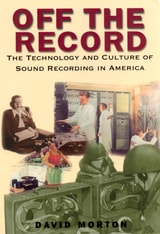
Off the Record
The Technology and Culture of Sound Recording in AmericaMorton, David
Rutgers University Press, 1999
David L. Morton examines the process of invention, innovation, and diffusion of communications technology, using the history of sound recording as the focus. Off the Record demonstrates how the history of both the hardware and the ways people used it is essential for understanding why any particular technology became a fixture in everyday life or faded into obscurity. Morton’s approach to the topic differs from most previous works, which have examined the technology’s social impact, but not the reasons for its existence. Recording culture in America emerged, Morton writes, not through the dictates of the technology itself but in complex ways that were contingent upon the actions of users.
Each of the case studies in the book emphasizes one of five aspects of the culture of recording and its relationship to new technology, at the same time telling the story of sound recording history. One of the misconceptions that Morton hopes to dispel is that the only important category of sound recording involves music. Unique in his broad-based approach to sound technology, the five case studies that Morton investigates are :- The phonograph record
- Recording in the radio business
- The dictation machine
- The telephone answering machine, and
- Home taping
On Record
Files and Dossiers in American LifeStanton Wheeler
Russell Sage Foundation, 1970
On the Record
Music Journalists on Their Lives, Craft, and CareersMike Hilleary
University of Massachusetts Press, 2020
Bringing together interviews from an impressive roster of over fifty music writers, Mike Hilleary offers up an engaging and wide-reaching examination of the past and potential future of music journalism. This accessible oral history contains professional insights into journalists’ craft and purpose, practical advice, and essential life lessons from a diverse cast of music writers—ranging from long-respected veterans of the field such as Rob Sheffield, Jessica Hopper, Ann Powers, and Chuck Klosterman to must-read modern voices including Amanda Petrusich, Hanif Abdurraqib, Lindsay Zoladz, and Jayson Greene. Honest and absorbing, On the Record will educate and enlighten anyone who wants to write about music, or anyone who wants a better understanding about those who do.
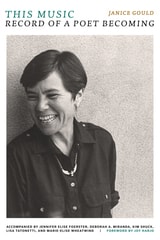
This Music
Record of a Poet BecomingJanice Gould; Edited by Jennifer Elise Foerster, Deborah A. Miranda, Kim Shuck, Lisa Tatonetti, and Marie-Elise Wheatwind; Foreword by Joy Harjo
University of Arizona Press, 2026
This Music is the final, intimate work of celebrated Koyoonk’auwi (Concow) poet and essayist Janice Gould, completed posthumously by a collective of close friends and literary scholars.
Told through lyrical prose poems and personal photographs, this memoir traces Gould’s life as a queer/Two-Spirit California Native coming of age in the late 1960s, navigating family, identity, activism, and art. With reflections on her mixed-blood heritage, her experiences in lesbian feminist circles, and her journey as a poet and musician, Gould’s voice resonates with clarity, tenderness, and fierce honesty.
The book opens with a foreword by Joy Harjo and an introduction from the editorial collective, including an essay by Gould’s spouse, Marie-Elise Wheatwind, framing the memoir as both a literary achievement and a loving tribute.
This Music is a vital contribution to Indigenous and LGBTQ+ literatures, offering readers a rare and powerful account of gender, sexuality, and Native identity in mid-century and contemporary America. As the one hundredth volume in the Sun Tracks series, this work honors Gould’s legacy while expanding the canon of poetic memoir. Ideal for readers of poetry, memoir, and Indigenous literature, this book will resonate deeply with scholars, students, and anyone drawn to stories of resilience, creativity, and the enduring power of memory.
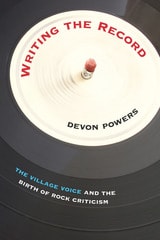
Writing the Record
The Village Voice and the Birth of Rock CriticismDevon Powers
University of Massachusetts Press, 2013
During the mid-1960s, a small group of young journalists made it their mission to write about popular music, especially rock, as something worthy of serious intellectual scrutiny. Their efforts not only transformed the perspective on the era's music but revolutionized how Americans have come to think, talk, and write about popular music ever since.
In Writing the Record, Devon Powers explores this shift by focusing on The Village Voice, a key publication in the rise of rock criticism. Revisiting the work of early pop critics such as Richard Goldstein and Robert Christgau, Powers shows how they stood at the front lines of the mass culture debates, challenging old assumptions and hierarchies and offering pioneering political and social critiques of the music. Part of a college-educated generation of journalists, Voice critics explored connections between rock and contemporary intellectual trends such as postmodernism, identity politics, and critical theory. In so doing, they became important forerunners of the academic study of popular culture that would emerge during the 1970s.
Drawing on archival materials, interviews, and insights from media and cultural studies, Powers not only narrates a story that has been long overlooked but also argues that pop music criticism has been an important channel for the expression of public intellectualism. This is a history that is particularly relevant today, given the challenges faced by criticism of all stripes in our current media environment. Powers makes the case for the value of well-informed cultural criticism in an age when it is often suggested that “everyone is a critic.”