Results by title
37 books match the query 'Religion and culture'

About Religion
Economies of Faith in Virtual CultureMark C. Taylor
University of Chicago Press, 1999
Traveling from high culture to pop culture and back again, About Religion approaches cyberspace and Las Vegas through Hegel and Kant and reads Melville's The Confidence-Man through the film Wall Street. As astonishing juxtapositions and associations proliferate, formerly uncharted territories of virtual culture disclose theological vestiges, showing that faith in contemporary culture is as unavoidable as it is elusive.
The most accessible presentation of Taylor's revolutionary ideas to date, About Religion gives us a dazzling and disturbing vision of life at the end of the old and beginning of the new millennium.

Anthropology of the Self
The Individual in Cultural PerspectiveBrian Morris
Pluto Press, 1994
Balinese Worlds
Fredrik Barth
University of Chicago Press, 1993
In this detailed ethnography of the Northern district of Buleleng, Barth rejects mainstream anthropological generalizations of Bali as a cultural system of carefully articulated parts. Instead—drawing on many sources, including the sociology of knowledge, interactional analysis, postmodern thought, and his own exceptionally varied field experience—Barth presents a new model that actually generates variation. Barth's innovative analysis of Balinese life highlights both the constructive and the disorganizing effects of individual action, the constant flux of interpretation, and the powerful interaction of memory and social relationships, and knowledge as a cultural resource.
Balinese Worlds is a unique contribution not only to Balinese studies but also to the theory and methods of the anthropology of complex societies.
Consuming Religion
Kathryn Lofton
University of Chicago Press, 2017
What are you drawn to like, to watch, or even to binge? What are you free to consume, and what do you become through consumption? These questions of desire and value, Kathryn Lofton argues, are questions for the study of religion. In eleven essays exploring soap and office cubicles, Britney Spears and the Kardashians, corporate culture and Goldman Sachs, Lofton shows the conceptual levers of religion in thinking about social modes of encounter, use, and longing. Wherever we see people articulate their dreams of and for the world, wherever we see those dreams organized into protocols, images, manuals, and contracts, we glimpse what the word “religion” allows us to describe and understand.
With great style and analytical acumen, Lofton offers the ultimate guide to religion and consumption in our capitalizing times.
Cultural Memory
Resistance, Faith, and IdentityBy Jeanette Rodriguez and Ted Fortier
University of Texas Press, 2007
Embodying Black Religions in Africa and Its Diasporas
Yolanda Covington-Ward and Jeanette S. Jouili, editors
Duke University Press, 2021
Contributors. Rachel Cantave, Youssef Carter, N. Fadeke Castor, Yolanda Covington-Ward, Casey Golomski, Elyan Jeanine Hill, Nathanael J. Homewood, Jeanette S. Jouili, Bertin M. Louis Jr., Camee Maddox-Wingfield, Aaron Montoya, Jacob K. Olupona, Elisha P. Renne
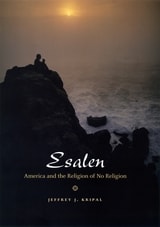
Esalen
America and the Religion of No ReligionJeffrey J. Kripal
University of Chicago Press, 2007
“An impressive new book. . . . [Kripal] has written the definitive intellectual history of the ideas behind the institute.”—San Francisco Chronicle
“Kripal examines Esalen’s extraordinary history and evocatively describes the breech birth of Murphy and Price’s brainchild. His real achievement, though, is effortlessly synthesizing a dizzying array of dissonant phenomena (Cold War espionage, ecstatic religiosity), incongruous pairings (Darwinism, Tantric sex), and otherwise schizy ephemera (psychedelic drugs, spaceflight) into a cogent, satisfyingly complete narrative.”—Atlantic Monthly
For Zion's Sake
The Judeo-Christian Tradition in American CultureFuad Sha'ban
Pluto Press, 2005
This book explores the role of religion, especially religious extremism, in American culture. In particular, it examines the development of the Judeo-Christian tradition, its impact on America's self-image, and the way it has influenced America's attitude to the Arab World.
The Christian Right has become a very powerful force in American politics. Its basic belief in Christian Zionism has resulted in a steadfast commitment to the establishment of the state of Israel and to its aggressive expansion, and has made Zionism a central part of government policy, for both Republicans and Democrats.
Fuad Sha'ban shows how this is not a new phenomenon: what he terms the 'Vision of Zion' in American life has its roots in literature, the arts and internal politics from colonial times until today. Looking in detail at a wealth of resources, including religious and literary texts, as well as official political statements, he pieces together a subtle account of how America's Puritan roots have fostered a specifically religious political culture that encourages hatred and suspicion of the Muslim World in domestic and foreign policy.
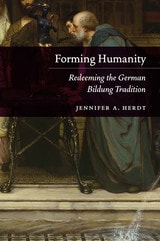
Forming Humanity
Redeeming the German Bildung TraditionJennifer A. Herdt
University of Chicago Press, 2019
Kant’s proclamation of humankind’s emergence from “self-incurred immaturity” left his contemporaries with a puzzle: What models should we use to sculpt ourselves if we no longer look to divine grace or received authorities? Deftly uncovering the roots of this question in Rhineland mysticism, Pietist introspection, and the rise of the bildungsroman, Jennifer A. Herdt reveals bildung, or ethical formation, as the key to post-Kantian thought. This was no simple process of secularization, in which human beings took responsibility for something they had earlier left in the hands of God. Rather, theorists of bildung, from Herder through Goethe to Hegel, championed human agency in self-determination while working out the social and political implications of our creation in the image of God. While bildung was invoked to justify racism and colonialism by stigmatizing those deemed resistant to self-cultivation, it also nourished ideals of dialogical encounter and mutual recognition. Herdt reveals how the project of forming humanity lives on in our ongoing efforts to grapple with this complicated legacy.
Friars, Nobles and Burghers – Sermons, Images and Prints
Studies of Culture and Society in Early-Modern Europe - In Memoriam István György TóthLászló Kontler
Central European University Press, 2010
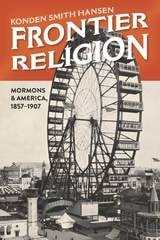
Frontier Religion
Mormons and America, 1857–1907Konden Smith Hansen
University of Utah Press, 2019
In Frontier Religion Konden Smith Hansen examines the dramatic influence these perceptions of the frontier had on Mormonism and other religions in America. Endeavoring to better understand the sway of the frontier on religion in the United States, this book follows several Mormon-American conflicts, from the Utah War and the antipolygamy crusades to the Reed Smoot hearings. The story of Mormonism’s move toward American acceptability represents a larger story of the nation’s transition to modernity and the meaning of religious pluralism. This book challenges old assumptions and provokes further study of the ever changing dialectic between society and faith.
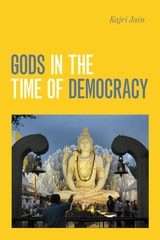
Gods in the Time of Democracy
Kajri Jain
Duke University Press, 2021
Holy Terrors, Second Edition
Thinking About Religion After September 11Bruce Lincoln
University of Chicago Press, 2006
Holy Terrors begins with a gripping dissection of the instruction manual given to each of the 9/11 hijackers. In their evocation of passages from the Quran, we learn how the terrorists justified acts of destruction and mass murder “in the name of God, the most merciful, the most compassionate.” Lincoln then offers a provocative comparison of President Bush’s October 7, 2001 speech announcing U.S. military action in Afghanistan alongside the videotaped speech released by Osama bin Laden just a few hours later. As Lincoln authoritatively demonstrates, a close analysis of the rhetoric used by leaders as different as George W. Bush and Osama bin Laden—as well as Mohamed Atta and even Jerry Falwell—betrays startling similarities. These commonalities have considerable implications for our understanding of religion and its interrelationships with politics and culture in a postcolonial world, implications that Lincoln draws out with skill and sensitivity.
With a chapter new to this edition, “Theses on Religion and Violence,” Holy Terrors remains one of the essential books on September 11 and a classic study on the character of religion.
“From time to time there appears a work . . . that serves to focus the wide-ranging, often contentious discussion of religion’s significance within broader cultural dynamics. Bruce Lincoln’s Holy Terrors is one such text. . . . Anyone still struggling toward a more nuanced comprehension of 9/11 would do well to spend time with this book.”—Theodore Pulcini, Middle East Journal
Holy Terrors
Thinking about Religion after September 11Bruce Lincoln
University of Chicago Press, 2002
Lincoln begins with a gripping dissection of the instruction manual given to each of the hijackers. In their evocation of passages from the Quran, we learn how the terrorists justified acts of destruction and mass murder "in the name of God, the most merciful, the most compassionate." Lincoln then offers a provocative comparison of President Bush's October 7 speech announcing U.S. military action in Afghanistan and Osama bin Laden's videotape released hours later. Each speech, he argues, betrays telling contradictions. Bin Laden, for instance, conceded implicitly that Islam is not unitary, as his religious rhetoric would have it, but is torn by deep political divisions. And Bush, steering clear of religious rhetoric for the sake of political unity, still reassured his constituents through coded allusions that American policy is firmly rooted in faith.
Lincoln ultimately broadens his discussion further to consider the role of religion since September 11 and how it came to be involved with such fervent acts of political revolt. In the postcolonial world, he argues, religion is widely considered the most viable and effective instrument of rebellion against economic and social injustices. It is the institution through which unified communities ensure the integrity and continuity of their culture in the wake of globalization. Brimming with insights such as these, Holy Terrors will become one of the essential books on September 11 and a classic study on the character of religion.
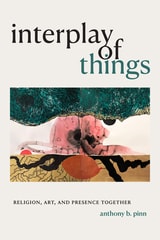
Interplay of Things
Religion, Art, and Presence TogetherAnthony B. Pinn
Duke University Press, 2021
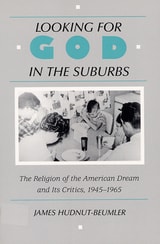
Looking for God in the Suburbs
The Religion of the American Dream and its Critics, 1945-1965Hudnut-Beumler, James
Rutgers University Press, 1994
In the 1950s, 99 percent of adult Americans said they believed in God. How, James Hudnut-Beumler asks, did this consensus about religion turn into the confrontational debates over religion in the 1960s? He argues that post-World War II suburban conformity made church-going so much a part of middle-class values and life that religion and culture became virtually synonymous. Secular critics like David Riesman, William Whyte, C. Wright Mills, and Dwight Macdonald, who blamed American culture for its conformism and lack of class consciousness, and religious critics like Will Herberg, Gibson Winter, and Peter Berger, who argued that religion had lost its true roots by incorporating only the middle class, converged in their attacks on popular religion.
Although most Americans continued to live and worship as before, a significant number of young people followed the critics' call for a faith that led to social action, but they turned away from organized religion and toward the counterculture of the sixties. The critics of the 1950s deserve credit for asking questions about the value of religion as it was being practiced and the responsibilities of the affluent to the poor—and for putting these issues on the social and cultural agenda of the next generation.

Love in the Drug War
Selling Sex and Finding Jesus on the Mexico-US BorderBy Sarah Luna
University of Texas Press, 2020
2020 — Ruth Benedict Prize – Association for Queer Anthropology, American Anthropological Association
2020 — Gloria E. Anzaldúa Book Prize – National Women’s Studies Association
2020 — Honorable Mention, Sara A. Whaley Book Prize
2021 — Best Book in Social Sciences – Mexico Section, Latin American Studies Association (LASA)
Sex, drugs, religion, and love are potent combinations in la zona, a regulated prostitution zone in the city of Reynosa, across the border from Hidalgo, Texas. During the years 2008 and 2009, a time of intense drug violence, Sarah Luna met and built relationships with two kinds of migrants, women who moved from rural Mexico to Reynosa to become sex workers and American missionaries who moved from the United States to forge a fellowship with those workers.
Luna examines the entanglements, both intimate and financial, that define their lives. Using the concept of obligar, she delves into the connections that tie sex workers to their families, their clients, their pimps, the missionaries, and the drug dealers—and to the guilt, power, and comfort of faith. Love in the Drug War scrutinizes not only la zona and the people who work to survive there, but also Reynosa itself—including the influences of the United States—adding nuance and new understanding to the current Mexico-US border crisis.
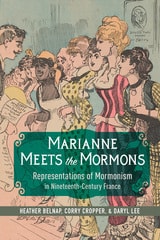
Marianne Meets the Mormons
Representations of Mormonism in Nineteenth-Century FranceHeather Belnap, Corry Cropper, and Daryl Lee
University of Illinois Press, 2022
Surprising and innovative, Marianne Meets the Mormons looks at how nineteenth-century French observers engaged with the idea of Mormonism in order to reframe their own cultural preoccupations.
Moving In and Out of Islam
By Karin van Nieuwkerk
University of Texas Press, 2018
Embracing a new religion, or leaving one’s faith, usually constitutes a significant milestone in a person’s life. While a number of scholars have examined the reasons why people convert to Islam, few have investigated why people leave the faith and what the consequences are for doing so. Taking a holistic approach to conversion and deconversion, Moving In and Out of Islam explores the experiences of people who have come into the faith along with those who have chosen to leave it—including some individuals who have both moved into and out of Islam over the course of their lives.
Sixteen empirical case studies trace the processes of moving in or out of Islam in Western and Central Europe, the United States, Canada, and the Middle East. Going beyond fixed notions of conversion or apostasy, the contributors focus on the ambiguity, doubts, and nonlinear trajectories of both moving in and out of Islam. They show how people shifting in either direction have to learn or unlearn habits and change their styles of clothing, dietary restrictions, and ways of interacting with their communities. They also look at how communities react to both converts to the religion and converts out of it, including controversies over the death penalty for apostates. The contributors cover the political aspects of conversion as well, including debates on radicalization in the era of the “war on terror” and the role of moderate Islam in conversions.
Myriad Intimacies
Lata Mani
Duke University Press, 2022
One State Under God
A History of Religion in TexasJoseph L. Locke
University of Texas Press, 2026
A broad and accessible history of religion in Texas, from prehistory to the present.
From sprawling megachurches to religious billboards and towering steel crosses, religion quite literally looms over Texas. Christian nationalism determines the state’s politics and, every school day, more than five million Texas children pledge allegiance to “one state under God.” But it wasn’t always this way.
In this wide-ranging chronicle, Joseph Locke uncovers the breadth of Texas’s religious history, from Indigenous painters of cosmological cave art and Spanish invaders who constructed missions to irreligious Anglo colonists, freethinking frontiersmen, Tejano folk saints, evangelical culture warriors, and Muslim immigrants. Locke traces the state’s religious transformations across the centuries, bringing them to life through his depiction of compelling figures, like enslaved preacher Anderson Edwards, fighting fundamentalist J. Frank Norris, and celebrated humanitarian Sister Norma Pimentel, and gripping moments, such as the murder of atheist newspaperman William Cowper Brann and the siege of the Branch Davidian compound in Waco. Comprehensive, fast-paced, and highly readable, One State Under God reveals how the Lone Star State’s spiritual path was blazed.
Rage and Carnage in the Name of God
Religious Violence in NigeriaAbiodun Alao
Duke University Press, 2022
Redeeming Culture
American Religion in an Age of ScienceJames Gilbert
University of Chicago Press, 1997
"Anyone seriously interested in the history of current controversies involving religion and science will find Gilbert's book invaluable."—Peter J. Causton, Boston Book Review
"Redeeming Culture provides some fascinating background for understanding the interactions of science and religion in the United States. . . . Intriguing pictures of some of the highlights in this cultural exchange."—George Marsden, Nature
"A solid and entertaining account of the obstacles to mutual understanding that science and religion are now warily overcoming."—Catholic News Service
"[An] always fascinating look at the conversation between religion and science in America."—Publishers Weekly
Religion and Its Other
Secular and Sacral Concepts and Practices in InteractionEdited by Heike Bock, Jörg Feuchter, and Michi Knecht
Campus Verlag, 2008
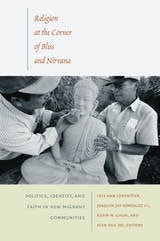
Religion at the Corner of Bliss and Nirvana
Politics, Identity, and Faith in New Migrant CommunitiesLois Ann Lorentzen, Joaquin Jay Gonzalez III, Kevin M. Chun and Hien Duc Do, eds.
Duke University Press, 2009
As they conducted research, the contributors not only visited churches and temples but also single-room-occupancy hotels, brothels, tattoo-removal clinics, and the streets of San Francisco, El Salvador, Mexico, and Vietnam. Their essays include an exploration of how faith-based organizations can help LGBT migrants surmount legal and social complexities, an examination of transgendered sex workers’ relationship with the unofficial saint Santisima Muerte, a comparison of how a Presbyterian mission and a Buddhist temple in San Francisco help Chinese immigrants to acculturate, and an analysis of the transformation of baptismal rites performed by Mayan migrants. The voices of gang members, Chinese and Vietnamese Buddhist nuns, members of Pentecostal churches, and many others animate this collection. In the process of giving voice to these communities, the contributors interrogate theories about acculturation, class, political and social capital, gender and sexuality, the sociology of religion, transnationalism, and globalization. The collection includes twenty-one photographs by Jerry Berndt.
Contributors. Luis Enrique Bazan, Kevin M. Chun, Hien Duc Do, Patricia Fortuny Loret de Mola, Joaquin Jay Gonzalez III, Sarah Horton, Cymene Howe, Mimi Khúc, Jonathan H. X. Lee, Lois Ann Lorentzen, Andrea Maison, Dennis Marzan, Rosalina Mira, Claudine del Rosario, Susanna Zaraysky
Religion, Media, and the Marketplace
Clark, Lynn Schofield
Rutgers University Press, 2007
Religion is infiltrating the arena of consumer culture in increasingly visible ways. We see it in a myriad of forms-in movies, such as Mel Gibson's The Passion of the Christ, on Internet shrines and kitschy Web "altars," and in the recent advertising campaign that attacked fuel-guzzling SUVs by posing the question: What would Jesus drive?
In Religion, Media, and the Marketplace, scholars in history, media studies, and sociology explore this intersection of the secular and the sacred. Topics include how religious leaders negotiate between the competing aims of the mainstream and the devout in the commercial marketplace, how politics and religious beliefs combine to shape public policy initiatives, how the religious "other" is represented in the media, and how consumer products help define the practice of different faiths.
At a time when religious fundamentalism in the United States and throughout the world is inseparable from political aims, this interdisciplinary look at the mutual influences between religion and the media is essential reading for scholars from a wide variety of disciplines.
Religions/Globalizations
Theories and CasesDwight N. Hopkins, Lois Ann Lorentzen, Eduardo Mendieta, and David Batstone, eds.
Duke University Press, 2001
As the contributors to this work suggest, a crucial component of globalization—the breakdown of familiar boundaries and power balances—may open a space in which religion can be deployed to help refabricate new communities. Examples of such deployments can be found in the workings of liberation theology in Latin America. In other cases, however, the operations of globalization have provided a space for strident religious nationalism and identity disputes to flourish. Is there in fact a dialectical tension between religion and globalization, a codependence and codeterminism? While religion can be seen as a globalizing force, it has also been transformed and even victimized by globalization.
A provocative assessment of a contemporary phenomenon with both cultural and political dimensions, Religions/Globalizations will interest not only scholars in religious studies but also those studying Latin America, the Middle East, South Asia, and Africa.
Contributors. David Batstone, Berit Bretthauer, Enrique Dussel, Dwight N. Hopkins, Mark Juergensmeyer, Lois Ann Lorentzen, Eduardo Mendieta, Vijaya Rettakudi Nagarajan, Kathryn Poethig, Lamin Sanneh, Linda E. Thomas
Ripples of the Universe
Spirituality in Sedona, ArizonaSusannah Crockford
University of Chicago Press, 2021
Many people move to Sedona because, they claim, they are called there by its special energy. But they are also often escaping job loss, family breakdown, or foreclosure. Spirituality, Crockford shows, offers a way for people to distance themselves from and critique current political and economic norms in America. Yet they still find themselves monetizing their spiritual practice as a way to both “raise their vibration” and meet their basic needs. Through an analysis of spirituality in Sedona, Crockford gives shape to the failures and frustrations of middle- and working-class people living in contemporary America, describing how spirituality infuses their everyday lives. Exploring millenarianism, conversion, nature, food, and conspiracy theories, Ripples of the Universe combines captivating vignettes with astute analysis to produce a unique take on the myriad ways class and spirituality are linked in contemporary America.
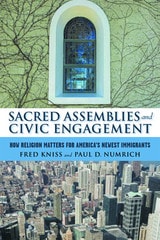
Sacred Assemblies and Civic Engagement
How Religion Matters for America's Newest ImmigrantsNumrich, Paul D
Rutgers University Press, 2007
Immigration to the United States has been a major source of population growth and cultural change throughout much of America’s history. Currently, about 40 percent of the nation’s annual population growth comes from the influx of foreign-born individuals and their children. As these new voices enter America’s public conversations, they bring with them a new understanding of Buddhism, Hinduism, Islam, Judaism, and Christianity to a society that has been marked by religious variety.
Sacred Assemblies and Civic Engagement takes an in-depth look at one particular urban area—the Chicago metropolitan region—and examines how religion affects the civic engagement of the nation’s newest residents. Chapters focus on important religious factors, including sectarianism, moral authority, and moral projects; on several areas of social life, including economics, education, marriage, and language, where religion impacts civic engagement; and on how notions of citizenship and community are influenced by sacred assemblies.
Secularisms
Janet R. Jakobsen and Ann Pellegrini, eds.
Duke University Press, 2008
With essays addressing secularism in India, Iran, Turkey, Great Britain, China, and the United States, this collection crucially complicates the dominant narrative by showing that secularism is multifaceted. How secularism is lived and experienced varies with its national, regional, and religious context. The essays explore local secularisms in relation to religious traditions ranging from Islam to Judaism, Hinduism to Christianity. Several contributors explicitly take up the way feminism has been implicated in the dominant secularization story. Ultimately, by dislodging secularism’s connection to the single (and singular) progress narrative, this volume seeks to open spaces for other possible narratives about both secularism and religion—as well as for other possible ways of inhabiting the contemporary world.
Contributors: Robert J. Baird, Andrew Davison, Tracy Fessenden, Janet R. Jakobsen, Laura Levitt,
Molly McGarry, Afsaneh Najmabadi, Taha Parla, Geeta Patel, Ann Pellegrini, Tyler Roberts,
Ranu Samantrai, Banu Subramaniam, Rajeswari Sunder Rajan, Angela Zito
Secularization and Cultural Criticism
Religion, Nation, and ModernityVincent P. Pecora
University of Chicago Press, 2006
Religion is an undiscovered country for much of the secular academy, which remains deeply ambivalent about it as an object of study. On the one hand, secular scholars agree that it is time to take religion seriously. On the other, these same scholars persist in assuming that religion rests not on belief but on power and ideology. According to Vincent Pecora, the idea of the secular itself is the source of much of the contradiction and confusion in contemporary thought about religion. Pecora aims here to work through the paradoxes of secularization, which emerges in this book as an intractable problem for cultural criticism in the nation-states of the post-Enlightenment West.
Secularization and Cultural Criticism examines the responses of a wide range of thinkers—Edward Said, Talal Asad, Jürgen Habermas, Walter Benjamin, Emile Durkheim, Carl Schmitt, Matthew Arnold, and Virginia Woolf, among others—to illustrate exactly why the problem of secularization in the study of society and culture should matter once again. Exploring the endemic difficulty posed by religion for the modern academy, Pecora makes sense of the value and potential impasses of secular cultural criticism in a global age.
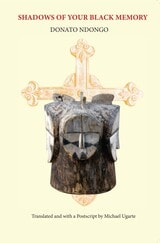
Shadows of Your Black Memory
Donato Ndongo
Swan Isle Press, 2007
Now in paperback, Shadows of Your Black Memory masterfully exposes the cultural fissures of Ndongo’s native land. “Spanish Guinea” is a heated, sensual landscape with exotic animals and trees, ancient rituals, ghosts, saints, and sinners. We come to know the narrator’s extended family, the people of his village, merchants, sorcerers, and Catholic priests; we see them critically at times, even humorously, yet always with compassion and a magical dignity. Michael Ugarte’s sensitive translation captures the spirit of the original Spanish prose and makes Ndongo’s powerful, gripping tale available to English-speaking readers for the first time.
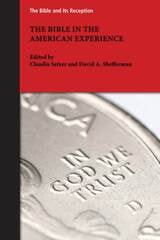
The Bible in the American Experience
Claudia Setzer
SBL Press, 2020
An interdisciplinary investigation of the Bible's place in American experience
Much has changed since the Society of Biblical Literature's Bible in American Culture series was published in the 1980s, but the influence of the Bible has not waned. In the United States, the stories, themes, and characters of the Bible continue to shape art, literature, music, politics, education, and social movements to varying degrees. In this volume, contributors highlight new approaches that move beyond simple citation of texts and explore how biblical themes infuse US culture and how this process in turn transforms biblical traditions.
Features
- An examination of changes in the production, transmission, and consumption of the Bible
- An exploration of how Bible producers disseminate US experiences to a global audience
- An assessment of the factors that produce widespread myths about and nostalgia for a more biblically grounded nation
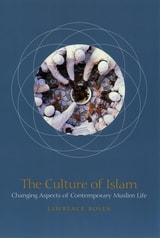
The Culture of Islam
Changing Aspects of Contemporary Muslim LifeLawrence Rosen
University of Chicago Press, 2002
Through a series of poignant tales—from the struggle by a group of friends against daily corruption to the contest over a saint's identity, from nostalgia for the departed Jews to Salman Rushdie's vision of doubt in a world of religious certainty—Rosen shows how a dazzling array of potential changes are occurring alongside deeply embedded continuity, a process he compares to a game of chess in which infinite variations of moves can be achieved while fundamental aspects of "the game" have had a remarkably enduring quality. Whether it is the potential fabrication of new forms of Islam by migrants to Europe (creating a new "Euro-Islam," as Rosen calls it), the emphasis put on individuals rather than institutions, or the heartrending problems Muslims may face when their marriages cross national boundaries, each story and each interpretation offers a window into a world of contending concepts and challenged coherence.
The Culture of Islam is both an antidote to simplified versions of Islam circulating today and a consistent story of the continuities that account for much of ordinary Muslim life. It offers, in its human stories and its insights, its own contribution, as the author says, "to the mutual understanding and forgiveness that alone will make true peace possible."
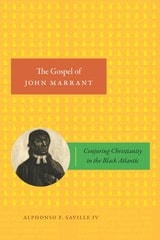
The Gospel of John Marrant
Conjuring Christianity in the Black AtlanticAlphonso F. Saville IV
Duke University Press, 2024
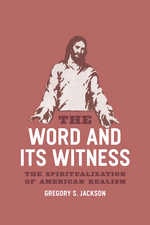
The Word and Its Witness
The Spiritualization of American RealismGregory S. Jackson
University of Chicago Press, 2009
Jackson shows how the homiletic tradition in Protestant sermons provided a foundation for the development of visual and literary realism. Evangelical preachers and writers used vivid language grounded in everyday life to translate abstract concepts like hell into concrete reality—a key influence on realist authors that brought about the more secular forms of the movement we know today. This emphasis on the sensuous also paved the way for Protestantism’s embrace of new media, evident in the photographs of Jacob Riis as well as the video game Left Behind: Eternal Forces.
With its remarkable scope and timely insights into the interplay between religion, secularism, and politics, The Word and Its Witness will transform the way we understand American realism and American religion.
Who Owns Religion?
Scholars and Their Publics in the Late Twentieth CenturyLaurie L. Patton
University of Chicago Press, 2019
Taking the reader through several compelling case studies, Patton identifies two trends of the ’80s and ’90s that fueled that rise: the growth of multicultural identity politics, which enabled a form of volatile public debate she terms “eruptive public space,” and the advent of the internet, which offered new ways for religious groups to read scholarship and respond publicly. These controversies, she shows, were also fundamentally about something new: the very rights of secular, Western scholarship to interpret religions at all.
Patton’s book holds out hope that scholars can find a space for their work between the university and the communities they study. Scholars of religion, she argues, have multiple masters and must move between them while writing histories and speaking about realities that not everyone may be interested in hearing.