Results by title
22 books match the query 'Republican Party (U.S. : 1854- )'
"The Disenthralled Hosts of Freedom"
Party Prophecy in the Antebellum Editions of Leaves of GrassDavid Grant
University of Iowa Press, 2021
Anti-slavery party discourse set itself the task of curing an ailing people who had grown compliant, inert, and numb; it fashioned a complete fictional world where the people could be reactivated into assuming their true role in the republic. Both as a cause and a result of this rejuvenation, they would come into their own and spread their energies over the land and over the body politic, thereby rescuing their country at the last minute from what would otherwise be the permanent dominion of slavery. Party discourse had long hinged its success on such magical transformations of the people individually and collectively, and Whitman’s celebrations of his nation’s potential need to be seen in this context: like his party, Whitman calls on the people to reject their own subordination and take command of the future, and redeem themselves as they also redeem the nation.
American Public Philosophy and the Mystery of Lincolnism
Eric C. Sands
University of Missouri Press, 2009
Apostles of Equality
The Birneys, the Republicans, and the Civil WarD. Laurence Rogers
Michigan State University Press, 2011
The first biographical account of the life of James Gillespie Birney in more than fifty years, this fabulously insightful history illuminates and elevates an all-but-forgotten figure whose political career contributed mightily to the American political fabric. Birney was a southern-born politician at the heart of the antislavery movement, with two southern-born sons who were major generals involved in key Union Army activities, including the leadership of the black troops. The interaction of the Birneys with historical figures (Abraham Lincoln, Harriet Beecher Stowe, and Henry Clay) highlights the significance of the family’s activities in politics and war. D. Laurence Rogers offers a unique historiography of the abolition movement, the Civil War, and Reconstruction through the experiences of one family navigating momentous developments from the founding of the Republic until the late 19th century.
Barbara F. Vucanovich
From Nevada to Congress, and Back AgainBarbara F. Vucanovich
University of Nevada Press, 2014

Barry Goldwater and the Remaking of the American Political Landscape
Edited by Elizabeth Tandy Shermer
University of Arizona Press, 2013
Since Goldwater’s death in 1998, politicians, pundits, and academics have been assessing his achievements and his shortcomings. The twelve essays in this volume thoroughly examine the life, times, and impact of “Mr. Conservative.” Scrutinizing the transformation of a Phoenix department store owner into a politician, de facto political philosopher, and five-time US senator, contributors highlight the importance of power, showcasing the relationship between the nascent conservative movement’s cadre of elite businessmen, newsmen, and intellectuals and their followers at the grassroots—or sagebrush—level.
Goldwater, who was born in the Arizona Territory in 1909, was deeply influenced by his Western upbringing. With his appearance on the national stage in 1964, he not only articulated a new brand of conservatism but gave a voice to many Americans who were not enamored with the social and political changes of the era. He may have lost the battle for the presidency, but he energized a coalition of journalists, publishers, women’s groups, and Southerners to band together in a movement that reshaped the nation.
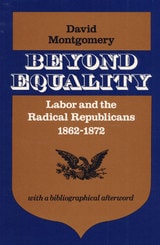
Beyond Equality
Labor and the Radical Republicans, 1862-1872David Montgomery
University of Illinois Press, 1981
"Beyond Equality is a masterpiece. . . . A book of bold and brilliant originality, it is now shaping the perspective of a new generation of graduate students." -- David Brion Davis, author of The Problem of Slavery in Western Culture
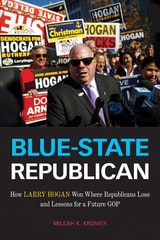
Blue-State Republican
How Larry Hogan Won Where Republicans Lose and Lessons for a Future GOPMileah K. Kromer
Temple University Press, 2023
Larry Hogan is one of the most popular political figures in the United States today. The two-term Republican governor of Maryland first won his seat after upsetting a favorite of the Democratic political establishment, and then overcame the Trump-driven wave in the heartland of the #resistance to win a second term in 2018.
Blue-State Republican is the remarkable story of how his carefully messaged, pragmatic approach to governance helped build a coalition of moderate and conservative Democrats, independents, women, college-educated and Black voters and maintained his GOP base during a time of polarization and negative partisanship. Mileah Kromer takes readers inside Maryland politics to illustrate exactly how Hogan won where Republicans lose and consider whether the un-Trump Republican offers any lessons for how the GOP can win the center-right voters who continue to make up a majority of the country.
Kromer conducts interviews with key political leaders and insiders, including Hogan himself, to explain the mechanics of his political success. She also provides a cogent analysis of public opinion polls and focus groups, ultimately showing why the success of a blue-state Republican matters outside of his home state, especially as Hogan considers a 2024 Presidential run.
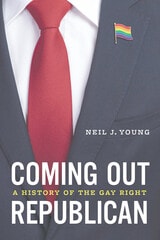
Coming Out Republican
A History of the Gay RightNeil J. Young
University of Chicago Press, 2024
One of the most maligned, misunderstood, and even mocked constituencies in American politics, gay Republicans regularly face condemnation from both the LGBTQ+ community and their own political party. Yet they’ve been active and influential for decades. Gay conservatives were instrumental, for example, in ending “Don’t Ask, Don’t Tell” and securing the legalization of same-sex marriage—but they also helped lay the groundwork for the rise of Donald Trump.
In Coming Out Republican, political historian and commentator Neil J. Young provides the first comprehensive history of the gay Right. From the 1950s up to the present day, Young excavates the multifarious origins, motivations, and evolutions of LGBTQ+ people who found their way to the institutions and networks of modern conservatism. Many on the gay Right have championed conservative values—like free markets, a strong national defense, and individual liberty—and believed that the Republican Party therefore offered LGBTQ+ people the best pathway to freedom. Meanwhile, that same party has actively and repeatedly demonized them. With his precise and provocative voice, Young details the complicated dynamics of being in—and yet never fully accepted into—the Republican Party.
Coming Out Republican provides striking insight into who LGBTQ+ conservatives are, what they want, and why many of them continue to align with a party whose rank and file largely seem to hate them. As the Republican Party renews its assaults on LGBTQ+ rights, understanding the significant history of the gay Right has never been more critical.
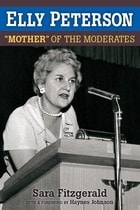
Elly Peterson
"Mother" of the ModeratesSara Fitzgerald
University of Michigan Press, 2012
"A magisterially written, well-researched, informative, and entertaining biography of a woman who helped throw open the doors to broader participation and power for women in the Republican Party and American politics."
---Dave Dempsey, author of William G. Milliken: Michigan's Passionate Moderate
"Elly Peterson will be a text to which historians and researchers turn for insight into the yin and yang of mainstream politics in the mid-century."
---Patricia Sullivan, past president, Journalism and Women Symposium
"This lively portrait of a leading woman in the Republican Party between 1952 and 1982 also charts the party's shift to the right after 1964, revealingly viewed through the eyes of liberal Republican women. Intensively researched with ethnographic attention to the subtleties of political culture, Fitzgerald's book is essential reading for anyone interested in how the Republican Party changed during the turbulent decades after 1960 and how women and women's issues shaped those changes."
---Kathryn Kish Sklar, Distinguished Professor of History, State University of New York, Binghamton
"Sara Fitzgerald tells Peterson's story in this superb and timely biography. It carries a message that deserves the widest audience as the nation struggles to find needed consensus on critical issues amid poisonous political partisanship that has made it increasingly difficult for public officials to bridge their differences. I hope that every American reads it."
---Pulitzer Prize winner Haynes Johnson, from the Foreword
"To understand the quest for equal rights in America you really need to meet those women who were active at the time of transition. In this gripping biography we meet one woman who entered a male dominated world and triumphed."
---Francis X. Blouin Jr., Director, Bentley Historical Library
"Sara Fitzgerald's writing is as intelligent as it is entertaining."
---Best-selling novelist Diane Chamberlain
Elly Peterson was one of the highest ranking women in the Republican Party. In 1964 she ran for a Michigan seat in the U.S. Senate and became the first woman to serve as chair of the Michigan Republican Party. During the 1960s she grew disenchanted with the increasing conservatism of her party, united with other feminists to push for the Equal Rights Amendment and reproductive choice, battled Phyllis Schlafly to prevent her from gaining control of the National Federation of Republican Women, and became an independent.
Elly Peterson's story is a missing chapter in the political history of Michigan, as well as the United States. This new biography, written by Sara Fitzgerald (a Michigan native and former Washington Post editor), finally gives full credit to one of the first female political leaders in this country.
When Peterson resigned in 1970 as assistant chairman of the Republican National Committee, David Broder of the Washington Post wrote that "her abilities would have earned her the national chairmanship, were it not for the unwritten sex barrier both parties have erected around that job."
How the Tea Party Captured the GOP
Insurgent Factions in American PoliticsRachel M. Blum
University of Chicago Press, 2020
In How the Tea Party Captured the GOP, Rachel Marie Blum approaches the Tea Party from the angle of party politics, explaining the Tea Party’s insurgent strategies as those of a party faction. Blum offers a novel theory of factions as miniature parties within parties, discussing how fringe groups can use factions to increase their political influence in the US two-party system. In this richly researched book, the author uncovers how the electoral losses of 2008 sparked disgruntled Republicans to form the Tea Party faction, and the strategies the Tea Party used to wage a systematic takeover of the Republican Party. This book not only illuminates how the Tea Party achieved its influence, but also provides a framework for identifying other factional insurgencies.
Lincoln and the Election of 1860
Michael S. Green
Southern Illinois University Press, 2011
Although Lincoln rose to national prominence in 1858 during his debates with Stephen Douglas, he was unable to publicly stump for the presidency in a time when personal campaigning for the office was traditionally rejected. This limitation did nothing to check Lincoln’s ambitions, however, as he consistently endeavored to place himself in the public eye while stealthily pulling political strings behind the scenes. Green demonstrates how Lincoln drew upon his considerable communication abilities and political acumen to adroitly manage allies and enemies alike, ultimately uniting the Republican Party and catapulting himself from his status as one of the most unlikely of candidates to his party’s nominee at the national convention.
As the general election campaign progressed, Lincoln continued to draw upon his experience from three decades in Illinois politics to unite and invigorate the Republican Party. Democrats fell to divisions between North and South, setting the stage for a Republican victory in November—and for the most turbulent times in U.S. history.
Moving well beyond a study of the man to provide astute insight into the era’s fiery political scene and its key players, Green offers perceptive analysis of the evolution of American politics and Lincoln’s political career, the processes of the national and state conventions, how political parties selected their candidates, national developments of the time and their effects on Lincoln and his candidacy, and Lincoln’s own sharp—and often surprising—assessments of his opponents and colleagues. Green frequently employs Lincoln’s own words to afford an intimate view into the political savvy of the future president.
The pivotal election of 1860 previewed the intelligence, patience, and shrewdness that would enable Lincoln to lead the United States through its greatest upheaval. This exciting new book brings to vivid life the cunning and strength of one of America’s most intriguing presidents during his journey to the White House.
Madam Chairman
Mary Louise Smith and the Republican Revival after WatergateSuzanne O'Dea
University of Missouri Press, 2012
Race, Republicans, and the Return of the Party of Lincoln
Tasha S. Philpot
University of Michigan Press, 2007
Whether their slogan is “compassionate conservatism” or “hawkish liberalism,” political parties have always sought to expand their electoral coalitions by making minor adjustments to their public image. How do voters respond to these, often short-term, campaign appeals? Race, Republicans, and the Return of the Party of Lincoln is Tasha Philpot’s insightful study of how parties use racial images to shape and reshape the way citizens perceive them.
“Philpot has produced a timely, provocative, and nuanced analysis of political party image change, using the Republican Party’s attempts to recast itself as a party sensitive to issues of race with its 2000, and later 2004, national conventions as case examples. Using a mixture of experiments, focus groups, national surveys, and analyses of major national and black newspaper articles, Philpot finds that if race-related issues are important to individuals, such as blacks, the ability of the party to change its image without changing its political positions is far more difficult than it is among individuals who do not consider race-related issues important, e.g., whites. This book makes a major contribution
to our understanding of party image in general, and political parties’ use of race in particular. Bravo!”
—Paula D. McClain, Duke University
“This book does an excellent job of illuminating the linkages between racial images and partisan support. By highlighting Republican efforts to ‘play against type’ Philpot emphasizes the limits of successfully altering partisan images. That she accomplishes this in the controversial, yet salient, domain of race is no small feat. In short, by focusing on a topical issue, and by adopting a novel theoretical approach, Philpot is poised to make a significant contribution to the literatures on race and party images.”
—Vincent Hutchings, University of Michigan
Tasha S. Philpot is Assistant Professor of Government and African and African American Studies at the University of Texas at Austin.
Revivalism and Cultural Change
Christianity, Nation Building, and the Market in the Nineteenth-Century United StatesGeorge M. Thomas
University of Chicago Press, 1989
"Subtle and complex. . . . Fascinating."—Randolph Roth, Pennsylvania History
"[Revivalism and Cultural Change] should be read with interest by those interested in religious movements as well as the connections among religion, economics, and politics."—Charles L. Harper, Contemporary Sociology
"Readers old and new stand to gain much from Thomas's sophisticated study of the macrosociology of religion in the United States during the nineteenth century. . . . He has given the sociology of religion its best quantitative study of revivalism since the close of the 1970s."—Journal for the Scientific Study of Religion
Rural Pain, Republican Gain
How the Republican Party Is Killing Rural America and Why Democrats Are BlamedMichael E. Shepherd
University of Chicago Press, 2026
An eye-opening look at how Republican policies have affected health outcomes in rural communities and why poor, rural white voters are turning to the Republican Party—not despite this harm, but because of it.
Over the last four decades, the health of rural Americans has been in free fall. Just as opioid and gun deaths have ripped apart rural communities, hospitals have closed at alarming rates, leaving millions desperately far from care. At the same time, voters in struggling rural communities have increasingly come to vote for the Republican Party.
In Rural Pain, Republican Gain, Michael E. Shepherd demonstrates that these two trends are closely connected. At both the federal and state levels, the Republican Party has increasingly enacted policies that worsen rural health. Rural voters are not indifferent to this development (quite the contrary), but they misassign blame, in part, because the Democratic Party is more commonly associated with health-related policy initiatives and has ownership of health as an issue area. Republican politicians can reap rewards from their own destructive policies by appealing to the shared grievances of rural people.
Shepherd draws on new, wide-ranging data, including in-depth studies of the opioid epidemic, hospital closures, and COVID-19. In so doing, he quantifies the harm of Republican policymaking and its disproportionate effect on rural communities, recasting how readers understand growing Republican support among less healthy, lower-income rural white Americans.

The Evangelical Crackup?
The Future of the Evangelical-Republican CoalitionEdited by Paul Djupe and Ryan L. Claassen
Temple University Press, 2019
Why did Donald Trump attract a record number of white evangelical voters without unified support—and despite nontrivial antipathy from evangelical leaders? The editors and leading scholars that contribute to the timely volume The Evangelical Crackup? answer this question and provide a comprehensive assessment of the status of evangelicals and the Christian Right in the Republican coalition.
The expected “crackup” with the Republican Party never happened. Each chapter in this cogent volume includes analyses of the 2016 election to explain why—and why that is critical. Chapters examine policy priorities, legal advocacy, and evangelical loyalty to the Republican Party; rhetoric, social networks, and evangelical elite influence; and the political implications of movements within evangelicalism, such as young evangelicals, Hispanics, and the Emergent Church movement.
Contributors include: Daniel Bennett, Mark Brockway, Ryan P. Burge, Brian R. Calfano, Jeremy Castle, Kimberly Conger, Daniel A. Cox, Kevin den Dulk, Sarah Allen Gershon, Tobin Grant, Robert P. Jones, Geoffrey Layman, Andrew R. Lewis, Ronald J. McGauvran, Joshua Mitchell, Juhem Navarro-Rivera, Jacob R. Neiheisel, Elizabeth Oldmixon, Adrian D. Pantoja, David Searcy, Anand Edward Sokhey, J. Benjamin Taylor, Robert Wuthnow, and the editors.
The Irony of the Solid South
Democrats, Republicans, and Race, 1865–1944Glenn Feldman
University of Alabama Press, 2013
Race, Politics, and the Making of the Modern South.
The Irony of the Solid South examines how the south became the “Solid South” for the Democratic Party and how that solidarity began to crack with the advent of American involvement in World War II. Relying on a sophisticated analysis of secondary research—as well as a wealth of deep research in primary sources such as letters, diaries, interviews, court cases, newspapers, and other archival materials—Glenn Feldman argues in The Irony of the Solid South that the history of the solid Democratic south is actually marked by several ironies that involve a concern with the fundamental nature of southern society and culture and the central place that race and allied types of cultural conservatism have played in ensuring regional distinctiveness and continuity across time and various partisan labels. Along the way, this account has much to say about the quality and nature of the New Deal in Dixie, southern liberalism, and its fatal shortcomings.
Feldman focuses primarily on Alabama and race but also considers at length circumstances in the other southern states as well as insights into the uses of emotional issues other than race that have been used time and again to distract whites from their economic and material interests. Feldman explains how conservative political forces (Bourbon Democrats, Dixiecrats, Wallace, independents, and eventually the modern GOP) ingeniously fused white supremacy with economic conservatism based on the common glue of animus to the federal government. A second great melding is exposed, one that joined economic fundamentalism to the religious kind along the shared axis of antidemocratic impulses.
Feldman’s study has much to say about southern and American conservatism, the enduring power of cultural and emotional issues, and the modern south’s path to becoming solidly Republican.

The Paradox of Progress
Economic Change, Individual Enterprise, and Politic Culture in Michigan, 1837-1878Martin J. Hershock
Ohio University Press, 2003
Guiding this transformation was the nineteenth-century Republican party. Drawing heavily from both the pro-market commitments of the early Whig party and the anti-capitalist culture of Jackson's Democratic party, the early Republican party found itself torn between these competing values. Nowhere was this contested process more obvious or more absorbing than in Civil War-era Michigan, the birthplace of the Republican party.
In The Paradox of Progress, a fascinating look at the central factors underlying the history of the GOP, Martin Hershock reveals how in their determination to resolve their ideological dilemma, Republicans of the Civil War era struggled to contrive a formula that wo uld enable them to win popular elections and to model America's acceptance of Gilded Age capitalism.
The Republicans
From Lincoln to BushRobert Allen Rutland
University of Missouri Press, 1996
The Republican party has always been fascinating to those who subscribe to its principles, as well as to those who take an alternative stand on the issues. In The Republicans: From Lincoln to Bush, Robert Allen Rutland has brought a clear and concise understanding of this political party to the general reader. The book is a lucid and fast-paced overview of the Republican party from its beginnings in the 1850s through the 1994 congressional elections, which saw the Democratic domination of the House and Senate come to an abrupt end.
In a crisp, highly readable style, Rutland begins by explaining how the "obnoxious" Kansas-Nebraska Act of 1854 overturned the Missouri Compromise, inflamed the North, and caused the collapse of the Whig and American parties. The result was the birth of the Republican party, whose purpose was to oppose the Democrats and stop the spread of slavery. Abraham Lincoln was elected the first Republican president in 1860.
The Republicans suggests that a major shift in voting strength took place twice during the twentieth century, first in the New Deal years, and again after 1968 when the GOP made an appeal to southern voters and finally took control of the area that had previously been dominated by the Democrats. With the 1980 election of Ronald Reagan as the fortieth president of the United States, the Republicans gained support from many first-time voters, middle-class whites, and labor unions-- groups not previously expected to vote Republican. In the companion volume, The Democrats: From Jefferson to Clinton, Rutland provides an honest and straightforward assessment of the strengths and weaknesses of Democratic presidents. Here he presents an evenhanded look at the good and not-so-good Republicans. By skillfully using stories and anecdotes from various administrations to enliven this narrative of political history, Rutland gives Republicans and Democrats alike a deeper appreciation for the two-party system.
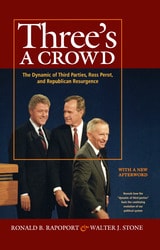
Three's a Crowd
The Dynamic of Third Parties, Ross Perot, and Republican ResurgenceRonald B. Rapoport and Walter J. Stone
University of Michigan Press, 2011
---Paul Herrnson, Director, Center for American Politics and Citizenship Professor, Department of Government and Politics, University of Maryland
"Powerfully persuasive in its exhaustive research, Three's a Crowd may surprise many by revealing the long- ignored but pivotal impact of Perot voters on every national election since 1992."
---Clay Mulford, Jones Day and General Counsel to the 1992 Perot Presidential Campaign and to the Reform Party.
"Rapaport and Stone have written an engaging and important book. They bring fresh perspectives, interesting data, and much good sense to this project. Three's a Crowd is fundamentally about political change, which will, in turn, change how scholars and pundits think of Ross Perot in particular, and third parties in general."
---John G. Geer, Professor of Political Science at Vanderbilt University and Editor of The Journal of Politics
"The definitive analysis of the Perot movement, its role in the 1994 GOP victory, and the emergence of an enduring governing majority."
---L. Sandy Maisel, Director, Goldfarb Center for Public Affairs, Colby College
Three's a Crowd begins with the simple insight that third parties are creatures of the American two-party system, and derive their support from the failures of the Democratic and Republican parties.
While third parties flash briefly in the gaps left by those failures, they nevertheless follow a familiar pattern: a sensation in one election, a disappointment in the next. Rapoport and Stone conclude that this steep arc results from one or both major parties successfully absorbing the third party's constituency. In the first election, the third party raises new issues and defines new constituencies; in the second, the major parties move in on the new territory. But in appropriating the third party's constituents, the major parties open themselves up to change. This is what the authors call the "dynamic of third parties."
The Perot campaign exemplified this effect in 1992 and 1996. Political observers of contemporary electoral politics missed the significance of Perot's independent campaign for the presidency in 1992. Rapoport and Stone, who had unfettered-and unparalleled-access to the Perot political machine, show how his run perfectly embodies the third-party dynamic. Yet until now no one has considered the aftermath of the Perot movement through that lens.
For anyone who seeks to understand the workings of our stubbornly two-party structure, this eagerly awaited and definitive analysis will shed new light on the role of third parties in the American political system.
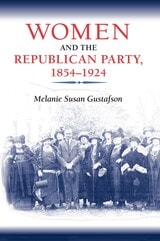
Women and the Republican Party, 1854-1924
Melanie Susan Gustafson
University of Illinois Press, 2001
Acclaimed as groundbreaking since its publication, Women and the Republican Party, 1854-1924 explores the forces that propelled women to partisan activism in an era of widespread disfranchisement and provides a new perspective on how women fashioned their political strategies and identities before and after 1920.
Melanie Susan Gustafson examines women's partisan history against the backdrop of women's political culture. Contesting the accepted notion that women were uninvolved in political parties before gaining the vote, Gustafson reveals the length and depth of women's partisan activism between the founding of the Republican Party, whose abolitionist agenda captured the loyalty of many women, and the passage of the Nineteenth Amendment. Her account also looks at the complex interplay of partisan and nonpartisan activity; the fierce debates among women about how to best use their influence; the ebb and flow of enthusiasm for women's participation; and the third parties that fused the civic world of reform organizations with the electoral world of voting and legislation.
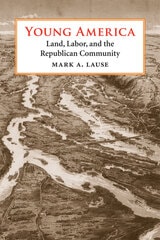
Young America
Land, Labor, and the Republican CommunityMark A. Lause
University of Illinois Press, 2005
Rooting the movement in contemporary economic structures and social ideology, Young America examines this urban and working-class "agrarianism," demonstrating how the political preoccupations of this movement transformed socialism by drawing its adherents from communitarian preoccupations into political action. The alliance of the NRA's land reformers and radical abolitionists led unprecedented numbers to petition Congress and established the foundations of what became the new Republican Party, promising "Free Soil, Free Labor, Free Men."