Results by title
16 books match the query 'Republicanism'
Alexander Hamilton's Public Administration
Richard T. Green
University of Alabama Press, 2019
Examines how Hamilton’s thoughts and experiences about public administration theory and practice have shaped the nation
American public administration inherited from Alexander Hamilton a distinct republican framework through which we derive many of our modern governing standards and practices. His administrative theory flowed from his republican vision, prescribing not only the how of administration but also what should be done and why. Administration and policy merged seamlessly in his mind, each conditioning the other. His Anti-Federalist detractors clearly saw this and fought his vision tooth and nail.
That conflict endures to this day because Americans still have not settled on just one vision of the American republic. That is why, Richard Green argues, Hamilton is a pivotal figure in our current reckoning. If we want to more fully understand ourselves and our ways of governing today, we must start by understanding Hamilton, and we cannot do that without exploring his administrative theory and practice in depth.
Alexander Hamilton’s Public Administration considers Hamilton both as a founder of the American republic, steeped in the currents of political philosophy and science of his day, and as its chief administrative theorist and craftsman, deeply involved in establishing the early institutions and policies that would bring his interpretation of the written Constitution to life. Accordingly, this book addresses the complex mix of classical and modern ideas that informed his vision of a modern commercial and administrative republic; the administrative ideas, institutions, and practices that flowed from that vision; and the substantive policies he deemed essential to its realization. Green’s analysis grows out of an immersion in Hamilton’s extant papers, including reports, letters, pamphlets, and essays. Readers will find a comprehensive explanation of his theoretical contributions and a richly detailed account of his ideas and practices in historical context.
Blood Runs Green
The Murder That Transfixed Gilded Age ChicagoGillian O'Brien
University of Chicago Press, 2015
It was the biggest funeral Chicago had seen since Lincoln’s. On May 26, 1889, four thousand mourners proceeded down Michigan Avenue, followed by a crowd forty thousand strong, in a howl of protest at what commentators called one of the ghastliest and most curious crimes in civilized history. The dead man, Dr. P. H. Cronin, was a respected Irish physician, but his brutal murder uncovered a web of intrigue, secrecy, and corruption that stretched across the United States and far beyond.
Blood Runs Green tells the story of Cronin’s murder from the police investigation to the trial. It is a story of hotheaded journalists in pursuit of sensational crimes, of a bungling police force riddled with informers and spies, and of a secret revolutionary society determined to free Ireland but succeeding only in tearing itself apart. It is also the story of a booming immigrant population clamoring for power at a time of unprecedented change.
From backrooms to courtrooms, historian Gillian O’Brien deftly navigates the complexities of Irish Chicago, bringing to life a rich cast of characters and tracing the spectacular rise and fall of the secret Irish American society Clan na Gael. She draws on real-life accounts and sources from the United States, Ireland, and Britain to cast new light on Clan na Gael and reveal how Irish republicanism swept across the United States. Destined to be a true crime classic, Blood Runs Green is an enthralling tale of a murder that captivated the world and reverberated through society long after the coffin closed.
Contentious Republicans
Popular Politics, Race, and Class in Nineteenth-Century ColombiaJames E. Sanders
Duke University Press, 2004
Beginning in the late 1840s, subaltern groups entered the political arena to forge alliances, both temporary and enduring, with the elite Liberal and Conservative Parties. In the process, each group formed its own political discourses and reframed republicanism to suit its distinct needs. These popular liberals and popular conservatives bargained for the parties’ support and deployed a broad repertoire of political actions, including voting, demonstrations, petitions, strikes, boycotts, and armed struggle. By the 1880s, though, many wealthy Colombians of both parties blamed popular political engagement for social disorder and economic failure, and they successfully restricted lower-class participation in politics. Sanders suggests that these reactionary developments contributed to the violence and unrest afflicting modern Colombia. Yet in illuminating the country’s legacy of participatory politics in the nineteenth century, he shows that the current situation is neither inevitable nor eternal.
Florentine Essays
Selected Writings of Marvin B. BeckerMarvin B. Becker
University of Michigan Press, 2002
In the capital of humanism, he initiated what was to be a lifelong examination of the Western civil tradition. In Florence he could study the interplay of ideas and action in what he was to call the "public world." The rise of this world out of the private, feudal and corporate structures of the medieval commune, its functioning and its eventual subversion by the authoritarian structures of the early modern state were, he thought, valuable information for modern political cultures. In the 1950s and 1960s, Becker produced approximately twenty papers dealing with a wide variety of themes and issues raised by the work of other scholars such as Davidson, Salvemini, Ottokar, Panella, Rodolico, Barbadoro, Baron, and others. He also introduced his own formulations on a range of subjects including the political role of Florence's minor guilds, usury, taxation, public debt, popular heresy, church-state relations, the city's chroniclers, the influence of "new men" upon Florentine government and changing mentalities.
These papers, in their originality, their richness of documentation and their suggestiveness, are still relevant for current scholarship. The editors of this volume have chosen the papers for the convenience of readers who may know Becker only through his books, or from the myriad of footnotes of other scholars who have drawn so much from his work. This volume will be of interest to scholars, students, and others interested in Renaissance history, whether it be social or political.
Marvin B. Becker is Professor Emeritus in the Department of History, University of Michigan. James Banker is Professor of History, North Carolina State University. Carol Lansing is Professor of History, University of California, Santa Barbara.
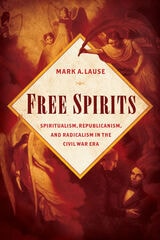
Free Spirits
Spiritualism, Republicanism, and Radicalism in the Civil War EraMark A. Lause
University of Illinois Press, 2016
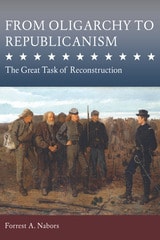
From Oligarchy to Republicanism
The Great Task of ReconstructionForrest A. Nabors
University of Missouri Press, 2026
In From Oligarchy to Republicanism: The Great Task of Reconstruction, Forrest A. Nabors shows that the ultimate goal of the Republican Party, the war, and Reconstruction was the same. This goal was to preserve and advance republicanism as the American founders understood it, against its natural, existential enemy: oligarchy. The principle of natural equality justified American republicanism and required abolition and equal citizenship. Likewise, slavery and discrimination on the basis of color stand on the competing moral foundation of oligarchy, the principle of natural inequality, which requires ranks.
The effect of slavery and the division of the nation into two “opposite systems of civilization” are causally linked. Charles Devens, a lawyer who served as a general in the Union Army, and his contemporaries understood that slavery’s existence transformed the character of political society.
One of those dramatic effects was the increased power of slaveowners over those who did not have slaves. When the slave state constitutions enumerated slaves in apportioning representation using the federal three-fifths ratio or by other formulae, intra-state sections where slaves were concentrated would receive a substantial grant of political power for slave ownership. In contrast, low slave-owning sections of the state would lose political representation and political influence over the state. This contributed to the non-slaveholders’ loss of political liberty in the slave states and provided a direct means by which the slaveholders acquired and maintained their rule over non-slaveholders.
This book presents a shared analysis of the slave South, synthesized from the writings and speeches of the Republicans who served in the Thirty-Eighth, Thirty-Ninth or Fortieth Congress from 1863-1869. The account draws from their writings and speeches dated before, during, and after their service in Congress. Nabors shows how the Republican majority, charged with the responsibility of reconstructing the South, understood the South.
Republicans in Congress were generally united around the fundamental problem and goal of Reconstruction. They regarded their work in the same way as they regarded the work of the American founders. Both they and the founders were engaged in regime change, from monarchy in the one case, and from oligarchy in the other, to republicanism. The insurrectionary states’ governments had to be reconstructed at their foundations, from oligarchic to republican. The sharp differences within Congress pertained to how to achieve that higher goal.
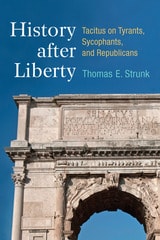
History after Liberty
Tacitus on Tyrants, Sycophants, and RepublicansThomas E. Strunk
University of Michigan Press, 2017
History after Liberty explores Tacitus’ political thought through his understanding of liberty. Influenced by modern republican writers such as Quentin Skinner and Philip Pettit, this study defines Tacitean libertas as the freedom from the rule of a dominus and as freedom to participate in the traditional politics of Rome through military service, public service in the senate and magistracies, and public speech. All of these elements are balanced in Tacitus’ writings with examples of those resisting the corruption of politics in an effort to restore a sense of free civic engagement. The work concludes with an exploration of Tacitus’ own writings as an act of restoring liberty. In contrast to most studies on Tacitus, History after Liberty argues that Tacitus is a republican who writes both to demonstrate that Rome had become a tyranny and to show a way out of that tyranny.
History after Liberty addresses the political thought of Tacitus’ writings. As such it will be of most interest to those who study the history and historiography of the early Roman empire, namely classicists and ancient historians. The work will also be of use to those interested in the antecedents to modern political thought, particularly the history of republicanism and freedom; readers from this category will include political scientists, philosophers, and modern historians.
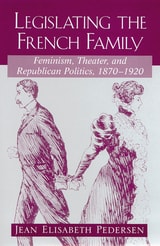
Legislating the French Family
Feminism, Theater, and Republican Politics: 1870-1920Jean Elisabeth Pedersen
Rutgers University Press, 2003
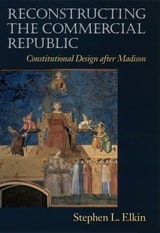
Reconstructing the Commercial Republic
Constitutional Design after MadisonStephen L. Elkin
University of Chicago Press, 2006
The deficiencies Elkin points out provide the starting point for his own constitutional theory of the republic—a theory that, unlike Madison’s, lays out a substantive conception of the public interest that emphasizes the power of institutions to shape our political, economic, and civic lives. Elkin argues that his theory should guide us toward building a commercial republic that is rooted in a politics of the public interest and the self-interest of the middle class. He then recommends specific reforms to create this kind of republic, asserting that Americans today can still have the lives a commercial republic is intended to promote: lives with real opportunities for economic prosperity, republican political self-government, and individual liberty.
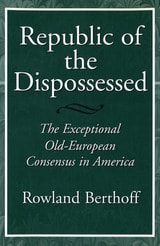
Republic of the Dispossessed
The Exceptional Old-European Consensus in AmericaRowland Berthoff
University of Missouri Press, 1997
Do Americans, in all their cultural diversity, share any fundamental consensus? Does such a consensus, or anything else, make America exceptional in the modern world?
Since 1960 most historians have answered no--except perhaps for the current nostalgia for the Eisenhower years (the "Ozzie and Harriet" years of popular recollection) of middle-class American prosperity.
In Republic of the Dispossessed social historian Rowland Berthoff maintains not only that there was--and still is--a middle-class consensus and that America is exceptional in it but that it goes back some five hundred years. The consensus stems from all those European peasants and artisans who, from 1600 to 1950, fled dispossession in the Old World. They brought with them basic social values that acted as a template for middle-class American values. To consider modern American society as exceptional--that is, as distinctive and different from any contemporary European pattern of thought--is therefore, in Berthoff's theory, not at all the "illogical absurdity" that current conventional wisdom makes it.
The Berthoff thesis, as he develops it in these ten essays from throughout the course of his career, is well worth a second look by those within and beyond the field of social history. It suggests that the ideal--both peasant and classical republican-- of maintaining a balance between personal liberty and communal equality has long inspired American reaction to the drastic modern changes of industrialization, urbanization, and immigration.
Observing that most Americans still see themselves as independent, basically equal, middle-class citizens, Berthoff explains the current apprehension among Americans that at the end of the twentieth century they are once again being dispossessed-- thus, the current emphasis on "traditional values." Because that problem is the same that worried their European ancestors as much as five hundred years ago, Berthoff argues, the time has come to face the question head-on.
Republicanism, Religion, and the Soul of America
Ellis Sandoz
University of Missouri Press, 2006

Sinn Fein and the Politics of Left Republicanism
Eoin O'Broin
Pluto Press, 2009
Sinn Féin is a growing force in Irish politics. Now the country's third largest party, Sinn Féin have been one of the central architects of the peace process and are increasingly setting the terms of political debate in Ireland north and south. Despite this, the party remains much misunderstood and often misrepresented.
In Sinn Féin & The Politics of Left Republicanism, Sinn Féin activist Eoin Ó Broin explores the ideological and organisational origins of the party, charts their history and recent political development and assesses their possible futures.
He argues that Sinn Féin is part of a distinct left-republican tradition in Irish society whose future lies in the globally resurgent radical democratic left.
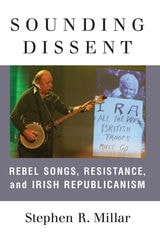
Sounding Dissent
Rebel Songs, Resistance, and Irish RepublicanismStephen R. Millar
University of Michigan Press, 2020
Sounding Dissent draws on three years of sustained fieldwork within Belfast's rebel music scene, in-depth interviews with republican musicians, contemporary audiences, and former paramilitaries, as well as diverse historical and archival material, including songbooks, prison records, and newspaper articles, to understand the history of political violence in Ireland.The book examines the potential of rebel songs to memorialize a pantheon of republican martyrs, and demonstrates how musical performance and political song not only articulate experiences and memories of oppression and violence, but also play a central role in the reproduction of conflict and exclusion in times of peace.
The Effective Republic
Administration and Constitution in the Thought of Alexander HamiltonHarvey Flaumenhaft
Duke University Press, 1992
Although Hamilton exterted an extraordinary influence on American institutions, his contribution and the thinking behind it often have been obscured and misconstrued by piecemeal approaches to his voluminous writings. Here, Flaumenhaft draws upon more than two dozen volumes of Hamilton’s papers to produce a comprehensive account of his thought on the principles of politics—the account which Hamilton himself hoped to give in a multivolume treatise, but died before producing.
Beginning with a discussion of the place of general principles in Hamilton’s thought, The Effective Republic proceeds to his views on popular representation as a safeguard of individual liberty. Flaumenhaft then elaborates on Hamilton’s thinking about efficacious administration, especially how the President and Senate meet the requirements of unity and duration in a republic, and on the importance of an independent judiciary for constitutional integrity. What emerges clearly as Hamilton’s chief concern is the need to make government not only safe but effective—hindered from doing harm by its popular base, but also, through the differentiation of administrative powers and tasks, capable of doing good.
Interpreting, linking, and, and arranging Hamilton’s words, Flaumenhaft allows Hamilton to speak for himself, to explain his benificiaries his vision of what the republican experiment needed in order to succeed.
The Spirit of Modern Republicanism
The Moral Vision of the American Founders and the Philosophy of LockeThomas L. Pangle
University of Chicago Press, 1988
"A work of extraordinary ambition, written with great intensity. . . . [Pangle offers] a trenchant analysis of Locke's writings, designed to demonstrate their remarkable originality and to clarify by doing so as much as the objective predicament as the conscious intentions of the Founding Fathers themselves."—John Dunn, Times Higher Education Supplement
"A forcefully argued study of the Founding Fathers' debt to Locke. . . . What distinguishes Pangle's study from the dozens of books which have challenged or elaborated upon the republican revision is the sharpness with which he exposes the errors of the revisionists while at the same time leaving something of substantive value for the reader to consider."—Joyce Appleby, Canadian Journal of History
"Breathtaking in its daring and novelty. . . . Pangle's book is tense and tenacious, a stunning meditation on America's political culture."—John Patrick Diggins, Transactions of the C. S. Peirce Society
The Terror of Natural Right
Republicanism, the Cult of Nature, and the French RevolutionDan Edelstein
University of Chicago Press, 2009
Natural right—the idea that there is a collection of laws and rights based not on custom or belief but that are “natural” in origin—is typically associated with liberal politics and freedom. In The Terror of Natural Right, Dan Edelstein argues that the revolutionaries used the natural right concept of the “enemy of the human race”—an individual who has transgressed the laws of nature and must be executed without judicial formalities—to authorize three-quarters of the deaths during the Terror. Edelstein further contends that the Jacobins shared a political philosophy that he calls “natural republicanism,” which assumed that the natural state of society was a republic and that natural right provided its only acceptable laws. Ultimately, he proves that what we call the Terror was in fact only one facet of the republican theory that prevailed from Louis’s trial until the fall of Robespierre.
A highly original work of historical analysis, political theory, literary criticism, and intellectual history, The Terror of Natural Right challenges prevailing assumptions of the Terror to offer a new perspective on the Revolutionary period.