Results by title
39 books match the query 'Rhetoric, Ancient'
A Sourcebook for Classical Rhetoric
John Tomarchio
Catholic University of America Press, 2023
Bodily Arts
Rhetoric and Athletics in Ancient GreeceBy Debra Hawhee
University of Texas Press, 2005
The role of athletics in ancient Greece extended well beyond the realms of kinesiology, competition, and entertainment. In teaching and philosophy, athletic practices overlapped with rhetorical ones and formed a shared mode of knowledge production. Bodily Arts examines this intriguing intersection, offering an important context for understanding the attitudes of ancient Greeks toward themselves and their environment.
In classical society, rhetoric was an activity, one that was in essence "performed." Detailing how athletics came to be rhetoric's "twin art" in the bodily aspects of learning and performance, Bodily Arts draws on diverse orators and philosophers such as Isocrates, Demosthenes, and Plato, as well as medical treatises and a wealth of artifacts from the time, including statues and vases.
Debra Hawhee's insightful study spotlights the notion of a classical gymnasium as the location for a habitual "mingling" of athletic and rhetorical performances, and the use of ancient athletic instruction to create rhetorical training based on rhythm, repetition, and response. Presenting her data against the backdrop of a broad cultural perspective rather than a narrow disciplinary one, Hawhee presents a pioneering interpretation of Greek civilization from the sixth, fifth, and fourth centuries BCE by observing its citizens in action.
Chain of Gold
Greek Rhetoric in the Roman EmpireSusan C. Jarratt
Southern Illinois University Press, 2019
Through allusions to classical Greek literature, sophists such as Dio Chrysostom, Aelius Aristides, and Philostratus slipped oblique challenges to empire into otherwise innocuous works. Such figures protected their creators from the danger of direct confrontation but nonetheless would have been recognized by elite audiences, Roman and Greek alike, by virtue of their common education. Focusing on such moments, Jarratt presents close readings of city encomia, biography, and texts in hybrid genres from key second sophistic figures, setting each in its geographical context. Although all the authors considered are male, the analyses here bring to light reflections on gender, ethnicity, skin color, language differences, and sexuality, revealing an underrecognized diversity in the rhetorical activity of this period.
While US scholars of ancient rhetoric have focused largely on the pedagogical, Jarratt brings a geopolitical lens to her study of the subject. Her inclusion of fourth-century texts—the Greek novel Ethiopian Story, by Heliodorus, and the political orations of Libanius of Antioch—extends the temporal boundary of the period. She concludes with speculations about the pressures brought to bear on sophistic political subjectivity by the rise of Christianity and with ruminations on a third sophistic in ancient and contemporary eras of empire.
Cicero, Catullus, and the Language of Social Performance
Brian A. Krostenko
University of Chicago Press, 2001
As Krostenko demonstrates, a key feature of this language is its capacity to express both approval and disdain—an artifact of its origins at a time when the "style" and "charm" of imported Greek cultural practices were greeted with both enthusiasm and hostility. Cicero played on that ambiguity, for example, by chastising lepidus ("fine") boys in the "Second Oration against Catiline" as degenerates, then arguing in his De Oratore that the successful speaker must have a certain charming lepos ("wit"). Catullus, in turn, exploited and inverted the political subtexts of this language for innovative poetic and erotic idioms.
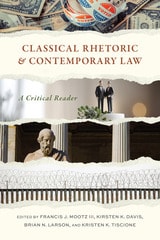
Classical Rhetoric and Contemporary Law
A Critical ReaderEdited by Francis J. Mootz III, Kirsten K. Davis, Brian N. Larson, and Kristen K. Tiscione
University of Alabama Press, 2024
A rigorous interdisciplinary inquiry into how classical rhetorical traditions continue to inform, challenge, and enrich modern legal reasoning and jurisprudence.
Classical Rhetoric and Contemporary Law: A Critical Reader is a rich work that analyzes the interplay between ancient rhetorical traditions and modern legal practice, reestablishing the lost connections between law and classical rhetoric. From Isocrates’s Panegyricus in 380 BCE to the landmark US Supreme Court case Trump v. Hawaii in 2018, and from Antiphon’s fifth century BCE First Tetralogy to 1995’s O. J. Simpson trial, the volume draws on an array of sources to illuminate how ancient rhetorical insights may even today challenge and enrich our grasp of contemporary legal principles.
The collection opens with a brisk review of the historical development of rhetoric. The second part examines a pair of rhetorical theorists whose works frame the period across which classical rhetoric declined as a mode of thought. A contemporary appellate case contrasts with the work of Giambattista Vico, an eighteenth-century professor of rhetoric who warned of the separation of law from rhetoric. The analysis of the work of twentieth-century scholars Chaïm Perelman and Lucie Olbrects-Tyteca shows that where Cartesian rationality fails, the humanistic tradition of rhetoric allows the law to respond to the needs of justice. In the third part, ten case studies bring together a classical rhetorical theorist with a contemporary court case, demonstrating the abiding relevance of the classical tradition to contemporary jurisprudence.
With its cross-disciplinary appeal, Classical Rhetoric and Contemporary Law encompasses the work of legal, rhetorical, English, and communication scholars alike, catalyzing interactive exploration into the profound ways ancient rhetorical insights continue to shape our comprehension of today’s legal landscape.
CONTRIBUTORS
Vasileios Adamidis / Elizabeth C. Britt / Kirsten K. Davis / David A. Frank / Michael Gagarin / Eugene Garver / Mark A. Hannah / Catherine L. Langford / Brian N. Larson / Craig A. Meyer / Francis J. Mootz III / Susan E. Provenzano / Nick J. Sciullo / Kristen K. Tiscione / Laura A. Webb
Demosthenes' "On the Crown"
Rhetorical PerspectivesEdited by James J. Murphy
Southern Illinois University Press, 2016
The volume includes biographical and historical background on Demosthenes and his political situation; a structural analysis of On the Crown; and an abstract of Aeschines’ speech Against Ctesiphon to which Demosthenes was responding. Four essays by contributors analyze Demosthenes’ speech using key elements of rhetoric defined by Aristotle: ēthos, the speaker’s character or authority; pathos, or emotional appeals; logos, or logical appeals; and lexis, a speaker’s style. An introduction and an epilogue by Murphy frame the speech and the rhetorical analysis of it.
By bringing together contextual material about Demosthenes and his speech with a translation and astute rhetorical analyses, Demosthenes’“On the Crown”:Rhetorical Perspectives highlights the oratorical artistry of Demosthenes and provides scholars and students with fresh insights into a landmark speech.
Enthusiasm And Divine Madness
Josef Pieper
St. Augustine's Press, 1999
Pieper gives interpretation of the dialogue. Leaving the more recondite scholarly preoccupations aside, he concentrates on the content, bringing the actual situation in the dialogue – Athens and its intellectuals engaged in spirited debate – alive. Equally alive is the discussion of ideas, which are brought to bear on contemporary experience and made to prove the perennial validity of Socratic wisdom, and its power to excite the mind. The main thesis – that in poetry and in love man is "beside himself," that is, divinely inspired - is discussed with reference to modern poets, novelists, and modern psychology.
Epideictic Rhetoric
Questioning the Stakes of Ancient PraiseBy Laurent Pernot
University of Texas Press, 2015
Speeches of praise and blame constituted a form of oratory put to brilliant and creative use in the classical Greek period (fifth to fourth century BC) and the Roman imperial period (first to fourth century AD), and they have influenced public speakers through all the succeeding ages. Yet unlike the other classical genres of rhetoric, epideictic rhetoric remains something of a mystery. It was the least important genre at the start of Greek oratory, but its role grew exponentially in subsequent periods, even though epideictic orations were not meant to elicit any action on the part of the listener, as judicial and deliberative speeches attempted to do. So why did the ancients value the oratory of praise so highly?
In Epideictic Rhetoric, Laurent Pernot offers an authoritative overview of the genre that surveys its history in ancient Greece and Rome, its technical aspects, and its social function. He begins by defining epideictic rhetoric and tracing its evolution from its first realizations in classical Greece to its eloquent triumph in the Greco-Roman world. No longer were speeches limited to tribunals, assemblies, and courts—they now involved ceremonies as well, which changed the political and social implications of public speaking. Pernot analyzes the techniques of praise, both as stipulated by theoreticians and as practiced by orators. He describes how epideictic rhetoric functioned to give shape to the representations and common beliefs of a group, render explicit and justify accepted values, and offer lessons on new values. Finally, Pernot incorporates current research about rhetoric into the analysis of praise.
Essays on Classical Rhetoric and Modern Discourse
Edited by Robert J. Connors, Lisa S. Ede, and Andrea A. Lunsford
Southern Illinois University Press, 1984
Eighteen essays by leading scholars in English, speech communication, education, and philosophy explore the vitality of the classical rhetorical tradition and its influence on both contemporary discourse studies and the teaching of writing.
Some of the essays investigate theoretical and historical issues. Others show the bearing of classical rhetoric on contemporary problems in composition, thus blending theory and practice. Common to the varied approaches and viewpoints expressed in this volume is one central theme: the 20th-century revival of rhetoric entails a recovery of the classical tradition, with its marriage of a rich and fully articulated theory with an equally efficacious practice. A preface demonstrates the contribution of Edward P. J.Corbett to the 20th-century revival, and a last chapter includes a bibliography of his works.
Fama and Fiction in Vergil's Aeneid
Antonia Syson
The Ohio State University Press, 2013
Gorgias and the New Sophistic Rhetoric
Bruce McComiskey
Southern Illinois University Press, 2002
In Gorgias and the New Sophistic Rhetoric, Bruce McComiskey achieves three rhetorical goals: he treats a single sophist's rhetorical technê (art) in the context of the intellectual upheavals of fifth-century bce Greece, thus avoiding the problem of generalizing about a disparate group of individuals; he argues that we must abandon Platonic assumptions regarding the sophists in general and Gorgias in particular, opting instead for a holistic reading of the Gorgianic fragments; and he reexamines the practice of appropriating sophistic doctrines, particularly those of Gorgias, in light of the new interpretation of Gorgianic rhetoric offered in this book.
In the first two chapters, McComiskey deals with a misconception based on selective and Platonic readings of the extant fragments: that Gorgias's rhetorical technê involves the deceptive practice of manipulating public opinion. This popular and ultimately misleading interpretation of Gorgianic doctrines has been the basis for many neosophistic appropriations. The final three chapters deal with the nature and scope of neosophistic rhetoric in light of the non-Platonic and holistic interpretation of Gorgianic rhetoric McComiskey postulates in his opening chapters. He concludes by examining the future of communication studies to discover what roles neosophistic doctrines might play in the twenty-first century.
McComiskey also provides a selective bibliography of scholarship on sophistic rhetoric and philosophy in English since 1900.
Insults in Classical Athens
Deborah Kamen
University of Wisconsin Press, 2022
While the classical city celebrated the democratic equality of "autochthonous" citizens, it counted a large population of noncitizens as inhabitants, so that ancient Athenians developed a preoccupation with negotiating, affirming, and restricting citizenship. Kamen raises key questions about what it meant to be a citizen in democratic Athens and demonstrates how insults were deployed to police the boundaries of acceptable behavior. In doing so, she illuminates surprising differences between antiquity and today and sheds light on the ways a democratic society valuing "free speech" can nonetheless curb language considered damaging to the community as a whole.
Listening to Homer
Tradition, Narrative, and AudienceRuth Scodel
University of Michigan Press, 2002
---Greece & Rome
---Irene J.F. de Jong, Gnomon
Mail and Female
Epistolary Narrative and Desire in Ovid's HeroidesSara H. Lindheim
University of Wisconsin Press, 2003
Using feminist and psychoanalytic approaches to examine the "female voice" in the Heroides, Sara H. Lindheim closely reads these fictive letters in which the women seemingly tell their own stories. She points out that in Ovid’s verse epistles all the women represent themselves in a strikingly similar and disjointed fashion. Lindheim turns to Lacanian theory of desire to explain these curious and hauntingly repetitive representations of the heroines in the "female voice." Lindheim’s approach illuminates what these poems reveal about both masculine and feminine constructions of the feminine
Metamorphosis of Language in Apuleius
A Study of Allusion in the NovelEllen D. Finkelpearl
University of Michigan Press, 1998
When Apuleius wrote his Metamorphoses, the novel--indeed the very concept of fiction in prose--was new. This study argues that Apuleius' repeated allusions to earlier Latin authors such as Vergil, Ovid, and Seneca represent an exploration on his part of the relationship between the novel and more established genres of the era. Apuleius' struggle with this tradition, Finkelpearl maintains, parallels the protagonist's move from an acceptance of the dominance of traditional forms to a sense of arrival and self- discovery.
An introductory chapter includes general discussion of the theory and practice of allusion. Finkelpearl then revisits the issues of parody in Apuleius. She also includes discussion of Apuleius' use of Vergil's Sinon, the Charite episode in relation to Apuleius' African origins, and the stepmother episode. Finally a new reading of Isis is offered, which emphasizes her associations with writing and matches the multiformity of the goddess with the novel's many voices.
This book will be of interest to scholars of literature and the origins of the novel, multiculturalism, and classical literature.
Ellen D. Finkelpearl is Associate Professor of Classics at Scripps College, Claremont, California.
Modes of Viewing in Hellenistic Poetry and Art
And ArtGraham Zanker
University of Wisconsin Press, 2003
Taking a fresh look at the poetry and visual art of the Hellenistic age, from the death of Alexander the Great in 323 B.C. to the Romans’ defeat of Cleopatra in 30 B.C., Graham Zanker makes enlightening discoveries about the assumptions and conventions of Hellenistic poets and artists and their audiences.
Zanker’s exciting new interpretations closely compare poetry and art for the light each sheds on the other. He finds, for example, an exuberant expansion of subject matter in the Hellenistic periods in both literature and art, as styles and iconographic traditions reserved for grander concepts in earlier eras were applied to themes, motifs, and subjects that were emphatically less grand.
Readings from Classical Rhetoric
Edited by Patricia P. Matsen, Philip Rollinson, and Marion Sousa
Southern Illinois University Press, 1990
Here, for the first time in one volume, are all the extant writings focusing on rhetoric that were composed before the fall of Rome.
This unique anthology of primary texts in classical rhetoric contains the work of 24 ancient writers from Homer through St. Augustine, including Herodotus, Thucydides, Plato, Aristotle, Cicero, Quintilian, Tacitus, and Longinus.
Along with many widely recognized translations, special features include the first English translations of works by Theon and Nicolaus, as well as new translations of two works by important sophists, Gorgias’ encomium on Helen and Alcidamas’ essay on composition.
The writers are grouped chronologically into historical periods, allowing the reader to understand the scope and significance of rhetoric in antiquity. Introductions are included to each period, as well as to each writer, with writers’ biographies, major works, and salient features of excerpts.
Rereading Aristotle's Rhetoric
Edited by Alan G. Gross and Arthur E. Walzer
Southern Illinois University Press, 2000
In this collection edited by Alan G. Gross and Arthur E. Walzer, scholars in communication, rhetoric and composition, and philosophy seek to “reread” Aristotle’s Rhetoric from a purely rhetorical perspective. So important do these contributors find the Rhetoric, in fact, that a core tenet in this book is that “all subsequent rhetorical theory is but a series of responses to issues raised by the central work.”
The essays reflect on questions basic to rhetoric as a humanistic discipline. Some explore the ways in which the Rhetoric explicates the nature of the art of rhetoric, noting that on this issue, the tensions within the Rhetoric often provide a direct passageway into our own conflicts.
Rhetoric in Antiquity
Laurent Pernot
Catholic University of America Press, 2005

Rhetoric in Tooth and Claw
Animals, Language, SensationDebra Hawhee
University of Chicago Press, 2017
Yet when you look at ancient and early modern treatises on rhetoric, what you find is surprising: they’re crawling with animals. With Rhetoric in Tooth and Claw, Debra Hawhee explores this unexpected aspect of early thinking about rhetoric, going on from there to examine the enduring presence of nonhuman animals in rhetorical theory and education. In doing so, she not only offers a counter-history of rhetoric but also brings rhetorical studies into dialogue with animal studies, one of the most vibrant areas of interest in humanities today. By removing humanity and human reason from the center of our study of argument, Hawhee frees up space to study and emphasize other crucial components of communication, like energy, bodies, and sensation.
Drawing on thinkers from Aristotle to Erasmus, Rhetoric in Tooth and Claw tells a new story of the discipline’s history and development, one animated by the energy, force, liveliness, and diversity of our relationships with our “partners in feeling,” other animals.
Rhetorical Action in Ancient Athens
Persuasive Artistry from Solon DemosthenesJames Fredal
Southern Illinois University Press, 2006
James Fredal’s wide-ranging survey examines the spatial and performative features of rhetorical artistry in ancient Athens from Solon to Demosthenes, demonstrating how persuasive skill depended not on written treatises, but on the reproduction of spaces and modes for masculine self-formation and displays of contests of character.
Studies of the history of rhetoric generally begin with Homer and Greek orality, then move on to fifth-century Sicily and the innovations of Corax, Tisias, and the older Sophists. While thorough and useful, these narratives privilege texts as the sole locus of proper rhetorical knowledge. Rhetorical Action in Ancient Greece:Persuasive Artistry from Solon to Demosthenes describes rhetoric as largely unwritten and rhetorical skill as closely associated with the ideologies and practices of gender formation and expression. In expanding the notion of rhetorical innovation to include mass movements, large social genres, and cultural practices—rather than the formulations of of individual thinkers and writers—Fredal offers a view of classical rhetoric as local and contingent, bound to the physical spaces, local histories, and cultural traditions of place.
Fredal argues that Greek rhetorical skill remained a function of local spaces like the Pnyx, social practices such as symposia or local meetings, cultural ideologies like those surrounding masculine friendship, and genres of performance such as how to act like a man, herald, sage, tyrant, or democrat. Citizen participation, he explains, was motivated by the desire to display masculine excellence in contests of character by overcoming fear and exerting symbolic and bodily control over self, situation, and audience. He shows how ancient Greek rhetoric employed patterns of “action” such as public oratory and performance to establish, reinforce, or challenge hierarchies and claims to political power.
Instead of examining speeches, handbooks, and theory, Rhetorical Action in Ancient Greece examines the origins of rhetoric in terms of performance. The result is a presentation of rhetorical knowledge as embodied in places and practices with spatial and practical logics that are rarely articulated in written discourse. The volume calls on archaeological, literary, and anthropological evidence about the rhetorical actions of Athens’s leading political agents—including Solon, Peisistratus, Cleisthenes, Demosthenes, and the anonymous “herm-choppers” of the Peloponnesian war—to demonstrate how each generation of political leaders adopted and transformed existing performance genres and spaces to address their own political exigency.
Rhetorical Renaissance
The Mistress Art and Her MasterworksKathy Eden
University of Chicago Press, 2022
Kathy Eden explores the intersection of early modern literary theory and practice. She considers the rebirth of the rhetorical art—resulting from the rediscovery of complete manuscripts of high-profile ancient texts about rhetoric by Plato, Aristotle, Cicero, Quintilian, and Tacitus, all unavailable before the early fifteenth century—and the impact of this art on early modern European literary production. This profound influence of key principles and practices on the most widely taught early modern literary texts remains largely and surprisingly unexplored.
Devoting four chapters to these practices—on status, refutation, similitude, and style—Eden connects the architecture of the most widely read classical rhetorical manuals to the structures of such major Renaissance works as Petrarch’s Secret, Castiglione’s Book of the Courtier, Erasmus’s Antibarbarians and Ciceronianus, and Montaigne’s Essays. Eden concludes by showing how these rhetorical practices were understood to work together to form a literary masterwork, with important implications for how we read these texts today.
Siren Songs
Gender, Audiences, and Narrators in the OdysseyLillian Eileen Doherty
University of Michigan Press, 1995
Siren Songs synthesizes audience-oriented and narratological approaches, and examines the relationships among three kinds of audiences: internal, implied, and actual. The author prefaces her own reading of the Odyssey with an analysis of the issues posed by the earlier feminist readings on which she builds. Should the Odyssey be read as a "closed" text, that is, as one whose meaning is highly determined, or as an "open" text whose contradictions and ambiguities undercut its overt meanings?
Siren Songs presents a feminist critique of the Odyssey in an accessible manner aimed at a more general audience. All Greek is translated, and critical terminology is clearly defined.
Lillian Eileen Doherty is Associate Professor of Classics, University of Maryland, College Park.
Speaking the Same Language
Speech and Audience in Thucydides' Spartan DebatesPaula Debnar
University of Michigan Press, 2002
Speaking the Same Language seeks to recover the role played by the audiences within the History. By restoring the internal audiences to a more prominent place, Debnar emphasizes the perspective of the participants in the war and heightens the dramatic immediacy of the debates. She thoroughly analyzes twelve speeches delivered by or to the Spartans, demonstrating how the earlier speeches illustrate the role of discourse in the construction of Sparta's identity and the unification of her Dorian allies in the face of their primarily Ionian adversaries.
Combining close textual analysis with an examination of narrative and historical context, Debnar bridges the gap between literary and historical studies of Thucydides. Accessible to specialists and nonspecialists alike, her work will interest those working in the fields of Greek literature, ancient historiography, rhetoric, political science, and ethnic studies.
Paula Debnar is Associate Professor of Classics, Mount Holyoke College.
Staging Masculinity
The Rhetoric of Performance in the Roman WorldErik Gunderson
University of Michigan Press, 2000
Stock Characters Speaking
Eight Libanian Declamations Introduced and TranslatedRobert J. Penella
University of Michigan Press, 2023
Declamations were composed and orally delivered in the Roman Empire by sophists, or teachers of rhetoric, of whom the Greek-speaking Libanius was one of the most distinguished. Stock Characters Speaking may be thought of as emerging from three developments of recent decades: an explosive interest in late antiquity, a newly sympathetic interest in rhetoric (including ancient declamation), and a desire to bring Libanius’s massive corpus into English and other modern languages.
In this book, author Robert J. Penella translates eight of Libanius’s declamations: 29, 30, 34, 35, 37, 45, 46, 47, and, in an appendix, the thirteenth-century Gregory of Cyprus’s response to Declamation 34. Each translation is accompanied by an introduction, in which Penella examines the themes, structure, and the stasis, or key issue, of the declamations. Figures who appear in the translated declamations include a parasite who has lost his patron, a man envious of his rich neighbor, a miser’s son, a poor man willing to die for his city, a rich war-hero accused of aiming at tyranny, and a convict asking for exile. Three of these declamations have appeared in German; otherwise, these translations are the first into a modern language.
Tertullian's Aduersus Iudaeos
A Rhetorical Analysis (NAPS Patristic Monograph Series, Volume 19)Geoffrey D. Dunn
Catholic University of America Press, 2008
The Artistry of the Homeric Simile
William C. Scott
Dartmouth College Press, 2009
The Chreia and Ancient Rhetoric
Commentaries on Aphthonius's ProgymnasmataRonald F. Hock
SBL Press, 2012
The Court of Comedy
Wilfred E. Major
The Ohio State University Press, 2013
The Ethics of Persuasion
Derrida's Rhetorical LegaciesBrooke Rollins
The Ohio State University Press, 2020
Drawing on Derrida’s (non)definition of ethics and his pointed accounts of performativity, Rollins argues that this vital ethical component of many ancient theories, practices, and pedagogies of persuasion has been undertheorized for more than two millennia. Through deconstructive readings of some of these texts, she shows us that we are not simply sovereign beings who both wield and guard against linguistic techniques of rule. Our persuasive endeavors, rather, are made possible by an ethics—an always prior encounter with otherness that interrupts self-presence.
The Philosophy, Theology, and Rhetoric of Marius Victorinus
Stephen A. Cooper
SBL Press, 2022
Pagan rhetor, (Neo-)Platonist philosopher, Christian theologian
This collection of essays is devoted to the rhetoric, Neoplatonic philosophy, and Christian theology of Marius Victorinus, a mid-fourth-century professor of rhetoric and philosopher who converted to Christianity late in life. Scholars from eight different countries, some of whom have not previously published in English, reflect on debates about his writings and theological development. These topics include Victorinus's deployment of philosophical sources for trinitarian theology, possible connections in his work to Origen, Augustine, Plotinus, Porphyry, and Gnosticism, as well as his contributions to Latin rhetoric and dialectic. Contributors include Jan Dominik Bogataj, Michael Chase, Nello Cipriani, Stephen A. Cooper, Volker Henning Drecoll, Lenka Karfíková, Josef Lössl, Václav Němec, Thomas Riesenweber, Guadalupe Lopetegui Semperena, Miran Špelič, Chiara O. Tommasi, John D. Turner, and Florian Zacher. The chapters in this volume are of great interest to students of late antique philosophy, Christian theology, and Latin rhetoric.
The Play of Fictions
Studies in Ovid's Metamorphoses Book 2A. M. Keith
University of Michigan Press, 1992
The Renaissance Rediscovery of Intimacy
Kathy Eden
University of Chicago Press, 2012
In 1345, when Petrarch recovered a lost collection of letters from Cicero to his best friend Atticus, he discovered an intimate Cicero, a man very different from either the well-known orator of the Roman forum or the measured spokesman for the ancient schools of philosophy. It was Petrarch’s encounter with this previously unknown Cicero and his letters that Kathy Eden argues fundamentally changed the way Europeans from the fourteenth through the sixteenth centuries were expected to read and write.
The Renaissance Rediscovery of Intimacy explores the way ancient epistolary theory and practice were understood and imitated in the European Renaissance.Eden draws chiefly upon Aristotle, Cicero, and Seneca—but also upon Plato, Demetrius, Quintilian, and many others—to show how the classical genre of the “familiar” letter emerged centuries later in the intimate styles of Petrarch, Erasmus, and Montaigne. Along the way, she reveals how the complex concept of intimacy in the Renaissance—leveraging the legal, affective, and stylistic dimensions of its prehistory in antiquity—pervades the literary production and reception of the period and sets the course for much that is modern in the literature of subsequent centuries. Eden’s important study will interest students and scholars in a number of areas, including classical, Renaissance, and early modern studies; comparative literature; and the history of reading, rhetoric, and writing.
The Rhetoric of Faith
Irenaeus and the Structure of the Adversus HaeresesScott D. Moringiello
Catholic University of America Press, 2019
The argument focuses on the Adversus Haereses, although it does begin with some discussion to put Irenaeus in the context of second century Christian literature. Moringiello concludes with a discussion of Irenaeus’s Demonstration of the Apostolic Preaching.Other scholars have provided introductions to Irenaeus’s work, and other scholars have argued for the structural unity of the Adversus Haereses. No other scholar, though, has argued that the faith of the Church is the basis of Irenaeus’s argument. This argument, then, presents an important contribution to the field of Irenaeus studies.
The Rhetoric of Seeing in Attic Forensic Oratory
By Peter A. O'Connell
University of Texas Press, 2017

The Thinker As Artist
From Homer To Plato and AristotleGeorge Anastaplo
Ohio University Press, 1997
Turntables and Tropes
A Rhetoric of RemixScott Haden Church
Michigan State University Press, 2022
When the Lamp is Shattered
Desire and Narrative in CatullusMichaela Janan
Southern Illinois University Press, 1993
The poetry of the Late Roman Republican poet Gaius Valerius Catullus, a rich document of the human heart, is the earliest-known reasonably complete body of erotic verse in the West.
Though approximately 116 poems survive, uncertainties about the condition of the fragmented manuscript and the narrative order of the poems make the Catullan text unusually problematic for the modern critic. Indeed, the poems can be arranged in a number of ways, making a multitude of different plots possible and frustrating the reader’s desire for narrative closure.
Micaela Janan contends that since unsatisfied desire structures both the experience of reading Catullus and its subject matter, critical interpretation of the text demands a "poetics of desire." Furthermore, postmodern critical theory, narratology, and psychoanalysis suggest a flexible concept of the "subject" as a site through which a multitude of social, cultural, and unconscious forces move. Human consciousness, Janan contends, is inherently incomplete and in a continuous process of transformation. She therefore proposes an original and provocative feminist reading of Catullus, a reading informed by theories of consciousness and desire as ancient as Plato and as contemporary as Freud and Lacan.
The Late Roman Republic in which Catullus lived, Janan reminds us, was a time of profound social upheaval when political and cultural institutions that had persisted for centuries were rapidly breaking down—a time not unlike our own. Catullus’ poetry provides an unusually honest look at his culture and its contradictory representations of class, gender, and power. By bringing to the study of this major work of classical literature the themes of consciousness and desire dealt with in postmodern scholarship, Janan’s book invites a new conversation among literary disciplines.