Results by title
30 books match the query 'San Francisco (Calif.)'
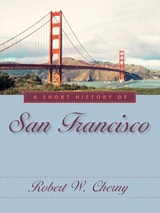
A Short History of San Francisco
Robert W. Cherny
University of Nevada Press, 2026
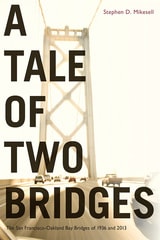
A Tale of Two Bridges
The San Francisco–Oakland Bay Bridges of 1936 and 2013Stephen Mikesell
University of Nevada Press, 2017
A Tale of Two Bridges is a history of two versions of the San Francisco—Oakland Bay Bridge: the original bridge built in 1936 and a replacement for the eastern half of the bridge finished in 2013. The 1936 bridge revolutionized transportation in the Bay Area and profoundly influenced settlement patterns in the region. It was also a remarkable feat of engineering. In the 1950s the American Society of Civil Engineers adopted a list of the “Seven Engineering Wonders” of the United States. The 1936 structure was the only bridge on the list, besting even the more famous Golden Gate Bridge. One of its greatest achievements was that it was built on time (in less than three years) and came in under budget. Mikesell explores in fascinating detail how the bridge was designed by a collection of the best-known engineers in the country as well as the heroic story of its construction by largely unskilled laborers from California, joined by highly skilled steel workers.
By contrast, the East Span replacement, which was planned between 1989 and 1998, and built between 1998 and 2013, fell victim to cost overruns in the billions of dollars, was a decade behind schedule, and suffered from structural problems that has made it a perpetual maintenance nightmare.
This is narrative history in its purest form. Mikesell excels at explaining highly technical engineering issues in language that can be understood and appreciated by general readers. Here is the story of two very important bridges, which provides a fair but uncompromising analysis of why one bridge succeeded and the other did not.
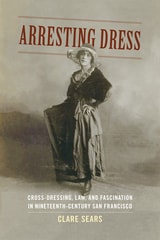
Arresting Dress
Cross-Dressing, Law, and Fascination in Nineteenth-Century San FranciscoClare Sears
Duke University Press, 2015
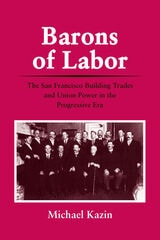
Barons of Labor
The San Francisco Building Trades and Union Power in the Progressive EraMichael Kazin
University of Illinois Press, 1989
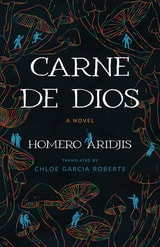
Carne de Dios
A NovelHomero Aridjis; Translated by Chloe Garcia Roberts
University of Arizona Press, 2025
María Sabina, the renowned Mazatec healer, spends her days in the small town of Huautla de Jiménez selling produce at the market and foraging under the new moon for the sacred mushrooms that grow near her home—her Holy Children, Carne de Dios, or Flesh of God. But her life changes forever when an amateur mycologist from New York, with a cameraman in tow, visits her to experience for himself the mushroom ceremony, or velada, he knows only from whispers in anthropological records. When he publishes an unauthorized article about his experience in LIFE Magazine 1957, the stage is set for an explosive encounter between the burgeoning international counterculture and the woman who became an unwilling icon of the psychedelic revolution.
Homero Aridjis’s novel, vividly translated by Chloe Garcia Roberts, tells the story of the motley crew of bohemians, researchers, and holy fools, both real and imagined, who descend on the town of Huautla de Jiménez searching for inspiration, distraction, and salvation in the sacred mushrooms. These seekers melt in and out of a narrative infiltrated by the slipstream logic of dreams. As John Lennon plays jazz on the patio of the Hotel Grande, Juan Rulfo contemplates horror movies, and Allen Ginsberg recites mantras at Philip Lamantia’s wedding, María Sabina’s life is increasingly thrown into turmoil.
Carne de Dios is a masterful and often humorous blend of history, myth, and poetic imagination, captured in a translation that mirrors the hallucinatory beauty of Aridjis’s original Spanish. Aridjis’s intimate portrayal of María Sabina, informed by his personal connection to her, serves as both a tribute to her enduring legacy and a critical reflection on the wave of global interest in mushroom culture still gaining momentum today.
This English translation includes an introduction by the translator and an afterword by the author.
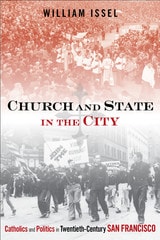
Church and State in the City
Catholics and Politics in Twentieth-Century San FranciscoWilliam Issel
Temple University Press, 2012
Church and State in the City provides the first comprehensive analysis of the city’s long debate about the public interest. Historian William Issel explores the complex ways that the San Francisco Catholic Church—and its lay men and women—developed relationships with the local businesses, unions, other community groups, and city government to shape debates about how to define and implement the common good. Issel’s deeply researched narrative also sheds new light on the city’s socialists, including Communist Party activists—the most important transnational challengers of both capitalism and Catholicism during the twentieth century.
Moreover, Church and State in the City is revisionist in challenging the notion that the history of urban politics and policy can best be understood as the unfolding of a progressive, secular modernization of urban political culture. Issel shows how tussles over the public interest in San Francisco were both distinctive to the city and shaped by its American character.
In the series Urban Life, Landscape, and Policy, edited by Zane L. Miller, David Stradling, and Larry Bennett
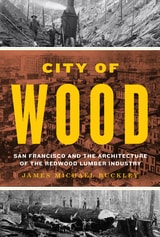
City of Wood
San Francisco and the Architecture of the Redwood Lumber IndustryJames Michael Buckley
University of Texas Press, 2024
2025 John Brinckerhoff Jackson Prize, Association of American Geographers
2025 Abbott Lowell Cummings Award
2025 John Brinckerhoff Jackson Prize, UVA Center for Cultural Landscapes
2026 Hagley Prize in Business History, Hagley Museum and Library
2025 Honorable Mention, PROSE Award, Association of American Publishers (AAP)
California’s 1849 gold rush triggered creation of the “instant city” of San Francisco as a base to exploit the rich natural resources of the American West. City of Wood examines how capitalists and workers logged the state’s vast redwood forests to create the financial capital and construction materials needed to build the regional metropolis of San Francisco. Architectural historian James Michael Buckley investigates the remote forest and its urban core as two poles of a regional “city.” This city consisted of a far-reaching network of spaces, produced as company owners and workers arrayed men and machines to extract resources and create human commodities from the region’s rich natural environment.
Combining labor, urban, industrial, and social history, City of Wood employs a variety of sources—including contemporary newspaper articles, novels, and photographs—to explore the architectural landscape of lumber, from backwoods logging camps and company towns in the woods to busy lumber docks and the homes of workers and owners in San Francisco. By imagining the redwood lumber industry as a single community spread across multiple sites—a “City of Wood”—Buckley demonstrates how capitalist resource extraction links different places along the production value chain. The result is a paradigm shift in architectural history that focuses not just on the evolution of individual building design across time, but also on economic connections that link the center and periphery across space.
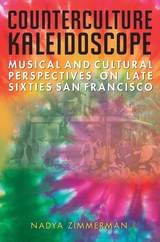
Counterculture Kaleidoscope
Musical and Cultural Perspectives on Late Sixties San FranciscoNadya Zimmerman
University of Michigan Press, 2013
In a bold reconsideration of the late sixties San Francisco counterculture movement, Counterculture Kaleidoscope takes a close look at the cultural and musical practices of that era. Addressing the conventional wisdom that the movement was grounded in rebellion and opposition, the book exposes two myths: first, that the counterculture was an organized social and political movement of progressives with a shared agenda who opposed the mainstream (dubbed "hippies"); and second, that the counterculture was an innocent entity hijacked by commercialism and transformed over time into a vehicle of so-called "hip consumerism."
Seeking an alternative to the now common narrative, Nadya Zimmerman examines primary source material including music, artwork, popular literature, personal narratives, and firsthand historical accounts. She reveals that the San Francisco counterculture wasn't interested in commitments to causes and made no association with divisive issues---that it embraced everything in general and nothing in particular.
"Astute and accessible, Counterculture Kaleidoscope provides thought-provoking insights into the historical, cultural and social context of the San Francisco counter-culture and its music scene, including discussions of Vietnam and student protest, the Haight-Ashbury Diggers, the Grateful Dead, Led Zeppelin, Altamont, and Charlie Manson. A must for students and scholars of socio-musical activity and for all of us to whom music matters."
---Sheila Whiteley, author of The Space Between the Notes: Rock and the Counter-Culture and Too Much Too Young: Popular Music, Age and Gender
"The hippie counterculture has never garnered the scholarly attention accorded the new left and the black freedom struggle. Overviews of the period ritualistically mention it as part and parcel of that apparently incandescent era---the Sixties---but rarely capture its distinctiveness. Counterculture Kaleidoscope is a timely and provocative intervention in Sixties scholarship that significantly deepens our understanding of this important but understudied phenomenon."
—Alice Echols, Associate Professor, University of Southern California, and author of Scars of Sweet Paradise: The Life and Times of Janis Joplin
Dahlia's Iris
Secret Autobiography and FictionLeslie Scalapino
University of Alabama Press, 2003
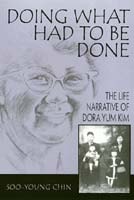
Doing What Had To Be Done
Soo-Young Chin
Temple University Press, 1999
Born in 1921, Dora, as she tells Chin her story, chronicles the shifting salience of gendered ethnic identity as she journeys through her life. Traveling through time and place, she moves from San Francisco's Chinatown -- where Koreans were a minority within a minority -- to suburban Dewey Boulevard where Dora and her family attempt to integrate into mainstream America, and where she becomes a social worker in the California State Department of Employment. As the Korean immigrant community grows in the late 1960s, Dora becomes deeply involved in community service. She remembers teaching English to senior citizens and preparing them for their naturalization exams, finding jobs for the younger Koreans, and founding a community center and meals program for seniors.
A detailed and inspiring lens through which to view Korean American history, Dora's life journey echoes the changing spaces of the American social landscape. And the grace and ease with which Dora just "does what has to be done" shows us the importance of everyday acts in making a difference.
Driven by Fear
Epidemics and Isolation in San Francisco's House of PestilenceGuenter B. Risse
University of Illinois Press, 2015
Filling a significant gap in contemporary scholarship, Driven by Fear looks at the past to offer critical lessons for our age of bioterror threats and emerging infectious diseases.
Finding Mars
Ned Rozell
University of Alaska Press, 2011
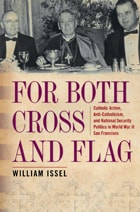
For Both Cross and Flag
Catholic Action, Anti-Catholicism, and National Security Politics in World War II San FranciscoAuthored by William Issel
Temple University Press, 2010
In this fascinating, detailed history, William Issel recounts the civil rights abuses suffered by Sylvester Andriano, an Italian American Catholic civil leader whose religious and political activism in San Francisco provoked an Anti-Catholic campaign against him. A leading figure in the Catholic Action movement, Andriano was falsely accused in state and federal Un-American Activities Committee hearings of having Fascist sympathies prior to and during World War II. As his ordeal began, Andriano was subjected to a hostile investigation by the FBI, whose confidential informants were his political rivals. Furthermore, the U.S. Army ordered him to be relocated on the grounds that he was a security risk.
For Both Cross and Flag provides a dramatic illustration of what can happen when parties to urban political rivalries, rooted in religious and ideological differences, seize the opportunity provided by a wartime national security emergency to demonize their enemy as “a potentially dangerous person.”
Issel presents a cast of characters that includes archbishops, radicals, the Kremlin, and J. Edgar Hoover, to examine the significant role faith-based political activism played in the political culture that violated Andriano’s constitutional rights. Exploring the ramifications of this story, For Both Cross and Flag presents interesting implications for contemporary events and issues relating to urban politics, ethnic groups, and religion in a time of war.
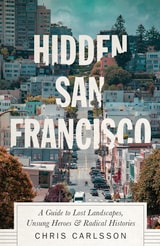
Hidden San Francisco
A Guide to Lost Landscapes, Unsung Heroes and Radical HistoriesChris Carlsson
Pluto Press, 2020
Hidden San Francisco is a guidebook like no other. It’s a radical, alternative guidebook and history of San Francisco, complete with maps detailing walking and bike routes around the city.
San Francisco is an iconic and symbolic city. But only when you look beyond the picture-postcards of the Golden Gate Bridge and the quaint cable cars do you realize that the city's most interesting stories are not the Summer of Love, the Beats or even the latest gold rush in Silicon Valley.
Carlsson delves into the Bay Area's long prehistory, examining the region's geography and the lives of its inhabitants before the 1849 Gold Rush changed everything, setting in motion the clash between capital and labor that shaped the modern city. Structured around the four major themes of ecology, labor, transit and dissent, Chris Carlsson’s book peels back the layers of San Francisco's history to reveal a storied past: behind old walls and gleaming glass facades lurk former industries, secret music and poetry venues, forgotten terrorist bombings, and much more.
From the perspective of the students and secretaries, hippies and beatniks, longshoremen and waitresses, Hidden San Francisco uncovers dozens of overlooked, forgotten and buried histories that pulse through the streets and hills even today, inviting the reader to see themselves in the middle of the ongoing, everyday process of making history together.
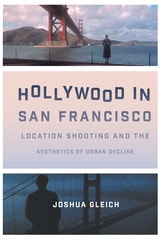
Hollywood in San Francisco
Location Shooting and the Aesthetics of Urban DeclineBy Joshua Gleich
University of Texas Press, 2018
One of the country’s most picturesque cities and conveniently located just a few hours’ drive from Hollywood, San Francisco became the most frequently and extensively filmed American city beyond the production hubs of Los Angeles and New York in the three decades after World War II. During those years, the cinematic image of the city morphed from the dreamy beauty of Vertigo to the nightmarish wasteland of Dirty Harry, although San Francisco itself experienced no such decline. This intriguing disconnect gives impetus to Hollywood in San Francisco, the most comprehensive study to date of Hollywood’s move from studio to location production in the postwar era.
In this thirty-year history of feature filmmaking in San Francisco, Joshua Gleich tracks a sea change in Hollywood production practices, as location shooting overtook studio-based filming as the dominant production method by the early 1970s. He shows how this transformation intersected with a precipitous decline in public perceptions of the American city, to which filmmakers responded by developing a stark, realist aesthetic that suited America’s growing urban pessimism and superseded a fidelity to local realities. Analyzing major films set in San Francisco, ranging from Dark Passage and Vertigo to The Conversation, The Towering Inferno, and Bullitt, as well as the TV show The Streets of San Francisco, Gleich demonstrates that the city is a physical environment used to stage urban fantasies that reveal far more about Hollywood filmmaking and American culture than they do about San Francisco.

If They Don't Bring Their Women Here
Chinese Female Immigration before ExclusionGeorge Anthony Peffer
University of Illinois Press, 1999
Seven years before the Chinese Exclusion Act of 1882, the Page Law sought to stem the tide of Chinese prostitutes entering the United States. Yet during these seven years, it was not just prostitutes but all Chinese females who encountered at best hostility and at worst expulsion when they reached the "Golden Door."
George Anthony Peffer looks at enforcement of immigration laws to provide the first detailed account of Chinese American women's lives in the pre-exclusion era. Peffer documents the habeas corpus trials in which the wives and daughters of Chinese laborers were required to prove their status as legal immigrants or return to China. He also surveys the virulently anti-Chinese coverage of these trials and the issue of Chinese immigration received in California newspapers, confirming that Chinatown's prostitution industry so dominated the popular imagination as to render other classes of female immigrants all but invisible.
Insightful and groundbreaking, If They Don't Bring Their Women Here amplifies the voices of Chinese immigrant women and establishes a place for them within the historiographic framework of Chinese American studies.
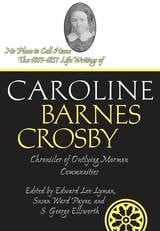
No Place To Call Home
The 1807-1857 Life Writings of Caroline Barnes Crosby, Chronicler of Outlying Mormon CommunitiesEdward Leo Lyman, Susan Ward Payne, and S. George Ellsworth
Utah State University Press, 2020
Caroline Crosby's life took a wandering course between her 1834 marriage to Jonathan Crosby and conversion to the infant Mormon Church and her departure for her final home, Utah, on New Year's Day, 1858. In the intervening years, she lived in many places but never long enough to set firm roots. Her adherence to a frontier religion on the move kept her moving, even after the church began to settle down in Utah. Despite the impermanence of her situation—perhaps even because of it—Caroline Crosby left a remarkably rich record of her life and travels, thereby telling us not only much about herself and her family but also about times and places of which her documentary record provides a virtually unparalleled view. A notable aspect of her memoirs and journals is what they convey of the character of their author, who, despite the many challenges of transience and poverty she faced, appears to have remained curious, dedicated, observant, and optimistic.
From Caroline's home in Canada, she and Jonathan Crosby first went to the headquarters of Joseph Smith's new church in Kirtland, Ohio. She recounts, in a memoir, the early struggles of his followers there. As the church moved west, the Crosbys did as well, but, as became characteristic, they did not move immediately with the main body to the center of the religion. For a while they settled in Indiana, finally reaching the new Mormon center of Nauvoo in 1842. Fleeing Nauvoo with the last of the Mormons in 1846, they spent two years in Iowa and set out for Utah in 1848, the account of which is the first of Caroline Crosby's vivid trail journals. The Crosbys were able to rest in Salt Lake City for less than two years before Brigham Young sent them on a church mission to the Society and Austral Islands in the South Pacific. She recorded, in detail, their overland travel to San Francisco and then by sea to French Polynesia and their service on the islands. In late 1852 the Crosbys returned to California, beginning what is probably the most historically significant time recorded in her writings, her diaries of life. First, in immediately post-Gold-Rush San Francisco and, second, in the new Mormon village of San Bernardino in southern California. There is no comparable record by a woman of 1850s life in these growing communities. The Crosbys responded in 1857 to Brigham Young's call for church members to gather in Utah and again abandoned a new home—the nicest one they had built and one of the finest houses in San Bernardino—again displaying their unquestioning loyalty to the Mormon church.
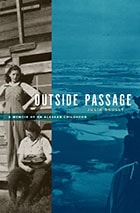
Outside Passage
A Memoir of an Alaskan ChildhoodJulia Scully
University of Alaska Press, 2010
Outside Passage is a lyrical and affecting memoir of those years, simultaneously an emotional account of a young girl’s first steps into adulthood and a unique portrait of a vanished frontier life.
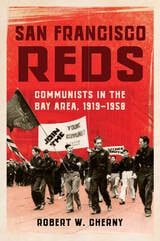
San Francisco Reds
Communists in the Bay Area, 1919-1958Robert W. Cherny
University of Illinois Press, 2024
Founded in 1919, the Communist Party (CP) in San Francisco survived an ineffectual early period to become a force in the trade union heyday of the 1930s. Robert Cherny uses the lives and careers of more than fifty members to tell the story of the city’s CP from its founding through 1958.
Cherny draws on FBI files, the records of the CP at the Russian State Archive for Social and Political History, interviews, and memoirs to follow male and female party and union leaders, rank-and-file members, and others. His history reveals why people joined the CP while charting the frequent changes in policy, constant member turnover, and disruptive factionalism that limited party aims and successes. Cherny also follows his subjects through their resignations, expulsions, or other reasons for departure and looks at the CP’s influence on their lives in subsequent years.
Vivid and exhaustively researched, San Francisco Reds is a long view account of the personal motivations and activism of an Old Left generation in a West Coast city.
San Francisco Year Zero
Political Upheaval, Punk Rock and a Third-Place Baseball TeamLincoln A. Mitchell
Rutgers University Press, 2019
In San Francisco Year Zero, San Francisco native Lincoln Mitchell traces the roots of the current situation back to 1978, when three key events occurred: the assassination of George Moscone and Harvey Milk occurring fewer than two weeks after the massacre of Peoples Temple members in Jonestown, Guyana, the explosion of the city’s punk rock scene, and a breakthrough season for the San Francisco Giants. Through these three strands, Mitchell explores the rifts between the city’s pro-business and progressive-left politicians, the emergence of Dianne Feinstein as a political powerhouse, the increasing prominence of the city’s LGBT community, punk’s reinvigoration of the Bay Area’s radical cultural politics, and the ways that the Giants helped unify one of the most ethnically and culturally diverse cities in the nation.
Written from a unique insider’s perspective, San Francisco Year Zero deftly weaves together the personal and the political, putting a human face on the social upheavals that transformed a city.
San Francisco, 1846-1856
From Hamlet to CityRoger W. Lotchin
University of Illinois Press, 1997
Now back in print with a new introduction by the author, this is the classic study of America's most admired instant city, from its days as a sleepy Mexican village, through the Gold Rush and into its establishment as a major international port. Roger Lotchin examines the urbanizing influences in San Francisco and compares these to other urban centers, doing so against a colorful backdrop of opium dens and other sinful institutions.
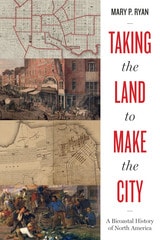
Taking the Land to Make the City
A Bicoastal History of North AmericaBy Mary P. Ryan
University of Texas Press, 2019
The history of the United States is often told as a movement westward, beginning at the Atlantic coast and following farmers across the continent. But cities played an equally important role in the country’s formation. Towns sprung up along the Pacific as well as the Atlantic, as Spaniards and Englishmen took Indian land and converted it into private property. In this reworking of early American history, Mary P. Ryan shows how cities—specifically San Francisco and Baltimore—were essential parties to the creation of the republics of the United States and Mexico.
Baltimore and San Francisco share common roots as early trading centers whose coastal locations immersed them in an international circulation of goods and ideas. Ryan traces their beginnings back to the first human habitation of each area, showing how the juggernaut toward capitalism and nation-building could not commence until Europeans had taken the land for city building. She then recounts how Mexican ayuntamientos and Anglo American city councils pioneered a prescient form of municipal sovereignty that served as both a crucible for democracy and a handmaid of capitalism. Moving into the nineteenth century, Ryan shows how the citizens of Baltimore and San Francisco molded landscape forms associated with the modern city: the gridded downtown, rudimentary streetcar suburbs, and outlying great parks. This history culminates in the era of the Civil War when the economic engines of cities helped forge the East and the West into one nation.
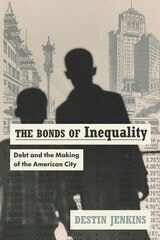
The Bonds of Inequality
Debt and the Making of the American CityDestin Jenkins
University of Chicago Press, 2021
In this passionate and deeply researched book, Destin Jenkins shows in vivid detail how, beyond the borrowing decisions of American cities and beneath their quotidian infrastructure, there lurks a world of politics and finance that is rarely seen, let alone understood. Focusing on San Francisco, The Bonds of Inequality offers a singular view of the postwar city, one where the dynamics that drove its creation encompassed not only local politicians but also banks, credit rating firms, insurance companies, and the national municipal bond market. Moving between the local and the national, The Bonds of Inequality uncovers how racial inequalities in San Francisco were intrinsically tied to municipal finance arrangements and how these arrangements were central in determining the distribution of resources in the city. By homing in on financing and its imperatives, Jenkins boldly rewrites the history of modern American cities, revealing the hidden strings that bind debt and power, race and inequity, democracy and capitalism.
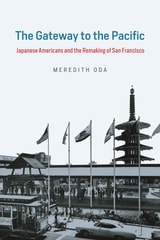
The Gateway to the Pacific
Japanese Americans and the Remaking of San FranciscoMeredith Oda
University of Chicago Press, 2018
Focusing on the development of the Center, Meredith Oda shows how this multilayered story was embedded within a larger story of the changing institutions and ideas that were shaping the city. During these formative decades, Oda argues, San Francisco’s relations with and ideas about Japan were being forged within the intimate, local sites of civic and community life. This shift took many forms, including changes in city leadership, new municipal institutions, and especially transformations in the built environment. Newly friendly relations between Japan and the United States also meant that Japanese Americans found fresh, if highly constrained, job and community prospects just as the city’s African Americans struggled against rising barriers. San Francisco’s story is an inherently local one, but it also a broader story of a city collectively, if not cooperatively, reimagining its place in a global economy.

The Letters of Mina Harker
Dodie Bellamy; with a new Forward by Dennis Cooper
University of Wisconsin Press, 2004
Bigger-than-life, half goddess, half Bette Davis, Mina sends letter after letter to friends and co-conspirators, holding her reader captive through a display of illusion and longing. Juggling quivering vulnerability on one hand and gossip on the other, Mina spoofs and consumes and spews back up demented reembodiments of trash media and high theory alike. It's all fodder for her ravenous libido and "a messy ambiguous place where pathology meets pleasure." Sensuous and captivating, The Letters of Mina Harker describes one woman's struggles finding the right words to explain her desires and fears without confining herself to one identity.
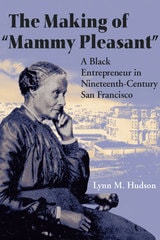
The Making of "Mammy Pleasant"
A Black Entrepreneur in Nineteenth-Century San FranciscoLynn M. Hudson
University of Illinois Press, 2002
Investigating Mary Ellen Pleasant's convoluted legacy
Mary Ellen Pleasant arrived in Gold Rush-era San Francisco a free black woman with abolitionist convictions and a predilection for entrepreneurial success. Behind the convenient and trusted disguise of "Mammy," she transformed domestic labor into enterprise, amassed remarkable real estate, wealth, and power, and gained notoriety for her work in fighting Jim Crow.
Pleasant's legacy is steeped in scandals and lore. Was she a voodoo queen who traded in sexual secrets? A madam? A murderer? In The Making of "Mammy Pleasant," Lynn M. Hudson examines the folklore of Pleasant's real and imagined powers. Emphasizing the significance of her life in the context of how it has been interpreted or ignored in the larger trends of American history, Hudson integrates fact and speculation culled from periodicals, court cases, diaries, letters, Pleasant's interviews with the San Francisco press, and various biographical and fictional accounts.
Addressing the lack of a historical record of black women's lives, the author argues that the silences and mysteries of Pleasant's past, whether never recorded or intentionally omitted, reveal as much about her life as what has been documented. Through Pleasant's life, Hudson also interrogates the constructions of race, gender, and sexuality during the formative years of California's economy and challenges popular mythology about the liberatory sexual culture of the American West.
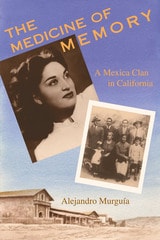
The Medicine of Memory
A Mexica Clan in CaliforniaBy Alejandro Murguía
University of Texas Press, 2002
"People who live in California deny the past," asserts Alejandro Murguía. In a state where "what matters is keeping up with the current trends, fads, or latest computer gizmo," no one has "the time, energy, or desire to reflect on what happened last week, much less what happened ten years ago, or a hundred." From this oblivion of memory, he continues, comes a false sense of history, a deluded belief that the way things are now is the way they have always been.
In this work of creative nonfiction, Murguía draws on memories—his own and his family's reaching back to the eighteenth century—to (re)construct the forgotten Chicano-indigenous history of California. He tells the story through significant moments in California history, including the birth of the mestizo in Mexico, destruction of Indian lifeways under the mission system, violence toward Mexicanos during the Gold Rush, Chicano farm life in the early twentieth century, the Chicano Movement of the 1960s, Chicano-Latino activism in San Francisco in the 1970s, and the current rebirth of Chicano-Indio culture. Rejecting the notion that history is always written by the victors, and refusing to be one of the vanquished, he declares, "This is my California history, my memories, richly subjective and atavistic."
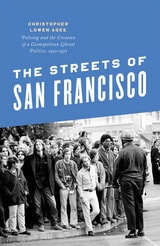
The Streets of San Francisco
Policing and the Creation of a Cosmopolitan Liberal Politics, 1950-1972Christopher Lowen Agee
University of Chicago Press, 2014
The Streets of San Francisco uncovers the seldom reported, street-level interactions between police officers and San Francisco residents and finds that police discretion was the defining feature of mid-century law enforcement. Postwar police officers enjoyed great autonomy when dealing with North Beach beats, African American gang leaders, gay and lesbian bar owners, Haight-Ashbury hippies, artists who created sexually explicit works, Chinese American entrepreneurs, and a wide range of other San Franciscans. Unexpectedly, this police independence grew into a source of both concern and inspiration for the thousands of young professionals streaming into the city's growing financial district. These young professionals ultimately used the issue of police discretion to forge a new cosmopolitan liberal coalition that incorporated both marginalized San Franciscans and rank-and-file police officers. The success of this model in San Francisco resulted in the rise of cosmopolitan liberal coalitions throughout the country, and today, liberal cities across America ground themselves in similar understandings of democracy, emphasizing both broad diversity and strong policing.
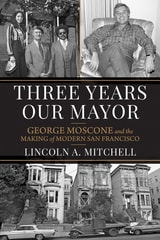
Three Years Our Mayor
George Moscone and the Making of Modern San FranciscoLincoln A. Mitchell
University of Nevada Press, 2025
Moscone was also a very colorful character who, in addition to being a successful politician, was a charming and charismatic bon vivant who was deeply embedded in the fabric and culture of San Francisco. He grew up the only son of a single mother in Cow Hollow when it was a working class, largely Italian American neighborhood, and he became the kind of politician who knew bartenders, playground attendants, small business owners, and neighborhood activists in every corner of the city. Moscone’s life and the history of San Francisco during the middle half of the twentieth century are deeply intertwined.
Through illustrating the life of Moscone, author Lincoln A. Mitchell explores how today’s San Francisco came into being. Moscone—through his work in the State Senate, victory in the very divisive 1975 mayor’s race, and brief tenure as mayor—was a key figure in the city’s evolution. The politics surrounding Moscone’s election as mayor, governance of the city, and tragic death are still relevant issues. Moscone was a groundbreaking politician whose life was cut short, but his influence on San Francisco can still be felt today.
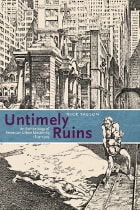
Untimely Ruins
An Archaeology of American Urban Modernity, 1819-1919Nick Yablon
University of Chicago Press, 2009
American ruins have become increasingly prominent, whether in discussions of “urban blight” and home foreclosures, in commemorations of 9/11, or in postapocalyptic movies. In this highly original book, Nick Yablon argues that the association between American cities and ruins dates back to a much earlier period in the nation’s history. Recovering numerous scenes of urban desolation—from failed banks, abandoned towns, and dilapidated tenements to the crumbling skyscrapers and bridges envisioned in science fiction and cartoons—Untimely Ruins challenges the myth that ruins were absent or insignificant objects in nineteenth-century America.
The first book to document an American cult of the ruin, Untimely Ruins traces its deviations as well as derivations from European conventions. Unlike classical and Gothic ruins, which decayed gracefully over centuries and inspired philosophical meditations about the fate of civilizations, America’s ruins were often “untimely,” appearing unpredictably and disappearing before they could accrue an aura of age. As modern ruins of steel and iron, they stimulated critical reflections about contemporary cities, and the unfamiliar kinds of experience they enabled. Unearthing evocative sources everywhere from the archives of amateur photographers to the contents of time-capsules, Untimely Ruins exposes crucial debates about the economic, technological, and cultural transformations known as urban modernity. The result is a fascinating cultural history that uncovers fresh perspectives on the American city.