Results by title

26 books match the query 'Senegal'
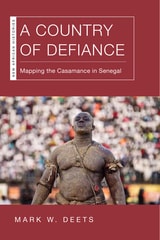
cover of A Country of Defiance: Mapping the Casamance in Senegal

A Country of Defiance

Mapping the Casamance in Senegal

Mark W. Deets

Ohio University Press, 2023

A historiographical analysis of human geography and a social history of nationalist separatism and cultural identity in southern Senegal. This book is a spatial history of the conflict in Casamance, the portion of Senegal located south of The Gambia. Mark W. Deets traces the origins of the conflict back to the start of the colonial period in a select group of contested spaces and places where the seeds of nationalism and separatism took root. Each chapter examines the development of a different piece of the still unrealized Casamançais nation: river, rice field, forest, school, and stadium. Each of these locations forms a spatial discourse of grievance that transformed space into place, rendering a separatist nation from the pieces where a particular Casamançais identity emerged. However, not every Casamançais identified with these spaces and places in the same way. Many refused to tie their beloved culture and landscape to the project of separatism, revealing a layer of counter-mapping below that of the separatist leaders like Father Augustin Diamacoune Senghor and Mamadou “Nkrumah” Sané. The Casamance conflict began on December 26, 1982. After an oath-taking ceremony in a sacred forest on the edge of Ziguinchor, hundreds of separatists from the Movement of Democratic Forces of the Casamance (MFDC) marched into the town to remove the Senegalese flag in front of the regional governor’s office and replace it with a white flag. The marchers were met by gendarmes who quickly found themselves outnumbered. Government surveillance, arrests, and interrogations followed into the next year, when gendarmes went to the sacred forest to stop another MFDC meeting. This time, the separatists greeted the gendarmes with a burst of violence that left four dead, their bodies mutilated. Senegalese security responded with force, driving the separatists—armed only with improvised rifles, bows and arrows, and machetes—into the forest. The Casamance conflict continues to the present day, so far having left more than five thousand dead, four hundred killed or maimed by land mines, and another eight hundred thousand living in a state of insecurity, with limited possibility for economic development. Ordinary Casamançais—on the Casamance River, in the rice fields, in the forests, in the schools, and in the sports stadiums—have demonstrated a diversity of opinions about the separatist project. Whether by the Senegalese state or by the separatists, these ordinary Casamançais have refused to be mapped. They have made the Casamance “a country of defiance.”
[more]
cover of Adventures in Africa

Adventures in Africa

Gianni Celati

University of Chicago Press, 2000

"In the life of a tourist who travels a bit far, I think that at a certain point, a question necessarily arises: 'But what have I come here for?' A question that sets in motion a great cinema of justification to oneself, so that one doesn't have to seriously say to oneself: 'I'm here doing nothing.'"
In 1997 the celebrated Italian novelist and essayist Gianni Celati accompanied his friend, filmmaker Jean Talon, on a journey to West Africa which took them from Mali to Senegal and Mauritania. The two had been hoping to research a documentary about Dogon priests, but frustrated by red tape, their voyage became instead a touristic adventure. The vulnerable, prickly, insightful Celati kept notebooks of the journey, now translated by Adria Bernardi as Adventures in Africa. Celati is the privileged traveler, overwhelmed by customs he doesn't understand, always at the mercy of others who are trying to sell him something he doesn't want to buy, and aware of himself as the Tourist who is always a little disoriented and at the center of the continual misadventures that are at the heart of travel.
Celati's book is both a travelogue in the European tradition and a trenchant meditation on what it means to be a tourist. Celati learns to surrender to the chaos of West Africa and in the process produces a work of touching and comic descriptions, in the lucid and ironic prose that is his hallmark. Hailed as one of the best travelogues on Africa ever written and awarded the first Zerilli-Marimó prize, Adventures in Africa is a modest yet profound account of the utter discombobulation of travel.
[more]
cover of African Meditations

African Meditations

Felwine Sarr

University of Minnesota Press, 2022

An influential thinker’s fascinating reflections and meditations on reacclimating to his native Senegal as a young academic after years of study abroad
 

The call to morning prayer. A group run at daybreak along the Corniche in Dakar. A young woman shedding tears on a beach as her friends take a boat to Europe. In African Meditations, paths to enlightenment collide with tales of loss and ruminations, musical gatherings, and the everyday sights and sounds of life in West Africa as a young philosopher and creative writer seeks to establish himself as a teacher upon his return to Senegal, his homeland, after years of study abroad. 

A unique contemporary portrait of an influential, multicultural thinker on a spiritual quest across continents—reflecting on his multiple literary influences along with French, African Francophone, and Senegalese tribal cultural roots in a homeland with a predominantly Muslim culture—African Meditations is a seamless blend of autobiography, journal entries, and fiction; aphorisms and brief narrative sketches; humor and Zen reflections. 

Taking us from Saint-Louis to Dakar, Felwine Sarr encounters the rhythms of everyday life as well as its disruptions such as teachers’ strikes and power outages while traversing a semi-surrealistic landscape. As he reacclimates to his native country after a life in France, we get candid glimpses, both vibrant and hopeful, sublime and mundane, into his Zen journey to resecure a foothold in his roots and to navigate academia, even while gleaning something of the good life, of joy, amid the struggles of life in Senegal. 

[more]
cover of Battling Siki: A Tale of Ring Fixes, Race, and Murder in the 1920s

Battling Siki

A Tale of Ring Fixes, Race, and Murder in the 1920s

Peter Benson

University of Arkansas Press, 2008
Battling Siki (1887–1925) was once one of the four or five most recognizable black men in the world, and was written about in detail by such figures as Ring Lardner and his son John, Damon Runyon, and Westbrook Pegler. One can find his legacy in the name of a popular rock group, one of Che Guevara’s lieutenants, a character on Xena, Warrior Princess, and the Battling Siki Hotel in the fighter’s homeland, Senegal. Peter Benson’s biography of the first African to win a world championshipin boxing delves into the complex world of sports, race, colonialism, and the cult of personality in the early twentieth century. Born Amadu Fall, Siki was taken from Senegal to France by an actress and assumed the name Louis M’barick Fall. After an inauspicious beginning as a boxer, he served in World War I with distinction then returned to boxing and compiled a most impressive record (forty-three wins in forty-six bouts). Then, on September 24, 1922, at Paris’s Buffalo Velodrome, before forty thousand stunned spectators (including a young Ernest Hemingway, who wrote about the fight), Battling Siki, employing his trademark “windmill” punch, fought and defeated the reigning world and European light heavyweight champion, Georges Carpentier. The colorful Siki spent a fortune partying and carousing, was arrested for firing a pistol in the air, and was frequently seen on the streets of Paris, dressed in flashy clothes, walking his pet lion cubs on a leash. But he also provoked a scandal by exposing the corruption of the fight game in France, spoke out boldly against racisim, and was arrected for deliberately defying the code of racial segregation in the American South. Siki’s flamboyant image was largely created by newsmen. In fact, the real Siki, while he did certainly like to party, was also an intelligent and socially conscious person, who detested the media’s image of him as a simple-minded drunken savage. Offers rushed in for him to fight in the United States, maybe even against Jack Dempsey. But in a move many have called one of the strangest a fighter ever made, he fought Irishman Mike McTigue in Dublin on St. Patrick’s Day—and lost. After losing his European title he came to the United States and fought without much success. He continued to drink and get into street brawls. On the evening of December 15, 1925, at the age of twenty-eight, he was shot and killed in Hell’s Kitchen in what some claimed was a gangland execution. Peter Benson’s biography beautifully captures Battling Siki’s amazing boxing career and sheds new light on the scandal surrounding his marriages and public behavior, his alleged participation in ring fixes, and the mystery surrounding his death.
[more]
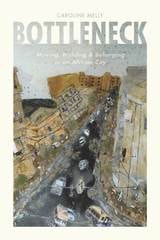
cover of Bottleneck: Moving, Building, and Belonging in an African City

Bottleneck

Moving, Building, and Belonging in an African City

Caroline Melly

University of Chicago Press, 2017

In Bottleneck, anthropologist Caroline Melly uses the problem of traffic bottlenecks to launch a wide-ranging study of mobility in contemporary urban Senegal—a concept that she argues is central to both citizens' and the state's visions of a successful future.
 
Melly opens with an account of the generation of urban men who came of age on the heels of the era of structural adjustment, a diverse cohort with great dreams of building, moving, and belonging, but frustratingly few opportunities to do so. From there, she moves to a close study of taxi drivers and state workers, and shows how bottlenecks—physical and institutional—affect both. The third section of the book covers a seemingly stalled state effort to solve housing problems by building large numbers of concrete houses, while the fourth takes up the thousands of migrants who attempt, sometimes with tragic results, to cross the Mediterranean on rickety boats in search of new opportunities. The resulting book offers a remarkable portrait of contemporary Senegal and a means of theorizing mobility and its impossibilities far beyond the African continent.
[more]
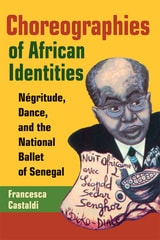
cover of Choreographies of African Identities: Négritude, Dance, and the National Ballet of Senegal

Choreographies of African Identities

Négritude, Dance, and the National Ballet of Senegal

Francesca Castaldi

University of Illinois Press, 2006
Choreographies of African Identities traces interconnected interpretative frameworks around and about the National Ballet of Senegal. Using the metaphor of a dancing circle Castaldi's arguments cover the full spectrum of performance, from production to circulation and reception. Castaldi first situates the reader in a North American theater, focusing on the relationship between dancers and audiences as that between black performers and white spectators. She then examines the work of the National Ballet in relation to Léopold Sédar Senghor's Négritude ideology and cultural politics. Finally, the author addresses the circulation of dances in the streets, discotheques, and courtyards of Dakar, drawing attention to women dancers' occupation of the urban landscape.
 
[more]
cover of Dancing Opacity: Contemporary Dance, Transnationalism, and Queer Possibility in Senegal

Dancing Opacity

Contemporary Dance, Transnationalism, and Queer Possibility in Senegal

Amy E. Swanson

University of Michigan Press, 2025
Amy Swanson’s Dancing Opacity chronicles the ways in which contemporary dancers in Senegal navigate the global contemporary dance circuit while challenging heteropatriarchal ideologies at home. A longstanding hub of African performing arts, Senegal was at the forefront of the explosion of contemporary dance across the continent at the turn of the twenty-first century. Drawing on ethnographic and historical research, Swanson demonstrates how Senegalese choreographers and dancers contend with entrenched racialized prejudices about Africa outside the continent, while pushing back against repressive regulations of gender and sexuality within Senegal. Swanson employs the concept of opacity, defined as a refusal to adhere to the colonial logic of transparency for dominant gazes and argues that artists create work with multiple layers of meaning that are not meant to be immediately transparent to all viewers. By doing so, these artists evade cultural norms that govern gender and sexual expression in Senegal, while challenging their international audiences to expand their perceptions of African dance. Dancing Opacity highlights the artists’ accounts of their pedagogies, performances, aesthetics, and lived realities, as well as Africanist conceptions of gender, sexuality, and queerness that have yet to be applied to contemporary dance.
[more]
cover of Diaspora Without Displacement: The Coloniality and Promise of Capoeira in Senegal

Diaspora Without Displacement

The Coloniality and Promise of Capoeira in Senegal

Celina de Sá

Duke University Press, 2025
Capoeira—a game of combat primarily developed by enslaved West Central Africans—has become an icon of both Brazilian national culture and pride in the country’s diasporic African heritage. Yet the sport remains less accessible in Africa itself, overshadowed in large part by participants in the Global North. In Diaspora Without Displacement, Celina de Sá tells the story of capoeira as it "returns" to the African continent through the creative initiatives of young urban professionals in Senegal. De Sá demonstrates how a new generation of African capoeiristas are taking up their own Afro-diasporic performance tradition, effectively reframing notions of diaspora and race through their social practice. Though capoeira has largely Angolan roots and the agents of return are typically white Brazilians and Europeans, the West African practitioners de Sá documents nonetheless form an exceptional relationship to capoeira that, in turn, becomes a mode of political and social consciousness. Analyzing a capoeira network across West Africa, de Sá shows how urban West Africans use capoeira to explore the relationship between Blackness, diaspora, and African heritage.
[more]
cover of Dying to Count: Post-Abortion Care and Global Reproductive Health Politics in Senegal

Dying to Count

Post-Abortion Care and Global Reproductive Health Politics in Senegal

Siri Suh

Rutgers University Press, 2021

During the early 1990s, global health experts developed a new model of emergency obstetric care: post-abortion care or PAC. In developing countries with restrictive abortion laws and where NGOs relied on US family planning aid, PAC offered an apolitical approach to addressing the consequences of unsafe abortion. In Dying to Count, Siri Suh traces how national and global population politics collide in Senegal as health workers, health officials, and NGO workers strive to demonstrate PAC’s effectiveness in the absence of rigorous statistical evidence that the intervention reduces maternal mortality. Suh argues that pragmatically assembled PAC data convey commitments to maternal mortality reduction goals while obscuring the frequency of unsafe abortion and the inadequate care women with complications are likely to receive if they manage to reach a hospital. At a moment when African women face the highest risk worldwide of death from complications related to pregnancy, birth, or abortion, Suh’s ethnography of PAC in Senegal makes a critical contribution to studies of global health, population and development, African studies, and reproductive justice.
 
[more]
cover of Edges of Exposure: Toxicology and the Problem of Capacity in Postcolonial Senegal

Edges of Exposure

Toxicology and the Problem of Capacity in Postcolonial Senegal

Noémi Tousignant

Duke University Press, 2018
In the industrialized nations of the global North, well-funded agencies like the CDC attend to citizens' health, monitoring and treating for toxic poisons like lead. How do the under-resourced nations of the global South meet such challenges? In Edges of Exposure, Noémi Tousignant traces the work of toxicologists in Senegal as they have sought to warn of and remediate the presence of heavy metals and other poisons in their communities. Situating recent toxic scandals within histories of science and regulation in postcolonial Africa, Tousignant shows how decolonization and structural adjustment have impacted toxicity and toxicology research. Ultimately, as Tousignant reveals, scientists' capacity to conduct research—as determined by material working conditions, levels of public investment, and their creative but not always successful efforts to make visible the harm of toxic poisons—affects their ability to keep equipment, labs, projects, and careers going.
[more]
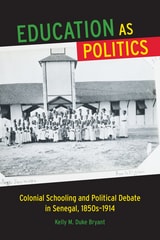
cover of Education as Politics: Colonial Schooling and Political Debate in Senegal, 1850s–1914

Education as Politics

Colonial Schooling and Political Debate in Senegal, 1850s–1914

Kelly M. Duke Bryant

University of Wisconsin Press, 2015

In 1914, Blaise Diagne was elected as Senegal’s first black African representative to the National Assembly in France. Education as Politics reinterprets the origins and significance of this momentous election, showing how colonial schools had helped reshape African power and politics during the preceding decades and how they prepared the way for Diagne’s victory.
            Kelly M. Duke Bryant demonstrates the critical impact of colonial schooling on Senegalese politics by examining the response to it by Africans from a variety of backgrounds and statuses—including rural chiefs, Islamic teachers, and educated young urbanites. For those Africans who chose to engage with them, the French schools in Senegal provided a new source of patronage, a potentially beneficial connection to the bureaucratizing colonial state, a basis for claims to authority or power, or an arena in which to debate pressing issues like the future of Qur’anic schooling and the increasing racism of urban society under colonial rule.
            Based on evidence from archives in Senegal and France, and on interviews Duke Bryant conducted in Senegal, she demonstrates that colonial schooling remade African politics during this period of transition to French rule, creating political spaces that were at once African and colonial, and ultimately allowing Diagne to claim election victory.
[more]
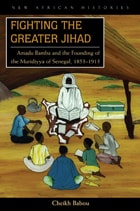
cover of Fighting the Greater Jihad: Amadu Bamba and the Founding of the Muridiyya of Senegal, 1853–1913

Fighting the Greater Jihad

Amadu Bamba and the Founding of the Muridiyya of Senegal, 1853–1913

Cheikh Anta Babou

Ohio University Press, 2007

In Senegal, the Muridiyya, a large Islamic Sufi order, is the single most influential religious organization, including among its numbers the nation’s president. Yet little is known of this sect in the West. Drawn from a wide variety of archival, oral, and iconographic sources in Arabic, French, and Wolof, Fighting the Greater Jihad offers an astute analysis of the founding and development of the order and a biographical study of its founder, Cheikh Ahmadu Bamba Mbakke.

Cheikh Anta Babou explores the forging of Murid identity and pedagogy around the person and initiative of Amadu Bamba as well as the continuing reconstruction of this identity by more recent followers. He makes a compelling case for reexamining the history of Muslim institutions in Africa and elsewhere in order to appreciate believers’ motivation and initiatives, especially religious culture and education, beyond the narrow confines of political collaboration and resistance. Fighting the Greater Jihad also reveals how religious power is built at the intersection of genealogy, knowledge, and spiritual force, and how this power in turn affected colonial policy.

Fighting the Greater Jihad will dramatically alter the perspective from which anthropologists, historians, and political scientists study Muslim mystical orders.

[more]
cover of Forensics of Capital

Forensics of Capital

Michael Ralph

University of Chicago Press, 2015

As one of Africa’s few democracies, Senegal has long been thought of as a leader of moral, political, and economic development on the continent. We tend to assume that any such nation has achieved favorable international standing due to its own merits. In Forensics of Capital, Michael Ralph upends this kind of conventional thinking, showing how Senegal’s diplomatic standing was strategically forged in the colonial and postcolonial eras at key periods of its history and is today entirely contingent on the consensus of wealthy and influential nations and international lending agencies.
           
Ralph examines Senegal’s crucial and pragmatic decisions related to its development and how they garnered international favor, decisions such as its opposition to Soviet involvement in African liberation—despite itself being a socialist state—or its support for the US-led war on terror—despite its population being predominately Muslim. He shows how such actions have given Senegal an inflated political and economic position and status as a highly credit-worthy nation even as its domestic economy has faltered. Exploring these and many other aspects of Senegal’s political economy and its interface with the international community, Ralph demonstrates that the international reputation of any nation—not just Senegal—is based on deep structural biases. 
[more]
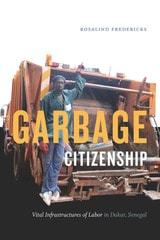
cover of Garbage Citizenship: Vital Infrastructures of Labor in Dakar, Senegal

Garbage Citizenship

Vital Infrastructures of Labor in Dakar, Senegal

Rosalind Fredericks

Duke University Press, 2018
Over the last twenty-five years, garbage infrastructure in Dakar, Senegal, has taken center stage in the struggles over government, the value of labor, and the dignity of the working poor. Through strikes and public dumping, Dakar's streets have been periodically inundated with household garbage as the city's trash collectors and ordinary residents protest urban austerity. Often drawing on discourses of Islamic piety, garbage activists have provided a powerful language to critique a neoliberal mode of governing-through-disposability and assert rights to fair labor. In Garbage Citizenship Rosalind Fredericks traces Dakar's volatile trash politics to recalibrate how we understand urban infrastructure by emphasizing its material, social, and affective elements. She shows how labor is a key component of infrastructural systems and how Dakar's residents use infrastructures as a vital tool for forging collective identities and mobilizing political action. Fleshing out the materiality of trash and degraded labor, Fredericks illuminates the myriad ways waste can be a potent tool of urban control and rebellion.
[more]
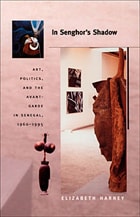
cover of In Senghor's Shadow: Art, Politics, and the Avant-Garde in Senegal, 1960–1995

In Senghor's Shadow

Art, Politics, and the Avant-Garde in Senegal, 1960–1995

Elizabeth Harney

Duke University Press, 2004

In Senghor’s Shadow is a unique study of modern art in postindependence Senegal. Elizabeth Harney examines the art that flourished during the administration of Léopold Sédar Senghor, Senegal’s first president, and in the decades since he stepped down in 1980. As a major philosopher and poet of Negritude, Senghor envisioned an active and revolutionary role for modern artists, and he created a well-funded system for nurturing their work. In questioning the canon of art produced under his aegis—known as the Ecole de Dakar—Harney reconsiders Senghor’s Negritude philosophy, his desire to express Senegal’s postcolonial national identity through art, and the system of art schools and exhibits he developed. She expands scholarship on global modernisms by highlighting the distinctive cultural history that shaped Senegalese modernism and the complex and often contradictory choices made by its early artists.

Heavily illustrated with nearly one hundred images, including some in color, In Senghor’s Shadow surveys the work of a range of Senegalese artists, including painters, muralists, sculptors, and performance-based groups—from those who worked at the height of Senghor’s patronage system to those who graduated from art school in the early 1990s. Harney reveals how, in the 1970s, avant-gardists contested Negritude beliefs by breaking out of established artistic forms. During the 1980s and 1990s, artists such as Moustapha Dimé, Germaine Anta Gaye, and Kan-Si engaged with avant-garde methods and local artistic forms to challenge both Senghor’s legacy and the broader art world’s understandings of cultural syncretism. Ultimately, Harney’s work illuminates the production and reception of modern Senegalese art within the global arena.
[more]
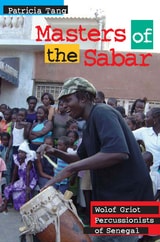
cover of Masters of the Sabar: Wolof Griot Percussionists of Senegal

Masters of the Sabar

Wolof Griot Percussionists of Senegal

Patricia Tang

Temple University Press, 2006
Masters of the Sabar is the first book to examine the music and culture of Wolof griot percussionists, masters of the vibrant sabar drumming tradition. Based on extensive field research in Senegal, this book is a biographical study of several generations of percussionists in a Wolof griot (géwël) family, exploring and documenting their learning processes, repertories, and performance contexts—from life-cycle ceremonies to sporting events and political meetings. Patricia Tang examines the rich history and changing repertories of sabar drumming, including dance rhythms and bàkks, musical phrases derived from spoken words. She notes the recent shift towards creating new bàkks which are rhythmically more complex and highlight the virtuosity and musical skill of the percussionist. She also considers the burgeoning popular music genre called mbalax. The compact disc that accompanies the book includes examples of the standard sabar repertory, as well as bàkks composed and performed by Lamine Touré and his family drum troupe.
[more]
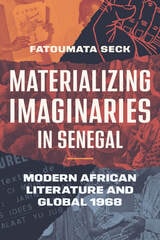
cover of Materializing Imaginaries in Senegal: Modern African Literature and Global 1968

Materializing Imaginaries in Senegal

Modern African Literature and Global 1968

Fatoumata Seck

Duke University Press, 2026
In Materializing Imaginaries in Senegal, Fatoumata Seck shows how cultural revolutionary projects in Senegal and beyond in the 1960s shaped African literature, cinema, and intellectual thought throughout the latter half of the twentieth century. She charts an intellectual and literary history that positions Global 1968 as a defining moment in modern African literature, analyzing the literature of this period through the prism of creative dissidence, revolutionary fervor, and cultural experimentation. Seck examines the role of African students and intellectuals in forging a decolonizing aesthetics underpinned by the Pan-African and internationalist solidarities of the 1960s. She traces the presence of these revolutionary projects in African letters, illuminating how revolutionary imaginaries sediment and remain as latent possibilities, while also reframing the emergence and reception of works by figures such as Léopold Sédar Senghor, Cheikh Anta Diop, David Mandessi Diop, Aminata Sow Fall, Ousmane Sembène, Awa Thiam, Djibril Diop Mambéty, Ken Bugul, Boubacar Boris Diop, and others. In so doing, Seck demonstrates that unfulfilled revolutions do not prevent the materialization of revolutionary imaginaries.
[more]
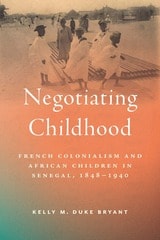
cover of Negotiating Childhood: French Colonialism and African Children in Senegal, 1848–1940

Negotiating Childhood

French Colonialism and African Children in Senegal, 1848–1940

Kelly M. Duke Bryant

University of Massachusetts Press, 2026

A groundbreaking study of the meaning of childhood in French colonial Senegal

Negotiating Childhood explores how colonial child protection policies and African children’s responses to them produced new ways of defining, measuring, documenting, and experiencing childhood in the French colony of Senegal from 1848 to 1940. In this groundbreaking book, Kelly M. Duke Bryant takes the scholarship in new directions, offering to a literature dominated by studies of British colonies in the twentieth century a study of childhood in a French colony from the immediate post-emancipation period through the 1930s. This focus allows her to complicate the generally accepted timeline of child protection in colonial Africa and question other assumptions about children’s history on the continent.

This deeply researched work uses a wide range of sources to examine children’s experiences in spaces where they encountered French discipline and surveillance, such as wardship courts, public streets, schools, juvenile reformatories, and vaccine clinics. The book shows not only how these spaces re-ordered African childhood, but also how children themselves shaped and limited French efforts to impose order, especially when the state depended on African children’s cooperation to make good on rhetoric about child “protection.” It also charts the rise of documentation in children’s lives, as colonial representatives recorded names, ages, and other details about the African children with whom they interacted. Tracing the “documented” child back to the early colonial period, Negotiating Childhood historicizes the emergence of identity documentation—so crucial to our contemporary world—and questions the naturalness of the very idea of the “child.”
[more]
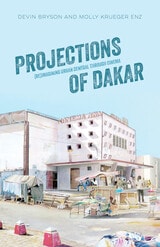
cover of Projections of Dakar: (Re)Imagining Urban Senegal through Cinema

Projections of Dakar

(Re)Imagining Urban Senegal through Cinema

Devin Bryson and Molly Krueger Enz

Ohio University Press, 2024

Projections of Dakar studies the audiovisual creations and practices of twenty-first-century Senegalese filmmakers living, working, and distributing their films in urban Senegal. Although some observers have described contemporary Senegalese cinema as a dying industry, this book shows that it retains great potential. Senegalese cinematic practitioners are forging unique, dynamic responses to social challenges and producing content in innovative forms.

Like contemporary Senegalese cinema, African urban centers are often perceived as sites of despair and social decay. In each chapter of this book, Devin Bryson and Molly Krueger Enz focus on a particular urban issue and analyze how Senegalese filmmakers document and reimagine it from diverse perspectives and contexts. The authors draw from interviews and ethnographic observations to center filmmakers’ practices and conceptualizations of contemporary cinema in Dakar. Bryson and Enz trace developments in production, distribution, viewership, and audience response since 2012 to study how these films and their production both reveal and contribute to how people live in the city, relate to one another, build their lives, advocate for change, find joy and meaning, and build community. They also document and articulate more equitable and inclusive forms of these activities. Ultimately, the book illustrates how Senegalese filmmakers reimagine Africa as a place that will lead to a better future for its inhabitants.
[more]
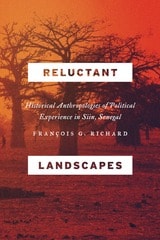
cover of Reluctant Landscapes: Historical Anthropologies of Political Experience in Siin, Senegal

Reluctant Landscapes

Historical Anthropologies of Political Experience in Siin, Senegal

Francois G. Richard

University of Chicago Press, 2018

West African history is inseparable from the history of the Atlantic slave trade and colonialism. According to historical archaeologist François Richard, however, the dominance of this narrative not only colors the range of political discourse about Africa but also occludes many lesser-known—but equally important—experiences of those living in the region.
 
Reluctant Landscapes is an exploration of the making and remaking of political experience and physical landscapes among rural communities in the Siin province of Senegal between the late 1500s and the onset of World War II. By recovering the histories of farmers and commoners who made up African states’ demographic core in this period, Richard shows their crucial—but often overlooked—role in the making of Siin history. The book also delves into the fraught relation between the Seereer, a minority ethnic and religious group, and the Senegalese nation-state, with Siin’s perceived “primitive” conservatism standing at odds with the country’s Islamic modernity. Through a deep engagement with oral, documentary, archaeological, and ethnographic archives, Richard’s groundbreaking study revisits the four-hundred-year history of a rural community shunted to the margins of Senegal’s national imagination.
[more]
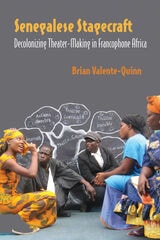
cover of Senegalese Stagecraft: Decolonizing Theater-Making in Francophone Africa

Senegalese Stagecraft

Decolonizing Theater-Making in Francophone Africa

Brian Valente-Quinn

Northwestern University Press, 2021

Senegalese Stagecraft explores the theatrical stage in Senegal as a site of poetic expression, political activism, and community engagement. In their responses to the country’s colonial heritage, as well as through their innovations on the craft of theater‑making, Senegalese performers have created an array of decolonizing stage spaces that have shaped the country’s theater history. Their work has also addressed a global audience, experimenting with international performance practices while proposing new visions of the role of culture and stagecraft in society.
 
Through a study of the innovative work of Senegalese theater-makers from the 1930s onward, Senegalese Stagecraft explores a wide range of historical contexts and themes, including French colonial education, cultural Pan‑Africanism, West African Sufism, uses of television and mass media, and popular theater and activism. Using a multidisciplinary approach that includes field, archival, and literary methods, Valente‑Quinn offers a fresh look at performance cultures of West Africa and the Global South in a book that will interest students and scholars in African, Francophone, and performance studies.
 
[more]
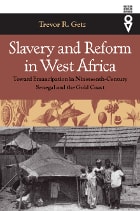
cover of Slavery and Reform in West Africa: Toward Emancipation in Nineteenth-Century Senegal and the Gold Coast

Slavery and Reform in West Africa

Toward Emancipation in Nineteenth-Century Senegal and the Gold Coast

Trevor R. Getz

Ohio University Press, 2004

A series of transformations, reforms, and attempted abolitions of slavery form a core narrative of nineteenth-century coastal West Africa. As the region’s role in Atlantic commercial networks underwent a gradual transition from principally that of slave exporter to producer of “legitimate goods” and dependent markets, institutions of slavery became battlegrounds in which European abolitionism, pragmatic colonialism, and indigenous agency clashed.

In Slavery and Reform in West Africa, Trevor Getz demonstrates that it was largely on the anvil of this issue that French and British policy in West Africa was forged. With distant metropoles unable to intervene in daily affairs, local European administrators, striving to balance abolitionist pressures against the resistance of politically and economically powerful local slave owners, sought ways to satisfy the latter while placating or duping the former.

The result was an alliance between colonial officials, company agents, and slave-owning elites that effectively slowed, sidetracked, or undermined serious attempts to reform slave holding. Although slavery was outlawed in both regions, in only a few isolated instances did large-scale emancipations occur. Under the surface, however, slaves used the threat of self-liberation to reach accommodations that transformed the master-slave relationship.

By comparing the strategies of colonial administrators, slave-owners, and slaves across these two regions and throughout the nineteenth century, Slavery and Reform in West Africa reveals not only the causes of the astounding success of slave owners, but also the factors that could, and in some cases did, lead to slave liberations. These findings have serious implications for the wider study of slavery and emancipation and for the history of Africa generally.
[more]
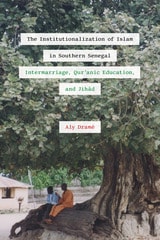
cover of The Institutionalization of Islam in Southern Senegal: Intermarriage, Qur'anic Education, and Jihad

The Institutionalization of Islam in Southern Senegal

Intermarriage, Qur'anic Education, and Jihad

Aly Dramé

University of Michigan Press, 2025

Weaving together oral and written sources, The Institutionalization of Islam in Southern Senegal investigates previously overlooked dimensions of Islamization in Senegambia through the processes of intermarriage, Qur’anic education, and jihãd. Due to its geographic location at the point where Senegal, The Gambia, and Guinea-Bissau meet, the Middle Casamance has historically been a melting pot where centralized and decentralized societies have coexisted for generations. In the past, historians have failed to consider the contributions of the Middle Casamance region and Mandinka Muslim settlements to the development of Islam, despite centers for Islamic education having existed in the region centuries before the emergence of the Sufi and jihãd movements of the eighteenth and nineteenth centuries. Aly Dramé seeks to close this gap by conceptualizing the leading role played by these Mandinka settlements and how religious spaces are negotiated, acquired, and transformed through intermarriage, Qur’anic education, and jihãd when peoples from distinct backgrounds encounter one another. 

Drawing on archival documents, oral history and traditions, travelers’ accounts, the Arabic text Pakao al-Qurano (Holy Book of Pakao), and original ethnography, The Institutionalization of Islam in Southern Senegal demonstrates how these communities reframe the debates about the institutionalization of Islam in Senegambia geographically, chronologically, and thematically.

[more]
cover of The Internet of Elsewhere: The Emergent Effects of a Wired World

The Internet of Elsewhere

The Emergent Effects of a Wired World

Farivar, Cyrus

Rutgers University Press, 2011

Through the lens of culture, The Internet of Elsewhere looks at the role of the Internet as a catalyst in transforming communications, politics, and economics. Cyrus Farivar explores the Internet's history and effects in four distinct and, to some, surprising societies—Iran, Estonia, South Korea, and Senegal. He profiles Web pioneers in these countries and, at the same time, surveys the environments in which they each work. After all, contends Farivar, despite California's great success in creating the Internet and spawning companies like Apple and Google, in some areas the United States is still years behind other nations.

Surprised? You won't be for long as Farivar proves there are reasons that:

  • Skype was invented in Estonia—the same country that developed a digital ID system and e-voting;
  • Iran was the first country in the world to arrest a blogger, in 2003;
  • South Korea is the most wired country on the planet, with faster and less expensive broadband than anywhere in the United States;
  • Senegal may be one of sub-Saharan Africa's best chances for greater Internet access.

The Internet of Elsewhere brings forth a new complex and modern understanding of how the Internet spreads globally, with both good and bad effects.

[more]
cover of Undesirable: Passionate Mobility and Women’s Defiance of French Colonial Policing, 1919–1952

Undesirable

Passionate Mobility and Women’s Defiance of French Colonial Policing, 1919–1952

Jennifer Anne Boittin

University of Chicago Press, 2022

Archival research into policing and surveillance of migrant women illuminates pressing contemporary issues.

Examining little-known policing archives in France, Senegal, and Cambodia, Jennifer Anne Boittin unearths the stories of hundreds of women labeled “undesirable” by the French colonial police and society in the early twentieth century. These “undesirables” were often women traveling alone, women who were poor or ill, women of color, or women whose intimate lives were deemed unruly. To refute the label and be able to move freely, they spoke out or wrote impassioned letters: some emphasized their “undesirable” qualities to suggest that they needed the care and protection of the state to support their movements, while others used the empire’s own laws around Frenchness and mobility to challenge state or societal interference. Tacking between advocacy and supplication, these women summoned intimate details to move beyond, contest, or confound surveillance efforts, bringing to life a practice that Boittin terms “passionate mobility.” In considering how ordinary women pursued autonomy, security, companionship, or simply a better existence in the face of surveillance and control, Undesirable illuminates pressing contemporary issues of migration and violence.
[more]
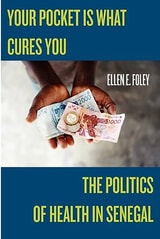
cover of Your Pocket Is What Cures You: The Politics of Health in Senegal

Your Pocket Is What Cures You

The Politics of Health in Senegal

Foley, Ellen E

Rutgers University Press, 2009

In the wake of structural adjustment programs in the 1980s and health reforms in the 1990s, the majority of sub-Saharan African governments spend less than ten dollars per capita on health annually, and many Africans have limited access to basic medical care. Using a community-level approach, anthropologist Ellen E. Foley analyzes the implementation of global health policies and how they become intertwined with existing social and political inequalities in Senegal. Your Pocket Is What Cures You examines qualitative shifts in health and healing spurred by these reforms, and analyzes the dilemmas they create for health professionals and patients alike. It also explores how cultural frameworks, particularly those stemming from Islam and Wolof ethnomedicine, are central to understanding how people manage vulnerability to ill health.

While offering a critique of neoliberal health policies, Your Pocket Is What Cures You remains grounded in ethnography to highlight the struggles of men and women who are precariously balanced on twin precipices of crumbling health systems and economic decline. Their stories demonstrate what happens when market-based health reforms collide with material, political, and social realities in African societies.

[more]