Results by title
12 books match the query 'Sentences (Criminal procedure)'
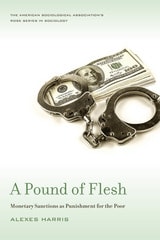
A Pound of Flesh
Monetary Sanctions as Punishment for the PoorAlexes Harris
Russell Sage Foundation, 2016
Over seven million Americans are either incarcerated, on probation, or on parole, with their criminal records often following them for life and affecting access to higher education, jobs, and housing. Court-ordered monetary sanctions that compel criminal defendants to pay fines, fees, surcharges, and restitution further inhibit their ability to reenter society. In A Pound of Flesh, sociologist Alexes Harris analyzes the rise of monetary sanctions in the criminal justice system and shows how they permanently penalize and marginalize the poor. She exposes the damaging effects of a little-understood component of criminal sentencing and shows how it further perpetuates racial and economic inequality.
Harris draws from extensive sentencing data, legal documents, observations of court hearings, and interviews with defendants, judges, prosecutors, and other court officials. She documents how low-income defendants are affected by monetary sanctions, which include fees for public defenders and a variety of processing charges. Until these debts are paid in full, individuals remain under judicial supervision, subject to court summons, warrants, and jail stays. As a result of interest and surcharges that accumulate on unpaid financial penalties, these monetary sanctions often become insurmountable legal debts which many offenders carry for the remainder of their lives. Harris finds that such fiscal sentences, which are imposed disproportionately on low-income minorities, help create a permanent economic underclass and deepen social stratification.
A Pound of Flesh delves into the court practices of five counties in Washington State to illustrate the ways in which subjective sentencing shapes the practice of monetary sanctions. Judges and court clerks hold a considerable degree of discretion in the sentencing and monitoring of monetary sanctions and rely on individual values—such as personal responsibility, meritocracy, and paternalism—to determine how much and when offenders should pay. Harris shows that monetary sanctions are imposed at different rates across jurisdictions, with little or no state government oversight. Local officials’ reliance on their own values and beliefs can also push offenders further into debt—for example, when judges charge defendants who lack the means to pay their fines with contempt of court and penalize them with additional fines or jail time.
A Pound of Flesh provides a timely examination of how monetary sanctions permanently bind poor offenders to the judicial system. Harris concludes that in letting monetary sanctions go unchecked, we have created a two-tiered legal system that imposes additional burdens on already-marginalized groups.
Crime and Justice, Volume 44
A Review of ResearchEdited by Michael Tonry
University of Chicago Press Journals, 2015
Crime and Justice, Volume 45
Sentencing Policies and Practices in Western Countries: Comparative and Cross-National PerspectivesEdited by Michael Tonry
University of Chicago Press Journals, 2016
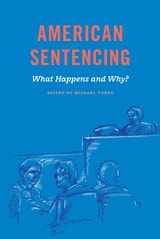
Crime and Justice, Volume 48
American SentencingEdited by Michael Tonry
University of Chicago Press Journals, 2019
This volume covers what students, scholars, practitioners, and policy makers need to know about how sentencing really works, what a half century’s “reforms” have and have not accomplished, how sentencing processes can be made fairer, and how sentencing outcomes can be made more just. Its writers are among America’s leading scholarly specialists—often the leading specialist—in their fields.
Clearly and accessibly written, American Sentencing is ideal for teaching use in seminars and courses on sentencing, courts, and criminal justice. Its authors’ diverse perspectives shed light on these issues, making it likely the single, most authoritative source of information on the state of sentencing in America today.
Cutting Life Short
A Second Look at Life SentencesDan Fetsco
University of Wyoming Press, 2026
Cutting Life Short challenges the idea that people who commit murder or other serious crimes are incapable of rehabilitation. The book tracks the growing population of people serving life in Wyoming and the US and explores research that indicates that much of the public, including victims of violent crime, support second chances for people who are serving excessive sentences.
Just over 200,000 Americans are now serving life sentences—more than the entire US prison population in 1970—in a cruel and fiscally irresponsible system, even though many inmates have demonstrated sustained rehabilitation over decades. Through individual case studies of Wyoming inmates, ranging from those who deserve release to rare cases like Matthew Shepard’s killer, who should remain imprisoned, the book explores themes of punishment, redemption, and justice reform while examining issues like prosecutorial misconduct, three-strike penalties, and restorative justice programs. Cases include the stories of Darla Rouse (one of Wyoming’s few commutation recipients), Russell Harrison (who claims he had an early release deal), and James Koester (whose investigating detective became his advocate). Drawing from a decade of experience on the Wyoming parole board, where he witnessed hundreds of rehabilitated inmates denied release despite widespread support from corrections officials and sometimes even victims, author Daniel Fetsco advocates creating systematic review processes for lengthy sentences that remove elected officials from clemency decisions, alongside broader reforms like restoring voting rights for former felons and promoting responsible crime reporting over fear-mongering sensationalism.
This forward-looking book argues that most of the people sentenced to life in prison can be, and should have been, safely released into the community and offers recommendations to help alleviate the problems associated with life sentences in Wyoming and across the US criminal justice system. It is of significance to students, scholars, professionals, and the general public invested in law, criminal justice and social justice.
Fear of Judging
Sentencing Guidelines in the Federal CourtsKate Stith and José A. Cabranes
University of Chicago Press, 1998
Fear of Judging is the first full-scale history, analysis, and critique of the new sentencing regime. The authors show that the present system has burdened the courts, dehumanized the sentencing process, and, by repressing judicial discretion, eroded the constitutional balance of powers. Eschewing ideological or politically oriented critiques of the Guidelines and offering alternatives to the current system, Stith and Cabranes defend a vision of justice that requires judges to perform what has traditionally been considered their central task—exercising judgment.
Hard Bargains
The Coercive Power of Drug Laws in Federal CourtMona Lynch
Russell Sage Foundation, 2016
As a result of the War on Drugs, the number of drug cases prosecuted each year in federal courts has increased fivefold since 1980. Lynch goes behind the scenes in three federal court districts and finds that federal prosecutors have considerable discretion in adjudicating these cases. Federal drug laws are wielded differently in each district, but with such force to overwhelm defendants’ ability to assert their rights. For drug defendants with prior convictions, the stakes are even higher since prosecutors can file charges that incur lengthy prison sentences—including life in prison without parole. Through extensive field research, Lynch finds that prosecutors frequently use the threat of extremely severe sentences to compel defendants to plead guilty rather than go to trial and risk much harsher punishment. Lynch also shows that the highly discretionary ways in which federal prosecutors work with law enforcement have led to significant racial disparities in federal courts. For instance, most federal charges for crack cocaine offenses are brought against African Americans even though whites are more likely to use crack. In addition, Latinos are increasingly entering the federal system as a result of aggressive immigration crackdowns that also target illicit drugs.
Hard Bargains provides an incisive and revealing look at how legal reforms over the last five decades have shifted excessive authority to federal prosecutors, resulting in the erosion of defendants’ rights and extreme sentences for those convicted. Lynch proposes a broad overhaul of the federal criminal justice system to restore the balance of power and retreat from the punitive indulgences of the War on Drugs.

Implicating the System
Judicial Discourses in Sentencing of Indigenous WomenElspeth Kaiser-Derrick
University of Manitoba Press, 2019
Lost Causes
Blended Sentencing, Second Chances, and the Texas Youth CommissionBy Chad R. Trulson, Darin R. Haerle, Jonathan W. Caudill, and Matt DeLisi<br>Foreword by James W. Marquart
University of Texas Press, 2016
What should be done with minors who kill, maim, defile, and destroy the lives of others? The state of Texas deals with some of its most serious and violent youthful offenders through “determinate sentencing,” a unique sentencing structure that blends parts of the juvenile and adult justice systems. Once adjudicated via determinate sentencing, offenders are first incarcerated in the Texas Youth Commission (TYC). As they approach age eighteen, they are either transferred to the Texas prison system to serve the remainder of their original determinate sentence or released from TYC into Texas’s communities.
The first long-term study of determinate sentencing in Texas, Lost Causes examines the social and delinquent histories, institutionalization experiences, and release and recidivism outcomes of more than 3,000 serious and violent juvenile offenders who received such sentences between 1987 and 2011. The authors seek to understand the process, outcomes, and consequences of determinate sentencing, which gave serious and violent juvenile offenders one more chance to redeem themselves or to solidify their place as the next generation of adult prisoners in Texas. The book’s findings—that about 70 percent of offenders are released to the community during their most crime-prone years instead of being transferred to the Texas prison system and that about half of those released continue to reoffend for serious crimes—make Lost Causes crucial reading for all students and practitioners of juvenile and criminal justice.
Sentencing in Time
Linda Ross Meyer
Amherst College Press, 2017
Sentencing without Guidelines
Rhys Hester
Temple University Press, 2024
Sentencing without Guidelines is Rhys Hester’s deep dive into how South Carolina, which never passed sentencing guideline legislation, nonetheless created meaningful punishment reform. It achieved uniformity in sentencing with a traveling circuit of judges, informal norms among judges, and the unique phenomenon of the “Plea Judge” to manage cases.
Hester examines how prior convictions, race, and geographical differences impact sentences to explain why individuals get the criminal sentences they do. He also explores how legal reform mechanisms can influence punishment goals and policy. Sentencing without Guidelines shows the benefits and drawbacks South Carolina experienced as it met sentencing reform goals. These lessons can be translated into policy for other jurisdictions.
Wisconsin Sentencing in the Tough-on-Crime Era
How Judges Retained Power and Why Mass Incarceration Happened AnywayMichael O'Hear
University of Wisconsin Press, 2021
O'Hear tracks the effects of sentencing laws and politics in Wisconsin from the eve of the imprisonment boom in 1970 up to the 2010s. Drawing on archival research, original public-opinion polling, and interviews with dozens of key policymakers, he reveals important dimensions that have been missed by others. He draws out lessons from the Wisconsin experience for the United States as a whole, where mass incarceration has cost taxpayers billions of dollars and caused untold misery to millions of inmates and their families.