Results by title
254 books match the query 'Sex' and 15 start with a
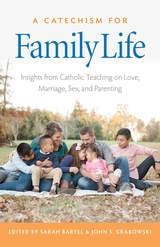
A Catechism for Family Life
Sarah Bartel
Catholic University of America Press, 2018
To address this need, we gathered pertinent questions facing men, women, and pastoral workers in marriage and family life. We then found passages relevant to these questions by researching Church documents on marriage and family from the past one hundred years. These include papal encyclicals, apostolic exhortations, and addresses, Vatican II documents, and the Catechism of the Catholic Church.
Mainstream media coverage of Church events and Church teaching leads many to misunderstand Catholic positions on marriage and family life. While the Catholic Church has developed a rich, detailed, and positive teaching on marriage, family, and sexuality, many Catholics do not have access to this teaching, buried as it is in lengthy Church documents which many find intimidating. Finding the relevant teaching to address specific questions is not always a simple task, either. This book’s main contribution is to present Church teaching relevant to marriage and family in one volume clearly organized by topic and question.
A Primer for Teaching Women, Gender, and Sexuality in World History
Ten Design PrinciplesMerry E. Wiesner-Hanks and Urmi Engineer Willoughby
Duke University Press, 2018
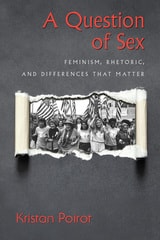
A Question of Sex
Feminism, Rhetoric, and Differences That MatterKristan Poirot
University of Massachusetts Press, 2014
Poirot focuses on five case studies—the circulation of Sojourner Truth's "Ain't I a Woman?" in early and contemporary feminist contexts; the visual rhetorics of the feminist self-help health movement; the public discourse of Elizabeth Cady Stanton and early nineteenth-century ideas about suffrage, sex, and race; the conflicts over lesbian sexuality in the 1960s and 1970s; and the discourse that surrounds twenty-first-century SlutWalks. In the process, Poirot rethinks the terms through which we understand U.S. feminist movements to explore the ways feminism has questioned sexed distinctions and practices over time. She emphasizes the importance of reading feminist engagements with sex as rhetorical endeavors—practices that are shaped by the instrumental demands of movements, the exigent situations that call for feminists to respond, and the enduring philosophical traditions that circulate in U.S. political contexts., reviewing a previous edition or volume
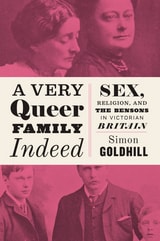
A Very Queer Family Indeed
Sex, Religion, and the Bensons in Victorian BritainSimon Goldhill
University of Chicago Press, 2016
So begins A Very Queer Family Indeed, which introduces us to the extraordinary Benson family. Edward White Benson became Archbishop of Canterbury at the height of Queen Victoria’s reign, while his wife, Mary, was renowned for her wit and charm—the prime minister once wondered whether she was “the cleverest woman in England or in Europe.” The couple’s six precocious children included E. F. Benson, celebrated creator of the Mapp and Lucia novels, and Margaret Benson, the first published female Egyptologist.
What interests Simon Goldhill most, however, is what went on behind the scenes, which was even more unusual than anyone could imagine. Inveterate writers, the Benson family spun out novels, essays, and thousands of letters that open stunning new perspectives—including what it might mean for an adult to kiss and propose marriage to a twelve-year-old girl, how religion in a family could support or destroy relationships, or how the death of a child could be celebrated. No other family has left such detailed records about their most intimate moments, and in these remarkable accounts, we see how family life and a family’s understanding of itself took shape during a time when psychoanalysis, scientific and historical challenges to religion, and new ways of thinking about society were developing. This is the story of the Bensons, but it is also more than that—it is the story of how society transitioned from the high Victorian period into modernity.
AIDS Alibis
Sex, Drugs, and Crime in the AmericasStephanie Kane
Temple University Press, 1998
The stories reveal the dynamics that determine how the policy decisions of white-collar health care professionals actually play out in real life. By focusing on life-changing social problems, the narratives highlight the contradictions between public health and criminal law. Look at how HIV has transformed our social consciousness, from intimate touch to institutional outreach. But, Kane argues, these changes are dwarfed by the United States's refusal to stop the war on drugs, in effect misdirecting resources and awareness.
AIDS Alibis combines empirical and interpretive methods in a path-breaking attempt to recognize the extent to which coercive institutional practices are implicated in HIV transmission patterns. Kane shows how th e virus feeds on the politics of inequality and indifference, even as it exploits the human need for intimacy and release.
Abundance
Sexuality’s HistoryAnjali Arondekar
Duke University Press, 2023

Amazons of the Huk Rebellion
Gender, Sex, and Revolution in the PhilippinesVina A. Lanzona
University of Wisconsin Press, 2009
Drawing on interviews with over one hundred veterans of the movement, Vina A. Lanzona explores the Huk rebellion from the intimate and collective experiences of its female participants, demonstrating how their presence, and the complex questions of gender, family, and sexuality they provoked, ultimately shaped the nature of the revolutionary struggle.
American Sexual Politics
Sex, Gender, and Race since the Civil WarEdited by John C. Fout and Maura Shaw Tantillo
University of Chicago Press, 1993
Included are Anthony S. Parent, Jr., and Susan Brown Wallace on childhood and sexual identity under slavery; Martha Hodes on white women and Black men in the South; Kevin J. Mumford on male sexual impotence and Victorian Culture; Jesse F. Battan on language, authority, and sexual desire; Joan Smith Iversen on the antipolygamy controversy, 1880-1890; Angus McLaren on sex radicalism in the Canadian Pacific Northwest, 1890-1920; Pamela S. Haag on ideologies of love, modern romance, and women's sexual subjectivity; Ann duCille on the novels of Jessie Fauset and Nella Larsen; Robyn Wiegman on the anatomy of lynching; Sonya Michel on sexuality in postwar films; Carole Joffe on abortion before legalization; Roy Cain on disclosure and secrecy among gay men; Joshua Gamson on condoms; Lillian Faderman on the return of butch and femme; Katherine Cummings on teaching AIDS; and Arthur Flannigan-Saint-Aubin on "black gay male" discourse.
This diverse overview of American sexual politics will interest students and scholars of the history of sexuality, gender studies, women's studies, and gay studies.
Amoral Gower
Language, Sex, and PoliticsDiane Watt
University of Minnesota Press, 2003
An innovative reading of John Gower’s work and an exciting new approach to medieval vernacular texts
“Moral Gower” he was called by friend and sometime rival Geoffrey Chaucer, and his “Confessio Amantis” has been viewed as an uncomplicated analysis of the universe, combining erotic narratives with ethical guidance and political commentary. Diane Watt offers the first sustained reading of John Gower’s “Confessio” to argue that this early vernacular text offers no real solutions to the ethical problems it raises—and in fact actively encourages perverse readings.
Drawing on a combination of queer and feminist theory, ethical criticism, and psychoanalytic, historicist, and textual criticism, Watt focuses on the language, sex, and politics in Gower’s writing. How, she asks, is Gower’s “Confessio” related to contemporary controversies over vernacular translation and debates about language politics? How is Gower’s treatment of rhetoric and language gendered and sexualized, and what bearing does this have on the ethical and political structure of the text? What is the relationship between the erotic, ethical, and political sections of “Confessio Amantis”? Watt demonstrates that Gower engaged in the sort of critical thinking more commonly associated with Chaucer and William Langland at the same time that she contributes to modern debates about the ethics of criticism.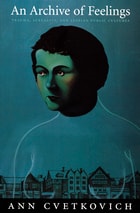
An Archive of Feelings
Trauma, Sexuality, and Lesbian Public CulturesAnn Cvetkovich
Duke University Press, 2003
An Archive of Feelings brings together oral histories from lesbian activists involved in act up/New York; readings of literature by Dorothy Allison, Leslie Feinberg, Cherríe Moraga, and Shani Mootoo; videos by Jean Carlomusto and Pratibha Parmar; and performances by Lisa Kron, Carmelita Tropicana, and the bands Le Tigre and Tribe 8. Cvetkovich reveals how activism, performance, and literature give rise to public cultures that work through trauma and transform the conditions producing it. By looking closely at connections between sexuality, trauma, and the creation of lesbian public cultures, Cvetkovich makes those experiences that have been pushed to the peripheries of trauma culture the defining principles of a new construction of sexual trauma—one in which trauma catalyzes the creation of cultural archives and political communities.
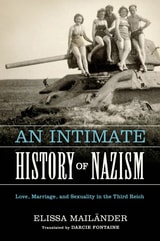
An Intimate History of Nazism
Love, Marriage, and Sexuality in the Third ReichElissa Mailänder
University of Wisconsin Press, 2027
Published to great acclaim in French and now available for the first time in English, this groundbreaking book explores how the Nazi regime used sexuality to promote political loyalty, conformity, and cohesion among “ordinary” Germans. Beginning before the collapse of the Weimar Republic and continuing through the postwar American occupation of Germany, Elissa Mailänder’s study highlights the complex and conflicted ways that sexual “liberation,” repression, and violence were used and experienced in the everyday lives of citizens of the Reich. Her analysis draws on a vast array of sources, from legal dossiers to private photographs and letters, as well as public archives, magazines, and movies. Mailänder’s findings are often uncomfortable; she demonstrates, for example, that a significant number of women who were not persecuted by the regime saw shifts in gender and sexual norms as positive developments—ones that some felt were lost under the American occupation, with its own routines of military sexual exploitation. What emerges is a portrait of a regime that was less interested in repressing sexuality than in reinventing it according to a racist, elitist, and homophobic agenda.
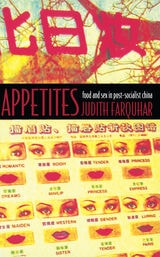
Appetites
Food and Sex in Post-Socialist ChinaJudith Farquhar
Duke University Press, 2002
From eating well in improving economic times to memories of the late 1950s famine, from the flavors of traditional Chinese medicine to modernity’s private sexual passions, this book argues that embodiment in all its forms must be invented and sustained in public reflections about personal and national life. As much at home in science studies and social theory as in the details of life in Beijing, this account uses anthropology, cultural studies, and literary criticism to read contemporary Chinese life in a materialist and reflexive mode. For both Maoist and market reform periods, this is a story of high culture in appetites, desire in collective life, and politics in the body and its dispositions.
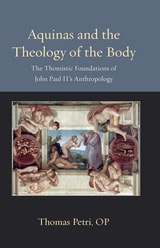
Aquinas and the Theology of the Body
Thomas Petri
Catholic University of America Press, 2016
Articulating Difference
Sex and Language in the German Nineteenth CenturySophie Salvo
University of Chicago Press, 2024
Drawing on a wide range of texts, from understudied ethnographic and scientific works to canonical literature and philosophy, Sophie Salvo uncovers the prehistory of the inextricability of gender and language. Taking German discourses on language as her focus, she argues that we are not the inventors but, rather, the inheritors and adapters of the notion that gender and language are interrelated. Particularly during the long nineteenth century, ideas about sexual differences shaped how language was understood, classified, and analyzed. As Salvo explains, philosophers asserted the patriarchal origins of language, linguists investigated “women’s languages” and grammatical gender, and literary Modernists imagined “feminine” sign systems, and in doing so they not only deemed sex-based divisions to be necessary categories of language but also produced a plethora of gendered tropes and fictions, which they used both to support their claims and delimit their disciplines.
Articulating Difference charts new territory, revealing how gendered conceptions of language make possible the misogynistic logic of exclusion that underlies arguments claiming, for example, that women cannot be great orators or writers. While Salvo focuses on how male scholars aligned language study with masculinity, she also uncovers how women responded, highlighting the contributions of understudied nineteenth-century works on language that women wrote even as they were excluded from academic opportunities.
Asexual Erotics
Intimate Readings of Compulsory SexualityEla Przybylo
The Ohio State University Press, 2019
Through a wide-ranging analysis of pivotal queer, feminist, and anti-racist movements; television and film; art and photography; and fiction, nonfiction, and theoretical texts, each chapter explores asexual erotics and demonstrates how asexuality has been vital to the formulation of intimate ways of knowing and being. Asexual Erotics assembles a compendium of asexual possibilities that speaks against the centralization of sex and sexuality, asking that we consider the ways in which compulsory sexuality is detrimental not only to asexual and nonsexual people but to all.