Results by title

11 books match the query 'Sexual minority community'

cover of Cruising the Dead River: David Wojnarowicz and New York's Ruined Waterfront

Cruising the Dead River

David Wojnarowicz and New York's Ruined Waterfront

Fiona Anderson

University of Chicago Press, 2019
In the 1970s, Manhattan’s west side waterfront was a forgotten zone of abandoned warehouses and piers. Though many saw only blight, the derelict neighborhood was alive with queer people forging new intimacies through cruising. Alongside the piers’ sexual and social worlds, artists produced work attesting to the radical transformations taking place in New York. Artist and writer David Wojnarowicz was right in the heart of it, documenting his experiences in journal entries, poems, photographs, films, and large-scale, site-specific projects. In Cruising the Dead River, Fiona Anderson draws on Wojnarowicz’s work to explore the key role the abandoned landscape played in this explosion of queer culture. Anderson examines how the riverfront’s ruined buildings assumed a powerful erotic role and gave the area a distinct identity. By telling the story of the piers as gentrification swept New York and before the AIDS crisis, Anderson unearths the buried histories of violence, regeneration, and LGBTQ activism that developed in and around the cruising scene.
[more]
cover of Defiant Bodies: Making Queer Community in the Anglophone Caribbean

Defiant Bodies

Making Queer Community in the Anglophone Caribbean

Nikoli A. Attai

Rutgers University Press, 2023
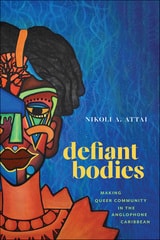
In the Anglophone Caribbean, international queer human rights activists strategically located within and outside of the region have dominated interventions seeking to address issues affecting people across the region; a trend that is premised on an idea that the Caribbean is extremely homophobic and transphobic, resulting in violence and death for people who defy dominant sexual and gender boundaries. Human rights activists continue to utilize international financial and political resources to influence these interventions and the region’s engagement on issues of homophobia, transphobia, discrimination, and the HIV/AIDS epidemic. This focus, however, elides the deeply complex nature of queerness across different spaces and places, and fails to fully account for the nuances of queer sexual and gender politics and community making across the Caribbean. Defiant Bodies: Making Queer Community in the Anglophone Caribbean problematizes the neocolonial and homoimperial nature of queer human rights activism in in four Anglophone Caribbean nations -- Barbados, Guyana, Jamaica, and Trinidad and Tobago -- and thinks critically about the limits of human rights as a tool for seeking queer liberation. It also offers critical insight into the ways that queer people negotiate, resist, and disrupt homophobia, transphobia, and discrimination by mobilizing “on the ground” and creating transgressive communities within the region.
 
[more]
cover of Diasporic Intimacies: Queer Filipinos and Canadian Imaginaries

Diasporic Intimacies

Queer Filipinos and Canadian Imaginaries

Edited by Robert Diaz, Marissa Largo, and Fritz Pino

Northwestern University Press, 2018

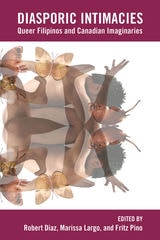
Diasporic Intimacies: Queer Filipinos and Canadian Imaginaries is the first edited volume of its kind, featuring the works of leading scholars, artists, and activists who reflect on the contributions of queer Filipinos to Canadian culture and society.

Addressing a wide range of issues beyond the academy, the authors present a rich and under-studied archive of personal reflections, in-depth interviews, creative works, and scholarly essays. Their trandsdisciplinary approach highlights the need for queer, transgressive, and utopian practices that render visible histories of migration, empire building, settler colonialism, and globalization.

Timely, urgent, and fascinating, Diasporic Intimacies offers an accessible entry point for readers who seek to pursue critically engaged community work, arts education, curatorial practice, and socially inflected research on sexuality, gender, and race in this ever-changing world.

[more]
cover of Forget Burial: HIV Kinship, Disability, and Queer/Trans Narratives of Care

Forget Burial

HIV Kinship, Disability, and Queer/Trans Narratives of Care

Marty Fink

Rutgers University Press, 2021

Finalist for the LGBTQ Nonfiction Award from Lambda Literary

Queers and trans people in the 1980s and early ‘90s were dying of AIDS and the government failed to care. Lovers, strangers, artists, and community activists came together take care of each other in the face of state violence. In revisiting these histories alongside ongoing queer and trans movements, this book uncovers how early HIV care-giving narratives actually shape how we continue to understand our genders and our disabilities. The queer and trans care-giving kinships that formed in response to HIV continue to inspire how we have sex and build chosen families in the present. In unearthing HIV community newsletters, media, zines, porn, literature, and even vampires, Forget Burial bridges early HIV care-giving activisms with contemporary disability movements. In refusing to bury the legacies of long-term survivors and of those we have lost, this book brings early HIV kinships together with ongoing movements for queer and trans body self-determination.

 
[more]
cover of Pakistan Desires: Queer Futures Elsewhere

Pakistan Desires

Queer Futures Elsewhere

Omar Kasmani, editor

Duke University Press, 2023

Drawing on history, anthropology, literature, law, art, film, and performance studies, the contributors to Pakistan Desires invite reflection on what meanings adhere to queerness in Pakistan. They illustrate how amid conditions of straightness, desire can serve as a mode of queer future-making. Among other topics, the contributors analyze gender transgressive performances in Pakistani film, piety in the transgender rights movement, the use of Grindr among men, the exploration of homoerotic subject matter in contemporary Pakistani artist Anwar Saeed's work, and the story of a sixteenth-century Sufi saint who fell in love with a Brahmin boy. From Kashmir to the 1947 Partition to the resonances of South Asian gay subjectivity in the diaspora, the contributors attend to narrative and epistemological possibilities for queer lives and loves. By embracing forms of desire elsewhere, ones that cannot correlate to or often fall outside dominant Western theorizations of queerness, this volume gathers other ways of being queer in the world.

Contributors. Ahmed Afzal, Asad Alvi, Anjali Arondekar, Vanja Hamzić, Omar Kasmani, Pasha M. Khan, Gwendolyn S. Kirk, Syeda Momina Masood, Nida Mehboob, Claire Pamment, Geeta Patel, Nael Quraishi, Abdullah Qureshi, Shayan Rajani, Jeffrey A. Redding, Gayatri Reddy, Syma Tariq
[more]
cover of Queer Companions: Religion, Public Intimacy, and Saintly Affects in Pakistan

Queer Companions

Religion, Public Intimacy, and Saintly Affects in Pakistan

Omar Kasmani

Duke University Press, 2022
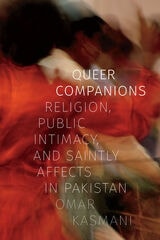
In Queer Companions Omar Kasmani theorizes saintly intimacy and the construction of queer social relations at Pakistan’s most important site of Sufi pilgrimage. Conjoining queer theory and the anthropology of Islam, Kasmani outlines the felt and enfleshed ways in which saintly affections bind individuals, society, and the state in Pakistan through a public architecture of intimacy. Islamic saints become lovers and queer companions just as a religious universe is made valuable to critical and queer forms of thinking. Focusing on the lives of ascetics known as fakirs in Pakistan, Kasmani shows how the affective bonds with the place’s patron saint, a thirteenth-century antinomian mystic, foster unstraight modes of living in the present. In a national context where religious shrines are entangled in the state’s infrastructures of governance, coming close to saints further entails a drawing near to more-than-official histories and public forms of affect. Through various fakir life stories, Kasmani contends that this intimacy offers a form of queer world making with saints.
[more]
cover of Queer Legacies: Stories from Chicago’s LGBTQ Archives

Queer Legacies

Stories from Chicago’s LGBTQ Archives

John D'Emilio

University of Chicago Press, 2020
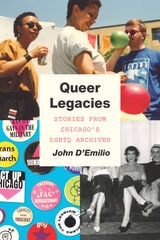
The variety of LGBTQ life in Chicago is too abundant and too diverse to be contained in a single place. But since 1981, the Gerber/Hart Library and Archives has striven to do just that, amassing a wealth of records related to the city’s gay, lesbian, bisexual, transgender, and queer-identified people and organizations. In Queer Legacies, John D’Emilio—a pioneering scholar in the field—digs deep into Gerber/Hart’s collection to unearth a kaleidoscopic look at the communities built by generations of LGBTQ people. Excavated from one of the country’s most important, yet overlooked, LGBTQ archives, D’Emilio’s entertaining and enthusiastic essays range in focus from politics and culture to social life, academia, and religion. He gives readers an inclusive and personal look at fifty years of a national fight for visibility, recognition, and equality led by LGBTQ Americans who, quite literally, made history. In these troubled times, it will surely inspire a new generation of scholars and activists.
[more]
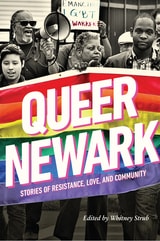
cover of Queer Newark: Stories of Resistance, Love, and Community

Queer Newark

Stories of Resistance, Love, and Community

Whitney Strub

Rutgers University Press, 2024

NJSAA Edited Works Award Winner (2024) 

Histories of gay and lesbian urban life typically focus on major metropolitan areas like San Francisco and New York, opportunity-filled destinations for LGBTQ migrants from across the country. Yet there are many other queer communities in economically depressed cities with majority Black and Hispanic populations that receive far less attention. Though just a few miles from New York, Newark is one of these cities, and its queer histories have been neglected—until now. 
 
Queer Newark charts a history in which working-class people of color are the central actors and in which violence, poverty, and homophobia could never suppress joy, resistance, love, and desire. Drawing from rare archives that range from oral histories to vice squad reports, this collection’s authors uncover the sites and people of Newark’s queer past in bars, discos, ballrooms, and churches. Exploring the intersections of class, race, gender, and sexuality, they offer fresh perspectives on the HIV/AIDS epidemic, community relations with police, Latinx immigration, and gentrification, while considering how to best tell the rich and complex stories of queer urban life. Queer Newark reveals a new side of New Jersey’s largest city while rewriting the history of LGBTQ life in America. 
 
[more]
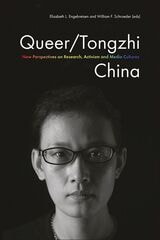
cover of Queer/Tongzhi China: New Perspectives on Research, Activism and Media Cultures

Queer/Tongzhi China

New Perspectives on Research, Activism and Media Cultures

Edited by Elisabeth L. Engebretsen and William F. Schroeder

National University of Singapore Press, 2015
This book brings together some of the most exciting, original and cutting-edge work being conducted on contemporary queer China. The volume includes original essays by some of the most prolific and central queer activists and artists in the PRC, placing their writing alongside work by emergent and established scholars from a variety of disciplines and backgrounds. The book offers unique perspectives by presenting primary accounts of the creative and multi-faceted strategies that activists and community organizers have developed in their various activities. The volume also presents rich, empirical evidence of every-day queer lives across China, offering a unique record not only of cosmopolitan community and activist perspectives but also of voices and experiences from a broad range of locations and identifications. As a whole it offers invaluable insights into sexual and gender diversity in China today. Queer/Tongzhi China thus breathes as it speaks, providing through its diverse approaches a different understanding of queer China than standard mono-ethnographies or social-scientific documentaries.
[more]
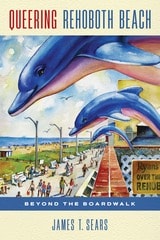
cover of Queering Rehoboth Beach: Beyond the Boardwalk

Queering Rehoboth Beach

Beyond the Boardwalk

James T. Sears

Temple University Press, 2024

“Create a More Positive Rehoboth” was a decades-long goal for progress and inclusiveness in a charming beach town in southern Delaware. Rehoboth, which was established in the 19th century as a Methodist Church meeting camp, has, over time, become a thriving mecca for the LGBTQ+ community. In Queering Rehoboth Beach, historian and educator James Sears charts this significant evolution.

Sears draws upon extensive oral history accounts, archival material, and personal narratives to chronicle “the Battle for Rehoboth,” which unfolded in the late 20th century, as conservative town leaders and homeowners opposed progressive entrepreneurs and gay activists. He recounts not just the emergence of the gay and lesbian bars, dance clubs, and organizations that drew the queer community to the region, but also the efforts of local politicians and homeowners, among other groups who fought to develop and protect the traditional identity of this beach town. Moreover, issues of race, class, and gender and sexuality informed opinions as residents and visitors struggled with the AIDS crisis and the legacy of Jim Crow.

Queering Rehoboth Beach is more than just an inspiring story about a community’s resilience and determination to establish a safe space for itself in the wake of the era of Don’t Ask, Don’t Tell. It is also a terrific beach read.
[more]
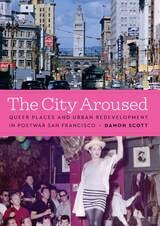
cover of The City Aroused: Queer Places and Urban Redevelopment in Postwar San Francisco

The City Aroused

Queer Places and Urban Redevelopment in Postwar San Francisco

Damon Scott

University of Texas Press, 2023

A history of San Francisco that studies change in the postwar urban landscape in relation to the city's queer culture.

The City Aroused is a lively history of urban development and its influence on queer political identity in postwar San Francisco. By reconstructing the planning and queer history of waterfront drinking establishments, Damon Scott shows that urban renewal was a catalyst for community organizing among racially diverse operators and patrons with far-reaching implications for the national gay rights movement.

Following the exclusion of suspected homosexuals from the maritime trades in West Coast ports in the early 1950s, seamen’s hangouts in the city came to resemble gay bars. Local officials responded by containing the influx of gay men to a strip of bars on the central waterfront while also making plans to raze and rebuild the area. This practice ended when city redevelopment officials began acquiring land in the early 1960s. Aided by law enforcement, they put these queer social clubs out of business, replacing them with heteronormative, desexualized land uses that served larger postwar urban development goals. Scott argues that this shift from queer containment to displacement aroused a collective response among gay and transgender drinking publics who united in solidarity to secure a place in the rapidly changing urban landscape.

[more]