Results by title
20 books match the query 'Sin'

AND SIN NO MORE
SOCIAL POLICY AND UNWED MOTHERS IN CLEVEMARIAN J. MORTON
The Ohio State University Press, 1993
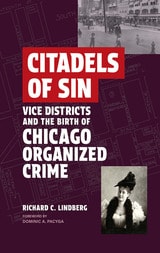
Citadels of Sin
Vice Districts and the Birth of Chicago Organized CrimeRichard C. Lindberg, with a foreword by Dominic A. Pacyga
Southern Illinois University Press, 2026
Revealing Chicago’s underworld before Al Capone
Vice in Chicago did not begin—or end—with Al Capone. In this vividly written narrative, historian Richard C. Lindberg peels back the mythology of Prohibition-era gangsters to reveal a more entrenched, intricate and disturbing system of vice and corruption that took shape decades earlier. Long before the rise of organized crime syndicates, Chicago’s political leaders in league with the criminal classes deliberately created and managed politically-protected segregated vice districts known in Chicago and in other cities as “Levees,” that institutionalized prostitution, graft, and forced sex work in the name of preserving civic order by isolating the vice trade from the citizenry.
Set against the backdrop of the Gilded Age and Progressive Era, Citadels of Sin situates Chicago within a nationwide experiment in regulating prostitution. Reformers, clergy, and municipal officials across the United States believed that confining vice to designated districts would protect respectable neighborhoods and commercial centers. More than fifty such districts emerged nationwide. Instead of curbing crime, however, the Levees became engines of corruption, enriching politicians, police, lawyers, and judges while normalizing exploitation and violence. Lindberg argues that these systems laid the groundwork for modern global human trafficking.
Chicago, with its size and political complexity, supported three major Levees. On the West Side, poverty and endemic corruption devastated local communities. On the North Side, one vice district survived longest, eventually transforming into the fashionable Rush Street nightclub scene. The South Side levee proved most consequential of all, evolving into the organized crime network known as “the Outfit,” whose influence continues to endure.
Lindberg brings the levee era to life through sharp portraits and damning accountability. He exposes how media sensationalism glamorized vice while masking its human cost, and he holds powerful figures—most notably Mayors Carter Harrison Sr. and Jr.—responsible for enabling a system built on bribery, “white slavery,” and coerced sex work. The levees were not accidental byproducts of urban growth; they were carefully managed political machines.
As World War I priorities and urban redevelopment finally dismantled formal vice districts, their activities did not disappear. Instead, they dispersed into neighborhoods, suburbs, and new forms.
By walking readers through the former vice districts as they exist today, Lindberg forges a powerful connection between past and present. In tracing the rise and fall of these districts, he reveals how efforts to impose moral order produced the very exploitation they claimed to prevent—proof that reform, when compromised by politics and greed, can collapse into catastrophe.

Cities, Sin, and Social Reform in Imperial Germany
Andrew Lees
University of Michigan Press, 2002
Thematically and methodologically wide-ranging and innovative, this volume considers a broad spectrum of responses not only to the supposed breakdown of social cohesion but also to specific forms of deviant behavior. It draws on large numbers of writings from the period by clergymen, jurists, medical doctors, educators, social workers, and others. This literature illuminates the histories not only of urbanization and cities but also of sexuality and Christianity, crime and criminology, leisure and education, youth and women, charity and social work, and the welfare state as well as local government.
Focusing on positive instead of escapist responses to the challenges that inhered in urban society, this work can be read as part of an ongoing reassessment of the German Empire that points away from the idea that Germans were traveling an antimodernist Sonderweg, or special path, that led inevitably to National Socialism and the Third Reich. Although intended primarily for scholars and students of modern Germany, this book should speak to a variety of readers, among them anyone who cares about the history of cities, deviant behavior, or social reform.
Andrew Lees is Professor of History, Rutgers University.
Darwin's Evolving Identity
Adventure, Ambition, and the Sin of SpeculationAlistair Sponsel
University of Chicago Press, 2018
Drawing on his own ambitious research in Darwin’s manuscripts and at the Beagle’s remotest ports of call, Sponsel takes us from the ocean to the Origin and beyond. He provides a vivid new picture of Darwin’s career as a voyaging naturalist and metropolitan author, and in doing so makes a bold argument about how we should understand the history of scientific theories.
Dostoevsky's Dialectics and the Problem of Sin
Ksana Blank
Northwestern University Press, 2019
In Dostoevsky’s Dialectics and the Problem of Sin, Ksana Blank borrows from ancient Greek, Chinese, and Christian dialectical traditions to formulate a dynamic image of Dostoevsky’s dialectics—distinct from Hegelian dialectics—as a philosophy of “compatible contradictions.” Expanding on the classical triad of Goodness, Beauty, and Truth, Blank guides us through Dostoevsky’s most difficult paradoxes: goodness that begets evil, beautiful personalities that bring about grief, and criminality that brings about salvation.
Dostoevsky’s philosophy of contradictions, this book demonstrates, contributes to the development of antinomian thought in the writings of early twentieth-century Russian religious thinkers and to the development of Bakhtin’s dialogism. Dostoevsky’s Dialectics and the Problem of Sin marks an important and original intervention into the enduring debate over Dostoevsky’s spiritual philosophy.
Grace, Predestination, and the Permission of Sin
A Thomistic AnalysisTaylor O'Neill
Catholic University of America Press, 2019

Isadore's Secret
Sin, Murder, and Confession in a Northern Michigan TownMardi Link
University of Michigan Press, 2010
"In Isadore's Secret, Mardi Link shines a journalist's lamp on this dark, quiet corner of Michigan's history, assuring that the tragic story of Sister Janina is not forgotten. Link's telling is fascinating and thorough, making a story you will not soon forget."
---Steve Lehto, author of Death's Door
A gripping account of the mysterious 1907 disappearance of a young nun in a northern Michigan town and the national controversy that followed when she turned up dead and buried in the basement of her own church.
Swinging planks of lantern light shine through the musty air and onto the dirt floor of the church basement. The oddly glowing rectangles syncopate over the damp ground and illuminate even the darkest, stooped-down corners of the space beyond. The only sound is the ragged breathing of two men, a young parish priest and a much older laborer. Aboveground these men belong completely to this place, in both body and soul. A glimpse of their faces anywhere in the sanctuary, the rectory, the school, the barn, or the gardens would be a welcome sight. But here below, these men of Isadore are interlopers. Only trespassers would sneak silently into the church's sloped underbelly without witness to carry out such a sinful and secret errand as this one. Despite their tools, and their lantern, and their resolve, neither is equipped for the task at hand or for what is to come.
Mardi Link, a former crime reporter, was named Antioch's Betty Crumrine Scholar for Creative Nonfiction in 2007. Her first book, When Evil Came to Good Hart, also published by the University of Michigan Press, spent four months on the Heartland Indie Bestseller List.
This true story was the basis for the Broadway play The Runner Stumbles and the film of the same name.
Front cover: Photograph of cemetery © John L. Russell, Great Lakes Images; image of face ©iStockphoto.com/duncan1890.

Logic and Sin in the Writings of Ludwig Wittgenstein
Philip R. Shields
University of Chicago Press, 1992
"Shields argues that the appearance throughout Wittgenstein's writings of such concepts as ritual, limit, transgression, a change of will, pride, temptation, and judgment implies a relation between religion and the logical aspects of Wittgenstein's philosophy."—Choice
"Of the many recent books about Wittgenstein, Logic and Sin is one of the very few that are well worth having"—Fergus Kerr, Modern Theology
"What Shields has uncovered in Wittgenstein's religious sensibility is something genuine and profound. . . . Shields has not just written an important book on Wittgenstein but an enlightening work that invites further reflection."—Eric O. Springsted, Cross Currents

Off Limits
New Writings on Fear and SinNawal El Saadawi
Gingko, 2018
Off Limits presents a selection of El Saadawi’s most recent recollections and reflections in which she considers the role of women in Egyptian and wider Islamic society, the inextricability of imperialism from patriarchy, and the meeting points of East and West. These thoughtful and wide-reaching pieces leave no stone unturned and no view unchallenged, and the essays collected here offer further insight into this profound author’s ideas about women, society, religion, and national identity.
On the Motive of the Incarnation
Dylan The Salmanticenses
Catholic University of America Press, 2019
Robert of Arbrissel
Sex, Sin, and Salvation in the Middle AgesJacques Dalarun
Catholic University of America Press, 2006
Sin and Confession in Colonial Peru
Spanish-Quechua Penitential Texts, 1560-1650By Regina Harrison
University of Texas Press, 2014
A central tenet of Catholic religious practice, confession relies upon the use of language between the penitent and his or her confessor. In the sixteenth and seventeenth centuries, as Spain colonized the Quechua-speaking Andean world, the communication of religious beliefs and practices—especially the practice of confession—to the native population became a primary concern, and as a result, expansive bodies of Spanish ecclesiastic literature were translated into Quechua. In this fascinating study of the semantic changes evident in translations of Catholic catechisms, sermons, and manuals, Regina Harrison demonstrates how the translated texts often retained traces of ancient Andean modes of thought, despite the didactic lessons they contained.
In Sin and Confession in Colonial Peru, Harrison draws directly from confession manuals to demonstrate how sin was newly defined in Quechua lexemes, how the role of women was circumscribed to fit Old World patterns, and how new monetized perspectives on labor and trade were taught to the subjugated indigenous peoples of the Andes by means of the Ten Commandments. Although outwardly confession appears to be an instrument of oppression, the reformer Bartolomé de Las Casas influenced priests working in the Andes; through their agency, confessional practice ultimately became a political weapon to compel Spanish restitution of Incan lands and wealth. Bringing together an unprecedented study (and translation) of Quechua religious texts with an expansive history of Andean and Spanish transculturation, Harrison uses the lens of confession to understand the vast and telling ways in which language changed at the intersection of culture and religion.

Sin and Salvation in Early Modern France
Three Women’s StoriesMarguerite d'Auge, Renée Burlamacchi, and Jeanne du Laurens
Iter Press, 2017
The texts available here in English for the first time open a window into the lives of three early modern Frenchwomen as they explore the common themes of family, memory, sin, and salvation. The Regrets of Marguerite d’Auge (1600), the Memoirs of Renée Burlamacchi (1623), and the Genealogy of Jeanne du Laurens (1631), taken from different genres of historical writings, raise important questions: Why and how did female authorship find its way into the historical record? How did these voices escape the censorship and prejudice against female publication? In a time of extreme religious conflict, how did these women convey their views on controversial issues such as primacy of grace, indulgences, and salvation without disrupting the gender expectations of the era?
Sin in the City
Chicago and Revivalism, 1880-1920Thekla Ellen Joiner
University of Missouri Press, 2013
Long before today’s culture wars, the “Third Great Awakening” rocked America. During the late nineteenth and early twentieth centuries, evangelists such as Dwight L. Moody and Billy Sunday roused citizens to renounce sin as it manifested in popular culture, moral ambiguity, and the changing role of women.
Sin in the City examines three urban revivals in turn-of-the-century Chicago to show how revivalists negotiated that era’s perceived racial, sexual, and class threats. While most studies of this movement have focused on its male leaders and their interactions with society, Thekla Ellen Joiner raises new questions about gender and race by exploring Third Awakening revivalism as the ritualized performance of an evangelical social system defined by middle-class Protestant moral aspirations for urban America. Rather than approaching these events merely as the achievements of persuasive men, she views them as choreographed collective rituals reinforcing a moral order defined by ideals of femininity, masculinity, and racial purity.
Joiner reveals how revivalist rhetoric and ritual shifted from sentimentalist identification of sin with males to a more hard-nosed focus on females, castigating “loose women” whose economic and sexual independence defied revivalist ideals and its civic culture. She focuses on Dwight L. Moody’s 1893 World’s Fair revival, the 1910 Chapman-Alexander campaign, and the 1918 Billy Sunday revival, comparing the locations, organization, messages, and leaders of these three events to depict the shift from masculinized to feminized sin. She identifies the central role women played in the Third Awakening as the revivalists promoted feminine virtue as the corrective to America’s urban decline. She also shows that even as its definition of sin became more feminized, Billy Sunday’s revivalism began to conform to Chicago’s emerging color line.
Enraged by rapid social change in cities like Chicago, these preachers spurred Protestant evangelicals to formulate a gendered and racialized moral regime for urban America. Yet, as Joiner shows, even as revivalists demonized new forms of entertainment, they used many of the modern cultural practices popularized in theaters and nickelodeons to boost the success of their mass conversions.
Sin in the City shows that the legacy of the Third Awakening lives on today in the religious right’s sociopolitical activism; crusade for family values; disparagement of feminism; and promotion of spirituality in middle-class, racial, and cultural terms. Providing cultural and gender analysis too often lacking in the study of American religious history, it offers a new model for understanding the development of a gendered theology and set of religious practices that influenced Protestantism in a period of enormous social change.
Sin in the Sixties
Maria C. Morrow
Catholic University of America Press, 2016
Sin
A Thomistic PsychologySteven J. Jensen
Catholic University of America Press, 2018
Sin
Selected Poems of Forugh FarrokhzadSholeh Wolpe
University of Arkansas Press, 2010

Sun, Sin & Suburbia
The History of Modern Las Vegas, Revised and ExpandedGeoff Schumacher
University of Nevada Press, 2015
Schumacher’s history also profiles the Las Vegas where more than two million people live. He explores the neighborhoods sprawling beyond the Strip’s neon gleam and uncovers a diverse community offering much more than table games, lounge acts, and organized crime. Schumacher discusses contemporary Las Vegas, charting its course from the nation’s fastest-growing metropolis to one of the Great Recession’s most battered victims.
Sun, Sin & Suburbia will appeal to tourists looking to understand more than the glitz and glitter of Las Vegas and to newcomers who want to learn about their new hometown. It will also be an essential addition to any longtime Nevadan’s library of local history.
First published in 2012 by Stephens Press, this paperback edition is now available from the University of Nevada Press.

The History of the Devil
Vilém Flusser
University of Minnesota Press, 2014
In 1939, a young Vilém Flusser faced the Nazi invasion of his hometown of Prague. He escaped with his wife to Brazil, taking with him only two books: a small Jewish prayer book and Goethe’s Faust. Twenty-six years later, in 1965, Flusser would publish The History of the Devil, and it is the essence of those two books that haunts his own. From that time his life as a philosopher was born. While Flusser would later garner attention in Europe and elsewhere as a thinker of media culture, The History of the Devil is considered by many to be his first significant work, containing nascent forms of the main themes that would come to preoccupy him over the following decades.
In The History of the Devil, Flusser frames the human situation from a pseudo-religious point of view. The phenomenal world, or “reality” in a general sense, is identified as the “Devil,” and that which transcends phenomena, or the philosophers’ and theologians’ “reality,” is identified as “God.” Referencing Wittgenstein’s Tractatus Logico-Philosophicus in its structure, Flusser provocatively leads the reader through an existential exploration of nothingness as the bedrock of reality, where “phenomenon” and “transcendence,” “Devil” and “God” become fused and confused. So radically confused, in fact, that Flusser suggests we abandon the quotation marks from the terms “Devil” and “God.” At this moment of abysmal confusion, we must make the existential decisions that give direction to our lives.
The Wages of Sin
Sex and Disease, Past and PresentPeter Lewis Allen
University of Chicago Press, 2000
Throughout history, Western society has often viewed sickness as a punishment for sin. It has failed to prevent and cure diseases—especially diseases tied to sex—that were seen as the retribution of a wrathful God. The Wages of Sin, the remarkable history of these diseases, shows how society's views of particular afflictions often heightened the suffering of the sick and substituted condemnation for care. Peter Allen moves from the medieval diseases of lovesickness and leprosy through syphilis and bubonic plague, described by one writer as "a broom in the hands of the Almighty, with which He sweepeth the most nasty and uncomely corners of the universe." More recently, medical and social responses to masturbation in the eighteenth and nineteenth centuries and AIDS in the twentieth round out Allen's timely and erudite study of the intersection of private morality and public health. The Wages of Sin tells the fascinating story of how ancient views on sex and sin have shaped, and continue to shape, religious life, medical practice, and private habits.