Results by title
10 books match the query 'Slave traders'
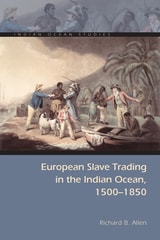
European Slave Trading in the Indian Ocean, 1500–1850
Richard B. Allen
Ohio University Press, 2015
Between 1500 and 1850, European traders shipped hundreds of thousands of African, Indian, Malagasy, and Southeast Asian slaves to ports throughout the Indian Ocean world. The activities of the British, Dutch, French, and Portuguese traders who operated in the Indian Ocean demonstrate that European slave trading was not confined largely to the Atlantic but must now be viewed as a truly global phenomenon. European slave trading and abolitionism in the Indian Ocean also led to the development of an increasingly integrated movement of slave, convict, and indentured labor during the late eighteenth and early nineteenth centuries, the consequences of which resonated well into the twentieth century.
Richard B. Allen’s magisterial work dramatically expands our understanding of the movement of free and forced labor around the world. Drawing upon extensive archival research and a thorough command of published scholarship, Allen challenges the modern tendency to view the Indian and Atlantic oceans as self-contained units of historical analysis and the attendant failure to understand the ways in which the Indian Ocean and Atlantic worlds have interacted with one another. In so doing, he offers tantalizing new insights into the origins and dynamics of global labor migration in the modern world.
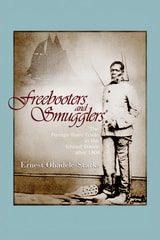
Freebooters and Smugglers
The Foreign Slave Trade in the United States after 1808Ernest Obadele-Starks
University of Arkansas Press, 2007
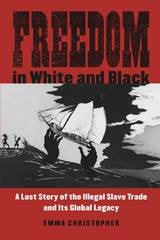
Freedom in White and Black
A Lost Story of the Illegal Slave Trade and Its Global LegacyEmma Christopher
University of Wisconsin Press, 2020
This story can be told because of an exceptional trove of court documents that provides unparalleled insight into one small link in the great, horrific chain of slavery. Emma Christopher follows a trail of evidence across four continents to examine the lives of this barracoon's owners, their workers, and their tragic human merchandise. She reveals how an American, Charles Mason, escaped justice, while British subjects Robert Bostock and John McQueen were arrested. In court five African men—Tamba, Tom Ball, Yarra, Noah, and Sessay—courageously testified against their former owners/captors. They, and 233 other liberated men, women, and children, were relocated to Freetown, Sierra Leone. There they endured harsh lives of "freedom," while the punishment of Bostock and McQueen was fleeting.
From the fragmented facts of these lives, Christopher sheds fascinating light on the early development of the nations of Sierra Leone, Liberia, and Australia (where Bostock and McQueen were banished) and the role of former slaves in combatting the illegal trade.
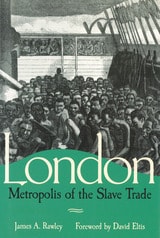
London, Metropolis of the Slave Trade
James A. Rawley & Foreword by David Eltis
University of Missouri Press, 2003
"The recognition that ordinary people could and did trade in slaves, as well as the fact that ordinary people became slaves, is, indeed, the beginning of comprehending the enormity of the forced migration of eleven million people and the attendant deaths of many more."
Rawley draws on material from the year 1700 to the American Civil War as he explores the role of London in the trade. He covers its activity as a port of departure for ships bound for Africa; its continuing large volume after the trade extended to Bristol and Liverpool; and the controversy between London’s parliamentary representatives, who defended the trade, and the abolitionist movement that was quartered there.
Sweeping in scope and thorough in its analysis, this collection of essays from a seasoned scholar will be welcomed by historians concerned with slavery and the slave trade, as well as by students just beginning their exploration of this subject.
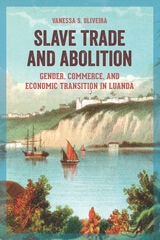
Slave Trade and Abolition
Gender, Commerce, and Economic Transition in LuandaVanessa S. Oliveira
University of Wisconsin Press, 2022
Vanessa S. Oliveira traces how existing commercial networks adapted to changes in the Atlantic slave trade during the first half of the nineteenth century. Slave Trade and Abolition reveals how women known as donas (a term adapted from the title granted to noble and royal women in the Iberian Peninsula) were often important cultural brokers. Acting as intermediaries between foreign and local people, they held high socioeconomic status and even competed with the male merchants who controlled the trade. Oliveira provides rich evidence to explore the many ways this Luso-African community influenced its society. In doing so, she reveals an unexpectedly nuanced economy with regard to the dynamics of gender and authority.
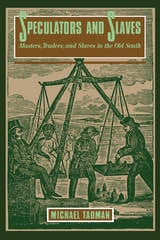
Speculators And Slaves
Masters, Traders, And Slaves In The Old SouthMichael Tadman
University of Wisconsin Press, 1996
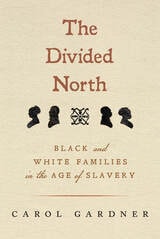
The Divided North
Black and White Families in the Age of SlaveryCarol Gardner
University of Massachusetts Press, 2025
Winner, 2026 New England Historical Association James P. Hanlan Book Prize
Finalist, 2026 New England Society Book Award in Nonfiction
Reuben Ruby and Nathaniel Gordon II were born eleven months apart in 1798 and 1799 and spent much of their boyhoods roaming the noisy, bustling waterfront of Portland, Maine. They lived just blocks from one another, attended school together, and went to the same church with their families. But they were worlds apart, separated by family, culture, and race. Reuben Ruby was Black and Nathaniel Gordon was White.
The Rubys became prominent antislavery activists, equal rights advocates, and operatives on the Underground Railroad. Their neighbors, the Gordons, became well-to-do ship masters, owners, and merchants: among them, the most notorious American slave ship captain of the century, Nathaniel Gordon III. As activists, sea captains, businessmen, prospectors, and politicians, members of these two families traveled to New York, California, Texas, Louisiana, Africa, Haiti, and Brazil, where their experiences were shaped by their racial identities. At home in the “Free North,” they faced social and political divisions nearly as sharp as those they encountered elsewhere.
To understand the issues that divided nineteenth-century America—and, in many ways, still divide the nation—few have looked to the far North. In this compelling narrative history and intimate dual-family biography, Carol Gardner traces the Rubys and Gordons as they navigate the turbulent 1800s. As families and individuals, they demonstrate that the North was a critical proving ground for American notions of freedom and equality, as telling as any town, plantation, or battlefield in the South. Their experiences help reveal what it meant to live in a free state during the age of slavery, with all the promise, disappointment, irony, and hope that the notion entailed.
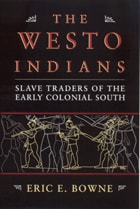
The Westo Indians
Slave Traders of the Early Colonial SouthEric E. Bowne
University of Alabama Press, 2005
A comprehensive study that rescues the Westo from obscurity.
The Westo Indians, who lived in the Savannah River region during the second half of the 17th century, are mentioned in few primary documents and only infrequently in secondary literature. There are no known Westo archaeological sites; no artifacts can be linked to the group; and no more than a single word of their language is known to us today. Yet, from the extant evidence, it is believed that the Westos, who migrated from around Lake Erie by 1656, had a profound effect on the development of the colonial South.
This volume reproduces excerpts from all 19 documents that indisputably reference the Westos, although the Europeans referred to them by a variety of names. Most of the information was written by Lords Proprietors who never met the Westos, or by a handful of Carolinians who did. But the author is able to chart a highly plausible history of this Native group who, for a period, thrived on the Southern frontier.
The narrative traces their northeastern origins and how the Erie conflicts with the Five Nations Iroquois in the Beaver Wars forced them southward, where they found new economic opportunities in the lucrative slave trade. At the height of their influence, between 1659 and 1680, it is believed the Westos captured and sold several thousand Indians from Spanish Florida, often trading them for guns. Eventually, their military advantage over the Indians of the lower South was compromised by the rise of powerful confederacies of native peoples, who could acquire equivalent firearms from the Europeans. Even though the aggressive Westos declined, they had influenced profound change in the Southeast. They furthered the demise of chiefly organization, helped to shift the emphasis from agricultural to hunting economies, and influenced the dramatic decrease in the number and diversity of native polities.
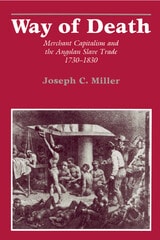
Way of Death
Merchant Capitalism and the Angolan Slave Trade, 1730–1830Joseph Calder Miller
University of Wisconsin Press, 1996
This acclaimed history of Portuguese and Brazilian slaving in the southern Atlantic is now available in paperback.
With extraordinary skill, Joseph C. Miller explores the complex relationships among the separate economies of Africa, Europe, and the South Atlantic that collectively supported the slave trade. He places the grim history of the trade itself within the context of the rise of merchant capitalism in the eighteenth century. Throughout, Miller illuminates the experiences of the slaves themselves, reconstructing what can be known of their sufferings at the hands of their buyers and sellers.
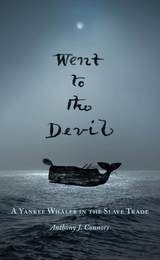
Went to the Devil
A Yankee Whaler in the Slave TradeAnthony J. Connors
University of Massachusetts Press, 2019
In this riveting biography, Anthony J. Connors explores this question by detailing not only the troubled, adventurous life of this man but also the turbulent times in which he lived. Set in an era of social and political fragmentation and impending civil war, when changes in maritime law and the economics of whaling emboldened slaving agents to target captains and their vessels for the illicit trade, Davoll's story reveals the deadly combination of greed and racial antipathy that encouraged otherwise principled Americans to participate in the African slave trade.