Results by title

13 books match the query 'Slums'

cover of A Jumble of Needs: Women’s Activism and Neoliberalism in the Colonias of the Southwest

A Jumble of Needs

Women’s Activism and Neoliberalism in the Colonias of the Southwest

Rebecca Dolhinow

University of Minnesota Press, 2010
Many immigrant communities along the U.S. border with Mexico are colonias, border settlements lacking infrastructure or safe housing. A Jumble of Needs examines the leadership of Mexican women immigrants in three colonias in New Mexico, documenting the role of NGOs in shaping women’s activism in these communities. Ethnographer Rebecca Dolhinow, who worked in the colonias, uncovers why such attempts to exercise political agency are so rarely successful.
 
Central to the relationship between NGOs and women activists in colonias, Dolhinow argues, is the looming presence of the neoliberal political project. In particular, the discourses of caretaking that NGOs use to recruit women into leadership positions simultaneously naturalize and depoliticize the activist work that these women do in their communities. Dolhinow discovers the connections between colonias as isolated communities and colonia leaders as political subjects who unintentionally reinforce neoliberal policy. In the long run, she finds, any politicization that might take place is limited to the women leaders and seldom involves the community as a whole.
 
Surprisingly, Dolhinow reveals, many NGOs promote neoliberal ideals, resulting in continued disenfranchisement, despite the women’s activism to better their lives, families, and communities.
[more]
cover of Amakomiti: Grassroots Democracy in South African Shack Settlements

Amakomiti

Grassroots Democracy in South African Shack Settlements

Trevor Ngwane

Pluto Press, 2021

Can people who live in shantytowns, shacks and favelas teach us anything about democracy? About how to govern society in a way that is inclusive, participatory and addresses popular needs? This book argues that they can. In a study conducted in dozens of South Africa's shack settlements, where more than 9 million people live, Trevor Ngwane finds thriving shack dwellers' committees that govern local life, are responsive to popular needs and provide a voice for the community. These committees, called 'amakomiti' in the Zulu language, organize the provision of basic services such as water, sanitation, public works and crime prevention. Democracy on the Margins argues that, contrary to common perception, slum dwellers are in fact an essential part of the urban population, whose political agency must be recognized and respected. In a world searching for democratic alternatives that serve the many and not the few, it is to the shantytowns, rather than the seats of political power, that we should turn.
[more]
cover of Cities From Scratch: Poverty and Informality in Urban Latin America

Cities From Scratch

Poverty and Informality in Urban Latin America

Brodwyn Fischer, Bryan McCann, Javier Auyero, eds.

Duke University Press, 2014

This collection of essays challenges long-entrenched ideas about the history, nature, and significance of the informal neighborhoods that house the vast majority of Latin America's urban poor. Until recently, scholars have mainly viewed these settlements through the prisms of crime and drug-related violence, modernization and development theories, populist or revolutionary politics, or debates about the cultures of poverty. Yet shantytowns have proven both more durable and more multifaceted than any of these perspectives foresaw. Far from being accidental offshoots of more dynamic economic and political developments, they are now a permanent and integral part of Latin America's urban societies, critical to struggles over democratization, economic transformation, identity politics, and the drug and arms trades. Integrating historical, cultural, and social scientific methodologies, this collection brings together recent research from across Latin America, from the informal neighborhoods of Rio de Janeiro and Mexico City, Managua and Buenos Aires. Amid alarmist exposés, Cities from Scratch intervenes by considering Latin American shantytowns at a new level of interdisciplinary complexity.

Contributors. Javier Auyero, Mariana Cavalcanti, Ratão Diniz, Emilio Duhau, Sujatha Fernandes, Brodwyn Fischer, Bryan McCann, Edward Murphy, Dennis Rodgers
[more]
cover of Colonias and Public Policy in Texas and Mexico: Urbanization by Stealth

Colonias and Public Policy in Texas and Mexico

Urbanization by Stealth

By Peter M. Ward

University of Texas Press, 1999

Today in Texas, over 1500 colonias in the counties along the Mexican border are home to some 400,000 people. Often lacking basic services, such as electricity, water and sewerage, fire protection, policing, schools, and health care, these "irregular" subdivisions offer the only low-cost housing available to the mostly Hispanic working poor.

This book presents the results of a major study of colonias in three transborder metropolitan areas and uncovers the reasons why colonias are spreading so rapidly. Peter Ward compares Texas colonias with their Mexican counterparts, many of which have developed into fully integrated working-class urban communities. He describes how Mexican governments have worked with colonia residents to make physical improvements and upgrade services-a model that Texas policymakers can learn from, Ward asserts. Finally, he concludes with a hard-hitting checklist of public policy initiatives that need to be considered as colonia housing policy enters its second decade in Texas.
[more]
cover of Globalized Authoritarianism: Megaprojects, Slums, and Class Relations in Urban Morocco

Globalized Authoritarianism

Megaprojects, Slums, and Class Relations in Urban Morocco

Koenraad Bogaert

University of Minnesota Press, 2018

A rich investigation into Morocco’s urban politics

Over the past thirty years, Morocco’s cities have transformed dramatically. To take just one example, Casablanca’s medina is now obscured behind skyscrapers that are funded by global capital and encouraged by Morocco’s monarchy, which hopes to transform this city into a regional leader of finance and commerce. Such changes have occurred throughout Morocco. Megaprojects are redesigning the cityscapes of Rabat, Tangiers, and Casablanca, turning the nation’s urban centers into laboratories of capital accumulation, political dominance, and social control.

In Globalized Authoritarianism, Koenraad Bogaert links more abstract questions of government, globalization, and neoliberalism with concrete changes in the city. Bogaert goes deep beneath the surface of Morocco’s urban prosperity to reveal how neoliberal government and the increased connectivity engendered by global capitalism transformed Morocco’s leading urban spaces, opening up new sites for capital accumulation, creating enormous class divisions, and enabling new innovations in state authoritarianism. Analyzing these transformations, he argues that economic globalization does not necessarily lead to increased democratization but to authoritarianism with a different face, to a form of authoritarian government that becomes more and more a globalized affair.

Showing how Morocco’s experiences have helped produce new forms of globalization, Bogaert offers a bridge between in-depth issues of Middle Eastern studies and broader questions of power, class, and capital as they continue to evolve in the twenty-first century.
[more]
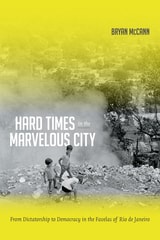
cover of Hard Times in the Marvelous City: From Dictatorship to Democracy in the Favelas of Rio de Janeiro

Hard Times in the Marvelous City

From Dictatorship to Democracy in the Favelas of Rio de Janeiro

Bryan McCann

Duke University Press, 2013
Beginning in the late 1970s, activists from the favelas of Rio de Janeiro challenged the conditions—such as limited access to security, sanitation, public education, and formal employment—that separated favela residents from Rio's other citizens. The activists built a movement that helped to push the nation toward redemocratization. They joined with political allies in an effort to institute an ambitious slate of municipal reforms. Those measures ultimately fell short of aspirations, and soon the reformers were struggling to hold together a fraying coalition. Rio was bankrupted by natural disasters and hyperinflation and ravaged by drug wars. Well-armed drug traffickers had become the new lords of the favelas, protecting their turf through violence and patronage. By the early 1990s, the promise of the favela residents' mobilization of the late 1970s and early 1980s seemed out of reach. Yet the aspirations that fueled that mobilization have endured, and its legacy continues to shape favela politics in Rio de Janeiro.
[more]
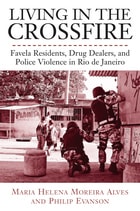
cover of Living in the Crossfire: Favela Residents, Drug Dealers, and Police Violence in Rio de Janeiro

Living in the Crossfire

Favela Residents, Drug Dealers, and Police Violence in Rio de Janeiro

Authored by Maria Helena Moreira Alves and Philip Evanson

Temple University Press, 2011

For all of Brazil's efforts to reduce poverty-and its progress-the favelas in Rio de Janeiro still house one-third of the city's poor, and violence permeates every aspect of the city. As urban drug gangs and police wage war in the streets, favela residents who are especially vulnerable live in fear of being caught in the crossfire. Politicians, human rights activists, and security authorities have been working to minimize the social and economic problems at the root of this "war."

Living in the Crossfire presents impassioned testimony from officials, residents, and others in response to the ongoing crisis. Maria Helena Moreira Alves and Philip Evanson provide vivid accounts from grieving mothers and members of the police working to stop the war and, among officials, from Brazil's President Luis Inácio Lula da Silva, who discusses his efforts to improve public security.
 

[more]
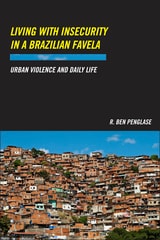
cover of Living with Insecurity in a Brazilian Favela: Urban Violence and Daily Life

Living with Insecurity in a Brazilian Favela

Urban Violence and Daily Life

Penglase, R. Ben

Rutgers University Press, 2015
The residents of Caxambu, a squatter neighborhood in Rio de Janeiro, live in a state of insecurity as they face urban violence. Living with Insecurity in a Brazilian Favela examines how inequality, racism, drug trafficking, police brutality, and gang activities affect the daily lives of the people of Caxambu.  Some Brazilians see these communities, known as favelas, as centers of drug trafficking that exist beyond the control of the state and threaten the rest of the city. For other Brazilians, favelas are symbols of economic inequality and racial exclusion. Ben Penglase’s ethnography goes beyond these perspectives to look at how the people of Caxambu themselves experience violence. 

Although the favela is often seen as a war zone, the residents are linked to each other through bonds of kinship and friendship. In addition, residents often take pride in homes and public spaces that they have built and used over generations. Penglase notes that despite poverty, their lives are not completely defined by illegal violence or deprivation. He argues that urban violence and a larger context of inequality create a social world that is deeply contradictory and ambivalent. The unpredictability and instability of daily experiences result in disagreements and tensions, but the residents also experience their neighborhood as a place of social intimacy. As a result, the social world of the neighborhood is both a place of danger and safety.  
[more]
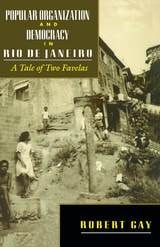
cover of Popular Organization and Democracy in Rio De Janeiro: A Tale of Two Favelas

Popular Organization and Democracy in Rio De Janeiro

A Tale of Two Favelas

Robert Gay

Temple University Press, 1993
"Robert Gay's study is well done. It provides a detailed look at two different forms of popular political organization in Brazil and how they relate to the state, local people, parties, and politicians.... Gay allows the reader to catch a glimpse of the enormous varieties of ways in which popular organizations relate politics to contemporary Brazil. There is no comparable book on Latin American politics." --Scott Mainwaring, Helen Kellogg Institute for International Studies, University of Notre Dame This urban tale of survival illustrates two versions of active, organized, aggressive participation in the political process. Vila Brasil survives by exchanging votes for favors. The president of its neighborhood association promises political candidates that the favela will vote in masse for the highest bidder. Vila Brasil has maneuvered this power to become one of the best served favelas in the region--for the moment, at least. Vidigal, on the other hand, steadfastly refuses to support candidates who campaign on boasts or promises alone. Vote-selling, or buying, is not permitted. To do well in Vidigal, a politician must talk not only about providing electricity and water in the favela, but also about wages, education, and health care over the longer term. In analyzing the favela's different responses to the popular movement that confronted the military in Rio de Janeiro in the late 1970s and early 1980s, the author makes a significant contribution to literature about relationships among urban poor, political elites, and the state.
[more]
cover of Slumming: Sexual and Racial Encounters in American Nightlife, 1885-1940

Slumming

Sexual and Racial Encounters in American Nightlife, 1885-1940

Chad Heap

University of Chicago Press, 2009
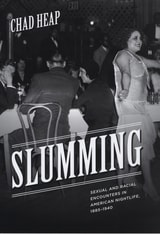
During Prohibition, “Harlem was the ‘in’ place to go for music and booze,” recalled the African American chanteuse Bricktop. “Every night the limousines pulled up to the corner,” and out spilled affluent whites, looking for a good time, great jazz, and the unmatchable thrill of doing something disreputable.
 
That is the indelible public image of slumming, but as Chad Heap reveals in this fascinating history, the reality is that slumming was far more widespread—and important—than such nostalgia-tinged recollections would lead us to believe. From its appearance as a “fashionable dissipation” centered on the immigrant and working-class districts of 1880s New York through its spread to Chicago and into the 1930s nightspots frequented by lesbians and gay men, Slumming charts the development of this popular pastime, demonstrating how its moralizing origins were soon outstripped by the artistic, racial, and sexual adventuring that typified Jazz-Age America. Vividly recreating the allure of storied neighborhoods such as Greenwich Village and Bronzeville, with their bohemian tearooms, rent parties, and “black and tan” cabarets, Heap plumbs the complicated mix of curiosity and desire that drew respectable white urbanites to venture into previously off-limits locales. And while he doesn’t ignore the role of exploitation and voyeurism in slumming—or the resistance it often provoked—he argues that the relatively uninhibited mingling it promoted across bounds of race and class helped to dramatically recast the racial and sexual landscape of burgeoning U.S. cities.
 
Packed with stories of late-night dance, drink, and sexual exploration—and shot through with a deep understanding of cities and the habits of urban life—Slumming revives an era that is long gone, but whose effects are still felt powerfully today.
[more]
cover of The Origins of the Dual City: Housing, Race, and Redevelopment in Twentieth-Century Chicago

The Origins of the Dual City

Housing, Race, and Redevelopment in Twentieth-Century Chicago

Joel Rast

University of Chicago Press, 2019
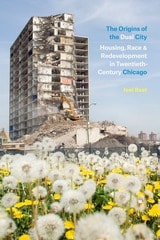
Chicago is celebrated for its rich diversity, but, even more than most US cities, it is also plagued by segregation and extreme inequality. More than ever, Chicago is a “dual city,” a condition taken for granted by many residents. In this book, Joel Rast reveals that today’s tacit acceptance of rising urban inequality is a marked departure from the past. For much of the twentieth century, a key goal for civic leaders was the total elimination of slums and blight. Yet over time, as anti-slum efforts faltered, leaders shifted the focus of their initiatives away from low-income areas and toward the upgrading of neighborhoods with greater economic promise. As misguided as postwar public housing and urban renewal programs were, they were born of a long-standing reformist impulse aimed at improving living conditions for people of all classes and colors across the city—something that can’t be said to be a true priority for many policymakers today. The Origins of the Dual City illuminates how we normalized and became resigned to living amid stark racial and economic divides.
 
[more]
cover of The War on Slums in the Southwest: Public Housing and Slum Clearance in Texas, Arizona, and New Mexico, 1935-1965

The War on Slums in the Southwest

Public Housing and Slum Clearance in Texas, Arizona, and New Mexico, 1935-1965

Robert B Fairbanks

Temple University Press, 2016

In The War on Slums in the Southwest, Robert Fairbanks provides compelling and probing case studies of economic problems and public housing plights in Albuquerque, Dallas, Houston, Phoenix and San Antonio. He provides brief histories of each city--all of which expanded dynamically between 1935 and 1965--and how they responded to slums under the Housing Acts of 1937, 1949, and 1954. 

Despite being a region where conservative politics has ruled, these Southwestern cities often handled population growth, urban planning, and economic development in ways that closely followed the national account of efforts to eliminate slums and provide public housing for the needy.  The War on Slums in the Southwest therefore corrects some misconceptions about the role of slum clearance and public housing in this region as Fairbanks integrates urban policy into the larger understanding of federal and state-based housing policies.

[more]
cover of Urban Saniscapes: Slums, Housing and Everyday Sanitation in  Accra and Nairobi, 1908–1963

Urban Saniscapes

Slums, Housing and Everyday Sanitation in Accra and Nairobi, 1908–1963

Waseem-Ahmed Bin-Kasim

Michigan State University Press, 2025

In this comparative study, Bin-Kasim examines environmental sanitation in the historical development of Accra and Nairobi, the capitals of the Gold Coast (Ghana) and Kenya. This book traces the approaches to sanitation during colonial rule and urban growth throughout the first half of the twentieth century and beyond. From the consolidation of the colonial regimes to the Great Depression, urbanization waves, and postwar development, sanitation was both a cause and a consequence of the built environment. Bin-Kasim characterizes this complex relationship between sanitation and urban growth over time as the 'saniscape.' The saniscape is the confluence of public health, planning interventions, and various urban constituencies, and includes an array of influences like colonial expertise and African industry, which shaped the two cities regardless of their power dynamics and land tenure. Attention to the saniscape validates how Africans called out colonial discrimination and inefficiencies to intervene and shape cities. This volume highlights the shared histories of Accra and Nairobi and upends conventional narratives that attach too much difference to non-settler and settler colonialism.
[more]