Results by title
8 books match the query 'Smell'
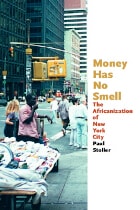
Money Has No Smell
The Africanization of New York CityPaul Stoller
University of Chicago Press, 2002
Blending fascinating ethnographic description with incisive social analysis, Stoller shows how these savvy West African entrepreneurs have built cohesive and effective multinational trading networks, in part through selling a simulated Africa to African Americans. These and other networks set up by the traders, along with their faith as devout Muslims, help them cope with the formidable state regulations and personal challenges they face in America. As Stoller demonstrates, the stories of these West African traders illustrate and illuminate ongoing debates about globalization, the informal economy, and the changing nature of American communities.
Olfactory Rhetoric
Sniffing Out Environmental ProblemsLisa L. Phillips
The Ohio State University Press, 2025
Human senses have the potential to play a significant role in inspiring action to combat climate change. When we smell pollutants in the air, for example, or feel the blast of a polar vortex, we are more likely to act in response to these changes in environmental conditions. However, the sensorium—and particularly our sense of smell—is often downplayed when we consider the rhetorics of environmental crises. In Olfactory Rhetoric, Lisa L. Phillips argues that how we sense the world around us should be a crucial piece of rhetorical evidence when evaluating environmental injustices. Specifically, Phillips elevates olfaction (what we smell) and olfactory rhetoric (how we talk about and experience what we smell) when discussing three contemporary environmental crises set in historically marginalized communities: the Sriracha sauce factory controversy, the Salton Sea scent events, and the Blue Ridge Landfill emissions problem. On a broader scale, Phillips develops an intersectional ecofeminist sensory-rhetorical approach for evaluating how olfactory and sensory persuasions work and how they can be used to advocate for environmental justice and a more breathable future.
Past Scents
Historical Perspectives on SmellJonathan Reinarz
University of Illinois Press, 2014
In this comprehensive and engaging volume, medical historian Jonathan Reinarz offers a historiography of smell from ancient to modern times. Synthesizing existing scholarship in the field, he shows how people have relied on their olfactory sense to understand and engage with both their immediate environments and wider corporal and spiritual worlds.
This broad survey demonstrates how each community or commodity possesses, or has been thought to possess, its own peculiar scent. Through the meanings associated with smells, osmologies develop--what cultural anthropologists have termed the systems that utilize smells to classify people and objects in ways that define their relations to each other and their relative values within a particular culture. European Christians, for instance, relied on their noses to differentiate Christians from heathens, whites from people of color, women from men, virgins from harlots, artisans from aristocracy, and pollution from perfume.
This reliance on smell was not limited to the global North. Around the world, Reinarz shows, people used scents to signify individual and group identity in a morally constructed universe where the good smelled pleasant and their opposites reeked.
With chapters including "Heavenly Scents," "Fragrant Lucre," and "Odorous Others," Reinarz's timely survey is a useful and entertaining look at the history of one of our most important but least-understood senses.
SMELL
Andrea Pavoni, Danilo Mandic, Caterina Nirta and Andreas Philippopoulos-Mihalopoulos
University of Westminster Press, 2023
Although somewhat marginal in relation to the other senses, smell is the most potent way of anchoring ourselves to the world. We subconsciously find our place in it by sniffing our body, the body of the one next to us, the room in which we are, the culture with which we are familiar. There is an incessant olfactory flow consisting of bodies, human and nonhuman, that are agents of generation, consumption, diffusion, reproduction and dissolution of odours. As they move or pause, as they cluster with others or try to move away, these bodies constantly partake in this olfactory flow, this dense planetary swirl that leaves nothing outside.
The law aims at presenting itself as rational and objective. Smell, on the other hand, is one of the least integrated senses in the legal edifice, in comparison to, say, seeing and hearing. This can be attributed mainly to the fact that sense-making of smell and law are different, even antithetical. Smell operates undercurrent, tickling the olfactory antennas of individual and collective bodies while habitually hiding behind other sensory volumes. Law, on the other hand, has an interest in appearing present, universal, constant. Olfactory sense-making relies on its elusiveness; legal sense-making invests in its obviousness. Yet, the two can interact in most unexpected ways, as this volume amply shows. If anything, smell airs the way in which law conceptualises and contextualises its own actuality. Smell brings law forth by allowing it to show its underbelly, its elusive sense-making that is invariably sacrificed in preference to the necessity of legal impressions of constancy. However, smell’s fragmentary, discontinuous and unstable nature, despite all the ordering that goes to it, poses a peculiar challenge to the law. This volume sets out to investigate this juncture.
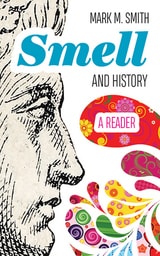
Smell and History
A ReaderMark M. Smith
West Virginia University Press, 2019
Smell and History collects many of the most important recent essays on the history of scent, aromas, perfumes, and ways of smelling. With an introduction by Mark M. Smith—one of the leading social and cultural historians at work today and the preeminent champion in the United States of the emerging field of sensory history—the volume introduces to undergraduate and graduate students as well as to historians of all fields the richness, relevance, and insightfulness of the olfactory to historical study.
Ranging from antiquity to the present, these ten essays, most of them published since 2003, consider how olfaction and scent have shaped the history of medicine, gender, race-making, class formation, religion, urbanization, colonialism, capitalism, and industrialization; how habits and practices of smelling informed ideas about the Enlightenment, modernity, and memory; how smell shaped perceptions of progress and civilization; and how people throughout history have used smell as a way to organize categories and inform worldviews.
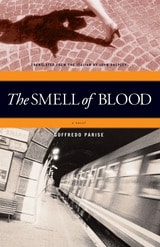
The Smell of Blood
Goffredo Parise
Northwestern University Press, 2003
"A smell very similar to that of slaughterhouses at dawn, but infinitely sweeter and slightly nauseating, or rather, to be more precise, exhilarating."
The smell of blood is really the smell of life. The psychiatrist narrating the story has the power to detect it. His young mistress hungers for it. And his middle-aged wife Silvia has just begun to emanate it--overpoweringly.
Silvia has begun an affair with a violent young idler and neofascist who despises and exploits women. At first her husband reacts with good humor--he has long been unfaithful himself. But jealousy soon colors his curiosity, and his obsession with the details of Silvia's relationship leads to fantasies that become self-fulfilling prophecies. At times coolly analytical, at others driven to know more, the narrator watches as Silvia's actions become more and more self-destructive. When she becomes a slave to her lover's wishes the smell of blood grows stronger, and the odor of life becomes an omen of death.
Goffredo Parise wrote The Smell of Blood in 1979 after suffering a heart attack. Once finished he sealed the manuscript in lead and wax and did not look at it again until a few days before his death in 1986. It was published posthumously in 1997 in Italy.
The Smell of Books
A Cultural-Historical Study of Olfactory Perception in LiteratureHans J. Rindisbacher
University of Michigan Press, 1993
Rindisbacher examines the works of the German Expressionists and of Baudelaire, Huxley, Rimbaud, Wilde, and Turgenev, as well as Holocaust memoirs and contemporary German books such as Patrick Suskind’s Das Parfum and Christa Wolf’s Storfall. He demonstrates that the sense of smell, which has heretofore occupied a position at the bottom of the sensory hierarchy, plays a consequential role in romantic, modern, and contemporary European and Russian literature.
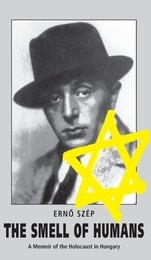
The Smell of Humans
A Memoir of the Holocaust in HungaryErno Szép
Central European University Press, 1994