Results by title

15 books match the query 'Social groups'

cover of Altruistically Inclined?: The Behavioral Sciences, Evolutionary Theory, and the Origins of Reciprocity

Altruistically Inclined?

The Behavioral Sciences, Evolutionary Theory, and the Origins of Reciprocity

Alexander J. Field

University of Michigan Press, 2004

Altruistically Inclined? examines the implications of recent research in the natural sciences for two important social scientific approaches to individual behavior: the economic/rational choice approach and the sociological/anthropological. It considers jointly two controversial and related ideas: the operation of group selection within early human evolutionary processes and the likelihood of modularity—domain-specific adaptations in our cognitive mechanisms and behavioral predispositions.

Experimental research shows that people will often cooperate in one-shot prisoner's dilemma (PD) games and reject positive offers in ultimatum games, contradicting commonly accepted notions of rationality. Upon first appearance, predispositions to behave in this fashion could not have been favored by natural selection operating only at the level of the individual organism.

Emphasizing universal and variable features of human culture, developing research on how the brain functions, and refinements of thinking about levels of selection in evolutionary processes, Alexander J. Field argues that humans are born with the rudiments of a PD solution module—and differentially prepared to learn norms supportive of it. His emphasis on failure to harm, as opposed to the provision of affirmative assistance, as the empirically dominant form of altruistic behavior is also novel.

The point of departure and principal point of reference is economics. But Altruistically Inclined? will interest a broad range of scholars in the social and behavioral sciences, natural scientists concerned with the implications of research and debates within their fields for the conduct of work elsewhere, and educated lay readers curious about essential features of human nature.
Alexander J. Field is the Michel and Mary Orradre Professor of Economics at Santa Clara University.
[more]
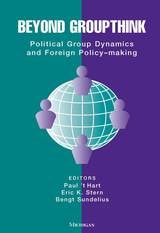
cover of Beyond Groupthink: Political Group Dynamics and Foreign Policy-making

Beyond Groupthink

Political Group Dynamics and Foreign Policy-making

Paul 't Hart, Eric K. Stern, and Bengt Sundelius, Editors

University of Michigan Press, 1997

Strategic issues and crises in foreign policy are usually managed by relatively small groups of elite policymakers and their closest advisors. Since the pioneering work of Irving Janis in the early 1970s, we have known that the interplay between the members of these groups can have a profound and, indeed, at times a pernicious influence on the content and quality of foreign policy decisions. Janis argued that "groupthink," a term he used to describe a tendency for extreme concurrence-seeking in decision-making groups, was a major cause of a number of U.S. foreign policy fiascoes. And yet not all small groups suffer from groupthink; in fact many high-level bodies are handicapped by an inability to achieve consensus at all.
Beyond Groupthink builds upon and extends Janis's legacy. The contributors develop a richer understanding of group dynamics by drawing on alternate views of small-group dynamics. The relevant literature is reviewed and the different perspectives are explored in detailed case studies. The contributors link the group process to the broader organizational and political context of the policy process and stress the need to develop a multi-level understanding of the collegial policy-making process, combining the insights drawn from micro-level theories with those derived from study of broader political phenomena. The contributors include Alexander George, Sally Riggs Fuller, Paul D. Hoyt, Ramon J. Aldag, Max V. Metselaar, Bertjan Verbeek, J. Thomas Preston, Jean A. Garrison, and Yaacov Y. I. Vertzberger.
This book should appeal to political scienctists and international relations specialists, as well as researchers in social psychology, public administration, and management interested in group decision-making processes.
Paul 't Hart is Associate Professor, Department of Public Administration, Leiden University and Scientific Director of of the Leiden-Rotterdam Crisis Research Center. Eric Stern is Professor of Political Science at Stockholm University. Bengt Sundelius is Professor of Political Science at Stockholm University.
[more]
cover of Collaborative Circles: Friendship Dynamics and Creative Work

Collaborative Circles

Friendship Dynamics and Creative Work

Michael P. Farrell

University of Chicago Press, 2001

Many artists, writers, and other creative people do their best work when collaborating within a circle of likeminded friends. Experimenting together and challenging one another, they develop the courage to rebel against the established traditions in their field. Out of their discussions they develop a new, shared vision that guides their work even when they work alone.

In a unique study that will become a rich source of ideas for professionals and anyone interested in fostering creative work in the arts and sciences, Michael P. Farrell looks at the group dynamics in six collaborative circles: the French Impressionists; Sigmund Freud and his friends; C. S. Lewis, J. R. R. Tolkien, and the Inklings; social reformers Elizabeth Cady Stanton and Susan B. Anthony; the Fugitive poets; and the writers Joseph Conrad and Ford Maddox Ford. He demonstrates how the unusual interactions in these collaborative circles drew out the creativity in each member. Farrell also presents vivid narrative accounts of the roles played by the members of each circle. He considers how working in such circles sustains the motivation of each member to do creative work; how collaborative circles shape the individual styles of the persons within them; how leadership roles and interpersonal relationships change as circles develop; and why some circles flourish while others flounder.

[more]
cover of Collision of Wills: How Ambiguity about Social Rank Breeds Conflict

Collision of Wills

How Ambiguity about Social Rank Breeds Conflict

Roger V. Gould

University of Chicago Press, 2003

Minor debts, derisive remarks, a fight over a parking space, butting in line—these are the little things that nevertheless account for much of the violence in human society. But why? Roger V. Gould considers this intriguing question in Collision of Wills. He argues that human conflict is more likely to occur in symmetrical relationships—among friends or social equals—than in hierarchical ones, wherein the difference of social rank between the two individuals is already established.

This, he maintains, is because violence most often occurs when someone wants to achieve superiority or dominance over someone else, even if there is no substantive reason for doing so. In making the case for this original idea, Gould explores a diverse range of examples, including murders, blood feuds, vendettas, revolutions, and the everyday disagreements that compel people to act violently. The result is an intelligent and provocative work that restores the study of conflict to the center of social inquiry.

[more]
cover of Crafting Prehispanic Maya Kinship

Crafting Prehispanic Maya Kinship

Bradley E. Ensor

University of Alabama Press, 2013

By contextualizing classes and their kinship behavior within the overall political economy, Crafting Prehispanic Maya Kinship provides an example of how archaeology can help to explain the formation of disparate classes and kinship patterns within an ancient state-level society.

Bradley E. Ensor provides a new theoretical contribution to Maya ethnographic, ethnohistoric, and archaeological research. Rather than operating solely as a symbolic order unobservable to archaeologists, kinship, according to Ensor, forms concrete social relations that structure daily life and can be reflected in the material remains of a society. Ensor argues that the use of cross-culturally identified and confirmed material indicators of postmarital residence and descent group organization enable archaeologists—those with the most direct material evidence on prehispanic Maya social organization—to overturn a traditional reliance on competing and problematic ethnohistorical models.
 
Using recent data from an arch aeological project within the Chontalpa Maya region of Tabasco, Mexico, Ensor illustrates how archaeologists can interpret and explain the diversity of kinship behavior and its influence on gender within any given Maya social formation.
[more]
cover of I Am Because We Are: Readings in Africana Philosophy

I Am Because We Are

Readings in Africana Philosophy

Fred Lee Hord

University of Massachusetts Press, 2016

First published in 1995, I Am Because We Are has been recognized as a major, canon-defining anthology and adopted as a text in a wide variety of college and university courses. Bringing together writings by prominent Black thinkers from Africa, the Caribbean, and North America, Fred Lee Hord and Jonathan Scott Lee made the case for a tradition of “relational humanism” distinct from the philosophical preoccupations of the West.

Over the past twenty years, however, new scholarly research has uncovered other contributions to the discipline now generally known as “Africana philosophy” that were not included in the original volume. In this revised and expanded edition, Hord and Lee build on the strengths of the earlier anthology while enriching the selection of readings to bring the text into the twenty-first century. In a new introduction, the editors reflect on the key arguments of the book's central thesis, refining them in light of more recent philosophical discourse. This edition includes important new readings by Kwame Gyekye, Oyeronke Oy ewumi­, Paget Henry, Sylvia Wynter, Toni Morrison, Charles Mills, and Tommy Curry, as well as extensive suggestions for further reading.

[more]
cover of Laughing Saints and Righteous Heroes: Emotional Rhythms in Social Movement Groups

Laughing Saints and Righteous Heroes

Emotional Rhythms in Social Movement Groups

Erika Summers Effler

University of Chicago Press, 2010

Why do people keep fighting for social causes in the face of consistent failure? Why do they risk their physical, emotional, and financial safety on behalf of strangers? How do these groups survive high turnover and emotional burnout?

To explore these questions, Erika Summers Effler undertook three years of ethnographic fieldwork with two groups: anti–death penalty activists STOP and the Catholic Workers, who strive to alleviate poverty. In both communities, members must contend with problems that range from the broad to the intimately personal. Adverse political conditions, internal conflict, and fluctuations in financial resources create a backdrop of daily frustration—but watching an addict relapse or an inmate’s execution are much more devastating setbacks. Summers Effler finds that overcoming these obstacles, recovering from failure, and maintaining the integrity of the group require a constant process of emotional fine-tuning, and she demonstrates how activists do this through thoughtful analysis and a lucid rendering of their deeply affecting stories.

[more]
cover of On Self and Social Organization

On Self and Social Organization

Charles Horton Cooley

University of Chicago Press, 1998

It is almost impossible now to imagine the prestigious position Charles Horton Cooley (1864-1929) held within the founding generation of American sociologists. His seminal work on human communication, social organization, and public opinion stimulated and guided much of early American sociological thought.

Cooley's work relating self and community is now more relevant than ever to the problems of understanding and directing modern democratic societies. Cooley applied the ideas of pragmatism to developing a systematic way of approaching social action, social change, and social order; he used these interrelated theories to analyze the social problems and cultural crises of the age. According to Cooley, social change is a fragile, interactive process that, due to constantly arising problems of action, requires ongoing scrutiny by the public. This collection of Cooley's best work is an important contribution not only to the history of ideas—especially to the origin of modern sociological theory— but also to the current public debate on civil society, community, and democracy.
[more]
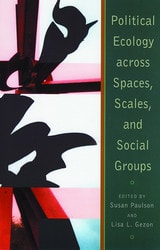
cover of Political Ecology Across Spaces, Scales, and Social Groups

Political Ecology Across Spaces, Scales, and Social Groups

Paulson, Susan

Rutgers University Press, 2004

Environmental issues have become increasingly prominent in local struggles, national debates, and international policies. In response, scholars are paying more attention to conventional politics and to more broadly defined relations of power and difference in the interactions between human groups and their biophysical environments. Such issues are at the heart of the relatively new interdisciplinary field of political ecology, forged at the intersection of political economy and cultural ecology.

This volume provides a toolkit of vital concepts and a set of research models and analytic frameworks for researchers at all levels. The two opening chapters trace rich traditions of thought and practice that inform current approaches to political ecology. They point to the entangled relationship between humans, politics, economies, and environments at the dawn of the twenty-first century and address challenges that scholars face in navigating the blurring boundaries among relevant fields of enquiry.  The twelve case studies that follow demonstrate ways that culture and politics serve to mediate human-environmental relationships in specific ecological and geographical contexts. Taken together, they describe uses of and conflicts over resources including land, water, soil, trees, biodiversity, money, knowledge, and information; they exemplify wide-ranging ecological settings including deserts, coasts, rainforests, high mountains, and modern cities; and they explore sites located around the world, from Canada to Tonga and cyberspace.

[more]
cover of Sharing Responsibility

Sharing Responsibility

Larry May

University of Chicago Press, 1992
Are individuals responsible for the consequences of actions taken by their community? What about their community's inaction or its attitudes? In this innovative book, Larry May departs from the traditional Western view that moral responsibility is limited to the consequences of overt individual action. Drawing on the insights of Arendt, Jaspers, and Sartre, he argues that even when individuals are not direct participants, they share responsibility for various harms perpetrated by their communities.
[more]
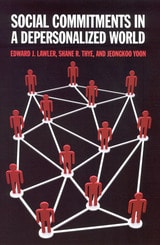
cover of Social Commitments in a Depersonalized World

Social Commitments in a Depersonalized World

Edward J. Lawler

Russell Sage Foundation, 2009
As individuals' ties to community organizations and the companies they work for weaken, many analysts worry that the fabric of our society is deteriorating. But others counter that new social networks, especially those forming online, create important and possibly even stronger social bonds than those of the past. In Social Commitments in a Depersonalized World, Edward Lawler, Shane Thye, and Jeongkoo Yoon examine interpersonal and group ties and propose a new theory of social commitments, showing that multiple interactions, group activities and, particularly, emotional attachment, are essential for creating and sustaining alignments between individuals and groups. Lawler, Thye, and Yoon acknowledge that long-term social attachments have proven fragile in a volatile economy where people increasingly form transactional associations—based not on collective interest but on what will yield the most personal advantage in a society shaped by market logic. Although person-to-group bonds may have become harder to sustain, they continue to play a vital role in maintaining healthy interactions in larger social groups from companies to communities. Drawing on classical and contemporary sociology, organizational psychology, and behavioral economics, Social Commitments in a Depersonalized World shows how affiliations—particularly those that involve a profound emotional component—can transcend merely instrumental or transactional ties and can even transform these impersonal bonds into deeply personal ones. The authors study the structures of small groups, corporations, economic transactions, and modern nation-states to determine how hierarchies, task allocation, and social identities help or hinder a group's vitality. They find that such conditions as equal status, interdependence, and overlapping affiliations figure significantly in creating and sustaining strong person-to-group bonds. Recurring collaboration with others to achieve common goals—along with shared responsibilities and equally valued importance within an organization—promote positive and enduring feelings that enlarge a person's experience of a group and the significance of their place within it. Employees in organizations with strong person-to-group ties experience a more unified, collective identity. They tend to work more cost effectively, meet company expectations, and better regulate their own productivity and behavior. The authors make clear that the principles of their theory have implications beyond business. With cultures pulling apart and crashing together like tectonic plates, much depends on our ability to work collectively across racial, cultural, and political divides. The new theory in Social Commitments in a Depersonalized World provides a way of thinking about how groups form and what it takes to sustain them in the modern world.
[more]
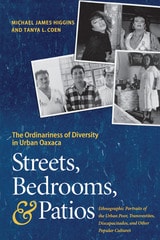
cover of Streets, Bedrooms, and Patios: The Ordinariness of Diversity in Urban Oaxaca

Streets, Bedrooms, and Patios

The Ordinariness of Diversity in Urban Oaxaca

By Michael James Higgins and Tanya L. Coen

University of Texas Press, 2000

Diversity characterizes the people of Oaxaca, Mexico. Within this city of half a million, residents are rising against traditional barriers of race and class, defining new gender roles, and expanding access for the disabled. In this rich ethnography of the city, Michael Higgins and Tanya Coen explore how these activities fit into the ordinary daily lives of the people of Oaxaca.

Higgins and Coen focus their attention on groups that are often marginalized—the urban poor, transvestite and female prostitutes, discapacitados (the physically challenged), gays and lesbians, and artists and intellectuals. Blending portraits of and comments by group members with their own ethnographic observations, the authors reveal how such issues as racism, sexism, sexuality, spirituality, and class struggle play out in the people's daily lives and in grassroots political activism. By doing so, they translate the abstract concepts of social action and identity formation into the actual lived experiences of real people.

[more]
cover of The Names of the Python: Belonging in East Africa, 900 to 1930

The Names of the Python

Belonging in East Africa, 900 to 1930

David L. Schoenbrun

University of Wisconsin Press, 2023

Systems of belonging, including ethnicity, are not static, automatic, or free of contest. Historical contexts shape the ways which we are included in or excluded from specific classifications. Building on an amazing array of sources, David L. Schoenbrun examines groupwork—the imaginative labor that people do to constitute themselves as communities—in an iconic and influential region in East Africa. His study traces the roots of nationhood in the Ganda state over the course of a millennia, demonstrating that the earliest clans were based not on political identity or language but on shared investments, knowledges, and practices.
 
Grounded in Schoenbrun’s skillful mastery of historical linguistics and vernacular texts, The Names of the Python supplements and redirects current debates about ethnicity in ex-colonial Africa and beyond. This timely volume carefully distinguishes past from present and shows the many possibilities that still exist for the creative cultural imagination.

[more]
cover of Tiny Publics: A Theory of Group Action and Culture

Tiny Publics

A Theory of Group Action and Culture

Gary Alan Fine

Russell Sage Foundation, 2012

If all politics is local, then so is almost everything else, argues sociologist Gary Alan Fine. We organize our lives by relying on those closest to us—family members, friends, work colleagues, team mates, and other intimates—to create meaning and order. In this thoughtful and wide-ranging book, Fine argues that the basic building blocks of society itself are forged within the boundaries of such small groups, the "tiny publics" necessary for a robust, functioning social order at all levels. Action, meaning, authority, inequality, organization, and institutions all have their roots in small groups. Yet for the past twenty-five years social scientists have tended to ignore the power of groups in favor of an emphasis on organizations, societies, or individuals. Based on over thirty-five years of Fine's own ethnographic research across an array of small groups, Tiny Publics presents a compelling new theory of the pivotal role of small groups in organizing social life. No social system can thrive without flourishing small groups. They provide havens in an impersonal world, where faceless organizations become humanized. Taking examples from such diverse worlds as Little League baseball teams, restaurant workers, high school debate teams, weather forecasters, and political volunteers, Fine demonstrates how each group has its own unique culture, or idioculture—the system of knowledge, beliefs, behavior, and customs that define and hold a group together. With their dense network of relationships, groups serve as important sources of social and cultural capital for their members. The apparently innocuous jokes, rituals, and nicknames prevalent within Little League baseball teams help establish how teams function internally and how they compete with other teams. Small groups also provide a platform for their members to engage in broader social discourse and a supportive environment to begin effecting change in larger institutions. In his studies of mushroom collectors and high school debate teams, Fine demonstrates the importance of stories that group members tell each other about their successes and frustrations in fostering a strong sense of social cohesion. And Fine shows how the personal commitment political volunteers bring to their efforts is reinforced by the close-knit nature of their work, which in turn has the power to change larger groups and institutions. In this way, the actions and debates begun in small groups can eventually radiate outward to affect every level of society. Fine convincingly demonstrates how small groups provide fertile ground for the seeds of civic engagement. Outcomes often attributed to large-scale social forces originate within such small-scale domains. Employing rich insights from both sociology and social psychology, as well as vivid examples from a revealing array of real-work groups, Tiny Publics provides a compelling examination of the importance of small groups and of the rich vitality they bring to social life. A Volume in the Russell Sage Foundation Series on Trust
[more]
cover of Us and Them: The Science of Identity

Us and Them

The Science of Identity

David Berreby

University of Chicago Press, 2008

Democrat and Republican. Meat Eaters and Vegetarians. Black and White. As human beings we sort ourselves into groups. And once we identify ourselves as a member of a particular group—say, Red Sox fans—we tend to feel more comfortable with others of our own kind, rather than, say, Yankees fans. Yet we all belong to multiple groups at the same time—one might be a woman, a mother, an American, a violinist. How do we decide which identities matter and why they matter so much? And what makes us willing to die for, or to kill for, a religion, a nation, or a race?
            In this award-winning book, David Berreby describes how twenty-first-century science is addressing these age-old questions. Ably linking neuroscience, social psychology, anthropology, and other fields, Us and Them investigates humanity’s “tribal mind” and how this alters our thoughts, affects our health, and is manipulated for good and ill. From the medical effects of stress to the rhetoric of politics, our perceptions of group identity affect every part of our lives. Science, Berreby argues, shows how this part of human nature is both unexpectedly important and surprisingly misunderstood.
            Humans need our tribal sense—it tells us who we are, how we should behave, and links us to others as well as the past and future. Some condemn this instinct, while others celebrate it. Berreby offers in Us and Them a third alternative: how we can accept and understand our inescapable tribal mind.
“[A] brave book. . . . Berreby’s quest is to understand what he sees as a fundamental human urge to classify and identify with ‘human kinds.’”—Henry Gee, Scientific American
[more]