Results by title
16 books match the query 'Social justice and education'
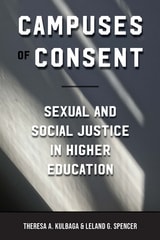
Campuses of Consent
Sexual and Social Justice in Higher EducationTheresa A. Kulbaga and Leland G. Spencer
University of Massachusetts Press, 2019
Winner of the 2020 OSCLG Outstanding Book Award
This new book for scholars and university administrators offers a provocative critique of sexual justice language and policy in higher education around the concept of consent. Complicating the idea that consent is plain common sense, Campuses of Consent shows how normative and inaccurate concepts about gender, gender identity, and sexuality erase queer or trans students' experiences and perpetuate narrow, regressive gender norms and individualist frameworks for understanding violence.
Theresa A. Kulbaga and Leland G. Spencer prove that consent in higher education cannot be meaningfully separated from larger issues of institutional and structural power and oppression. While sexual assault advocacy campaigns, such as It's On Us, federal legislation from Title IX to the Clery Act, and more recent affirmative-consent measures tend to construct consent in individualist terms, as something “given” or “received” by individuals, the authors imagine consent as something that can be constructed systemically and institutionally: in classrooms, campus communication, and shared campus spaces.
Community Is the Way
Engaged Writing and Designing for Transformative Changeby Aimée Knight
University Press of Colorado, 2022
Empathy and the Other
Difference, Connection, and the Teaching of WritingLisa Blankenship
Utah State University Press, 2026
Empathy and the Other: Difference, Connection, and the Teaching of Writing focuses on the theoretical basis for empathy as a pedagogical concern, adding to important conversations happening in writing studies about how to foster empathetic understanding and practices for teachers and students. It offers ways for higher education classrooms to become sites for the cultivation of a critical form of empathy that can help address the most important challenges of our time.
Drawing on the study of empathy in rhetorical theory and related fields, teacher-scholars from a variety of institutions and backgrounds offer pedagogical rationales and approaches for fostering empathetic, inclusive, and antiracist pedagogies centered around five key themes related to empathetic teaching: difference, citizenship, storytelling, assessment, and process. A reflective and critical approach to empathetic teaching—as presented by the authors in this collection—can begin to address forces of social division, particularly in the ways we read and write about others. Teaching grounded in empathetic principles can offer students ways of relating to one another across cultural, religious, class, ethnic, political, and ideological differences.
Empathy and the Other is a companion volume to Enacting Empathy: Stories and Strategies from the Writing Classroom, which features vignettes and praxis pieces focused on classroom experiences and reflections on teaching empathy. The two collections may stand alone or be read together and are of great interest to writing teachers and graduate students invested in social justice in the classroom.
Enacting Empathy
Stories and Strategies from the Writing ClassroomLisa Blankenship
Utah State University Press, 2026
Featuring vignettes and praxis pieces focused on classroom experiences and reflections on teaching empathy, Enacting Empathy: Stories and Strategies from the Composition Classroom provides inspiration and consideration of how and why teachers might adopt an emphasis on empathy. Contributors locate empathy in the particulars of writing assignments, classroom discussions, responses to students, interpretations of texts, and connections with communities.
The challenges and means of understanding one another—as we encounter one another in words, images, and texts—are a central focus of the writing classroom. Teaching for and about empathy has become only more important as we have experienced increased social division, greater recognition and attention to identity, and an emphasis on attending to personal experiences and stories as part of larger efforts to support social justice. With its possibilities for critical reflection and revision, writing is a key tool for developing empathy. Empathy likewise can make us more present, accountable, and socially engaged in our writing. This collection explores how empathy might best be put into practice in the composition classroom, featuring teaching resources, assignment designs, and reflections on empathy and teaching writing for diverse institutional contexts.
The first edited collection in at least thirty years to present strategies for teaching empathy in composition classrooms, Enacting Empathy is a companion volume to Empathy and the Other: Difference, Connection, and the Teaching of Writing, which focuses on the theoretical basis for empathy as a pedagogical concern. The two volumes may stand alone or be read together and are of great interest to writing teachers and graduate students invested in social justice in the classroom.
Grassroots Engagement and Social Justice through Cooperative Extension
Nia Imani Fields
Michigan State University Press, 2022
Inclusion, Diversity and Innovation in Translation Education
Edited by Alejandro Bolaños García-Escribano and Mazal Oaknín
University College London, 2024
In Inclusion, Diversity and Innovation in Translation Education, editors Alejandro Bolaños, García-Escribano, and Mazal Oaknín, emphasize the latest developments in literary and audiovisual translation education and teaching foreign languages while exploring the relevance of equality, diversity, and inclusion. They propose best practices and pieces of training, inviting readers to incorporate social issues affecting marginalized groups in their language and translation teaching practices.
Media Literacy for Justice
Lessons for Changing the WorldBelinha S. De Abreu
American Library Association, 2022
Foreword by Yohuru Williams, Racial Justice Initiative, Dean of the College of Arts and Sciences. St. Thomas University, Minneapolis; Preface by Asha Rangappa, former FBI agent and Senior Lecturer, Yale University’s Jackson Institute for Global Affairs
Providing context, reflection points, and ready-to-use lesson plans, this powerful book illuminates the intersections of social justice and media literacy for educators, school and public librarians, teachers of history and civics, information literacy instructors, and community leaders.The corrosive effects of today’s relentless tide of media are pernicious. We are conditioned in many ways by our media environments to accept and not question, making it crucial that young people master the skills necessary to access, analyze, evaluate, and create media. De Abreu and her fellow contributors propose that a key solution to our society’s crisis of misinformation, misrepresentation, and misunderstanding lies in melding social justice aims with media literacy concepts and skills. Featuring reflective activities and lesson ideas that can be adapted for educational settings from higher education to the K-12 spectrum, community centers, and libraries, this resource
- spotlights the work of school library media specialists, classroom teachers, academic educators, and representatives of non-profits from around the world;
- presents ten chapters which explore such timely issues as how to deal with controversial topics in the classroom, the effects of misinformation/disinformation on civics in society, why the media underrepresents certain people in their programming, the digital divide and where libraries fit in, how injustice exacerbates public health issues, and global conceptions of social justice and media literacy examined through various world events; and
- provides information about additional resources like social action/advocacy organizations, classroom resources, and films that will assist readers as they reflect upon, teach, and discuss media literacy and social justice.
Narratives of Joy and Failure in Antiracist Assessment
Exploring Collaborative Writing AssessmentsAsao B. Inoue
University Press of Colorado, 2024
Progressive Dystopia
Abolition, Antiblackness, and Schooling in San FranciscoSavannah Shange
Duke University Press, 2019
Radical Writing Center Praxis
A Paradigm for Ethical Political EngagementLaura Greenfield
Utah State University Press, 2019
Large, intersecting systems of oppression manifest in the everyday practices of institutions, classrooms, and writing centers. Local practices in turn influence the surrounding world. Radical Writing Center Praxis therefore challenges the writing center field to resist assumptions of political neutrality and instead to redefine itself in terms of more explicit ethical commitments. In this paradigm it is clear that to engage in anti-oppression work is not merely a special interest but rather a vital interest to all.
Introducing the concepts and vocabulary of radical politics, Radical Writing Center Praxis examines the tensions between the field’s professed beliefs and everyday practices and offers a process by which the writing center discipline as a whole might rebuild itself anew. It will be invaluable to writing center directors, tutors, scholars, and students as well as to administrators and compositionists.
Raising Ollie
How My Nonbinary Art-Nerd Kid Changed (Nearly) Everything I KnowTom Rademacher
University of Minnesota Press, 2021
The account of one radically new school year for a Teacher of the Year and for his nonbinary, art-obsessed, brilliant child
Seven-year-old Ollie was researching local advanced school programs—because every second grader does that, right? Ollie, who used to hate weekends because they meant no school, was crying on the way to school almost every day. Sure, there were the slings and arrows of bullies and bad teachers, but, maybe worse, Ollie, a funny, anxious, smart kid with a thing for choir and an eye for graphic art, was gravely underchallenged and also struggling with identity and how to live totally as themselves. Ollie begged to switch to a new school with “kids like me,” where they wouldn’t feel so alone, or so bored, and so they made the change.
Raising Ollie is dad Tom Rademacher’s story (really, many stories) of that eventful and sometimes painful school year, parenting Ollie and relearning every day what it means to be a father and teacher. As Ollie—who is nonbinary and uses they/them pronouns, and prefers art to athletics, vegetables to cake, and animals to most humans—flourishes in their new school, Rademacher is making an eye-opening adjustment to a new school of his own, one that’s whiter and more suburban than anywhere he has previously taught, with a history of racial tension that he tries to address and navigate.
While Ollie is learning to code, 3D model, animate, speak Japanese, and finally feel comfortable at school, Rademacher increasingly sees how his own educational struggles, anxieties, and childhood upbringing are reflected in his teaching, writing, and parenting, as well as in Ollie’s experience. And with this story of one anything-but-academic year of inquiry and wonder, doubt and revelation, he shows us how raising a kid changes everything—and how much raising a kid like Ollie can teach us about who we are and what we’re doing in the world.

Systems Shift
Creating and Navigating Change in Rhetoric and Composition AdministrationGenesea M. Carter
University Press of Colorado, 2024
Teaching Writing through the Immigrant Story
Heather Ostman
Utah State University Press, 2021
Each of the chapters recognizes the prevalence of immigrant students in writing classrooms across the United States—including foreign-born, first- and second-generation Americans, and more—and the myriad opportunities and challenges those students present to their instructors. These contributors have seen the validity in the stories and experiences these students bring to the classroom—evidence of their lifetimes of complex learning in both academic and nonacademic settings. Like thousands of college-level instructors in the United States, they have immigrant stories of their own. The immigrant “narrative” offers a unique framework for knowledge production in which students and teachers may learn from each other, in which the ordinary power dynamic of teacher and students begins to shift, to enable empathy to emerge and to provide space for an authentic kind of pedagogy.
By engaging writing and literature teachers within and outside the classroom, Teaching Writing through the Immigrant Story speaks to the immigrant narrative as a viable frame for teaching writing—an opportunity for building and articulating knowledge through academic discourse. The book creates a platform for immigration as a writing and literary theme, a framework for critical thinking, and a foundation for significant social change and advocacy.
Contributors: Tuli Chatterji, Katie Daily-Bruckner, Libby Garland, Silvia Giagnoni, Sibylle Gruber, John Havard, Timothy Henderson, Brennan Herring, Lilian Mina, Rachel Pate, Emily Schnee, Elizabeth Stone
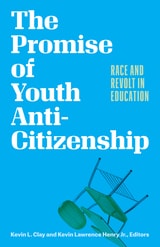
The Promise of Youth Anti-Citizenship
Race and Revolt in EducationKevin L. Clay
University of Minnesota Press, 2024
When inclusion into the fold of citizenship is conditioned by a social group’s conceit to ritual violence, humiliation, and exploitation, what can anti-citizenship offer us?
The Promise of Youth Anti-citizenship argues that Black youth and youth of color have been cast as anti-citizens, disenfranchised from the social, political, and economic mainstream of American life. Instead of asking youth to conform to a larger societal structure undergirded by racial capitalism and antiblackness, the volume’s contributors propose that the collective practice of anti-citizenship opens up a liberatory space for youth to challenge the social order.
The chapters cover an array of topics, including Black youth in the charter school experiment in post-Katrina New Orleans; racial capitalism, the queering of ethnicity, and the 1980s Salvadoran migration to South Central Los Angeles; the notion of decolonizing classrooms through Palestinian liberation narratives; and more. Through a range of methodological approaches and conceptual interventions, this collection illuminates how youth negotiate and exercise anti-citizenship as forms of either resistance or refusal in response to coercive patriotism, cultural imperialism, and predatory capitalism.
Contributors: Karlyn Adams-Wiggins, Portland State U; Ariana Brazier; Julio Cammarota, U of Arizona; Michael Davis, U of Wisconsin–Madison; Damaris C. Dunn, U of Georgia; Diana Gamez, U of California, Irvine; Rachel F. Gómez, Virginia Commonwealth U; Luma Hasan; Gabriel Rodriguez, Iowa State U; Christopher R. Rogers, U of Pennsylvania; Damien M. Sojoyner, U of California, Irvine.
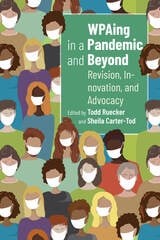
WPAing in a Pandemic and Beyond
Revision, Innovation, and AdvocacyTodd Ruecker
Utah State University Press, 2025
The chapters in this collection include a variety of voices who have been involved in writing program administration in recent years to reflect on the work done in this moment of crisis. Through both short vignettes and longer chapters, this book explores the complicated interactions between WPA work and navigating times of crisis to provide insights for moving forward. Authors explore a variety of topics including professional development, curricular change, advocating in the face of intransigent administrations and others, caring for students, and taking time for self-care. Pointing to specific actions for continued advocacy, WPAing in a Pandemic and Beyond will be of great interest to WPAs and writing studies scholars.
Writing Assessment, Social Justice, and the Advancement of Opportunity
Mya Poe
University Press of Colorado, 2018