Results by title
11 books match the query 'Space Exploration'
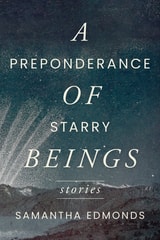
A Preponderance of Starry Beings
StoriesSamantha Edmonds
Northwestern University Press, 2025
Genre-bending stories of the cosmos and the worlds within our own skin
Blending fairy tale and science fiction with the otherworldliness of adolescence, A Preponderance of Starry Beings is a collection for anyone preoccupied with looking skyward. These stories probe the experience of coming of age on the outskirts of the universe, whether that be a small Midwestern town or a distant galaxy, and of weighing earthly obligations against the vast promises of space.
In a sleepy Ohio neighborhood, two girls seek refuge from their homophobic schoolmates in an antiques shop filled with Star Trek memorabilia. On a generation spaceship, children revolt against their parents’ plans to colonize a distant world. Deep in the Florida Everglades, seven sisters must protect their otherworldly mythology when two men arrive to fix the family automobile.
A Preponderance of Starry Beings invites us into a mundane and whimsical world of night islands, small towns, and faith lost and found, where a safe landing matters less than taking the leap.
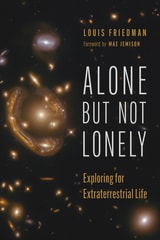
Alone but Not Lonely
Exploring for Extraterrestrial LifeLouis Friedman
University of Arizona Press, 2023
Friedman argues that intelligent life is probably rare in the universe (maybe even uniquely on Earth) but that simple life is likely abundant on millions or billions of planets waiting now to be discovered. He asserts that studying and searching for extraterrestrial life cannot be done by interstellar probes—due to the vastness of space and the comparative brevity of human lifespans—but it can be done remotely by a new technique involving the solar gravity lens that can magnify exoplanets by tens of billions. This technique will allow humankind to explore exoplanets and open up an exciting new field of comparative astrobiology.
Wide-ranging in scope, this book discusses the history of searching for extraterrestrial life, the scientific evidence thereof, and finally his own conclusions on what’s next. Included in the book are three appendices: an explanation of interstellar messaging, a reprint of a debate between Carl Sagan and Ernst Mayr on extraterrestrial intelligence, and an opinion essay on the search for extraterrestrial intelligence.
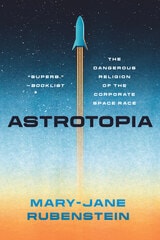
Astrotopia
The Dangerous Religion of the Corporate Space RaceMary-Jane Rubenstein
University of Chicago Press, 2022
As environmental, political, and public health crises multiply on Earth, we are also at the dawn of a new space race in which governments team up with celebrity billionaires to exploit the cosmos for human gain. The best-known of these pioneers are selling different visions of the future: while Elon Musk and SpaceX seek to establish a human presence on Mars, Jeff Bezos and Blue Origin work toward moving millions of earthlings into rotating near-Earth habitats. Despite these distinctions, these two billionaires share a core utopian project: the salvation of humanity through the exploitation of space.
In Astrotopia, philosopher of science and religion Mary-Jane Rubenstein pulls back the curtain on the not-so-new myths these space barons are peddling, like growth without limit, energy without guilt, and salvation in a brand-new world. As Rubenstein reveals, we have already seen the destructive effects of this frontier zealotry in the centuries-long history of European colonialism. Much like the imperial project on Earth, this renewed effort to conquer space is presented as a religious calling: in the face of a coming apocalypse, some very wealthy messiahs are offering an other-worldly escape to a chosen few. But Rubenstein does more than expose the values of capitalist technoscience as the product of bad mythologies. She offers a vision of exploring space without reproducing the atrocities of earthly colonialism, encouraging us to find and even make stories that put cosmic caretaking over profiteering.
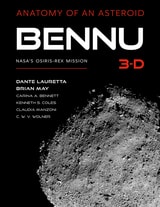
Bennu 3-D
Anatomy of an AsteroidDante Lauretta, Brian May, Carina A. Bennett, Kenneth S. Coles, Claudia Manzoni, and C. W. V. Wolner
University of Arizona Press, 2023
In 2020 the OSIRIS-REx spacecraft successfully landed on the surface of Bennu and collected pristine asteroid material for delivery to Earth in September 2023. Scientific studies of the samples, along with data collected during the rendezvous, promise to help find answers to some of humanity’s deepest questions: Where did we come from? What is our destiny in space?
This book, the world’s first complete (and stereoscopic) atlas of an asteroid, is the result of a unique collaboration between OSIRIS-REx mission leader Dante Lauretta and Brian May’s London Stereoscopic Company. Lauretta’s colleagues include Carina Bennett, Kenneth Coles, and Cat Wolner, as well as Brian May and Claudia Manzoni, who became part of the ultimately successful effort to find a safe landing site for sampling. The text details the data collected by the mission so far, and the stereo images have been meticulously created by Manzoni and May from original images collected by the OSIRIS-REx cameras.
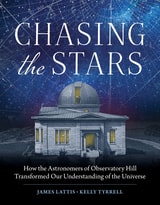
Chasing the Stars
How the Astronomers of Observatory Hill Transformed Our Understanding of the UniverseJames Lattis
Wisconsin Historical Society Press, 2024
Explore the remarkable story of Wisconsin astronomers whose curiosity, persistence, and innovation helped us better understand our universe.
Chasing the Stars traces the history of the University of Wisconsin’s Washburn Observatory, where some of the world’s most cutting-edge astronomical inventions were born. Learn about the earliest Indigenous stargazers, the women who worked as the first human computers, the astronomers who sold time by the stars, the scientists who shrank the Milky Way, and the crucial role Wisconsin astronomers played in the development of modern astrophysics and space astronomy.
This extraordinary book features more than 100 modern and historic photographs that illustrate the people and science behind Wisconsin’s astronomical innovations. Designed for lay readers and astronomers alike, Chasing the Stars inspires all of us to look up at the sky in wonder.
“Filled with fascinating astronomy-related facts, Chasing the Stars covers the first century-plus of the University of Wisconsin’s Washburn Observatory and the science it inspired. . . . [It is] a thorough, enlightening history of an important scientific site and the personalities who brought it to life.”
—Foreword Reviews
“Lattis and Tyrrell give us a masterful tour of Washburn Observatory, its legacy of astronomical discovery, and the key figures who forever changed our understanding of the cosmos. Readers will find delightful insights on these pages that bring this rich history to life and instill a desire to gaze at the stars.”
—Kenneth Sembach, former director of the Space Telescope Science Institute
“Through enchanting photos and compelling tales of astronomers, Lattis and Tyrrell shed light on the impressive innovations Wisconsin has contributed to the field of astrophysics. From the novel ways of collecting light from space to the new technologies sent to space on early satellites, readers will be fascinated to learn how Wisconsin astronomers have influenced our understanding of the universe.”
—Dr. Amanda Bauer, deputy director and head of science and education, Yerkes Observatory
“This fascinating and detailed account of the history of astronomy in Wisconsin highlights a diverse set of connections, from the construction of the University of Wisconsin’s first observatory in the late 1880s, to General Mills, Oscar Meyer, railroads, and the creation of the American Astronomical Society. Chasing the Stars recounts for us how Wisconsin’s astronomers came to be leaders in this field for more than a century and reminds us of why astronomy is a deeply human endeavor that appeals to professionals and nonprofessionals alike.”
—Dr. Andrea Ghez, UCLA astrophysicist and Nobel laureate
Going to the Moon
Sally Ashton
Duke University Press, 2026
In 2022, poet Sally Ashton learned that one of her poems would be included in a time capsule to be sent to the Moon via Astrobotic’s 2024 Griffin/VIPER as part of the Lunar Codex project. For her, this event seemed like the high point in a life spent chasing the Moon, from a childhood inspired by the space race of the 1960s to an adulthood spent in contemplation and conversation with the sky. In Going to the Moon, Ashton marvels at the Moon’s powerful influence since the dawn of humanity—how we have, in our own ways, gone to the Moon, and what we have found. Contemplating lunar settlement in the light of history, culture, the rise of the space industry, and geopolitical conflict, Ashton shares her sense of wonder at the simple beauty of our unchanged Moon and reveals what is at stake in our contemporary attempts to colonize it.

How to Find a Martian
A Fossil Hunter’s Guide to the Red PlanetSean McMahon
University of Chicago Press, 2027
Join today’s search for signs of alien life in fossil remains from prehistoric Mars, an Earth-like world that glittered with rivers, lakes, and deep blue seas.
Billions of years ago, there was another Earth in our solar system: the temperate and blue-streaked world of ancient Mars. Today, the rocky ruins of that lost world offer our best hope of finding signs of alien life. In How to Find a Martian, astrobiologist and paleontologist Sean McMahon argues that we may soon find fossils on Mars—perhaps even in our lifetime.
There are now thousands of astrobiologists around the world, using the tools of modern science to answer some of the most profound, intellectually exciting questions that have ever been asked: What is life? How does it evolve and proliferate across vast spans of space and time, and what forms might it take on alien worlds? The search for life on Mars is a mainstay of this research program, and it has never been more advanced, more sophisticated, or better funded than it is today. Although scientists have not yet found fossils on Mars, astrobiologist Sean McMahon says, we have at least learned how to find them. We now know which regions and landscapes on Mars could once have supported life and preserved its remains in rocks and minerals. We know how the remains of living organisms can end up woven into the texture of ancient rocks, transmuted into minerals or transcribed into the subtle language of fossil carbon molecules. But we have also learned to be cautious—and not to be fooled when non-living nature imitates the patterns of life.
Accessibly explaining trailblazing ideas and findings in astronomy, geology, microbiology, and paleontology, McMahon makes a persuasive and alluring case that we have the tools, ideas, methods, and missions to find past life on Mars.
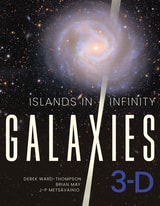
Islands in Infinity
Galaxies 3-DDerek Ward-Thompson, Brian May, and J-P Metsävainio
University of Arizona Press, 2026
This groundbreaking book brings the cosmos to life like never before. Featuring more than two hundred stunning color photographs from the world’s leading observatories and eighty detailed diagrams, this large-format book offers a mesmerizing journey through the formation, nature, evolution, and classification of galaxies.
Highlights include:
• A look at the universe in three dimensions with Brian May’s patented 3-D viewer,
• Accessible science, offering a non-mathematical review of modern cosmology and astronomy
• An exploration of the chaotic beauty of colliding and merging galaxies,
• A reference section on historical galaxy catalogues, plus a comprehensive index.
Authored by renowned astrophysicist Derek Ward-Thompson and the world’s most famous astronomer Dr Brian May, with ground-breaking stereos by J-P Metsävainio, Islands of Infinity is a must-have for anyone fascinated by the night sky.
Co-published with London Stereoscopic Company. The University of Arizona Press is pleased to offer this title in North America.
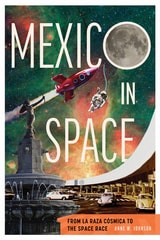
Mexico in Space
From la Raza Cósmica to the Space RaceAnne W. Johnson
University of Arizona Press, 2026
From Aztec sun stones to satellite launches, from muralist visions to dark sky parks, Mexico’s engagement with outer space is fundamental to its identity. Mexico in Space offers a groundbreaking look at how the country has navigated the tensions between technological dependence and sovereign dreams.
Anthropologist Anne W. Johnson reveals Mexico’s unique relationship with outer space, describing Indigenous knowledge, nationalist projects, artistic visions, and community practices. Through rich ethnographic detail and historical insight, Johnson challenges the notion that space is for everyone and shows whose voices truly shape the world’s cosmic futures. Johnson introduces us to satellite engineers, community astronomers, space generation youth, and artists imagining Mars, each crafting alternative cosmic futures.
As space exploration increasingly becomes the domain of billionaires and superpowers, this book offers a compelling counternarrative, demonstrating how Mexican cosmic engagements suggest more just, inclusive ways of inhabiting Earth and beyond and providing vital lessons for reimagining humanity’s place in the cosmos.
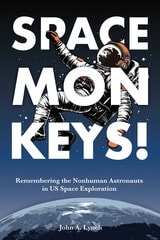
Space Monkeys!
Remembering the Nonhuman Astronauts in US Space ExplorationJohn A. Lynch
University of Alabama Press, 2026
Exposes how emotion, memory, and national pride shape the stories we tell about science, animals, and the history of the “race to space”
Before humans ever left Earth’s atmosphere, a handful of primates paved the way—earning fame and fascination but leaving behind a complicated and often highly debated legacy. As the Cold War intensified, the US space program turned to monkeys—Able, Baker, Ham, and Enos—to test and explore the limits of human survival in space. These animals became media sensations, museum exhibits, and symbols of American ingenuity, even as their suffering was often overlooked.
With insight and empathy, Lynch unpacks the stories we tell about these primates and how they are remembered through culture and time, both modern and historically. Lynch argues that the public memory of these animals often justifies their use in the name of scientific progress. Sometimes they are portrayed as tools, other times as human stand-ins, and frequently as objects of sympathy—but rarely as subjects of critique.
Lynch shows how feelings—compassion, cuteness, patriotism, and the technological sublime—shape the stories we tell about these animals and the ethical frameworks we build around them. Each chapter focuses on a different genre of memory-making, from newspaper and photojournalism to museum exhibits, children’s literature, and fictional films.
By reframing these animal pioneers, Lynch uncovers the ethical and emotional narratives that shape how we remember science. Space Monkeys! is a vital reflection on memory, identity, and the more-than-human costs of progress.

The Mars Project
Wernher Von Braun
University of Illinois Press, 1953
Today von Braun is recognized as the person most responsible for laying the groundwork for public acceptance of America's space program. When President Bush directed NASA in 1989 to prepare plans for an orbiting space station, lunar research bases, and human exploration of Mars, he was largely echoing what von Braun proposed in The Mars Project.