Results by title
43 books match the query 'Spanish language'
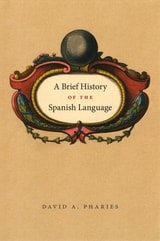
A Brief History of the Spanish Language
David A. Pharies
University of Chicago Press, 2007
After introductory chapters on what it means to study the history of a language, the concept of linguistic change, and the nature of language families, Pharies traces the development of Spanish from its Latin roots, all with the minimum amount of technical language possible. In the core sections of the book, readers are treated to an engaging and remarkably succinct presentation of the genealogy and development of the language, including accounts of the structures and peculiarities of Latin, the historical and cultural events that deeply influenced the shaping of the language, the nature of Medieval Spanish, the language myths that have become attached to Spanish, and the development of the language beyond the Iberian Peninsula, especially in the Americas. Focusing on the most important facets of the language’s evolution, this compact work makes the history of Spanish accessible to anyone with a knowledge of Spanish and a readiness to grasp basic linguistic concepts.
Available in both English and Spanish editions, A Brief History of the Spanish Language provides a truly outstanding introduction to the exciting story of one of the world’s great languages.
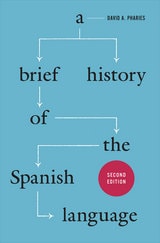
A Brief History of the Spanish Language
Second EditionDavid A. Pharies
University of Chicago Press, 2015
A Brief History of the Spanish Language focuses on the most important aspects of the development of the Spanish language, eschewing technical jargon in favor of straightforward explanations. Along the way, it answers many of the common questions that puzzle native speakers and non-native speakers alike, such as: Why do some regions use tú while others use vos? How did the th sound develop in Castilian? And why is it la mesa but el agua?
David A. Pharies, a world-renowned expert on the history and development of Spanish, has updated this edition with new research on all aspects of the evolution of Spanish and current demographic information. This book is perfect for anyone with a basic understanding of Spanish and a desire to further explore its roots. It also provides an ideal foundation for further study in any area of historical Spanish linguistics and early Spanish literature.
A Brief History of the Spanish Language is a grand journey of discovery, revealing in a beautifully compact format the fascinating story of the language in both Spain and Spanish America.
A Dictionary of New Mexico and Southern Colorado Spanish
Revised and Expanded EditionRubén Cobos
Museum of New Mexico Press, 2011
Ruben Cobos spent a decade working on the revised and expanded edition of the dictionary, published in 2003. The Dictionary of New Mexico and Southern Colorado Spanish has assumed its place as the most authoritative reference on the archaic dialect of Spanish spoken in this region.
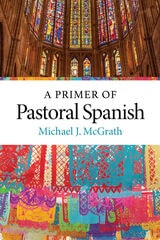
A Primer of Pastoral Spanish
Michael J. McGrath
Catholic University of America Press, 2022
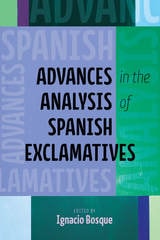
Advances in the Analysis of Spanish Exclamatives
Ignacio Bosque
The Ohio State University Press, 2017
The book begins by summarizing, commenting on, and evaluating previous descriptive and theoretical contributions on Spanish exclamatives. This introductory overview also contains a detailed classification of Spanish exclamative grammatical types, along with an analysis of their main properties. Special attention is devoted in the book throughoutto the syntactic structures displayed by exclamative patterns; the differences between exclamations and other speech acts (specifically questions and imperatives); the peculiar semantic denotation of exclamative words and their relationship to quantifiers denoting high degree; the semantics of adjectives and adverbs expressing extreme evaluation; the form and interpretation of negated and embedded exclamatives; the properties of optative utterances; and the different ways in which expressive contents are related to unexpected reactions of the speaker, as well as possible knowledge shared by interlocutors.
This groundbreaking volume provides a complete and accurate picture of Spanish exclamation by integrating its numerous component parts.
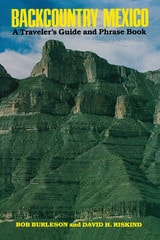
Backcountry Mexico
A Traveler’s Guide and Phrase BookBy Bob Burleson and David H. Riskind
University of Texas Press, 1986
<p>Going well beyond the usual tourist guidebook entries, <cite>Backcountry Mexico</cite> will help you hire a guide and burro, navigate rural roads and trails, and communicate with the friendly and, sometimes, unfriendly folks you are likely to meet in a rural setting.</p>
<p>In addition to English-Spanish and Spanish-English vocabulary lists containing both standard words and numerous terms relating to people, conditions, land, and situations not ordinarily encountered in tourists' lists, the authors have provided literally hundreds of helpful phrases and short conversations in easy-to-use sections arranged according to topics. Experienced unconventional travelers themselves, Burleson and Riskind have become experts in such subjects as "Eating and Staying Well on the Road, " "Camping in Mexico, " "Rural Mexican Village Life," and many more. Their experience, and the resultant wealth of language and cultural information contained in this guide, will help you to enjoy your trip ancd to better understand and appreciate the people and the land you visit.</p>
<p>Throughout the book, the language examples are interwoven with beautifully illustrated anecdotes about culture and lifeways, so that the traveler is equipped with practical knowledge as well as appropriate behavior and speech. Fascinating in its treatment of a culture that is little known and unique in its coverage of rural-style Mexican Spanish, <cite>Backcountry Mexico</cite> will prove invaluable to anyone who ventures forth into northern Mexico.</p>
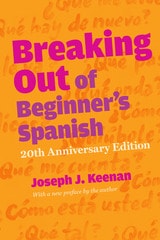
Breaking Out of Beginner's Spanish
By Joseph J. Keenan
University of Texas Press, 2014
Many language books are boring—this one is not. Written by a native English speaker who learned Spanish the hard way—by trying to talk to Spanish-speaking people—it offers English speakers who have a basic knowledge of Spanish hundreds of tips for using the language more fluently and colloquially, with fewer obvious “gringo” errors.
Writing with humor, common sense, and a minimum of jargon, Joseph J. Keenan covers everything from pronunciation, verb usage, and common grammatical mistakes to the subtleties of addressing other people, “trickster” words that look alike in both languages, inadvertent obscenities, and intentional swearing. He guides readers through the set phrases and idiomatic expressions that pepper the native speaker’s conversation and provides a valuable introduction to the most widely used Spanish slang.
With this book, both students in school and adult learners who never want to see another classroom can rapidly improve their speaking ability. Breaking Out of Beginner’s Spanish will be an essential aid in passing the supreme language test—communicating fluently with native speakers.
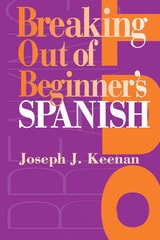
Breaking Out of Beginner's Spanish
By Joseph J. Keenan
University of Texas Press, 1994
Many language books are boring—this one is not. Written by a native English speaker who learned Spanish the hard way—by trying to talk to Spanish-speaking people—it offers English speakers with a basic knowledge of Spanish hundreds of tips for using the language more fluently and colloquially, with fewer obvious "gringo" errors.
Writing with humor, common sense, and a minimum of jargon, Joseph Keenan covers everything from pronunciation, verb usage, and common grammatical mistakes to the subtleties of addressing other people, "trickster" words that look alike in both languages, inadvertent obscenities, and intentional swearing. He guides readers through the set phrases and idiomatic expressions that pepper the native speaker's conversation and provides a valuable introduction to the most widely used Spanish slang.
With this book, both students in school and adult learners who never want to see another classroom can rapidly improve their speaking ability. Breaking Out of Beginner's Spanish will be an essential aid in passing the supreme language test-communicating fluently with native speakers.
Breve historia de la lengua española
Segunda edición revisadaDavid A. Pharies
University of Chicago Press, 2015
La Breve historia de la lengua española se concentra en los cambios más importantes de la evolución de la lengua, evitando la jerga académica ininteligible y favoreciendo la claridad en las explicaciones. Por el camino, intenta dar respuesta a muchas de las preguntas que con frecuencia desconciertan a los hablantes nativos y no nativos: ¿Por qué se utiliza tú en algunos lugares y vos en otros? ¿Cómo surgió la pronunciación como fricativa interdental de la zeta castellana? ¿Por qué se dice la mesa pero el agua con un artículo que parece masculino?
David A. Pharies es un experto en el estudio de la historia y evolución del español, que goza de un reconocido prestigio en la escena internacional. Para actualizar esta segunda edición ha revisado en profundidad todos los aspectos de la evolución del español, incluido su desarrollo demográfico. El libro va dirigido a quienes tienen un conocimiento básico del español y desean aprender más sobre sus orígenes. También constituye una base ideal para emprender el estudio de cualquier aspecto de la lingüística histórica española y de la literatura medieval. Entretenida y accesible, la Breve historia de la lengua española es un gran viaje de descubrimiento en una presentación amena y sucinta.
Since its publication in 2007, A Brief History of the Spanish Language has become the leading introduction to the history of one of the world’s most widely spoken languages. Moving from the language’s Latin roots to its present-day forms, this concise book offers readers insights into the origin and evolution of Spanish, the historical and cultural changes that shaped it, and its spread around the world.
A Brief History of the Spanish Language focuses on the most important aspects of the development of the Spanish language, eschewing technical jargon in favor of straightforward explanations. Along the way, it answers many of the common questions that puzzle native and nonnative speakers alike, such as: Why do some regions use tú while others use vos? How did the th sound develop in Castilian? And why is it la mesa but el agua?
David A. Pharies, an internationally recognized expert on the history and development of Spanish, has updated this edition with new research on all aspects of the evolution of Spanish while adding current demographic information as well. This book is perfect for anyone with a basic understanding of Spanish and a desire to further explore its roots. It also provides an ideal foundation for further study in any area of historical Spanish linguistics and early Spanish literature. Both absorbing and accessible, A Brief History of the Spanish Language is a grand journey of discovery in a beautifully compact format.
Breve historia de la lengua española
Spanish editionDavid A. Pharies
University of Chicago Press, 2007
Después de los capítulos introductorios de lo que significa el estudio de la historia de una lengua, el concepto del cambio lingüístico y de la naturaleza de las familias lingüísticas, Pharies hace un seguimiento al desarrollo del español desde sus raíces latinas, todo ello con una mínima cantidad de lenguaje técnico posible. En las secciones centrales del libro, los lectores son llevados por una presentación sucinta, comprometedora y admirable, de la genealogía y desarrollo de la lengua incluyendo explicaciones de las estructuras y peculiaridades del latín, los eventos históricos y culturales que influenciaron profundamente la forma del lenguaje, la naturaleza del español medieval, los mitos lingüísticos formando parte del español y el desarrollo de la lengua más allá de la península ibérica, en particular, en el continente americano. Centrándose en las más importantes facetas de la evolución de la lengua, esta obra concisa hace que la historia del español sea accesible a todos, con una comprensión del mismo y una disposición para entender los conceptos básicos del lenguaje.
Disponible en ambas ediciones, inglés y español, Una Breve Historia de la Lengua Española, nos brinda una extraordinaria introducción a la fascinante historia de una de las más importantes lenguas del mundo.
Spanish is the fourth most widely spoken language in the world and a language of ever-increasing importance in the United States. In what will likely become the introduction to the history of the Spanish language, David Pharies clearly and concisely charts the evolution of Spanish from its Indo-European roots to its present form. An internationally recognized expert on the history and development of this language, Pharies brings to his subject a precise sense of what students of Spanish linguistics need to know.
After introductory chapters on what it means to study the history of a language, the concept of linguistic change, and the nature of language families, Pharies traces the development of Spanish from its Latin roots, all with the minimum amount of technical language possible. In the core sections of the book, readers are treated to an engaging and remarkably succinct presentation of the genealogy and development of the language, including accounts of the structures and peculiarities of Latin, the historical and cultural events that deeply influenced the shaping of the language, the nature of Medieval Spanish, the language myths that have become attached to Spanish, and the development of the language beyond the Iberian Peninsula, especially in the Americas. Focusing on the most important facets of the language’s evolution, this compact work makes the history of Spanish accessible to anyone with a knowledge of Spanish and a readiness to grasp basic linguistic concepts.
Available in both English and Spanish editions, A Brief History of the Spanish Language provides a truly outstanding introduction to the exciting story of one of the world’s great languages.
Building Confianza
Empowering Latinos/as Through Transcultural Health Care CommunicationDalia Magaña
The Ohio State University Press, 2021
Centros y Programas de Escritura en América Latina
Opciones teóricas y pedagógicas para la enseñanza de la escritura disciplinarEstela Inés Moyano
University Press of Colorado, 2023
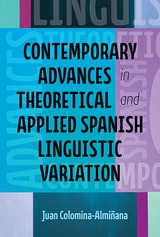
Contemporary Advances in Theoretical and Applied Spanish Linguistic Variation
Juan J. Colomina-Almiñana
The Ohio State University Press, 2017
This volume makes three major contributions to Hispanic sociolinguistics. First, it covers variation in less commonly studied varieties, which are new areas of interest in a broader world where certain minorities and their languages are crucial. Second, it offers recent and innovative approaches to variation coming from formal theories in order to spark a debate about methodology that is more comprehensive of the diverse approaches to variation currently practiced in the field. Finally, it includes chapters that combine quantitative and qualitative analysis of different linguistic variables.
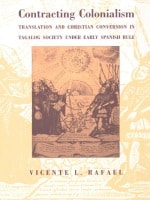
Contracting Colonialism
Translation and Christian Conversion in Tagalog Society Under Early Spanish RuleVicente L. Rafael
Duke University Press, 1993

Cultural Erotics in Cuban America
Ricardo L. Ortíz
University of Minnesota Press, 2006
In this wide-ranging work Ortíz argues for the authentically diasporic quality of postrevolutionary, off-island Cuban experience. Highlighting various forms of cultural expression, Cultural Erotics in Cuban America traces underrepresented communities’ responses to the threat of cultural disappearance in an overwhelming and hegemonic U.S. culture. Ortíz shows how the work of Cuban-American writers and artists challenges the heteronormativity of both home and host culture. Focusing on artists who have had an ambivalent, indirect, or nonexistent connection to Miami, he presents close readings of such novelists as Reinaldo Arenas, Roberto G. Fernández, Achy Obejas, and Cristina García, the playwright Eduardo Machado, the poet Rafael Campo, and musical performers Albita Rodríguez and Celia Cruz.
Ortíz charts the legacies of sexism and homophobia in patriarchal Cuban culture, as well as their influence on Cuban-revolutionary and Cuban-exile ideologies. Moving beyond the outdated cultural terms of the Cold War, he looks forward to envision queer futures for Cuban-American culture free from the ties to restrictive—indeed, oppressive—constructions of nation, place, language, and desire.
Ricardo L. Ortíz is associate professor of English at Georgetown University.
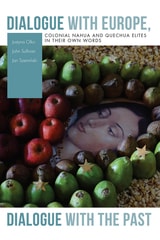
Dialogue with Europe, Dialogue with the Past
Colonial Nahua and Quechua Elites in Their Own WordsJustyna Olko
University Press of Colorado, 2018
In each chapter a particular document is transcribed exactly as it appears in the original manuscript or colonial printed document, with the editor placing it in historical context and considering the degree of European influence. These texts show the nobility through documents they themselves produced or caused to be produced—such as wills, land deeds, and petitions—and prioritize indigenous ways of expression, perspectives, and concepts. Together, the chapters demonstrate that native elites were independent actors as well as agents of social change and indigenous sustainability in colonial society. Additionally, the volume diversifies the commonly homogenous term “cacique” and recognizes the differences in elites throughout Mesoamerica and the Andes.
Showcasing important and varied colonial genres of indigenous writing, Dialogue with Europe, Dialogue with the Past reveals some of the realities, needs, strategies, behaviors, and attitudes associated with the lives of the elites. Each document and its accompanying commentary provide additional insight into how the nobility negotiated everyday life. The book will be of great interest to students and researchers of Mesoamerican and Andean history, as well as those interested in indigenous colonial societies in the Spanish Empire.
Contributors: Agnieszka Brylak, Maria Castañeda de la Paz, Katarzyna Granicka, Gregory Haimovich, Anastasia Kalyuta, Julia Madajczak, Patrycja Prządka-Giersz
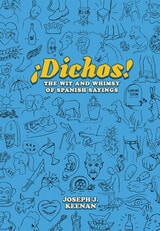
Dichos! The Wit and Whimsy of Spanish Sayings
By Joseph J. Keenan
University of Texas Press, 2019
One of the most challenging—and entertaining—aspects of learning another language is the idiom. Those quirky phrases, steeped in metaphor and colorful cultural references, enliven conversation and make your cross-cultural communication familiar, fun, and meaningful. ¡Dichos! (Sayings) brings us a vibrant compendium of both age-old and brand-new expressions from across Latin America, compiled by the language enthusiast whose Breaking Out of Beginner’s Spanish transformed thousands of readers’ interactions with the Spanish language.
¡Dichos! is divided into thematic sections covering topics ranging from games and relaxation to politics, macho men, and Mondays. Spanish speakers can also use the book to identify the spot-on/best slangy English equivalent for a Spanish-language idiom. Packed with gems like La barba me huele a tigre, y yo mismo me tengo miedo (My beard smells of tiger, and I’m even afraid of myself) and Para todo mal, mezcal; para todo bien, también (For everything bad, mezcal; for everything good, likewise), this book is the ultimate tool for taking your language skills to the next level as you navigate nuance with humor and linguistic agility.
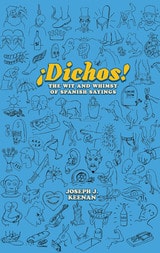
Dichos! The Wit and Whimsy of Spanish Sayings
By Joseph J. Keenan
University of Texas Press, 2019
One of the most challenging—and entertaining—aspects of learning another language is the idiom. Those quirky phrases, steeped in metaphor and colorful cultural references, enliven conversation and make your cross-cultural communication familiar, fun, and meaningful. ¡Dichos! (Sayings) brings us a vibrant compendium of both age-old and brand-new expressions from across Latin America, compiled by the language enthusiast whose Breaking Out of Beginner’s Spanish transformed thousands of readers’ interactions with the Spanish language.
¡Dichos! is divided into thematic sections covering topics ranging from games and relaxation to politics, macho men, and Mondays. Spanish speakers can also use the book to identify the spot-on/best slangy English equivalent for a Spanish-language idiom. Packed with gems like La barba me huele a tigre, y yo mismo me tengo miedo (My beard smells of tiger, and I’m even afraid of myself) and Para todo mal, mezcal; para todo bien, también (For everything bad, mezcal; for everything good, likewise), this book is the ultimate tool for taking your language skills to the next level as you navigate nuance with humor and linguistic agility.
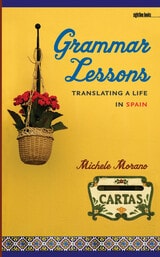
Grammar Lessons
Translating a Life in SpainMichele Morano
University of Iowa Press, 2007
Morano focuses first on her year of living in Oviedo, in the early 1990s, a time spent immersing herself in a new culture and language while working through the relationship she had left behind with an emotionally dependent and suicidal man. Next, after subsequent trips to Spain, she explores the ways that travel sparks us to reconsider our personal histories in the context of larger historical legacies. Finally, she turns to the aftereffects of travel, to the constant negotiations involved in retelling and understanding the stories of our lives. Throughout she details one woman’s journey through vocabulary and verb tense toward a greater sense of her place in the world.
Grammar Lessons illustrates the difficulty and delight, humor and humility of living in a new language and of carrying that pivotal experience forward. Michele Morano’s beautifully constructed essays reveal the many grammars and many voices that we collect, and learn from, as we travel.
Hegemonies of Language and Their Discontents
The Southwest North American Region Since 1540Carlos G. Vélez-Ibáñez
University of Arizona Press, 2017
Well-regarded author Carlos G. Vélez-Ibáñez details the linguistic and cultural processes used by penetrating imperial and national states. He argues that these impositions have been not linear but hydra-headed, complex and contradictory, sometimes accommodated and sometimes forcefully imposed. Such impositions have created discontent resulting in physical and linguistic revolts, translanguage versions, and multilayered capacities of use and misuse of imposed languages—even the invention of community-created trilingual dictionaries.
Vélez-Ibáñez gives particular attention to both sides of the border, explaining the consequences of the fragile splitting of the area through geopolitical border formation. He illustrates the many ways those discontents have manifested in linguistic, cultural, educational, political, and legal forms.
From revolt to revitalization, from silent objection to expressive defiance, people in the Southwest North American Region have developed arcs of discontent from the Spanish colonial period to the present. These narratives are supported by multiple sources, including original Spanish colonial documents and new and original ethnographic studies of performance rituals like the matachines of New Mexico. This unique work discusses the most recent neurobiological studies of bilingualism and their implications for cognitive development and language as it spans multiple disciplines. Finally, it provides the most important models for dual language development and their integration to the "Funds of Knowledge" concept as creative contemporary discontents with monolingual approaches.
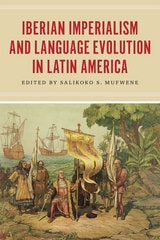
Iberian Imperialism and Language Evolution in Latin America
Edited by Salikoko S. Mufwene
University of Chicago Press, 2014
The essays approach language development through an ecological lens, exploring the effects of politics, economics, cultural contact, and natural resources on the indigenization of Spanish and Portuguese in a variety of local settings. They show how languages adapt to new environments, peoples, and practices, and the ramifications of this for the spread of colonial languages, the loss or survival of indigenous ones, and the way hybrid vernaculars get situated in larger political and cultural forces. The result is a sophisticated look at language as a natural phenomenon, one that meets a host of influences with remarkable plasticity.
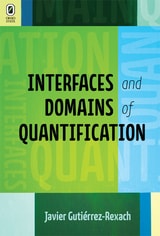
Interfaces and Domains of Quantification
Javier Gutiérrez-Rexach
The Ohio State University Press, 2014
Interfaces and Domains of Quantification advocates an interface approach to the grammar of Spanish quantification. Only a precise characterization of the syntactic properties of quantificational constructions and of their associated meanings allows us to understand how more general syntactic and semantic constraints are at work. Among other findings, the interaction of scope and parallelism with ellipsis is reconsidered; the structural significance of modal anchoring and essential properties for the interpretation of indefiniteness is explored in detail; additionally, quantificational variability and correlativity phenomena in relative clauses are analyzed; degree expression is characterized for concessive conditionals and superlatives; and, finally, several discourse particles with a quantificational core are shown to be critical for the articulation of semantic and discourse-pragmatic relations. Taking a detailed look at the different forms, patterns and structures associated with several quantificational domains seems to be the only fully explanatory way to advance our knowledge of the syntax, semantics and pragmatics of quantificational structures.
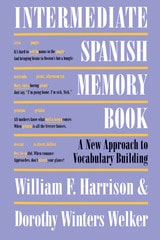
Intermediate Spanish Memory Book
A New Approach to Vocabulary BuildingBy William F. Harrison and Dorothy Winters Welker
University of Texas Press, 1997
Mnemonics is an age-old device for remembering names, numbers, and many other things. As in the authors' previous Memory Books, the Intermediate Spanish Memory Book makes use of this reliable memory help in a series of mnemonic jingles that are by turns playful, sardonic, touching, and heroic to help both students and independent learners acquire and remember Spanish vocabulary. The 500-plus words in this book represent a more advanced vocabulary than those in the Spanish Memory Book (1990) and the Spanish Memory Book, Junior Edition (1993).
The mnemonic jingles present both the sound of the Spanish word (indicated by syllables in italic type) and its English meaning (given by a word or phrase in boldface type):
merienda: picnic, afternoon tea
Mary, end a boring picnic.
Just say, "I'm going home. I'm sick, Nick."
This innovative approach to vocabulary building is simple, effective, and entertaining.
Manual for (Relatively) Painless Medical Spanish
A Self-Teaching CourseBy Ana Malinow Rajkovic
University of Texas Press, 1992
Spanish-speaking patients are no rarity in United States hospitals and clinics, as many English-speaking health care providers have discovered. To help these providers better communicate with the patients they serve, Ana Malinow Rajkovic has prepared the Manual for (Relatively) Painless Medical Spanish, a lively and innovative self-teaching guide to the grammar, pronunciation, and medical vocabulary of Spanish.
Presented in a systematic and highly entertaining fashion, twelve lessons cover some of the most commonly encountered situations. These include the family clinic, the emergency room, appendicitis, the social chat, pregnancy, family planning, pelvic inflammatory disease and urinary tract infection, depression, children with asthma, patients with angina, explaining a venipuncture and a spinal tap, and patients with shortness of breath. Each lesson closes with a bilingual interview that includes vocabulary and grammar introduced in that lesson. A guide to the medical history and physical examination appears in English and Spanish in the appendix.
Excellent in the classroom or for independent learning, the Manual will enable health care providers better to understand and supply the needs of Spanish-speaking patients.
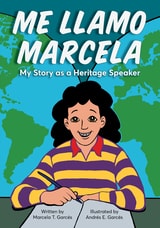
Me llamo Marcela
My Story as a Heritage SpeakerWritten by Marcela T. Garcés and illustrated by Andrés E. Garcés
The Ohio State University Press, 2024
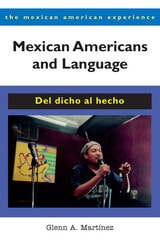
Mexican Americans and Language
Del dicho al hechoGlenn A. Martínez
University of Arizona Press, 2006
This book offers an overview of some of the central issues in the Mexican American language experience, describing it in terms of both bilingualism and minority status. It is the first book to focus on the historical, social, political, and structural aspects of multiple languages in the Mexican American experience and to address the principles and methods of applied sociolinguistic research in the Mexican American community. Spanish and non-Spanish speakers in the Mexican American community share a common set of social and ethnic bonds. They also share a common experience of bilingualism.
As Martínez observes, the ideas that have been constructed around bilingualism are as important to understanding the Mexican American language experience as bilingualism itself. Mexican Americans and Language gives students the background they need to respond to the multiple social problems that can result from the language differences that exist in the Mexican American community. By showing students how to go from word to deed (del dicho al hecho), it reinforces the importance of language for their community, and for their own lives and futures.
Mopan Maya-Spanish-English Dictionary
Charles A Hofling
University of Utah Press, 2011
Charles Andrew Hofling
Smithsonian-Utah Publications in American Indian Languages
Lyle Campbell and Ives Goddard
Linguistics
This is highly valuable dictionary of the Mopan (Mayan) language. In addition to its many entries, it also provides an introductory grammatical description, as well as general dictionary features such as parts of speech, examples, cross-references, variant forms, homophones, and indexes. The book also contains special sections on orthography and pronunciation unique to this important Mayan language, as well as translations into English and Spanish.
The dictionary has the merits well known from other dictionaries of indigenous languages of the Americas, preserving knowledge systems as they are encoded in vocabulary and providing valuable information for numerous fields, including Mayanists, Mesoamericanists, American Indian scholars, anthropologists, historians, linguists, students of Mayan hieroglyphic writing, and members of modern Mayan communities, among others.
This is the second book in the new Smithsonian-Utah Publications in American Indian Languages (SUPAIL) series, a joint venture of the University of Utah Press and the Smithsonian Institution.
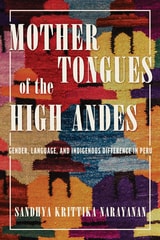
Mother Tongues of the High Andes
Gender, Language, and Indigenous Difference in PeruSandhya Krittika Narayanan
University of Arizona Press, 2025
Anthropologist Sandhya Krittika Narayanan begins with these challenges, and asks: What does it mean to be a Quechua or Aymara speaker in Puno today? What does it mean to be an Indigenous ethnic Quechua or Aymara individual?
Mother Tongues of the High Andes opens with these questions, exploring what Quechua and Aymara languages and identities mean for Indigenous puneños as they navigate their past and present. Narayanan argues that understanding inter-Indigenous linguistic and social differences involves examining Indigenous gender roles, responsibilities, and linguistic practices, particularly those of Indigenous puneña women. She shows how these practices have contributed to the maintenance of Indigenous multilingualism and continuity in local modes of understanding Indigenous identity and difference.
Even as ideologies around Indigenous identity and linguistic practices shift due to global discourses on Indigenous ethnic identity and nationalism, Indigenous women continue to play a crucial role, promoting new ways to speak and think about Quechua and Aymara linguistic differences, making the Indigenous roots and histories of Puno recognizable to a global audience. Through a comprehensive ethnographic exploration of gender, language, and Indigenous difference, Narayanan shows how the linguistic and social practices of Indigenous puneña women both contest and reaffirm competing visions of Quechua and Aymara linguistic identity and authority.
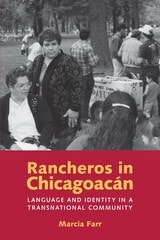
Rancheros in Chicagoacán
Language and Identity in a Transnational CommunityBy Marcia Farr
University of Texas Press, 2006
Rancheros hold a distinct place in the culture and social hierarchy of Mexico, falling between the indigenous (Indian) rural Mexicans and the more educated city-dwelling Mexicans. In addition to making up an estimated twenty percent of the population of Mexico, rancheros may comprise the majority of Mexican immigrants to the United States. Although often mestizo (mixed race), rancheros generally identify as non-indigenous, and many identify primarily with the Spanish side of their heritage. They are active seekers of opportunity, and hence very mobile. Rancheros emphasize progress and a self-assertive individualism that contrasts starkly with the common portrayal of rural Mexicans as communal and publicly deferential to social superiors.
Marcia Farr studied, over the course of fifteen years, a transnational community of Mexican ranchero families living both in Chicago and in their village-of-origin in Michoacán, Mexico. For this ethnolinguistic portrait, she focuses on three culturally salient styles of speaking that characterize rancheros: franqueza (candid, frank speech); respeto (respectful speech); and relajo (humorous, disruptive language that allows artful verbal critique of the social order maintained through respeto). She studies the construction of local identity through a community's daily talk, and provides the first book-length examination of language and identity in transnational Mexicans.
In addition, Farr includes information on the history of rancheros in Mexico, available for the first time in English, as well as an analysis of the racial discourse of rancheros within the context of the history of race and ethnicity in Mexico and the United States. This work provides groundbreaking insight into the lives of rancheros, particularly as seen from their own perspectives.
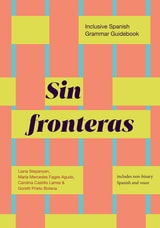
Sin fronteras
Inclusive Spanish Grammar GuidebookLiana Stepanyan, María Mercedes Fages Agudo, Carolina Castillo Larrea, Goretti Prieto Botana
Amherst College Press, 2024
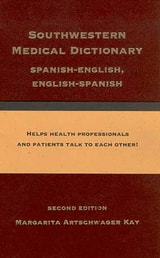
Southwestern Medical Dictionary
Spanish-English, English-SpanishMargarita Artschwager Kay
University of Arizona Press, 2001
A staple of southwestern health care for more than twenty years, this dictionary can make a difference in patient care. Now available in a revised edition, it focuses on vocabulary used in health contexts by Spanish-speaking people in order to help patients tell their stories and medical practitioners to understand them. Unlike other bilingual dictionaries that emphasize scientific terms, this one focuses on standard Spanish terms as well as regional expressions peculiar to Mexican Spanish—language encountered in Chicago as easily as in Phoenix.
In the Spanish-to-English section, Spanish terms are followed by English translations and sample sentences to help health care practitioners understand how a patient might use them:
acedías, heartburn, pain in lower esophagus perceived as in the heart. Uno tiene la tendencia a sufrir de acedías después de comer chile. One has a tendency to suffer heartburn after eating chile. (syn: acidez, agruras del estómago)
In the English-to-Spanish section, English words are translated into simple Spanish terms along with English synonyms.
Now available in a revised edition, this handy reference features:
• more than 3,000 entries
• new entries that reflect current health problems and treatments
• inclusion of cognates
• Spanish definitions of English words
• anatomical drawings with bilingual labels
• more material on medicinal plants, including an appendix of poisonous and non-poisonous plants
• lists of food items and kinship terms
This book is an indispensable reference for all health care professionals who see patients of Mexican origin. Combining idiomatic precision with technical accuracy, it can help break down language barriers on either side of the border.
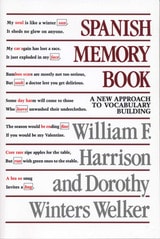
Spanish Memory Book
A New Approach to Vocabulary BuildingBy William F. Harrison and Dorothy Winters Welker
University of Texas Press, 1990
Using mnemonics is an age-old technique for remembering names, numbers, and many other things. In Spanish Memory Book, William Harrison and Dorothy Welker offer original mnemonic rimes that are by turns amusing, ironic, pathetic, sentimental, and sardonic to help students and independent learners acquire and remember Spanish vocabulary.
Included are mnemonic jingles for 700 of the 2,000 most commonly used Spanish words. Each jingle contains both the sound of the Spanish word and its English meaning. The authors have included a general pronunciation guide to Spanish vowels and consonants.
This innovative approach, which the authors have used successfully with their own students, is simple, effective, and entertaining. In the words of one student, "This book teaches me not only Spanish words but English words as well."
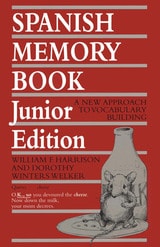
Spanish Memory Book
A New Approach to Vocabulary Building, Junior EditionBy William F. Harrison and Dorothy Winters Welker
University of Texas Press, 1990
Mnemonics is an age-old technique for remembering names, numbers, and many other things. In Spanish Memory Book, Junior Edition, William Harrison and Dorothy Welker offer onginal mnemonic rimes appropriate in subject matter and skill level for junior high and high school students to help them acquire and remember Spanish vocabulary.
Included are mnemonic jingles for several hundred of the 2,000 most commonly used Spanish words. Each jingle contains both the sound of the Spanish word and its English meaning. The authors have also included a general pronunciation guide to Spanish vowels and consonants.
This innovative approach, which the authors have used successfully with their own students, is simple, effective, and entertaining. In the words of one student, "This book teaches me not only Spanish words but English words as well."
Spanish Verbs Made Simple(r)
By David Brodsky
University of Texas Press, 2005
It's time for a new approach to learning Spanish verbs. Unlike popular verb guides that require the rote memorization of hundreds of verb forms, this book clearly explains the rules that govern the conjugation of all classes of Spanish verbs—especially the irregular ones that give second-language learners the most trouble. These simple, easy-to-understand rules for conjugating Spanish verbs are effective learning tools for both beginning students and more advanced speakers who want to perfect their usage of Spanish verb forms.
Spanish Verbs Made Simple(r) has many helpful features that you won't find in any other verb guide:
- Clear explanations of all verb tenses and forms.
- The simple rules that govern the conjugation of all verbs—including the 90% of irregular verbs whose irregularities are entirely predictable.
- A detailed discussion of how each verb form is used, with numerous examples.
- A full explanation of the distinction between ser and estar—the single most confusing element in the Spanish verbal system.
- An extended treatment of the subjunctive that will help you understand why it is used in some situations but not others.
- Conjugations for 35 model Spanish verbs and a comprehensive listing of 4,800 verbs that indicates which of the models each verb follows.
Going well beyond any other guide in the clarity and detail of its explanations—as well as the innovative manner in which individual verbs are linked to model conjugations—Spanish Verbs Made Simple(r) is the only guide to Spanish verbs a learner needs.
Spanish Vocabulary
An Etymological ApproachBy David Brodsky
University of Texas Press, 2008
Unlike other vocabulary guides that require the rote memorization of literally thousands of words, this book starts from the premise that using the etymological connections between Spanish and English words—their common derivations from Latin, Greek, and other languages—is the most effective way to acquire and remember vocabulary. This approach is suitable for beginners as well as for advanced students. Teachers of the language will also find much material that can be used to help motivate their students to acquire, and retain, Spanish vocabulary.
Spanish Vocabulary is divided into four parts and four annexes:
- Part I provides background material on the origins of Spanish and begins the process of presenting Spanish vocabulary.
- Part II presents "classical" Spanish vocabulary—words whose form (in both Spanish and English) is nearly unchanged from Latin and Greek.
- Part III deals with "popular" Spanish vocabulary, which underwent significant changes in form (and often meaning) during the evolution from Latin to Spanish. A number of linguistic patterns are identified that will help learners recognize and remember new vocabulary.
- Part IV treats a wide range of themes, including words of Germanic and Arabic origin, numbers, time, food and animals, the family, the body, and politics.
- Annex A: Principal exceptions to the "Simplified Gender Rule"
- Annex B: 700 words whose relations, if any, to English words are not immediately obvious
- Annex C: -cer verbs and related words
- Annex D: 4,500 additional words, either individually or in groups, with English correspondences
Spanish and Empire
Nelsy Echavez-Solano
Vanderbilt University Press, 2007

The Afro-Bolivian Spanish Determiner Phrase
A Microparametric AccountSandro Sessarego
The Ohio State University Press, 2014
This dialect presents phenomena that offer a real challenge to current linguistic theory. The Afro-Bolivian Spanish Determiner Phrase elaborates on the importance of enhancing a stronger dialogue between formal generative theory and sociolinguistic methodology, in line with recent work in the field of minimalist syntax. Sessarego’s study combines sociolinguistic techniques of data collection with generative models of data analysis to obtain more fine-grained, empirically testable generalizations.
The Promise of the Foreign
Nationalism and the Technics of Translation in the Spanish PhilippinesVicente L. Rafael
Duke University Press, 2005
Through close readings of nationalist newspapers and novels, the vernacular theater, and accounts of the 1896 anticolonial revolution, Rafael traces the deep ambivalence with which elite nationalists and lower-class Filipinos alike regarded Castilian. The widespread belief in the potency of Castilian meant that colonial subjects came in contact with a recurring foreignness within their own language and society. Rafael shows how they sought to tap into this uncanny power, seeing in it both the promise of nationhood and a menace to its realization. Tracing the genesis of this promise and the ramifications of its betrayal, Rafael sheds light on the paradox of nationhood arising from the possibilities and risks of translation. By repeatedly opening borders to the arrival of something other and new, translation compels the nation to host foreign presences to which it invariably finds itself held hostage. While this condition is perhaps common to other nations, Rafael shows how its unfolding in the Philippine colony would come to be claimed by Filipinos, as would the names of the dead and their ghostly emanations.
The University of Chicago Spanish Dictionary, Fifth Edition, Spanish-English, English-Spanish
Universidad de Chicago Diccionario Español-Inglés, Inglés-EspañolEdited by David A. Pharies
University of Chicago Press, 2002
With thousands of added entries, the Dictionary builds on the features that have made it the leader in its field for more than fifty years: authority, scope, clarity, and conciseness. And with this edition, the Dictionary brilliantly captures the current core vocabularies of two rapidly changing—and increasingly connected—languages and cultures.
Entirely bilingual, the fifth edition focuses on two contemporary international languages—American English and a basic, worldwide Spanish that draws from both Latin American and Iberian sources.
Designed for a wide range of users, including travelers, businesspeople, students, teachers, and professionals, the new Dictionary is the essential first resource for speakers of both languages—from beginners to those at all other stages. Up to date, just comprehensive enough, and extraordinarily clear and easy to use, the new edition of The University of Chicago Spanish Dictionary stands alone. No other dictionary offers so many users so much help—or so much value.
The University of Chicago Spanish-English Dictionary, Sixth Edition
Diccionario Universidad de Chicago Inglés-Español, Sexta EdiciónDavid A. Pharies, Editor in Chief
University of Chicago Press, 2012
A concise, authoritative, up-to-date guide to Spanish and English
The University of Chicago Spanish–English Dictionary has long set the standard for concise bilingual dictionaries. Portable yet remarkably thorough, the dictionary enables users to find the precise equivalents of the words and phrases they seek.
The Writer's Reference Guide to Spanish
By David William Foster, Daniel Altamiranda, and Carmen de Urioste
University of Texas Press, 2000
Writers and editors of Spanish have long needed an authoritative guide to written language usage, similar to The MLA Style Manual and The Chicago Manual of Style. And here it is! This reference guide provides comprehensive information on how the Spanish language is copyedited for publication.
The book covers these major areas:
- Language basics: capitalization, word division, spelling, and punctuation.
- Language conventions: abbreviations, professional and personal titles, names of organizations, and nationalities.
- Bibliographic format, particularly how Spanish differs from English.
- Spanish language forms of classical authors' names.
- Literary and grammatical terminology.
- Linguistic terminology.
- Biblical names and allusions.
- A dictionary of grammatical doubts, including usage, grammatical constructions of particular words and phrases, verbal irregularities, and gender variations.
Words and Worlds Turned Around
Indigenous Christianities in Colonial Latin AmericaDavid Tavárez
University Press of Colorado, 2017
A sophisticated, state-of-the-art study of the remaking of Christianity by indigenous societies, Words and Worlds Turned Around reveals the manifold transformations of Christian discourses in the colonial Americas. The book surveys how Christian messages were rendered in indigenous languages; explores what was added, transformed, or glossed over; and ends with an epilogue about contemporary Nahuatl Christianities.
In eleven case studies drawn from eight Amerindian languages—Nahuatl, Northern and Valley Zapotec, Quechua, Yucatec Maya, K'iche' Maya, Q'eqchi' Maya, and Tupi—the authors address Christian texts and traditions that were repeatedly changed through translation—a process of “turning around” as conveyed in Classical Nahuatl. Through an examination of how Christian terms and practices were made, remade, and negotiated by both missionaries and native authors and audiences, the volume shows the conversion of indigenous peoples as an ongoing process influenced by what native societies sought, understood, or accepted.
The volume features a rapprochement of methodologies and assumptions employed in history, anthropology, and religion and combines the acuity of of methodologies drawn from philology and historical linguistics with the contextualizing force of the ethnohistory and social history of Spanish and Portuguese America.
Contributors: Claudia Brosseder, Louise M. Burkhart, Mark Christensen, John F. Chuchiak IV, Abelardo de la Cruz, Gregory Haimovich, Kittiya Lee, Ben Leeming, Julia Madajczak, Justyna Olko, Frauke Sachse, Garry Sparks
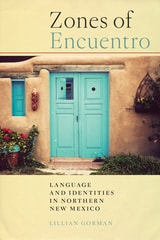
Zones of Encuentro
Language and Identities in Northern New MexicoLillian Gorman
The Ohio State University Press, 2024
Winner, 2025 New Mexico Book Awards, Multicultural Category
Finalist, New Mexico Book Awards, BIPOC Author or Subject Category and First Book Category
Working at the intersection of Latina/o/x cultural studies, sociocultural linguistics, and Chicana feminist studies, Lillian Gorman’s Zones of Encuentro takes an in-depth look at the cultural and linguistic interactions between two distinct Latina/o/x communities in the region: Nuevomexicanos (Hispanic people who trace their presence in the region to colonial times and whose families have historically spoken Traditional New Mexican Spanish, or TNMS) and first-generation Mexicano immigrants (who tend to speak Mexican Spanish). Gorman examines the everyday lived language experiences and ethnolinguistic identities of Mexicanos and Nuevomexicanos together, specifically through the case of mixed Mexicano-Nuevomexicano families. Through an interdisciplinary critical reading of ethnographic data, pláticas (informal conversations that gather family and community knowledge), interviews, articles, and historical memoirs, Gorman analyzes language ideologies, identity formations, and language practices by exploring complex spaces of encounter within Mexicano-Nuevomexicano families. Zones of Encuentro complicates homogeneous notions of language and identity and contemplates what a shared cultural and linguistic homeplace looks like for Mexicanos and Nuevomexicanos in northern New Mexico.